The Spending Audit: How to Review 3 Months of Expenses and Find What to Cut
A practical method to audit three months of bank and card statements, categorise spending, and decide what to keep, reduce, or cut for Indian households.
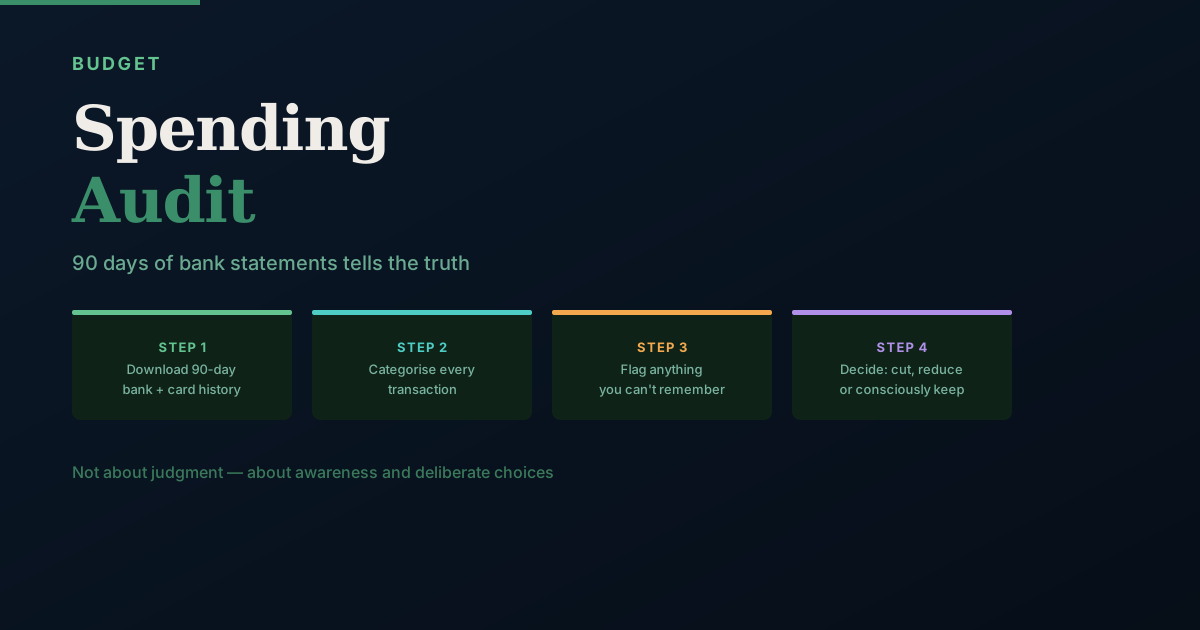
Most people have a vague sense of where their money goes. A spending audit replaces vague with specific — 3 months of actual transaction data, categorised and totalled, showing exactly where every rupee went.
The point is not judgment. The point is information. You cannot make good decisions about money you cannot see clearly.
Step 1: Gather your data
You need 3 months of complete transaction data from every payment channel you use:
- Bank account statement: Download from net banking (PDF or CSV). Most banks offer export going back 12 months.
- Credit card statement: Download from the card issuer's portal. Include all cards.
- UPI transaction history: PhonePe, Google Pay, and BHIM have export or detailed history sections.
- Cash spending: Estimate if you cannot track exactly. Note: shifting to digital payments makes future audits much easier.
Three months is the minimum. It averages out irregular expenses and captures patterns better than one month.
Step 2: Categorise every transaction
Create a simple spreadsheet or use a notebook. For each transaction, assign a category. Keep the categories consistent. A working set for Indian households:
| Category | What it includes |
|---|---|
| Housing | Rent, EMI, maintenance, water, electricity |
| Transport | Fuel, vehicle EMI, cabs (Uber/Ola), auto, commute |
| Food | Groceries, eating out, food delivery |
| Health | Insurance, medicine, doctors, tests |
| Education | School fees, tuition, online courses |
| Personal care | Salon, skincare, gym |
| Entertainment | OTT, streaming, movies, events, hobbies |
| Savings & Investments | SIP, PPF, NPS, RD |
| Debt repayment | Credit card bill above minimum, personal loan |
| Miscellaneous | Everything else |
Miscellaneous should not exceed 5–8% of total spending. If it is higher, you have under-categorised.
Step 3: Total each category and calculate percentages
Once all 3 months are categorised, sum each category and divide by 3 to get a monthly average. Calculate what percentage of total spending each category represents.
This total-and-percentage view is where patterns become visible:
- A household spending 28% of take-home on food across grocery, dining, and delivery
- Transport consuming 15% between two vehicle EMIs and cab rides
- Six OTT subscriptions adding to ₹2,400/month
These are visible only in aggregate. The individual transactions are invisible in isolation.
Step 4: The keep/review/cut decision
For each category, make one of three decisions:
Keep: Essential, intentional, and correctly sized. Rent, utilities, insurance premiums, groceries at a reasonable level.
Review: Spending you value but that has crept upward. Dining out at ₹8,000/month where ₹5,000 was the intent. Food delivery at ₹6,000/month when ₹3,000 feels right.
Cut: Spending that does not serve you. Subscriptions you had forgotten about. A gym membership not used in 4 months. Impulse purchase categories.
Step 5: Build the revised budget
From the review and cut lists, define new target amounts per category. These become your forward budget. The audit revealed what happened; the budget defines what should happen.
Review again in 90 days. The second audit will show whether the changes held.
The Categories Where Money Leaks Quietly
Some spending hides because each transaction is small or automatic. Check these specifically:
- Auto-renewing subscriptions: OTT, music, cloud storage, app premiums, that annual tool you forgot. Scan for identical recurring amounts — most urban households carry several they no longer use. A dedicated subscription audit goes deeper on this one category alone.
- Micro-UPI spends: ₹40 here, ₹120 there. Individually trivial, collectively often ₹5,000–10,000/month. Sort your UPI history by amount and count the under-₹200 transactions; the total surprises most people.
- Convenience premiums: delivery fees and surge, quick-commerce markups, frequent cabs over public transport.
- Fees: card annual fees, bank charges, ATM fees, late-payment and minimum-due interest — pure leakage with zero value returned.
- EMIs on small purchases: "no-cost" and BNPL EMIs on phones, gadgets, and appliances quietly commit future income.
Compare Against a Benchmark
Percentages mean more measured against a target. A common starting frame is 50/30/20 — roughly 50% needs, 30% wants, 20% savings and debt repayment. Map your categories to those three buckets and compare. If "wants" is at 45% and savings at 5%, the audit just showed you exactly where the gap is. (It's a starting point, not a rule — adjust for your rent and city.)
Why UPI Makes This Necessary
A decade ago spending had friction — you felt cash leave your hand. UPI removed almost all of it, which is wonderful for convenience and quietly corrosive for awareness. A ₹150 tap feels like nothing; ninety of them a month is ₹13,500. The audit restores the awareness the technology removed.
Make the Next Audit Automatic
The first audit is manual and a little tedious. The next one shouldn't be:
- Route most spending through one or two accounts so the data lives in fewer places.
- Tag transactions for 15 minutes monthly instead of reconstructing a whole quarter at once.
- Or use an expense app that auto-categorises from statements — accept it's ~80% right and fix the rest.
A 15-minute monthly check beats a painful quarterly excavation, and it catches lifestyle creep while it's still small.
For context on monthly review systems, see the guide on monthly budget review process.
A Worked Audit: Three Months of a Bangalore Household
Suresh and Anita are a dual-income couple in Bangalore with one child in Class 4. Combined take-home: ₹1,35,000. Below is what three months of their statements revealed, compared to what they assumed:
| Category | What They Assumed | Actual Monthly Average | Difference |
|---|---|---|---|
| Groceries | ₹8,000 | ₹11,400 | +₹3,400 |
| Eating out | ₹4,000 | ₹7,200 | +₹3,200 |
| Food delivery | ₹2,500 | ₹5,800 | +₹3,300 |
| Subscriptions (OTT + apps) | ₹600 | ₹2,150 | +₹1,550 |
| School-related | ₹6,500 | ₹8,900 | +₹2,400 |
| Fuel and transport | ₹5,000 | ₹7,400 | +₹2,400 |
| Personal care | ₹1,500 | ₹3,800 | +₹2,300 |
| Savings/investments | ₹25,000 | ₹18,000 | -₹7,000 |
The total gap between assumption and reality: ₹18,550/month more spent than they thought. Their savings rate was 13.3% (₹18,000 / ₹1,35,000) against an assumed 18.5%.
Key findings from the audit:
- Groceries were higher because they had started ordering from Blinkit and Zepto in addition to Big Basket. The convenience premium and smaller, more frequent orders meant they were paying more per item and also buying more impulsively.
- Five subscriptions they had forgotten about: a cloud storage plan, a children's learning app their daughter had outgrown, a premium gym app one of them downloaded once, and two OTT services they kept "for a specific series" that had long ended.
- School-related was higher because of extra-curricular activity fees that were charged irregularly and not accounted for in their assumed monthly budget.
After the audit, they made three decisions: cap food delivery at ₹3,000/month, cancel four of the five forgotten subscriptions (₹1,800/month recovered), and set up a dedicated school expenses sub-account funded at ₹9,000/month to match the real average.
Their savings rate after changes: approximately 19% within two months.
How to Handle a Joint-Family Audit
In households where multiple generations live together and expenses are partially shared, a spending audit requires additional structure. Common situations:
Shared grocery and household expenses: If parents and children share groceries, decide upfront whether to audit combined household spending or only the nuclear family's portion. Splitting it with a consistent method (e.g., 60% attributed to the earning children, 40% to parents) avoids double-counting but requires agreement.
Mixed payments: In many joint families, whoever is physically present at the time of purchase pays — which means expenses can appear across multiple people's bank accounts with no consistent pattern. Moving to a dedicated household expenses account (a savings account from which grocery and utility payments are made) makes the audit far simpler. Even transferring a fixed monthly household contribution from each earner to a shared account creates a clear audit trail.
Different discretionary standards: An audit in a joint family can reveal that one person's discretionary spending is much higher than others'. The audit should be treated as a household optimization exercise, not an individual accusation.
Downloading Transaction Data from Indian Platforms
A practical guide to pulling data for the audit:
HDFC Bank: Log into NetBanking → Accounts → Statement of Account → Select account → Choose custom date range → Download as PDF or Excel. The Excel format is far easier to work with for categorisation.
SBI: Internet Banking → My Accounts → Account Statement → Set date range → Generate. The format is a bit less clean but downloadable as text or PDF.
ICICI Bank: iMobile Pay or net banking → Accounts → e-Statements → Choose period. CSV download is available for 6-month periods.
Axis Bank: Net banking → Account Summary → Account Statement → Download.
Credit cards (all major banks): Most card portals allow PDF statement download going back 12–18 months. HDFC, ICICI, and SBI cards all support this via their respective card portals or net banking credit card section.
Google Pay: Open app → Transaction history → Filter by month. The export function is limited in Google Pay India; screenshot or manually note recurring patterns.
PhonePe: Open app → History → Filter by period. PhonePe provides a passbook view; you can see all UPI payments by date but there is no CSV export. Manual review is required.
BHIM UPI: Transaction history available in the app for the last 90 days; no download function. For BHIM users, the bank statement is the more reliable data source.
The Debt Visibility Section of the Audit
Most spending audits focus on where discretionary money goes. A complete audit also maps the debt picture:
List every outstanding balance with the interest rate:
- Home loan: ₹ outstanding, interest rate, EMI
- Car loan: ₹ outstanding, rate, EMI, months remaining
- Personal loan: ₹ outstanding, rate
- Credit card balance (anything not paid in full each month): effective annualised rate is typically 36–42%
The credit card outstanding balance is the most urgent item. If any credit card is not fully paid each month, the interest being charged is likely 3%/month (36% annualised). No investment earns this reliably, which means clearing a revolving credit card balance is the highest-return financial action available — see the full credit card debt strategy for the step-by-step payoff plan.
The audit's debt section should answer: what is my total monthly debt service (EMIs + credit card minimum payments), what percentage of take-home is that, and is any of it at a rate high enough to justify prioritising prepayment over investment?
Seasonal Patterns to Watch For
Three months of data may or may not capture seasonal high-spend periods. Common ones for Indian households:
- October/November: Diwali shopping (electronics, clothes, gifts, sweets, crackers), festive dining, gifting obligations. Can push monthly spending 30–50% above normal for households that do not provision for it.
- January: School annual fees or academic session fees, insurance renewal season.
- March: Last-minute 80C tax-saving investments (which may not show as "spending" but reduce available liquidity) — Section 80C is renumbered as Section 123 under the Income-tax Act, 2025 (effective 1 April 2026), though the ₹1.5 lakh limit is unchanged — and medical bills if trying to use insurance benefits before policy year ends.
- June/July: School supplies season, monsoon vehicle maintenance.
If your three months happened to fall in a low-spend period, the audit will underestimate your typical annual costs. Check whether the period covered any of these seasonal spikes, and if not, factor in an estimated annual amount and divide by 12 for a more accurate monthly picture. A sinking fund is the practical fix once you know which months run high — save toward them monthly instead of being surprised each time.
From Audit to Action: The 48-Hour Rule
A spending audit produces its value only if it results in decisions. The most common failure mode: you do the audit, discover uncomfortable numbers, feel motivated in the moment, and do nothing — because the motivation is highest right after the audit and the specific actions are not taken while the motivation exists.
A productive audit session ends with at least one concrete action taken within 48 hours, not just planned. The most useful actions are structural — they change the financial architecture so the improvement happens automatically, rather than requiring repeated willpower decisions.
Examples of 48-hour actions:
- Cancel the subscriptions identified as unused (takes 5–10 minutes)
- Increase the SIP amount by the amount recovered from subscription cuts (takes 5 minutes in your mutual fund app)
- Set a UPI daily spend limit on your biggest discretionary category
- Move this month's identified "wasted spend" amount to a separate savings account before the salary account balance drops further
The audit is the diagnosis. The 48-hour action is the intervention. Without the intervention, the diagnosis is just information that sits in a spreadsheet.
Frequently Asked Questions
Sources and references
- Reserve Bank of India (RBI)
- Association of Mutual Funds in India (AMFI)
- Income Tax Department — Income-tax Act, 2025 hub page (section renumbering)
Rules, rates, and thresholds in India change over time. Always confirm the current position with the official source above before acting on it.