A Monthly Budget Review That Actually Works
Most budget reviews fail by asking the wrong questions. A practical 30-minute process for reviewing your money monthly, built around decisions not guilt.
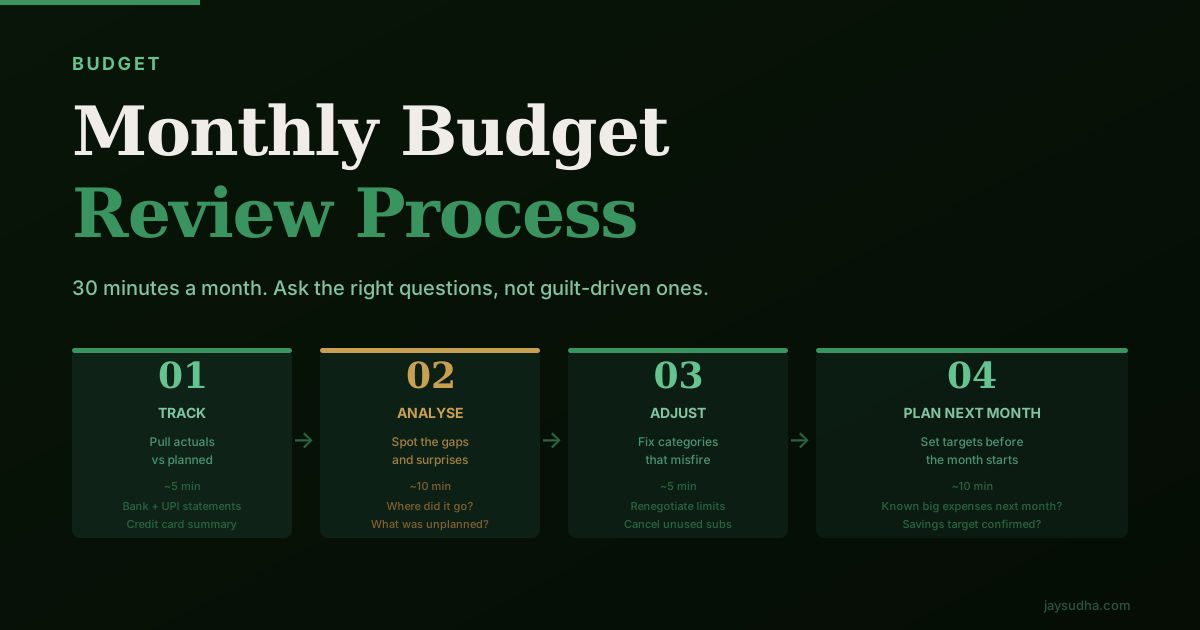
Most people who try monthly budgeting fall into one of two patterns. They either get obsessed with tracking every rupee — logging every coffee, reviewing every transaction — until it becomes a second job they abandon after two months. Or they set up a budget, never look at it again, and feel vaguely guilty about money for the rest of the year.
A useful monthly review sits between these extremes. It's structured enough to surface what matters, short enough that you'll actually do it, and decision-focused rather than judgment-focused.
Why most reviews fail
A budget review that makes you feel bad without changing anything is worse than useless. It creates negative associations with money that make you avoid the whole topic.
The problem is that most budget reviews ask "did I stick to my budget?" — which is a backward-looking, judgment question. The useful question is: "what does last month tell me about next month's decisions?"
The goal of a review is a decision, not a verdict.
The 30-minute monthly process
Set a fixed time — same day each month. Block it in your calendar. Keep it to 30 minutes maximum. Anything longer becomes a barrier to doing it at all.
Step 1: Gather (5 minutes)
Download or open the last month's bank statements and credit card statements. If you use UPI heavily, your UPI app transaction history is useful too. You want a complete picture — the number of transactions doesn't matter, the total in each category does.
Don't rely on memory. The review is only as good as the data.
Step 2: Categorize (10 minutes)
Group spending into categories. The exact categories depend on your life, but a practical starting set:
- Housing (rent, maintenance, home loan EMI)
- Food (groceries, dining out — keep these separate)
- Transportation (fuel, public transport, cab bookings)
- Utilities (electricity, internet, phone, OTT subscriptions)
- Health (medical, pharmacy, gym)
- Personal (clothing, grooming, personal care)
- Family (money sent to parents, children's education or activities)
- Financial (SIP investments, insurance premiums, EMIs)
- Discretionary (everything else)
Don't get precise — "roughly ₹3,500 on dining out" is good enough. You're looking for proportions and outliers, not an accounting audit.
Step 3: Three questions (10 minutes)
Ask three questions in order.
Question 1: What surprised me?
Look for categories where the number is noticeably higher or lower than you expected. A surprise — positive or negative — is information. High dining out in a month with three birthdays is different from high dining out with no obvious explanation.
Don't explain away every surprise. Some of them indicate a pattern worth addressing.
Question 2: What was one-time versus recurring?
Separate unusual expenses from ongoing ones. A flight ticket, an annual insurance premium, a car repair — these happen but shouldn't be treated as monthly commitments.
The goal here is to get an accurate picture of your structural monthly expenses: what does a normal month actually cost? Once you know this, you can plan around it rather than constantly feeling blindsided.
Question 3: What is my savings rate?
Savings rate = (income − expenses) ÷ income.
Calculate it. Write it down. Track it across months. This single number tells you more about your financial trajectory than any other metric — see how to calculate and improve your savings rate for the full breakdown.
If your savings rate is below 15%, it deserves serious attention. If it's above 25%, you're in a strong position to build wealth — assuming the savings are actually going to investments, not sitting in a zero-yield account.
Step 4: One decision (5 minutes)
End every review with a specific, concrete decision for next month. Not a vague intention — a decision.
Vague: "I'll spend less on food delivery." Concrete: "I'll cook at home on weekdays. Delivery only on weekends."
Vague: "I should start saving more." Concrete: "I'll increase my SIP by ₹2,000 from next month."
The decision can be small. The point is that the review produces an action, not just an observation.
What to track over time
After three to four months of reviews, patterns emerge. You'll see:
- Which categories consistently run over budget (and whether the budget needs adjustment or the behavior does)
- How your savings rate trends with income changes
- Whether your "one-time" expenses are actually happening every month (many are)
- Which subscriptions or commitments you've forgotten about — worth a dedicated subscription audit once you spot the pattern
A six-month trend in your savings rate tells you more than any individual month's number.
Adjusting the budget, not just the behavior
A budget that doesn't match reality isn't a budget — it's a wish list. If you consistently spend ₹8,000 on groceries but budgeted ₹5,000, the solution is usually to revise the budget, not to feel guilty about it every month.
Budget adjustment is not failure. It's calibration. The budget is a model of your spending; if reality consistently differs from the model, update the model.
The exception: if the category represents spending you genuinely want to reduce. In that case, the gap between budget and actual is the target, and you address it with a specific behavioral change — not willpower, but a structural change like meal planning, reducing restaurant apps on your phone, or cooking in batches.
The two things worth measuring long-term
You don't need to obsess over every spending category forever. Once your budget is calibrated and you're not constantly surprised, simplify the review to two metrics:
Savings rate: Are you saving an increasing percentage of your income over time?
Net worth: Is your total financial position growing month over month? See why net worth matters before you even start investing if you haven't tracked it yet.
These two numbers, tracked consistently, tell you whether the budget system is working — without requiring you to audit every grocery run.
A monthly review isn't about restriction. It's about staying in contact with your financial reality so that your decisions are intentional. Thirty minutes a month is a small cost for that clarity.
What a Real Monthly Review Looks Like: A Sample Session
Nisha and Karthik sit down on the last Sunday of each month. Here is what their December review actually involves:
Step 1 — Gather (5 minutes): Nisha opens HDFC NetBanking and downloads their joint household account statement for November. Karthik opens his ICICI credit card statement PDF. Both open their respective PhonePe transaction histories.
Step 2 — Categorise and total (10 minutes): They have a shared Google Sheet with 12 categories. Karthik pastes the credit card transactions; Nisha handles the bank account. Their categories auto-colour if they exceed the budget for that category. This month's surprises: dining (₹9,200 against a ₹5,500 budget — November had three birthday celebrations), transport (₹7,800 vs ₹5,000 — Karthik used Ola heavily for a client visit week).
Step 3 — Three questions (10 minutes):
What surprised us? The dining overspend was explained (three birthdays) — one-time, not structural. The transport overspend was partially one-time (client week) but Karthik notes he's been defaulting to Ola instead of metro more generally. This is worth watching.
What was one-time versus recurring? Dining overspend: one-time. Transport pattern: behavioural, worth a limit.
Savings rate? They saved and invested ₹32,000 against combined take-home of ₹1,40,000. That is 22.9%. Their target is 25%. Below target but not dramatically so — and the November SIP ran as usual (₹25,000), so the gap is discretionary savings, not investment savings.
Step 4 — One decision (5 minutes): Karthik commits to a ₹200/day Ola spend limit (his phone's UPI app supports this). That should bring transport back to ₹5,500–6,000/month. Nisha increases the grocery budget from ₹8,000 to ₹9,000 — they've been over every month, and the budget was set 8 months ago before prices rose.
The review ends in 25 minutes with two concrete decisions and a clear picture of where November actually went.
What the Review Reveals Over 6 Months
After half a year of consistent reviews, patterns that were invisible in any single month become clear:
Structural vs situational overspend: A category that runs over three months in a row is structural — the budget needs to change or the behaviour needs to change. A category that spikes once is situational. Single-month numbers hide this; six months of reviews make it obvious.
Whether savings rate is trending up or down: If combined income grew 10% over the past year but savings rate is flat at 20%, all of the income growth went into spending — a textbook case of lifestyle inflation. This should be visible and prompt a decision. Many households only notice this pattern during an annual review; monthly tracking with a recorded savings rate makes it visible much sooner.
The actual cost of "free" promotions: Households that participate in frequent sale events (Big Billion Day, End of Season sales, Diwali offers) often discover in their monthly reviews that sale months are actually higher-spending months, not lower — because the sales prompt spending that would not have happened otherwise. The review makes this cost visible.
Which months are reliably expensive: After 6 months, the household typically knows that November and February are high-spend months for them specifically. This allows forward provisioning — setting up a sinking fund that builds up through the quieter months so November and February stop being a surprise.
The Tool Question: What Actually Works in India
The review's quality depends on data quality. For Indian households using multiple payment channels, here is what works:
For the review itself — Google Sheets: Create a monthly tab. Columns: Date, Description, Amount, Category. At month end, paste transactions from bank statements (downloadable as Excel/CSV from most major bank net banking portals) and manually tag the categories. The first month takes 45 minutes; the third month takes 20.
Semi-automatic option — CRED: If credit cards are managed through CRED, the app categorises spending automatically and provides monthly summaries. It gets most transactions right but not all — expect to manually recategorise a handful each month, especially UPI payments and merchants it hasn't seen before. Good as a first-pass before a proper review.
For tracking savings rate — simple formula: In your Google Sheet, add a row: "Savings Rate = (SIP + any lump sum investments + RD contributions) / Total take-home income × 100." Review this single number each month and chart it. A rising trend over 12 months means the system is working.
For couples — shared Google Sheets: One person owns the sheet, both can view and edit. Set a monthly calendar invite for the review session. A shared, recurring number to look at together tends to surface disagreements early and calmly, rather than as a surprise argument when a statement arrives — the review becomes a routine check-in instead of an occasional confrontation.
Common Reasons Reviews Fail (and Fixes)
"We don't have time." The review needs to be under 30 minutes. If it's taking longer, the categorisation is too granular. Reduce to 8 broad categories and stop trying to perfectly account for every ₹50 transaction. Imperfect data reviewed consistently beats perfect data never reviewed.
"It makes me feel bad." The review is backward-looking by design, which means it surfaces mistakes. If the tone of the review is judgmental, it becomes aversive and gets abandoned. Reframe explicitly: the goal is one decision for next month, not an accounting of past failures. What is the one thing we can do differently next month?
"My partner won't engage." Start the review without making it a joint obligation. After 2–3 months of having the data consistently available, a brief comment ("did you know we spent ₹11,000 on food delivery in October?") is more likely to spark engagement than a scheduled meeting about finances.
"Income is irregular, so categories don't match." For variable income earners, the monthly review has an additional step: record what income actually arrived and compare it to the expected amount. If income was lower than expected, the review should assess which discretionary categories to pull back. The review becomes even more important for variable income because the budget needs active adjustment each month rather than running on autopilot — see budgeting on variable income for the floor-income method this calls for.
The Annual Rollup: What 12 Monthly Reviews Tell You
Individual months are noisy — a January medical bill, an October Diwali splurge, a one-time vehicle repair. The annual rollup smooths this noise and reveals the actual financial trajectory.
At year end (or in April at the financial year end), do a 10-minute annual review using your 12 months of saved data:
Savings rate trend: Calculate savings rate for each quarter: Q1, Q2, Q3, Q4. Is it flat, rising, or falling? Rising is the goal. Flat means you're maintaining but not improving. Falling means lifestyle inflation is outrunning income growth.
Category year-over-year change: Compare December's monthly average to the previous year's average in your top 4–5 spending categories. Which categories grew faster than income? These are the lifestyle inflation points.
One-time vs recurring surprises: List the "one-time" expenses that appeared through the year. How many recurred? Most households find that 40–60% of their "one-time" surprises are actually semi-regular events — a vehicle service, a family contribution, a home repair. These should move from the surprise column to the buffer fund column next year.
Actual vs intended savings: Compare what you planned to save at the start of the year to what you actually saved. A consistent 20% shortfall signals that the plan was aspirational; a consistent 10% surplus signals room to raise the target.
This 10-minute annual rollup converts 12 months of records into a meaningful financial picture — and feeds the next year's planning with accurate real data rather than assumptions.