The EMI Trap: When Monthly Installments Become a Debt Burden
EMIs feel affordable alone but stack up across loans and cards. Learn to calculate your true debt burden, spot overborrowing, and find a way out.
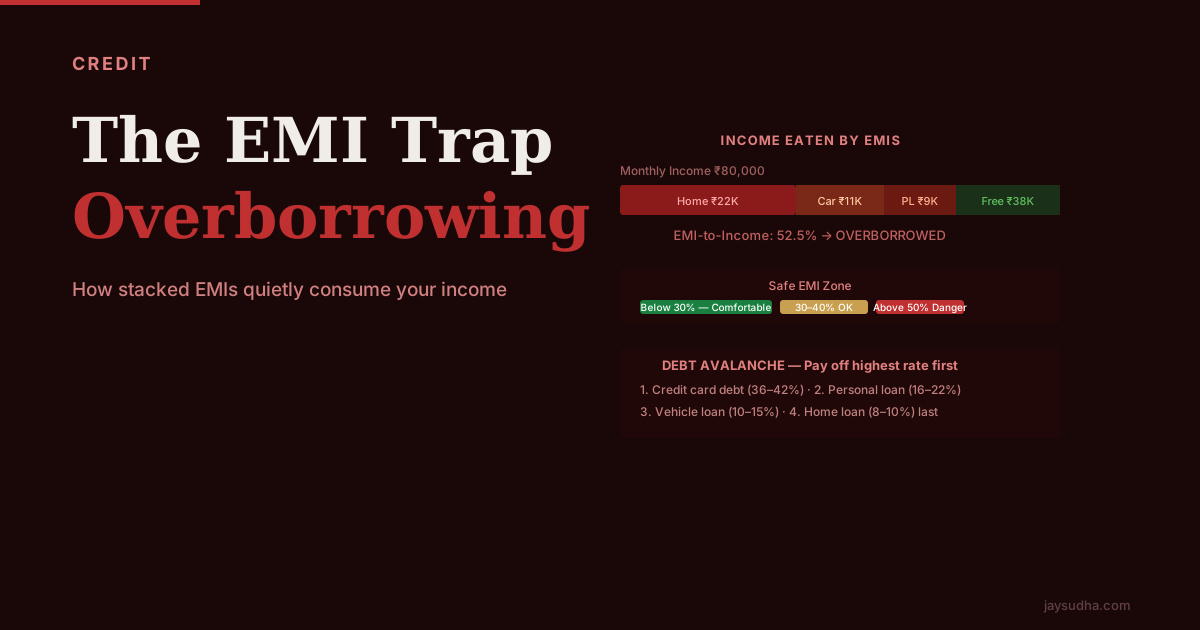
The EMI is the most successful financial product India has ever produced — because it makes large purchases feel small. A ₹6 lakh two-wheeler becomes ₹8,500 per month for 72 months. A ₹40,000 phone becomes ₹3,300 per month for 12 months. A ₹12 lakh personal loan for a wedding becomes ₹22,000 per month for 60 months.
Each of these EMIs feels manageable in isolation. The problem is that nobody takes one EMI at a time.
How the Trap Accumulates
The EMI trap isn't a single bad decision. It's a sequence of individually reasonable decisions that compound into a suffocating monthly obligation.
Typically it starts with the most socially expected loan: a vehicle loan for a two-wheeler or car. This seems entirely normal — everyone does it, the monthly payment is affordable.
Then comes a home loan or a shift to a larger rental with higher deposit, funded by a personal loan. Still manageable in isolation.
Then a credit card, used for emergencies or rewards, with a balance that doesn't get cleared each month and starts accruing interest.
Then a consumer durable loan for an appliance or device. Then a top-up personal loan when cash is short. Then a loan against property.
Each addition felt reasonable at the time. Cumulatively, they've eaten 60% of the take-home salary. There is no room for saving, no emergency fund, and no buffer for a job change or medical expense.
Calculating Your True EMI Burden
Most people underestimate their EMI burden because they don't count everything. The calculation must include:
Fixed EMIs:
- Home loan EMI
- Vehicle loan EMI (car, two-wheeler, EV)
- Personal loan EMIs (active)
- Education loan EMI
- Loan against property or gold loan
- Consumer durable loan EMIs (phone, appliance, furniture)
- Buy Now Pay Later (BNPL) instalments — these count
Credit card obligations:
- If you carry a balance on a credit card and pay the minimum each month, the minimum payment is effectively an EMI — often an extremely expensive one
- If you use credit card no-cost EMI, those instalments count
Informal obligations:
- Money borrowed from family or friends with an implicit or explicit repayment expectation
Add everything up. Divide by your monthly take-home salary (not gross — use what actually hits your bank account after tax, EPF, and other deductions).
This is your EMI-to-income ratio.
| Ratio | Assessment |
|---|---|
| Below 20% | Excellent — significant room for savings and decisions |
| 20–30% | Good — manageable with sensible savings discipline |
| 30–40% | Manageable but tight — limited room for new obligations |
| 40–50% | Stressed — vulnerable to any income shock |
| Above 50% | Overborrowed — requires active deleveraging plan |
The Hidden Costs That Make It Worse
The EMI amount understates the true cost of debt for several reasons.
Interest is the rent you pay for money. On a ₹5 lakh personal loan at 16% interest over 4 years, you'll pay approximately ₹1.8 lakh in interest — total cost of the loan is ₹6.8 lakh. The EMI of ₹14,000/month looks affordable; the total payment over four years does not.
Credit card interest is particularly brutal. Most Indian credit cards charge 36–42% per annum on the unpaid balance. A ₹50,000 balance left unpaid for a year costs ₹18,000–21,000 in interest alone. People who habitually pay the minimum on credit cards often owe more after two years than when they started.
Processing fees, insurance add-ons, and prepayment penalties add to the effective cost of borrowing. A "zero-interest" consumer loan often has a processing fee that, when annualised, comes to an effective rate of 8–14%.
The opportunity cost is what your money would have earned if it had been invested instead of servicing debt. ₹15,000/month invested in an index fund over 5 years grows to approximately ₹11–13 lakh at typical market returns. That's the cost of carrying an avoidable ₹15,000 EMI for five years.
Recognising Overborrowing Before It Becomes a Crisis
These are early warning signs — not of catastrophe, but of a trajectory that needs to change:
You take new loans to cover monthly shortfalls. If you're using a personal loan or credit card to manage monthly expenses rather than for a specific purchase, your income is not keeping up with your obligations.
You only know each loan's EMI, not the outstanding balance. If someone asked you the total debt you owe across all loans and cards right now, could you answer? If not, that's a signal.
You've missed a payment in the last year. A single missed payment might be an oversight. A pattern of missed or partial payments is a crisis forming.
You have no emergency fund. If you had to stop working for three months, you couldn't cover your EMIs. This means you're one health event or job loss away from default.
Your credit card minimum payment is what you typically pay. The minimum payment is designed to maximise interest income for the bank. It barely touches the principal.
You've applied for multiple loans in the last 6–12 months. Each hard inquiry hits your credit score, and multiple applications in a short period signal financial stress to lenders.
Building a Way Out
Once you've identified that EMI burden is too high, there are several approaches, which can be combined.
Approach 1: The Debt Avalanche
List all debts by interest rate, highest first. Maintain minimum payments on all. Direct every available rupee at the highest-rate debt first. When it's cleared, roll that payment into the next.
The avalanche saves the most money in total interest and is mathematically optimal. For most people this means attacking credit card balances first (highest rate), then personal loans, then vehicle loans, then home loan (usually lowest rate).
Approach 2: The Debt Snowball
List debts by outstanding balance, smallest first. Pay minimums everywhere, attack the smallest balance aggressively. Clear it, then roll that payment into the next smallest.
The snowball gives faster emotional wins, which helps people sustain motivation. It costs more in interest than the avalanche but works better for people who need visible progress to stay committed.
Approach 3: Balance Transfer or Refinancing
If credit card balances are high, a balance transfer to a card with a 0% introductory rate (typically 3–6 months) buys time to pay down principal without interest running.
If a high-rate personal loan is the main drag, refinancing with a lower-rate lender (or using a lower-rate secured loan like loan against property if you have assets) reduces the interest burden immediately.
Warning: Balance transfers and refinancing only help if you don't accumulate new debt while paying down the refinanced amount.
Approach 4: EMI Restructuring
If the repayment is genuinely unmanageable, contact the lender before missing payments. Banks can extend the loan tenure (reducing the monthly EMI at the cost of more total interest), offer a moratorium period, or restructure the debt. This is much easier to negotiate proactively than after default.
Approach 5: Increasing Income Targeted at Debt
If the income side is the constraint, any additional income — freelance work, overtime, asset sales — directed entirely at debt repayment can change the trajectory faster than expense cutting alone.
Preventing Overborrowing in Future
The best debt management is avoiding the debt that shouldn't have been taken in the first place. Three practical checks:
Before any new EMI: Add it to your current total EMI obligations. Calculate what the new EMI-to-income ratio will be. If it crosses 40%, you need a compelling reason to proceed.
Before a purchase: If you're considering financing something, ask whether this would be purchased if you had to pay cash. If the answer is no, the EMI is enabling a purchase you don't truly need.
The 30-day rule for discretionary loans: For anything other than a genuine necessity, wait 30 days. The clarity that comes from not being in a showroom or an app checkout often changes the decision.
EMIs are not inherently bad — a home loan at a reasonable loan-to-income ratio, used to build an asset in a city where you're going to live, is a legitimate and useful product. The problem is when they stack up, when they finance depreciating assets or experiences, and when the accumulated monthly obligation leaves no room for building financial security.
The EMI burden number — your total EMIs as a percentage of take-home pay — should be something you know and review annually, as deliberately as your investment returns or savings rate.
How the RBI's Household Finance Data Frames India's EMI Problem
RBI's Household Finance Committee Report (released in 2017 and referenced in subsequent monetary policy commentary) found that Indian households were significantly under-invested relative to their income and over-exposed to physical assets (primarily real estate) financed through debt. The structural shift toward EMI-driven consumption accelerated in the 2010s with the proliferation of consumer finance, and the growth of BNPL (Buy Now Pay Later) products has continued this trend.
The average EMI-to-income ratio for urban salaried Indians in metro cities is considerably higher than it was a decade ago. The combination of rising property prices (requiring larger and longer home loans), the normalisation of vehicle EMIs, and the growth of discretionary consumer credit has pushed many household financial profiles into the 40–55% range — a level that leaves minimal buffer for wealth creation.
This is not an alarmist observation — it is a mathematical constraint. If 50% of your income is committed to debt service, and another 30–40% goes to living expenses and rent, the remaining 10–20% for savings and investments is insufficient to build wealth at a meaningful pace, especially accounting for inflation.
The Moratorium Decision: When to Ask Your Bank for Temporary Relief
If you find yourself genuinely unable to service EMIs due to a job loss, medical emergency, or business disruption, proactive engagement with your lender is critical.
During COVID-19, RBI permitted banks to offer loan moratoriums (payment deferrals) for 6 months. This provision demonstrated that banks can and do offer structured relief. While no blanket moratorium is currently in place, individual borrowers facing genuine hardship can still approach lenders for:
EMI moratorium (payment holiday): A temporary deferral of 2–3 months, after which normal payments resume. Interest typically continues to accrue during the deferral and is either added to the outstanding principal or paid as a lump sum at the end of the holiday.
Loan restructuring (enhanced tenure): The outstanding loan is restructured with a longer remaining tenure, reducing the monthly EMI. The total interest paid increases, but the monthly obligation becomes manageable.
EMI size reduction: Some lenders will agree to reduce EMI temporarily (effectively an extended tenure) if the borrower documents genuine financial hardship. This is typically reserved for secured loans (home loan, vehicle loan).
One-time settlement: For severely distressed borrowers (multiple missed payments, NPA classification), lenders may agree to a negotiated settlement for less than the full outstanding. This is a last resort — the account is marked "settled" on the credit report, which significantly damages future borrowing ability for several years.
The critical principle: approach your lender before you miss payments, not after. Banks are far more flexible when you proactively communicate a short-term problem than when they are already in recovery mode.
Credit Score Impact of High EMI Burden
High EMI burden affects your credit profile in two distinct ways:
Direct effect (payment history): If the EMI burden exceeds what you can comfortably pay, missed or delayed payments accumulate. Each 30+ day delay is a DPD (Days Past Due) entry on the CIBIL report. One DPD-30 can reduce a 750+ score by 30–50 points. Multiple DPDs or an account going into NPA classification is catastrophic for the score.
Indirect effect (FOIR and new credit access): Even if you are servicing all EMIs on time, a high FOIR makes it difficult to get new credit when genuinely needed. If your total EMIs are already at 55% of income and an emergency arises requiring a personal loan, you may not qualify. The lender calculates that adding another EMI would push your FOIR beyond their threshold.
This is the "debt ceiling" problem — as EMI burden grows, the safety net that additional credit could provide in an emergency becomes harder to access precisely when you might need it.
I have lived on the wrong side of this ceiling — where every new obligation looked manageable in isolation, and it was only the total that quietly became unmanageable. The number that matters is never the individual EMI you are being sold; it is what is left after every EMI you already owe.
Maintaining EMI burden below 35–40% of net income is therefore not just a budgeting principle. It is a financial resilience strategy that preserves your ability to access credit when circumstances genuinely require it.
For a debt load already past comfortable, a CA or a debt counsellor can help map a realistic way out rather than guessing at one.
Related calculatorpersonal loan calculator
Frequently Asked Questions
Sources and references
- TransUnion CIBIL — Understand Your Credit Score and Report FAQ
- RBI — Press Release, Household Finance Committee Report
Rules, rates, and thresholds in India change over time. Always confirm the current position with the official source above before acting on it.