The 50/30/20 Rule: How It Works for Indian Incomes
The 50/30/20 rule is a starting framework for budgeting — but applying it to Indian incomes requires adjustments for EMIs, taxes, and cost of living.
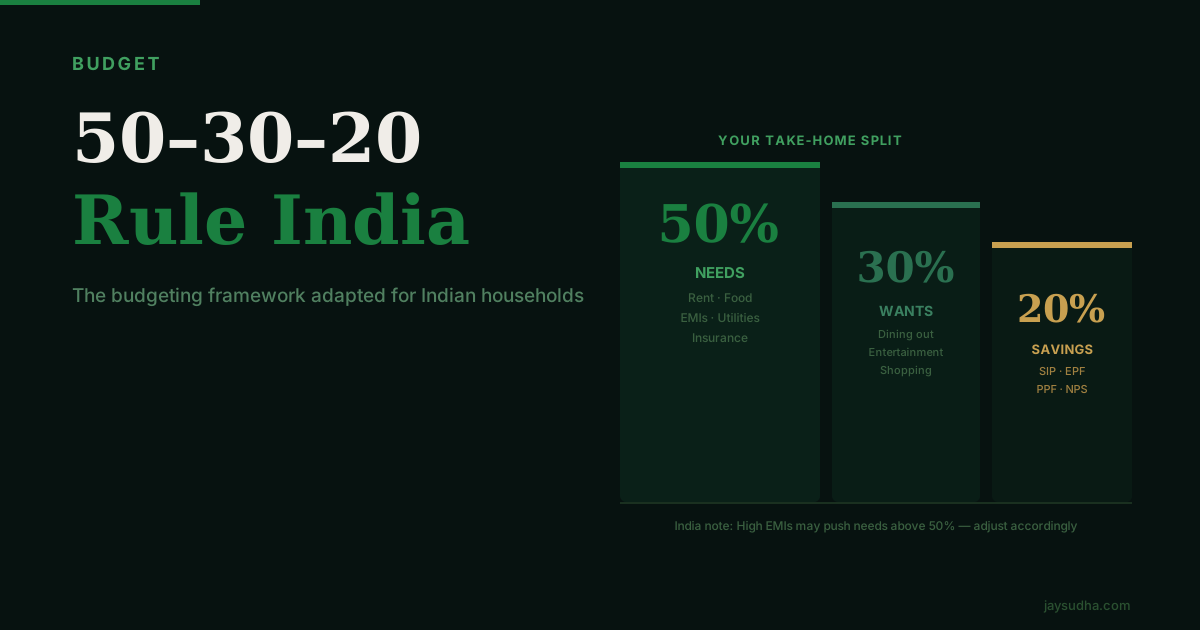
The 50/30/20 rule comes from Elizabeth Warren — yes, the US senator — and her book All Your Worth, co-authored with her daughter in 2005. The core idea is straightforward: split your after-tax income so that 50% goes to needs, 30% to wants, and 20% to savings and debt repayment.
It's widely cited in personal finance content because it's simple, memorable, and gives people a starting reference point when they have no other framework. Those are real advantages.
But the rule was designed for American middle-class incomes, American housing costs, and an American tax structure. Applying it to Indian incomes — especially in metros, at middle-to-high income levels, with the specific financial obligations Indian households carry — requires some adjustment.
This article explains how the rule works, where it breaks down in the Indian context, and how to adapt it into something actually useful.
What the Three Categories Mean
Needs (50%)
Needs are expenses you cannot reasonably avoid without disrupting your basic life. In the original framework, these include:
- Rent or home loan EMI (housing)
- Groceries and household supplies
- Utilities: electricity, gas, water, internet, phone
- Minimum debt repayments (the minimum required, not extra payments)
- Insurance premiums (health, life, vehicle)
- School fees
- Commute costs
The test Elizabeth Warren uses is: would your life be seriously disrupted if you cut this? Not inconvenient — disrupted. That distinction keeps "needs" genuinely constrained. A gym membership is not a need by this logic. Netflix is not a need.
Wants (30%)
Wants are the spending choices that make life enjoyable but aren't essential. Dining out, weekends away, new clothes beyond necessity, streaming services, gadgets, hobbies, entertainment. This category is largely discretionary.
Savings and Debt Repayment (20%)
This is the "pay yourself forward" bucket — investments, retirement contributions, extra debt payments beyond the minimum, and building your financial security. In Indian terms: SIPs, PPF contributions, NPS, FD, extra EMI payments, and emergency fund contributions.
Where the Rule Gets Complicated in India
The EMI Problem
In Mumbai, Bangalore, Pune, Delhi, and most Tier-1 cities, housing costs alone will often push the "needs" number past 50% for middle-income earners.
Consider someone earning ₹1 lakh take-home per month in Bangalore. A 2BHK rental in a decent area: ₹25,000–35,000. A home loan EMI on a ₹60 lakh apartment at 8.5% over 20 years: roughly ₹52,000 per month. That's more than half the take-home, before groceries or utilities.
This isn't a failure of budgeting discipline. It's a structural mismatch between the rule's design assumptions and Indian metro housing reality.
The Tax Burden for Mid-to-High Incomes
The 50/30/20 rule is applied to after-tax income (take-home), not gross salary. That's actually its saving grace — it avoids the common mistake of budgeting off a CTC figure that includes employer's PF contribution, gratuity, and other components you never see in your bank account.
But here's the nuance: if you're in the 30% tax bracket and your employer deducts TDS, you're already taking home significantly less than your CTC would suggest. Someone with a ₹20 lakh CTC might see ₹1.1–1.2 lakh/month in their account after tax and PF deductions. Budget against that number — not against ₹1.67 lakh (the gross monthly equivalent).
Family Financial Obligations
The original framework doesn't account for what is a genuine cost in many Indian households: supporting parents, contributing to family events (weddings, functions), sending money to a hometown, or covering expenses for a sibling's education. These aren't "wants" in any meaningful sense — they're obligations that carry real social and moral weight. They need their own slot in your thinking.
The 20% Savings Floor vs Indian Savings Norms
Indian households, particularly first-generation earners, often feel the pressure to save significantly more than 20%. When your parents' retirement isn't separately funded, when you're building property in the hometown, when you're accumulating for a child's education without access to federal student loans — 20% might genuinely be insufficient.
Use 20% as the minimum check, not the target.
How to Adapt the Rule for Indian Incomes
Use Post-Tax, Post-PF Take-Home
Your working income is what lands in your bank account. If your employer deducts PF, that's already a forced savings mechanism. You can count it toward your 20% savings, but calculate your percentages against your actual bank inflow.
Illustrative example: Gross salary ₹85,000/month. After TDS (assuming old regime, standard deduction, and basic 80C): take-home approximately ₹70,000. Budget against ₹70,000.
Reclassify EMI Principal as Savings
Your home loan EMI has two components. The interest portion is a cost — it goes under needs. The principal repayment is building equity in an asset — it should be counted under savings. Your bank statement won't tell you this split; check your loan amortisation schedule.
Early in a loan, the interest component dominates. On a ₹50 lakh loan at 8.5%, the first EMI is roughly 80% interest and 20% principal. So calling the whole EMI a "need" isn't wrong in early years. As the loan ages, more of each payment is principal.
Build a "Family and Social" Category
Rather than forcing family support and social obligations into "wants" (which implies they're optional), many Indian households benefit from creating an explicit category in the needs bucket. Call it "family obligations" or "social commitments." Once you've named it and sized it, you can plan around it rather than being surprised by it.
Accept That 50% Needs Is a Target, Not a Law
In metros especially, it's common for needs to run at 55–65% of take-home. This isn't a moral failure. It means your savings and wants buckets are compressed. The framework's value in this situation is clarity: you can see exactly how much runway you have, and you can make deliberate choices about whether to reduce wants or accept a lower savings rate while you're in this phase.
Practical Exercise: Apply It to ₹1 Lakh Take-Home
Here's how the numbers might look for a household earning ₹1 lakh take-home in a metro city. These are illustrative figures.
| Category | Ideal (50/30/20) | Metro Reality |
|---|---|---|
| Needs | ₹50,000 | ₹58,000–65,000 |
| Wants | ₹30,000 | ₹15,000–22,000 |
| Savings/Investments | ₹20,000 | ₹15,000–20,000 |
What typically makes up "Needs" at ₹58,000:
- Rent/EMI: ₹28,000
- Groceries: ₹8,000
- School fees: ₹5,000
- Utilities (electricity, gas, internet, phone): ₹4,000
- Commute (fuel/cabs): ₹4,000
- Insurance premiums: ₹3,000
- Minimum debt payments: ₹6,000
When needs run over 50%, the shortfall comes from somewhere. Usually from wants first (which is fine), then from savings (which requires attention).
What to Do When Your Numbers Don't Fit
If needs exceed 60% of income: You likely have a housing cost problem or a debt load problem. These are structural, not discretionary. Look at whether refinancing debt reduces the EMI burden. Consider whether housing decisions going forward can be made with this constraint in mind. Meanwhile, protect the savings floor even if wants compress severely.
If savings fall below 10%: This is worth taking seriously. A 10% savings rate on ₹1 lakh is ₹10,000/month — over a decade, even without investment returns, that's ₹12 lakh. Below 10% and you're genuinely at risk of having no cushion for anything. Check whether "wants" spending is the lever or whether needs are structurally too high.
If wants approach zero: You're likely either in a high-cost housing situation or have significant debt. This is sustainable short-term but not long-term. Human beings need some discretionary breathing room. If this persists beyond 12–18 months, look at the structural inputs.
Alternative Approaches Worth Knowing
Zero-Based Budgeting
Assign every rupee a job at the start of the month. Nothing is left unassigned. This requires more upfront work but gives complete clarity and is often better for people who've tried 50/30/20 and found the categories too blunt.
Pay-Yourself-First
Decide the savings/investment number first, automate it on day 1 (SIP debit, RD, or transfer), and then manage the rest. This works well when the primary goal is hitting a savings target and you trust yourself to manage the remaining spending without a detailed breakdown.
Percentage-of-Excess
For households with highly variable income (freelancers, business owners), saving a fixed percentage of every income receipt — say, 25% of every client payment — is more practical than trying to fit a monthly budget framework onto irregular cash flows.
When to Use 50/30/20
Use it as a diagnostic: run your numbers through it once, see what the gaps are, and use that as a conversation starter with yourself (or your household) about where your financial life currently is.
Don't use it as a rigid rule you feel guilty about violating. It was designed as a simplification. Your situation is more complex than any three-bucket rule can capture.
A better way to use it: check once a year whether your categories are still in a shape that allows you to save meaningfully and live a life you find worthwhile. If both of those things are true, you're doing fine regardless of what percentages end up in which bucket.
Applying 50/30/20 Across Different Income Levels
The rule's practicality changes significantly with income level. Here's an honest look:
Take-home ₹40,000–60,000/month (entry to early-career): In metros, this is genuinely tight. Rent alone at ₹12,000–18,000 is 25–45% of take-home before groceries. Hitting 50% on needs is standard; savings may only be achievable at 10–15%. The priority at this stage is building the habit of saving anything at all and keeping lifestyle fixed as income grows. The 50/30/20 is aspirational, not achievable, but useful as a direction.
Take-home ₹80,000–1,20,000/month (mid-career): This is the range where the rule becomes most actionable. Needs can potentially be kept at 50% with deliberate housing and EMI decisions. Savings of 20–25% is achievable without serious hardship for most. This is the stage where building the 20% savings habit has the most compounding time ahead of it.
Take-home ₹1,50,000–2,50,000/month (senior/leadership): At this income, the 50% needs ceiling becomes increasingly achievable — fixed costs are a smaller percentage of a larger income. The real challenge is the 30% wants bucket: lifestyle inflation makes it easy for wants to crowd out the savings bucket. Households at this income level who maintain 30–35% savings rates are building wealth rapidly; those who spend 45% on wants and save 10–15% are not.
For Tier-2 and Tier-3 city households: The rule works better here. Rent of ₹10,000–15,000 in a Tier-2 city versus ₹28,000–40,000 in a metro means needs are genuinely achievable at 45–50% even on modest incomes. A household earning ₹60,000 in Nagpur or Coimbatore may find the 50/30/20 fits more naturally than the same income in Mumbai.
One Worked Application: ₹90,000 Household in Pune
Take-home: ₹90,000 combined (one earner).
Needs (actual): ₹46,000 (51.1%)
- Rent: ₹20,000
- Groceries: ₹8,500
- School fees: ₹5,500
- Utilities and phone: ₹4,200
- Health insurance: ₹2,500
- Vehicle loan EMI: ₹5,300
Wants (actual): ₹22,000 (24.4%)
- Dining and food delivery: ₹8,000
- Entertainment and OTT: ₹2,000
- Personal care and clothing: ₹5,000
- Weekend activities: ₹4,000
- Miscellaneous: ₹3,000
Savings (actual): ₹22,000 (24.4%)
- SIP: ₹15,000
- Emergency fund contribution: ₹5,000
- PPF: ₹2,000
This household is close to 50/30/20 — needs slightly over at 51%, wants at 24%, savings at 24%. The fact that wants are below 30% and savings above 20% means the financial health is solid even though needs exceed the theoretical target. This is why the rule is a diagnostic, not a prescription: the outcome (24% savings, 24% wants) is good regardless of which bucket the 1% overspend on needs comes from.
Tracking Your Three Buckets Over Time
The 50/30/20 framework is most useful not as a monthly micromanagement tool but as a quarterly or annual check. Running the numbers once a year reveals whether the buckets are drifting in a direction that needs attention.
A practical way to track this without elaborate accounting: at the end of each quarter, download three months of bank and credit card statements. Total all spending. Categorise each transaction as Needs, Wants, or Savings. Calculate the three percentages.
This takes 45–60 minutes once a quarter and gives you the clearest single-page picture of your financial health: are needs under control, are wants reasonable, is savings adequate?
The number to watch most closely over time is the savings percentage. It should be rising. If it stays flat at 20% for three years while income has grown, lifestyle inflation is capturing all the growth. If it is falling below 15%, something structural needs attention.
The needs percentage is less controllable but worth monitoring. A needs percentage that has risen from 45% to 58% over two years, driven by housing and EMI decisions, tells you that the fixed cost floor has risen significantly. This is not always avoidable — housing costs rise, children start school — but knowing it allows you to make the trade-off explicitly rather than discovering it only when there is no savings left.
Putting this into practice
A real example
On ₹70,000 take-home pay, the split is Needs ₹35,000 (50%), Wants ₹21,000 (30%), and Savings ₹14,000 (20%). In a metro, rent alone can push Needs past 50% — in that case you trim the Wants bucket, never the Savings one. The 20% is the line you protect.
A common mistake
Applying the rule to gross salary instead of take-home, or treating savings as "whatever is left at month-end" rather than a fixed transfer at the start.
When this doesn't apply
High-rent metros and lower incomes genuinely can't hold Needs at 50% — the rule is a starting frame, not a law of physics. If Needs run to 60%, accept it for now, keep Savings at 20% by squeezing Wants, and work on raising income or cutting a big fixed cost.
Jay's operating note: The only non-negotiable number in 50/30/20 is the 20. Automate it on salary day and the other two buckets tend to sort themselves out.
Your decision checklist
- Percentages applied to take-home pay, not gross
- Savings auto-transferred on salary day, before spending
- Each expense honestly tagged Need or Want
- EMIs counted inside Needs
- Review it monthly, and raise the savings share as income grows