Breaking the Paycheck-to-Paycheck Cycle India: What Is Actually Keeping You Stuck
Why the paycheck-to-paycheck cycle persists even at high salaries, the structural triggers that maintain it, and a step-by-step approach to breaking out.
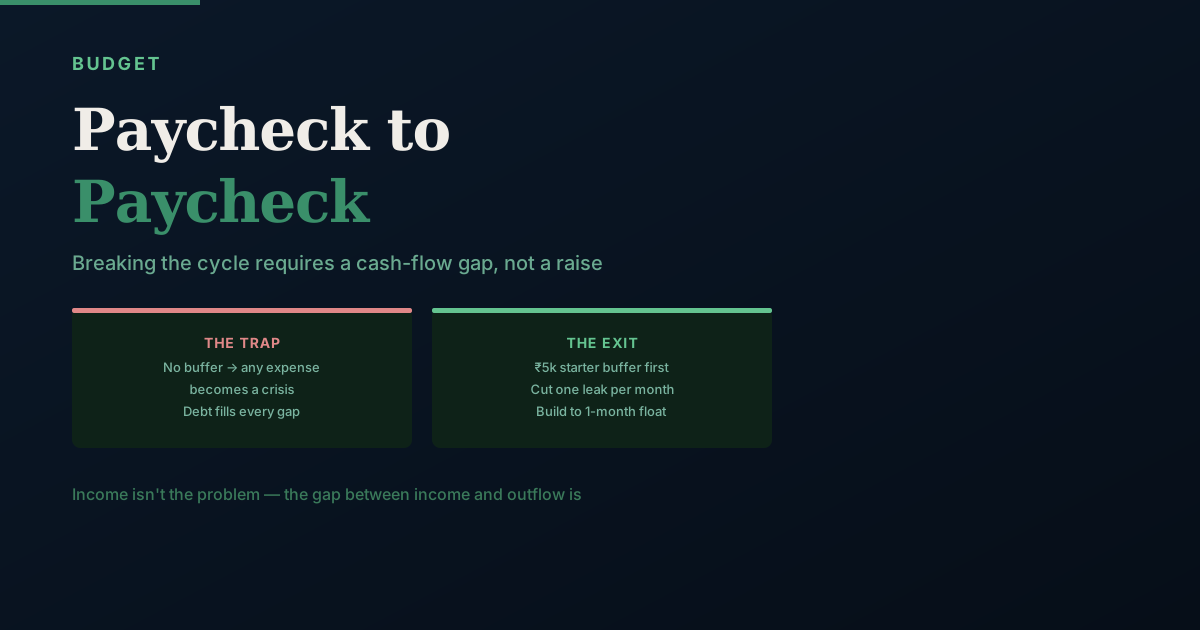
The paycheck-to-paycheck cycle is not primarily an income problem. It is a structural problem. Many households in India with take-home pay of ₹60,000–1,20,000/month experience the same pattern: salary arrives, expenses absorb it within 2–3 weeks, and the last week before payday is spent in low balance anxiety.
Understanding what maintains the cycle is the starting point for breaking it.
What maintains the cycle
EMI accumulation: Each loan or big-ticket purchase adds a fixed outflow. A car loan, a personal loan for a gadget, and a credit card EMI conversion can easily consume ₹25,000–40,000/month of a ₹80,000 take-home. The income feels adequate; the fixed obligations ensure it never stays.
No savings automation: If saving is what is left after spending, it is rarely left. The cycle perpetuates because spending naturally fills available balance. Without an auto-save on the day salary arrives, savings are always the residual.
Lifestyle calibrated to salary peak: Spending is calibrated to the best recent income. When income dips (variable month, medical expense), spending does not reduce immediately — the credit card or overdraft fills the gap, creating debt that increases next month's obligations.
Absence of a buffer: Without a small buffer between salary and zero, every unexpected expense — a vehicle repair, a medical visit, an appliance breakdown — requires either credit card use or stress management. The buffer does not exist because there was never any intentional mechanism to create it.
Step 1: The ₹10,000 buffer
Before anything else, create a buffer fund. Open a separate savings account (not your salary account) and move ₹10,000 there. Do not touch it except for genuine emergencies.
This buffer breaks the psychological pattern. When a ₹3,000 unexpected bill arrives on day 25 before payday, you transfer from the buffer, pay the bill, and replenish on payday. The anxiety of running to zero is removed.
Step 2: Identify the three largest spending drains
Pull the last 3 months of bank and credit card statements. Identify the three highest-spending categories that are not fixed obligations (rent, EMIs, utilities).
Common findings in Indian households:
- Food delivery: ₹5,000–12,000/month
- Dining out: ₹3,000–8,000/month
- Subscriptions (OTT, apps, gym): ₹1,500–4,000/month
These three categories often account for 15–25% of take-home pay. Reducing each by 40% is not elimination — it creates meaningful savings without significant lifestyle change.
Step 3: Auto-save on payday
Set up a standing instruction from your salary account: on the 1st or 2nd of the month (or the day after salary credits), transfer a fixed amount to a savings account or liquid fund.
Start small: ₹2,000/month if necessary. The habit of the transfer matters more than the initial amount. Increase by ₹500–1,000 each month.
The amount you auto-save is invisible to your spending habits. What remains in the salary account sets your spending baseline. Most people find their spending naturally adjusts to the available balance over 2–3 months.
Step 4: Stop adding new EMIs
The cycle deepens every time a new EMI is added. While breaking the cycle, treat all purchases that would require a loan or EMI as deferred — including gadgets, furniture, and appliances. The EMI commitment reduces available income for the following 12–36 months, reinforcing the paycheck-to-paycheck pattern.
Once you have 3 months of buffer and a functioning auto-save, the cycle starts to break. The next 6 months consolidate it into a new normal.
Step 5: Shrink the Existing EMI Load
Stopping new EMIs prevents the cycle deepening; shrinking existing ones is what creates room. List every loan with its interest rate and attack the most expensive first:
- Credit card EMIs and revolving balances (36–42% effective): the most destructive item. Clear these before saving beyond your buffer — no investment reliably beats a 40% cost.
- Personal loans (12–24%): prepay where there's no penalty; many waive it after 12 months.
- Consolidate only if the rate genuinely drops (e.g., a top-up home loan at ~9% replacing a 20% personal loan) — not just to shrink the EMI by stretching the tenure, which quietly raises total interest.
Every EMI you retire permanently lifts your monthly free cash. It's the highest-return move available to a paycheck-to-paycheck household.
Diagnose It With One Number: The Fixed-Cost Ratio
Add up your unavoidable monthly outflows — rent or home-loan EMI, other EMIs, insurance, utilities, school fees — and divide by take-home pay:
- Under 50%: mostly behavioural; the buffer, auto-save, and spending cuts above will break it.
- 50–70%: structural. Cutting food delivery won't be enough — you need to reduce fixed costs (refinance, retire an EMI, lower rent).
- Over 70%: fragile regardless of income; the priority is aggressively clearing debt and adding no new commitment.
This one ratio tells you whether your problem is lattes or loans — and they need completely different fixes.
If Your Income Is Irregular
Freelancers and commission earners can't auto-save a fixed sum on the 1st. Instead, treat fluctuating income like a reservoir: keep earnings in one account and pay yourself a fixed, conservative "salary" into your spending account each month — sized to your average lean month, not your best one. Surpluses from good months stay back to cover the slow ones. You get the stability of a paycheck without having one.
In my own business, the hard part was never setting this up — it was leaving it alone after a genuinely good month. The temptation to treat one strong month as the new normal and raise what you pay yourself immediately is real, and it is exactly what breaks the reservoir. I wait out a full quarter of results before I let a good run change what I actually draw.
What Breaking Out Actually Looks Like
- Month 1: a ₹10,000 buffer exists and never hits zero.
- Months 2–3: auto-save runs every payday; the three biggest discretionary drains are down ~40%.
- Months 4–6: one EMI retired or refinanced; one full month of expenses saved.
- Beyond: the last week before payday stops being an anxious one — and that emotional shift is the real marker that the cycle is broken.
A Specific Worked Example: ₹80,000 Household Breaking the Cycle
Sanjeev earns ₹80,000 take-home in Hyderabad. He's been living paycheck to paycheck for three years. His situation at the start:
Fixed monthly outflows:
- Rent: ₹18,000
- Car loan EMI: ₹9,500
- Personal loan EMI (bought phone on EMI 18 months ago): ₹3,200
- Credit card minimum payment (running balance of ₹45,000 at 3.5%/month): ₹4,500
- Mobile and internet: ₹1,100
- Fixed total: ₹36,300
Variable monthly spending (actual, from last 3 months):
- Groceries: ₹5,800
- Food delivery: ₹8,400
- Fuel: ₹3,200
- Dining out: ₹5,500
- Clothing and personal care: ₹3,900
- Entertainment: ₹2,800
- Miscellaneous: ₹3,100
- Variable total: ₹32,700
Total outflow: ₹69,000. Savings: ₹11,000 — but no investment, no auto-save, and this ₹11,000 was absorbed by the first surprise each month.
His fixed-cost ratio: ₹36,300 / ₹80,000 = 45%. Not extreme, but the variable spending is the problem.
Month 1 action: Move ₹10,000 to a new savings account (the buffer). This means Month 1 ends with only ₹1,000 available, which is uncomfortable but survivable.
Month 2 action: Set up ₹3,000 auto-save on the 2nd of the month (day after salary credit). Cut food delivery to ₹3,500 (saves ₹4,900). Cancel dining out except for two planned occasions (saves ₹3,500). Recovered: ₹8,400 in discretionary savings.
Month 3 action: Begin paying ₹2,000 extra on the credit card each month (₹6,500 total instead of minimum ₹4,500). At this rate, the ₹45,000 balance clears in approximately 9 months — ending an effective 42% annualised cost.
Month 6 outcome: Buffer is intact at ₹10,000. Auto-save has accumulated ₹18,000. Credit card balance down to ₹27,000. Food delivery and dining costs permanently reduced by ₹8,000/month — the new baseline feels normal.
Month 12 projected: Credit card cleared (month 9). The ₹6,500/month previously going to credit card payment is now split: ₹4,500 to additional SIP, ₹2,000 to remaining personal loan. Monthly savings rate crosses 25%.
This is not a dramatic financial transformation — it is a systematic reduction of expensive debt combined with modest behavioural change. The outcome at month 12 is materially different from month 1, achieved without any income increase.
The UPI Trap: Why Spending Looks Smaller Than It Is
The paycheck-to-paycheck problem is made significantly worse by UPI payment infrastructure. This is not an argument against UPI — it is a practical observation about how seamless payment affects spending awareness.
A person who paid for food by cash in 2015 handed over ₹400 for a restaurant meal and watched it leave their wallet. The same person in 2025 taps their phone, the transaction completes in 0.8 seconds, and there is no visible depletion of anything. The psychological register of money leaving is much weaker.
This shows up in audits. When people see their UPI transaction history for the first time — all 200+ entries in a month — they are almost always surprised by both the number and the total. Sixty UPI transactions under ₹200 each can add up to ₹8,000–10,000 of spending that never registered consciously.
Two tools that help:
UPI spend limits: BHIM and most bank UPI apps allow setting a daily or per-transaction spending limit. Even ₹1,500/day creates a pause — when the limit is reached, the app requires a PIN re-entry or shows a warning. The pause is the goal; it converts automatic spending back into a decision.
The 24-hour rule for non-essential UPI purchases: Before any discretionary UPI payment over ₹500 that was not pre-planned, wait 24 hours. Add it to a list. If you still want it the next day, buy it. This rule does not prevent all discretionary spending — it prevents automatic spending.
Joint-Family Paycheck-to-Paycheck Dynamics
Paycheck-to-paycheck cycles in joint families have a specific additional complication: multiple household members have partial visibility into household finances, and financial obligations (contributing to household expenses, funding parents' medical bills, contributing to a sibling's wedding) arrive without a formal budget.
In these households, the cycle is maintained by obligation ambiguity — the sense that "someone will pay for this" combined with the absence of any formal agreement about who pays how much for what.
A practical fix: a monthly household expense meeting, even brief, where the major expected expenses for the upcoming month are named and funded in advance. Each earning member knows their contribution to the household pool for that month, and discretionary spending happens from what remains.
This does not require formality or spreadsheets. A five-minute conversation on the 1st of the month — "parents' medicine budget is ₹3,000, I'll cover it; household groceries split as usual; the car service is coming this month, ₹4,000" — eliminates the most common surprises that break joint-family budgets.
When to Seek Outside Help
If the cycle persists after 6 months of genuine effort — the buffer cannot be built, the auto-save keeps getting cancelled, the debt is not reducing — the problem may not be behavioural. It may be structural income insufficiency for the city and lifestyle, or it may involve financial stress that is affecting decision-making in ways that are difficult to manage alone.
Two resources appropriate to this situation in India:
Debt Management Plans (DMP) through banks: If credit card debt is the primary problem, most major banks have hardship programs that reduce interest rates for borrowers in genuine distress. This requires proactive contact with the bank's collections or credit department. It is underutilised.
SEBI-registered fee-only financial planners: A one-time session with a fee-only financial planner (listed on the National Institute of Securities Markets registry) costs ₹3,000–8,000 and provides a structured diagnosis of why the cycle is persisting. This is useful when self-help approaches have stalled.
The Mental Accounting Shift
Breaking the paycheck-to-paycheck cycle is partly structural (the buffer, the auto-save, the debt reduction) and partly psychological. A specific mental accounting shift accelerates the structural changes:
Treat your salary account balance as "spoken for" on Day 1. The moment salary arrives, mentally allocate it: EMIs, SIP, buffer top-up, month's essential expenses. The amount remaining after all committed allocations is your actual disposable income. Most people experiencing paycheck-to-paycheck stress treat the full salary account balance as available — which it isn't — and experience a slow drain throughout the month until the account is empty before payday.
Practically, the auto-save and auto-debit on payday do this physically. The mental shift reinforces it: "I got ₹80,000 salary, but ₹55,000 is already allocated. I have ₹25,000 to manage for the month." This is a smaller number to manage, but it is the real number.
People who make this shift consistently report a qualitative change in how money feels. The anxiety of watching a large balance drain away is replaced by the more manageable feeling of spending within a defined envelope. The large starting balance was an illusion anyway; the ₹25,000 envelope reflects reality.
Frequently Asked Questions
Sources and references
Rules, rates, and thresholds in India change over time. Always confirm the current position with the official source above before acting on it.