The No-Spend Challenge: What It Is, How to Run One, and What to Do With the Savings
A no-spend challenge is not about deprivation — it is a structured way to spot mindless spending and redirect that money. How to run one well in India.
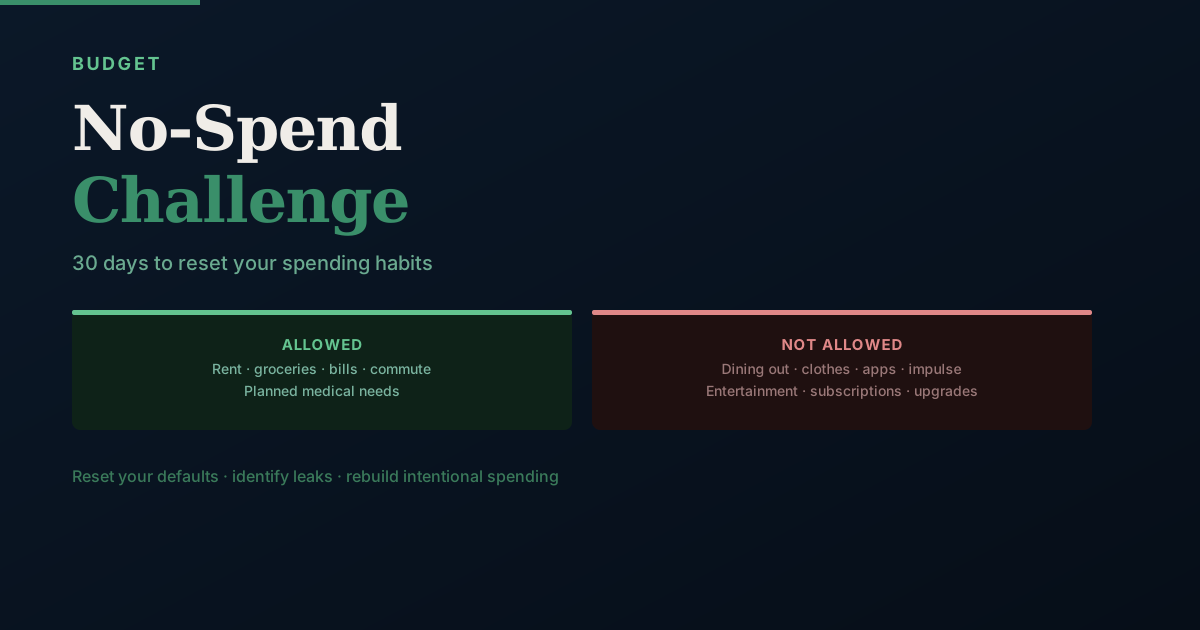
A no-spend challenge is a defined period — usually 7, 14, or 30 days — during which you commit to spending only on essentials. The purpose is not to be miserable. It is to create a pause in automatic spending habits long enough to examine them.
Most people who do a no-spend challenge find two things: they can survive fine without much of what they routinely spend on, and the recovered money adds up faster than expected.
Setting your rules before you start
The challenge fails without clear rules defined upfront.
Essential (allowed):
- Rent, EMIs, home loan payments
- Utility bills, mobile recharge
- Groceries (cooking at home)
- Medicine and healthcare
- Children's school fees
- Commute to work
- Active insurance premiums
Discretionary (not allowed during challenge):
- Eating out, food delivery orders
- New clothing, footwear, accessories
- Entertainment: movies, concerts, events
- Online shopping (anything non-essential)
- Beverages outside home (chai, coffee)
- New apps, subscriptions, or services
- Personal care beyond basics
Write this list down before Day 1. When temptation arises, you have a written decision to fall back on rather than a judgment call in the moment.
Running a 30-day challenge
Days 1–7: Uncomfortable The first week typically involves the highest frustration. You will notice how many small spending decisions are automatic — the evening chai order, the weekend restaurant booking, the late-night Amazon browse. Discomfort in this phase is the point.
Days 8–14: Pattern recognition By week two, you start to see patterns. You notice that boredom is a spending trigger. Social pressure drives dining out. The UPI tap for small items is effortless in a way that hides the accumulation.
Days 15–21: Adaptation New behaviours emerge: cooking on weekends, using a library app instead of buying books, finding free activities. The adaptation is not deprivation — it is substitution.
Days 22–30: Inventory In the final week, do the numbers. How much have you not spent? Which categories showed the biggest gaps between your assumption and reality?
What to do when you want to break the challenge
Write down the item you want to buy. Put it on a list. The list's job is not to deny the purchase — it is to move it from an impulse to a considered decision. After the 30 days, review the list. You will find most items no longer seem urgent.
This is the practical lesson: most discretionary spending is driven by immediacy, not genuine need.
What to do with the recovered money
The challenge only creates lasting value if the recovered money goes somewhere intentional:
- If emergency fund is below target: put all savings there immediately
- If carrying high-interest debt: apply it to the balance
- If investments are on track: make an extra SIP contribution or invest the lump sum in a liquid fund
- If saving for a specific goal: deposit directly into the goal savings account
Do not leave the money in your salary account. It will be absorbed.
What you actually learn from a no-spend challenge
The primary value is not the money saved in 30 days — it is the audit of automatic behaviour. After the challenge, most people restructure some subscriptions (cancel what they do not use), reduce food delivery frequency, and become more conscious of impulse purchases.
This behavioural shift, maintained even partially, compounds over time into significantly different spending patterns and higher savings rates.
For a broader framework on monthly budgeting, see the guide on monthly budget system.
A Worked Example: What 30 Days Actually Looks Like
Rohit is a 31-year-old software engineer in Pune earning ₹85,000 take-home per month. His current discretionary spending, before the challenge:
| Category | Monthly Spend |
|---|---|
| Food delivery (Swiggy/Zomato) | ₹6,200 |
| Dining out | ₹4,800 |
| Clothing and accessories | ₹3,500 |
| Weekend activities | ₹2,200 |
| Impulse online shopping | ₹4,100 |
| Beverages outside home | ₹1,400 |
| Total discretionary | ₹22,200 |
During his 30-day challenge, he pauses all of the above. His rules: groceries yes, cooking fuel yes, EMIs yes, but Zomato off, Amazon browsing off, restaurants off.
By day 10: He notices three things. Food delivery was genuinely automatic — he ordered out of boredom, not hunger. His impulse wish-list from Flipkart now has 14 items he added during the month that he cannot order; most already seem less important. He cooked 8 meals on the weekend instead of zero.
By day 20: His salary account has ₹18,000 more than usual mid-month. He's surprised by how quickly the balance built. He's also identified two OTT subscriptions he had been paying but not watching.
Result after 30 days: He saved approximately ₹19,000 compared to a normal month (the full ₹22,200 minus groceries for eating in, which increased by roughly ₹3,000). The wish-list has 14 items; he decides to buy two of them — a book he still wants and a kitchen gadget he'd use. Total: ₹1,800. The rest he passes on.
He routes ₹10,000 to his emergency fund (it was below target) and ₹7,000 to an index fund SIP increase. That's the difference: not the one month of restraint, but the habit shift and the investment boost that follows.
The Psychology: Why Discretionary Spending Feels Smaller Than It Is
One reason the no-spend challenge surprises people is UPI. When you pay ₹249 for a food delivery, the payment takes less than a second. There is no moment of counting out notes, no visible depletion of a wallet. The friction of spending has almost entirely disappeared.
The no-spend challenge artificially reintroduces friction. When you cannot order through Swiggy, you have to cook or eat something at home — which takes effort. That effort is annoying but it is also informative: you discover that the ordering was at least partly a convenience tax, not a food preference. Many people find cooking on weeknights for 30 days results in a meaningfully lower grocery bill than they expected, because the ingredients they buy are actually used rather than abandoned as the weekly delivery habit takes over.
Common Mistakes That Undermine the Challenge
Setting ambiguous rules: "I'll try not to spend too much" is not a challenge. If it is not written down as allowed or not allowed, the moment of temptation produces a negotiation rather than a decision. Write the rules before Day 1.
Excepting too many categories: If dining out is allowed for "social occasions" and online shopping is allowed when it is "a good deal" and clothing is allowed when it is "genuinely needed," the challenge has no discipline left in it. Set a hard boundary for the month. Social occasions can be navigated differently — invite people to your home, meet in a park, suggest activities that do not involve spending.
Not telling the people around you: If your partner, flatmates, or close friends do not know you are doing a challenge, the default social pressure (birthday dinner, weekend plan, Diwali shopping trip) will break it by week two. A quick explanation — "I'm doing a spending pause for the month, I'll join for free or low-cost activities but skipping the restaurants this month" — prevents most social friction.
Saving nothing with the money: The recovered money has to move the same month. Do not leave it in your salary account. Decide on Day 1 where it will go. The money saved from the challenge that sits in the same account as regular spending will be absorbed by next month's spending. The deliberate transfer — to a liquid fund, to an extra SIP, to an emergency account — is what makes the challenge financially productive rather than just uncomfortable.
Using the Challenge to Reset Long-Term Patterns
The most common outcome for people who complete a full 30 days is not that they permanently stop dining out or buying clothes. It is that their baseline resets. After the challenge, ₹3,000/month on food delivery feels normal rather than the previous ₹6,000. The subscription list is 40% shorter. The impulse online shopping basket empties more slowly because the habit of the immediate purchase has weakened.
A good follow-up routine: run a mini no-spend challenge for one week every quarter. Seven days is enough to catch new spending drift before it becomes the new normal.
The challenge is most powerful as a reset, not as a permanent way of living. After 30 days, you spend again — but the spending is more deliberate because you have now seen clearly which parts of it you actually miss.
Preparing for the Challenge: The Week Before Day 1
Preparation prevents the most common failure mode — running out of essentials and being forced to break the challenge on Day 3 for a genuinely necessary purchase.
Stock essentials: Before Day 1, grocery shop for the full week ahead. A well-stocked kitchen means the challenge doesn't fail because there are no vegetables or cooking oil. Include snacks you normally buy outside — if you routinely eat a packet of biscuits from the office canteen, buy a stock for home. Removing the need to purchase even small items during the challenge week keeps the discipline clean.
Handle outstanding planned purchases: If you had already decided to buy something before hearing about the challenge — a specific book you ordered, a birthday gift you planned to pick up — complete those purchases before Day 1. The challenge is a forward-looking pause, not a retroactive prohibition on things already decided.
Tell your household: If you live with a partner, family, or flatmates, they need to know the rules you've set and why. If your partner orders food delivery on Day 12 without knowing you're on a challenge, it is not a failure of their cooperation — it is a failure of your communication.
Set your money-saving destination: On Day 0, decide specifically where the recovered money will go. Not "savings generally" — a named account, a specific SIP increase, a named goal. The research on goal-setting is consistent: named goals with a specific action attached are significantly more likely to be completed than vague intentions.
Variations to Fit Your Situation
A no-spend challenge does not have to follow a rigid 30-day template. Some variations work well for different household types:
The 7-day weekend-only version: Run the challenge only on weekends for four consecutive weekends. For many urban professionals, weekend spending accounts for 40–50% of total discretionary spending — restaurants on Saturday, shopping on Sunday, a movie outing, brunch with friends. Four restricted weekends reveal the same patterns as a 30-day challenge for most people, with less weekday friction.
The category challenge: Instead of stopping all discretionary spending, pick one category and zero it out for 30 days. Food delivery is the most popular choice. Going 30 days without Swiggy or Zomato reveals how much of the ordering was habit versus genuine need, forces meal planning, and typically saves ₹4,000–8,000 for the average urban household. A single-category challenge is less daunting and easier to complete.
The cash-only challenge: For seven days, all discretionary spending is in cash only. Withdraw a fixed weekly budget (₹1,500–2,500 is reasonable) and live within it. When the cash is gone, the week is over. This variant works specifically on UPI impulse spending — the physical reality of handing over notes reintroduces the friction that digital payments removed.
The couples challenge: Run the challenge jointly. The social accountability dimension is significant — it is much harder to cancel when a partner is also committed. Couples who run a no-spend month together often report that the shared experience improves financial communication beyond the challenge itself, because it requires explicit conversations about what counts as essential and what can wait.
After the Challenge: Three Financial Habits Worth Keeping
The full discipline of a no-spend challenge is unsustainable as a permanent lifestyle. But three specific behaviours that emerge during the challenge are worth retaining:
The wish list habit: Writing down things you want to buy before buying them. During the challenge, the list is how you survive the 30 days without impulse purchases. After the challenge, maintain the list. Revisit it every two weeks. Most items lose urgency within 10–14 days of being added — this is the signal that the original impulse was exactly that. Items that remain on the list after two weeks are genuine wants that deserve consideration.
Cooking on weekdays: Most people who do a 30-day challenge cook far more than usual. Many discover this is not as difficult as they assumed once it becomes a default rather than a deliberate choice. Post-challenge, keeping a "cook on weeknights, order on weekends" structure rather than ordering as the default saves ₹3,000–6,000/month with minimal lifestyle reduction.
The subscription audit outcome: Almost every 30-day challenge surfaces forgotten subscriptions when participants go looking for what they cannot spend on. The cancelled subscriptions discovered during the challenge — the gym app opened once, the OTT service for a series that ended nine months ago, the premium plan on a tool used on the free tier — are real money recovered permanently. This outcome alone typically justifies the challenge even if spending habits revert completely afterward.