ITR Filing Mistakes 2026: 17 Errors That Can Delay Your Refund
Filing ITR for AY 2026-27? Here are 17 common ITR filing mistakes in 2026 that cause AIS mismatches, refund delays and notices — and how to fix each one.
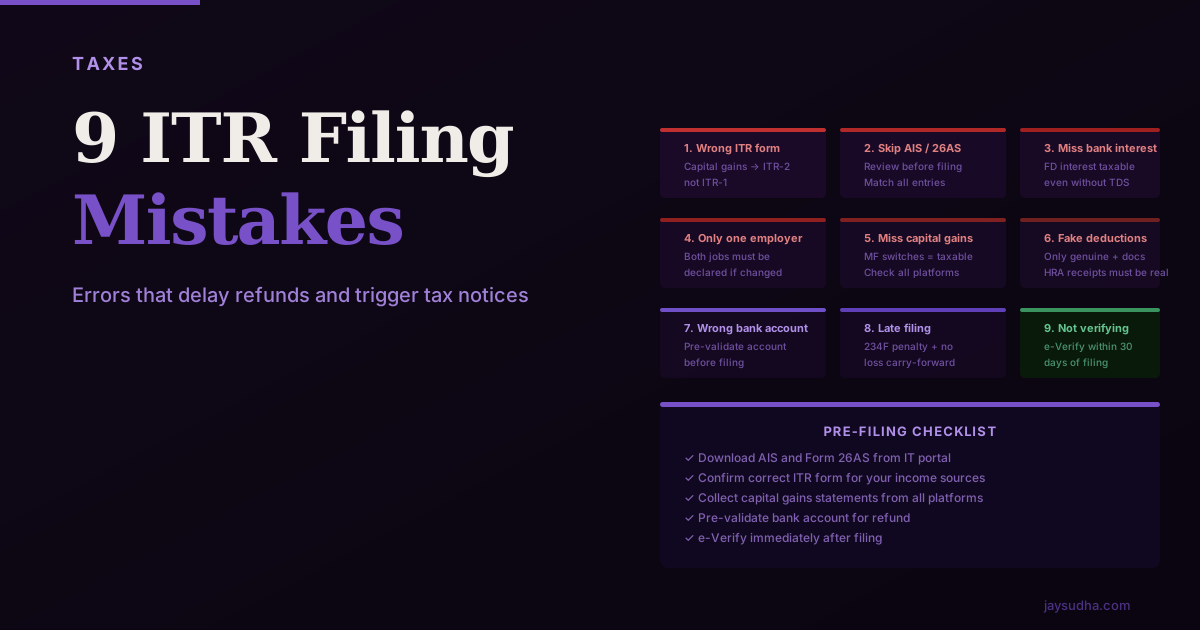
Most people assume filing an ITR means copying numbers from Form 16 into the portal. That's where a lot of the ITR filing mistakes in 2026 actually start. A complete, accurate return usually needs more than one document — it means checking Form 16 or Form 16A against your AIS, your TIS, Form 26AS, bank interest certificates, broker capital-gains statements, mutual fund statements, property and home-loan papers, income from a previous employer, and any tax-payment challans you've made during the year.
None of this is complicated on its own. The trouble is that these documents rarely arrive in one neat bundle, and small gaps between them — a bank that reports interest differently than you expected, a broker statement that doesn't match your own trade log, an old employer's TDS that never showed up — are exactly what leads to tax-credit mismatches, delayed processing, or a request for clarification. This guide walks through the 17 mistakes that most commonly cause this, in plain language, with a clear way to avoid and fix each one.
In short: the most common ITR filing mistakes in 2026 include choosing the wrong ITR form, missing income such as FD interest or freelance receipts, ignoring AIS or Form 26AS mismatches, selecting a tax regime without comparing both, misreporting capital gains or F&O income, claiming unsupported deductions, and forgetting to e-verify the return after submission.
AY 2026-27 filing status, as things stand today
ITR-1, ITR-2, ITR-3 and ITR-4 are currently live on the e-filing portal, with Excel utility, online, and offline filing all available. For individual taxpayers not requiring an audit, the statute now sets 31 August 2026 where you have income from business or profession, and 31 July 2026 for everyone else — which in practice means 31 August for ITR-3 and ITR-4 filers and 31 July for ITR-1 and ITR-2. That split is new for this filing season, so don't assume last year's single deadline still applies to you. Audit cases run until 31 October 2026, and cases needing a transfer-pricing report until 30 November 2026. As of this writing, no extension has been announced for AY 2026-27. That can change, so check the "Latest Updates" section on incometax.gov.in before you rely on any date, including the ones here.
Before you file: the document checklist
AIS, TIS, and Form 26AS often get treated as the same thing. They're not. Form 26AS is essentially a tax-credit statement — it shows TDS, TCS, advance tax, and self-assessment tax linked to your PAN. AIS (Annual Information Statement) is much broader — it pulls in bank interest, dividends, securities transactions, mutual fund activity, foreign remittances, and property transactions reported by various institutions. TIS (Taxpayer Information Summary) is a simplified, de-duplicated version of AIS meant for quick reference and pre-filling your return. The Form 16 vs AIS vs Form 26AS guide goes deeper into how the three interact — worth a read if you've never compared them side by side.
None of the three is guaranteed to be complete or error-free — they reflect what reporting entities have submitted, and duplication or misclassification does happen. Use them as a cross-check, not as a substitute for your own records.
| Document/statement | What to check | Common mismatch |
|---|---|---|
| PAN and Aadhaar | Name, DOB, linkage status | Aadhaar not linked, or details don't match bank/PAN records |
| Form 16 | Salary, TDS, deductions claimed by employer | Doesn't include income from a previous employer or other sources |
| Form 16A | TDS on non-salary payments (rent, professional fees, etc.) | TDS deducted but not yet reflected in Form 26AS |
| AIS | All reported financial transactions | Duplicate entries, wrong amount, or a transaction that isn't actually yours |
| TIS | Summarised, category-wise figures | Doesn't reflect a recent correction you submitted in AIS feedback |
| Form 26AS | TDS/TCS/advance tax/self-assessment tax credits | Credit shown in AIS but missing here, or vice versa |
| Bank statements | Interest, large deposits, loan repayments | Interest income not separately confirmed against the certificate |
| FD/RD interest certificates | Accrued interest for the year | Interest not shown if no TDS was deducted |
| Home loan interest certificate | Interest and principal split | Confusing pre-EMI/pre-construction interest with regular interest |
| Rent and property details | Municipal taxes paid, rent received, co-ownership share | Full rent reported by one owner instead of splitting by ownership share |
| Capital gains report (broker) | Sale value, cost of acquisition, holding period | Broker's tax computation doesn't match the legally correct capital gain |
| Mutual fund statement | Redemptions, switches, SIP-wise cost | Each SIP instalment has its own acquisition date and cost |
| F&O profit-and-loss statement | Turnover, net profit/loss | Treated as capital gains instead of business income |
| Crypto/VDA transaction report | Every transfer, gain/loss per asset | Losses assumed to be adjustable against other gains |
| Advance/self-assessment tax challans | Amount, date, correct PAN | Challan details entered incorrectly, or not yet reflected in Form 26AS |
| Deduction proofs | Receipts, certificates, payment mode | Claimed for the wrong financial year or an ineligible regime |
Mistake 1: Selecting the wrong assessment year
The FY/AY naming genuinely trips people up — the year you earned the income (FY 2025-26) isn't the year you file it (AY 2026-27). Picking the wrong year can mean the return gets filed against the wrong period entirely.
Remember it this way: FY is when you earned the money, AY is when you assess and file it. For income earned between 1 April 2025 and 31 March 2026, the AY is 2026-27. If you catch this before the due date, just start a fresh return under the correct year — after filing, you'd typically need a revised return instead. Check before filing: confirm "AY 2026-27" shows at the top of your return before entering a single figure.
Mistake 2: Choosing the wrong ITR form
Taxpayers often reuse the form they filed last year without checking whether their income sources changed. A return filed on the wrong form can be treated as defective and sent back for correction.
Match your actual income sources — salary, house property, capital gains, business or professional income, presumptive taxation — against form eligibility, rather than picking whatever feels simplest. If you haven't e-verified yet, you can generally withdraw and refile on the correct form before the due date; after verification, a revised return is usually the route. The which ITR form should you use guide breaks eligibility down in more detail.
| Taxpayer situation | Likely applicable form | Important condition | Verify before filing |
|---|---|---|---|
| Salary + one/two house properties + interest income, total income up to ₹50 lakh | ITR-1 | LTCG under Section 112A allowed only up to ₹1.25 lakh, no brought-forward losses | Confirm no other capital gains or business income exists |
| Salary + capital gains beyond the ITR-1 limit, more than two house properties, foreign assets | ITR-2 | No business or professional income | Confirm total income and asset disclosures |
| Business or professional income, F&O, intraday, partnership firm partner | ITR-3 | Books of account and audit rules may apply | Check turnover against tax-audit thresholds |
| Presumptive income under 44AD/44ADA/44AE, total income up to ₹50 lakh | ITR-4 | No capital gains, foreign assets, or company directorship | Confirm presumptive eligibility conditions are met |
Note on section numbers: the Income-tax Act, 2025 (effective 1 April 2026) consolidated Sections 44AD, 44ADA, and 44AE into a single Section 58 — confirmed against the Income Tax Department's official transition FAQ and the Act's own text. The rates and thresholds behind the presumptive-eligibility row above are unchanged.
Example: an investor who sold shares held for two years, alongside a salary, needs ITR-2 — not ITR-1 — since capital gains beyond the small permitted LTCG limit fall outside ITR-1's scope.
Mistake 3: Filing only from Form 16
Form 16 feels authoritative because the employer prepares it, so it's tempting to treat it as the whole story. It isn't. Savings and FD interest, dividends, freelance receipts, rental income, and income from another employer all live outside it.
Treat Form 16 as one input among several — cross-check interest and dividend income against AIS, and add anything freelance or rental separately. If it's already filed and something's missing, a revised return can add it. Example: a salaried employee with ₹40,000 in FD interest and ₹15,000 in dividend income needs to add both; Form 16 only reflects the salary.
Mistake 4: Ignoring mismatches between AIS, TIS, Form 26AS and your own records
AIS can carry duplicated entries — the same transaction reported by two intermediaries — or figures that simply don't match what happened. Copying an inflated AIS figure overstates income; ignoring a genuine one understates it. Either way raises the odds of a mismatch query.
Reconcile AIS against your bank and broker records line by line, and use the official AIS feedback option where something's wrong, rather than silently ignoring it or blindly copying it in. Example: a taxpayer's AIS shows the same ₹25,000 bank interest twice because two branches reported it separately — reporting it twice in the ITR would overstate income. For repeated or complex mismatches, professional help is worth the cost.
Mistake 5: Reporting tax credits that don't appear correctly
A deductor filing late, using the wrong PAN, or making a challan error can all mean TDS, TCS, advance tax, or self-assessment tax doesn't show up the way you expect in Form 26AS — none of it your fault, but it still affects processing.
Match every TDS/TCS entry and every challan against Form 26AS before claiming it. If a genuine credit is missing, follow up with the deductor to get their filing corrected rather than simply dropping a legitimate claim. Example: an employer deducts ₹18,000 TDS that hasn't yet reflected in Form 26AS due to a filing delay on their end — the fix is to follow up with payroll, not to assume the credit is gone.
Mistake 6: Selecting the wrong tax regime
The new regime is now the default, so a lot of taxpayers stay in it automatically without checking whether the old regime — with its deductions — actually works out cheaper for their specific numbers.
For FY 2025-26, the new regime has a ₹4 lakh basic exemption, a ₹75,000 standard deduction, and a Section 87A rebate that makes taxable income up to ₹12 lakh effectively tax-free — which for a salaried taxpayer means gross salary up to about ₹12.75 lakh, once the ₹75,000 standard deduction is applied. The old regime keeps its earlier slabs, a ₹50,000 standard deduction, and a rebate only up to ₹5 lakh income — but it still allows deductions like 80C, 80D, and home loan interest that the new regime largely doesn't. Compute both before deciding; don't assume either one wins by default. The old vs new tax regime guide walks through the comparison with worked numbers.
Salaried taxpayers without business income can switch regimes every year directly in the ITR. Taxpayers with business or professional income need to file Form 10-IEA by the due date to opt for the old regime — and once they exit the old regime, re-entry is restricted for as long as they continue to have business income. Example (illustration only): a salaried person with ₹12 lakh taxable income and modest 80C/80D claims may find the new regime cheaper purely on the rebate, while someone with a large home loan interest claim and full 80C utilisation might still do better under the old regime — the right answer depends on your own numbers, not a rule of thumb.
Mistake 7: Forgetting income from a previous employer
After a mid-year job change, each employer only knows about the salary they paid — so slab calculations and standard deduction may not account for the full year, and combined TDS often falls short once both incomes are added up.
Collect Form 16 from every employer for the year and consolidate the total salary, including joining bonus, leave encashment, or arrears, before filing. Example: someone who worked at two companies during FY 2025-26, each deducting TDS as if they were the sole employer, may find combined income pushes them into a higher slab — requiring a small top-up payment at filing time.
Mistake 8: Missing savings account, FD, RD and other interest income
There's a common assumption that if no TDS was deducted, the income isn't taxable. It isn't correct — interest is taxable regardless of TDS, and submitting Form 15G or Form 15H only stops the bank from deducting TDS; it doesn't exempt genuinely taxable interest.
Report all interest income for the year, TDS or not, under "Income from Other Sources." Example: a retired person with ₹3 lakh in FD interest and no TDS deducted, because Form 15H was submitted, still needs to report that interest if their total income is taxable.
Mistake 9: Missing dividend or miscellaneous income
Dividends, freelance receipts, commission, and family pension often feel too small or irregular to "count," especially spread across several platforms — but they add up, and AIS usually picks up more of them than people expect.
Go through the year's bank statement specifically looking for dividend credits, freelance payments, or commission income, and report them under the correct schedule. Example: a software professional who did occasional freelance work worth ₹80,000 over the year needs to report that separately from their salary.
Mistake 10: Reporting stock and mutual fund transactions incorrectly
Broker capital-gains statements are convenient, but they're a computational aid, not automatically the final legal position — bonus shares, splits, and buybacks can affect cost of acquisition in ways the statement doesn't always capture correctly.
Compute the taxable gain (sale value minus cost of acquisition, split by holding period) rather than relying on sale value or the broker PDF alone. For transfers on or after 23 July 2024, short-term gains on STT-paid listed equity and equity mutual funds are taxed at 20%, and long-term gains on the same at 12.5% with a ₹1.25 lakh annual exemption — rates can differ for debt-oriented funds and for transactions before that date, so don't assume one rate covers every holding. The capital gains tax in India and LTCG vs STCG on stocks guides cover the mechanics in full. Example (illustration only): a broker statement shows ₹2 lakh as "capital gain" for a stock that included a bonus issue — recomputing the cost of acquisition after the bonus might show a different taxable gain.
Mistake 11: Treating F&O or intraday trading as normal capital gains
Both involve buying and selling securities, so it's easy to assume the same tax treatment applies as investing. It doesn't. F&O trading is generally non-speculative business income, reported under ITR-3. Intraday equity trading — buying and selling the same share the same day without delivery — is speculative business income, with its own separate loss rules. Delivery-based investing is usually capital gains, though high-frequency delivery trading can sometimes need separate analysis.
Misclassifying either as capital gains affects the applicable ITR form, allowable expenses, and loss carry-forward eligibility. Example (illustration only): a trader with F&O turnover — the absolute sum of profits, losses, and options premium — crossing ₹1 crore may need a tax audit under Section 44AB, unless at least 95% of transactions are non-cash, which raises the threshold to ₹10 crore. Whether audit actually applies depends on the full picture, not turnover alone. High-volume derivatives trading, or anything near the audit threshold, is worth a conversation with a qualified tax professional before filing.
Mistake 12: Ignoring crypto and virtual-digital-asset transactions
Crypto tax rules are newer and less familiar than most, and transactions are often spread across multiple exchanges and wallets — easy to lose track of when there's no single consolidated statement.
Since VDA-related TDS is reported to AIS and Form 26AS under Section 194S, an unreported transfer can create a visible gap between what's disclosed and what tax was already deducted. Report every transfer in Schedule VDA, including transfers across exchanges and gifted VDAs. Gains are taxed flat at 30% with no deduction beyond cost of acquisition, and losses from one VDA can't be set off against gains from another VDA or any other income. The crypto tax in India guide has the full breakdown. Example: someone who moved coins between two exchanges and sold on the second one needs to report the transfer using records from both platforms, not just the one where the final sale happened.
Mistake 13: Incorrect house-property and home-loan reporting
Rules around self-occupied versus let-out property, and co-borrower versus co-owner status, aren't always intuitive — being a co-borrower on a loan doesn't automatically entitle you to a deduction if you're not also a co-owner of the property.
Report rental income and claim home loan interest strictly in proportion to actual ownership share. Pre-construction interest is claimed in five equal instalments starting from the year construction is completed, separate from regular annual interest. The home loan tax benefits guide covers the ownership and documentation rules in detail. Example: a property jointly owned 70:30 by spouses should have rental income and home loan interest split 70:30, not claimed entirely by whoever manages the bank account.
Mistake 14: Claiming unsupported or ineligible deductions
Pre-filled portal data can create a false sense that a deduction is automatically validated, when it's really just carried over from a previous filing or a third-party report. Most Chapter VI-A deductions — 80C, 80D, donations, education-loan interest, NPS — also aren't available at all under the new regime.
Check that the investment or payment date falls within FY 2025-26, that the payment mode qualifies, and that any relationship or ownership condition is genuinely met, and keep receipts on hand even after filing. The income tax deductions guide lists what documentation each one actually requires. Example: a taxpayer under the new regime who still enters an 80C deduction meant for the old regime needs to remove it before filing.
Mistake 15: Incorrectly setting off or carrying forward losses
Different loss categories — capital, business, house property, speculative, F&O, VDA — each follow their own set-off and carry-forward rules, and it's easy to apply one rule universally across all of them.
Filing on or before the due date is generally required if you want to carry forward capital losses or non-speculative business losses. Speculative losses, like intraday trading, can typically only be set off against speculative income, and VDA losses can't be set off or carried forward against anything at all. Example (illustration only): a trader with a ₹1.5 lakh intraday trading loss can't adjust it against salary — it can only be set off against speculative gains, in the same year or carried forward against future speculative gains.
Mistake 16: Entering incorrect personal or bank details
PAN, Aadhaar, name, date of birth, address, email, mobile number, and bank account/IFSC fields are often auto-filled or copied from an old return without being rechecked — and a closed or dormant refund account is one of the more preventable causes of a stuck refund.
Confirm PAN-Aadhaar linkage, make sure your registered email and mobile are ones you actually check, and pre-validate the bank account you want the refund credited to. Example: a taxpayer who closed their salary account after switching jobs but never updated it in the e-filing profile finds the refund can't be credited until the account is corrected.
Mistake 17: Filing the return but failing to e-verify it
Filing feels like the finish line, so the separate verification step gets skipped or forgotten — but an unverified return is treated as not filed at all, and that affects everything downstream, including refund processing.
E-verify within 30 days of filing, using Aadhaar OTP, net banking, bank account EVC, demat account EVC, or a Digital Signature Certificate. If you can't e-verify, send the signed ITR-V by post to CPC Bengaluru within the same window. Example: someone who filed on 20 July but only e-verifies on 25 August has missed the 30-day window and needs to request condonation of delay rather than assume the filing still stands.
A quick note on terms: an original return is your first filing for the year; a belated return is filed after the original due date but before the belated deadline (31 December 2026 for AY 2026-27); a revised return corrects an already-filed return before the revision deadline (31 March 2027), free up to 31 December 2026 and after that expected to attract a Section 234-I fee of ₹1,000 where total income does not exceed ₹5 lakh, ₹5,000 in any other case (the section as printed puts its nine-month trigger a year later than the Notes on Clauses do, so 31 December 2026 is the date to work to); and an updated return (ITR-U) is a later window — up to 48 months from the end of the assessment year — to correct or add income even after the revised-return deadline has passed, with additional tax depending on how late it's filed.
Why your refund can be delayed even after filing
A delay doesn't automatically mean something's wrong — most returns simply take time to move through processing. The common reasons: the return isn't e-verified yet; it's genuinely still under processing, especially during the peak July-August window; there's an AIS or tax-credit mismatch under review; the bank account isn't validated or is incorrect; an outstanding demand from an earlier year gets adjusted against the current refund; or a deductor hasn't corrected their TDS filing yet, so the credit doesn't reflect on the department's end.
A normal processing delay usually resolves on its own. An error requiring correction — a mismatch, an invalid bank account, or a defective-return notice — needs you to act before the refund can move. Checking your return's status and AIS on the portal is the fastest way to tell which one you're dealing with.
If you discover a mistake after filing
- Check whether the return is verified — an unverified return needs verification before anything else can happen.
- Identify whether the issue is factual (wrong income), computational (wrong tax calculation), or a tax-credit mismatch.
- Recheck AIS, TIS, and Form 26AS to see whether the mismatch originates from your entry or from third-party reporting.
- Check your return's current status on the e-filing portal.
- Confirm whether a revised return is still available for AY 2026-27 (the window runs until 31 March 2027, but a revision from 1 January 2027 is expected to carry a Section 234-I fee of ₹1,000, or ₹5,000 if your total income exceeds ₹5 lakh — revise by 31 December 2026 to stay clear of it).
- Fix the source of the error where it lies outside your return — for instance, asking a deductor to correct a TDS filing.
- Pay any additional self-assessment tax genuinely due.
- Refile using the correct process — revised, or updated if the revision window has closed.
- E-verify the corrected return within 30 days, same as any original filing.
- Save the acknowledgement and computation for your records.
Don't revise the moment you spot a discrepancy — trace where it's actually coming from first, since the fix sometimes belongs to a bank or deductor rather than your own entries.
When to seek professional help
Not every ITR filing needs a CA. But these situations typically benefit from one: multiple income sources spanning business, freelance, capital gains, and salary; foreign income or foreign assets; high-volume F&O or intraday trading nearing audit thresholds; any prior outstanding demand or notice; and first-time filing with genuinely complex income. The cost of a qualified professional's time is usually modest next to the cost of an error, a missed carry-forward, or a stalled refund.
10-minute accuracy check before you submit
- Correct AY selected
- Correct ITR form selected
- PAN and Aadhaar details checked
- Form 16 compared against actual income sources
- AIS and TIS reviewed line by line
- Form 26AS reviewed against claimed tax credits
- Bank interest included, TDS or not
- Capital gains checked against cost of acquisition and holding period
- Trading income (F&O/intraday) correctly classified as business income
- Rental income checked against actual ownership share
- Deductions supported by documentation and eligible under your chosen regime
- Tax regime confirmed after comparing both options
- Tax payments matched against Form 26AS
- Refund bank account validated
- Return preview downloaded and reviewed
- E-verification completed
- Acknowledgement saved
Accurate filing starts with reconciling your records, not with rushing to submit. Comparing Form 16 against AIS, TIS, and Form 26AS before you begin catches most of these 17 mistakes before they become a problem — and filing early, rather than in the last few days before the due date, gives you time to actually fix a mismatch instead of just discovering it. For the full walkthrough of the filing process itself, the step-by-step guide to filing ITR online covers it end to end.
For a return with capital gains, foreign assets, or multiple income sources, a CA's review before submission catches errors this checklist alone won't.
Frequently Asked Questions
Sources and references
- Finance Act, 2026 (No. 4 of 2026) — Gazette of India (new Section 234-I: fee for furnishing a revised return)
- Finance Bill, 2026 — Notes on Clauses (Clause 12: the Section 234-I fee is described as running from nine months after the end of the relevant previous year)
- Income Tax Department — Income Tax Returns FAQ (Revised/Belated Return Deadlines)
- Income Tax Department — Form 10-IEA FAQs
- Income Tax Department — ITR-V FAQs / 30 Days' Timeline for E-verification
- Income Tax Department — Response to Defective Notice 139(9) FAQs
- Income Tax India — Schedule VDA
- Income Tax Department — Income-tax Act, 2025 (FAQs on Interplay and Transition, and Act text)
Rules, rates, and thresholds in India change over time. Always confirm the current position with the official source above before acting on it.