Home Loan Tax Benefits: Sections 24(b), 80C, and 80EEA Explained
A home loan provides tax benefits on both principal and interest payments. Understanding how each section works helps you maximise what you can claim.
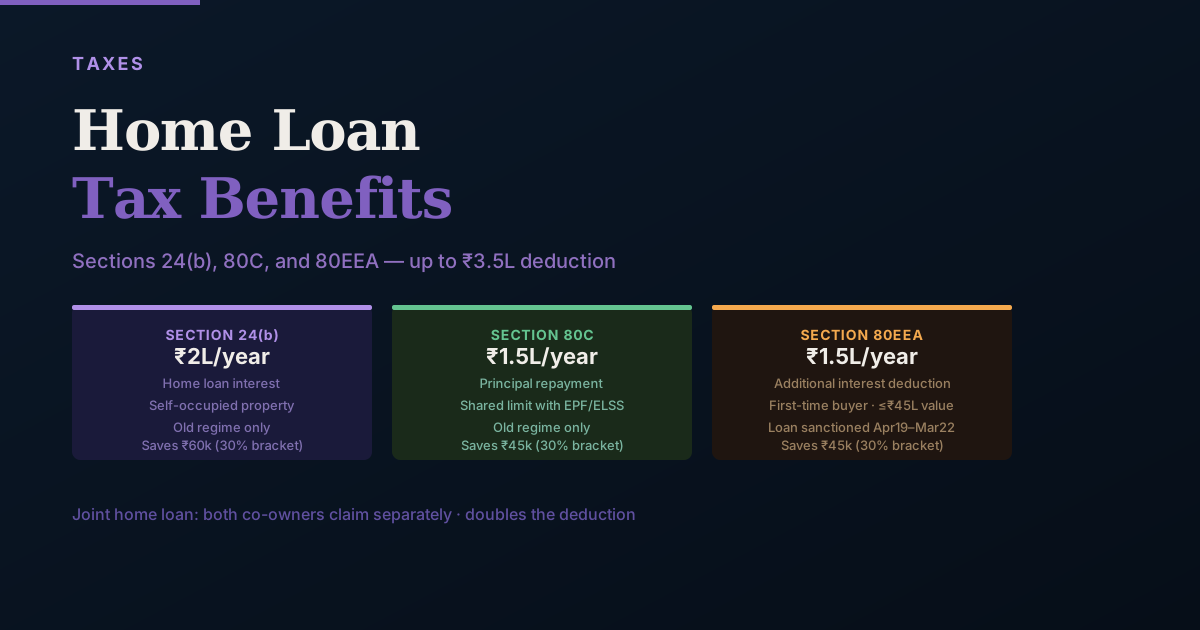
A home loan is one of the few personal finance decisions that comes with significant built-in tax benefits. Understanding and correctly claiming these deductions can meaningfully reduce your annual tax liability.
The Three Sections That Apply
Section 24(b): Deduction on home loan interest Section 80C: Deduction on principal repayment Section 80EEA: Additional interest deduction for eligible first-time buyers (for loans sanctioned before March 2022)
A note on section numbers. The Income-tax Act, 2025 replaced the 1961 Act from 1 April 2026, so for FY 2026-27 (AY 2027-28) the interest deduction technically sits in Section 22 and the principal deduction in Section 123 read with Schedule XV. Nothing about the money changed — the ₹2 lakh and ₹1.5 lakh ceilings and the old-regime-only restriction all carry across unchanged. Lenders, employers and tax software still print "24(b)" and "80C" on their certificates, so this guide uses those names throughout.
Section 24(b) — Interest Deduction
Self-occupied property (you live there):
- Deduction available on interest paid up to ₹2 lakh per year
- Available only under the old tax regime
- If the property is still under construction, you can claim the interest paid during construction (pre-possession interest) in five equal instalments starting the year of possession
Let-out property (rented out):
- Entire interest paid is deductible — no ₹2 lakh cap
- Net loss from house property (interest paid minus rental income received) can be set off against other income up to ₹2 lakh per year
- Remaining loss carried forward for 8 years
Key point: Interest deduction under 24(b) applies to the interest component of your EMI only — not the principal repayment portion.
Section 80C — Principal Repayment
The principal repayment portion of your EMI qualifies for deduction under Section 80C, subject to the overall ₹1.5 lakh Section 80C limit.
This limit is shared with all other 80C investments: EPF, PPF, ELSS, life insurance premium, children's tuition fees, NSC, etc.
Practical implication: If your EPF contribution + insurance premium already use up ₹1.5 lakh, your home loan principal repayment may not yield additional tax benefit under 80C even though it technically qualifies.
Also qualifies under 80C:
- Stamp duty and registration charges paid in the year of purchase (one-time, in the year of property registration)
Restriction: The property cannot be sold within 5 years of possession. If sold before 5 years, deductions claimed under 80C are reversed and added back to income in the year of sale.
Section 80EEA — Additional Interest Deduction
For loans sanctioned between April 1, 2019 and March 31, 2022:
- Additional ₹1.5 lakh deduction on home loan interest (over and above 24(b))
- Conditions: stamp duty value of property ≤ ₹45 lakh, no other residential property at time of loan sanction
- For qualifying borrowers, combined benefit: ₹2L (24(b)) + ₹1.5L (80EEA) = ₹3.5 lakh annual interest deduction
The sanction window closed on 31 March 2022 and has not been reopened in any Budget since. If you are borrowing today, treat this section as history — it only matters if you are still servicing a loan sanctioned inside that window.
How Much Can You Save?
For a borrower in the 30% tax bracket with a home loan:
| Deduction | Amount | Annual Tax Saved (30% bracket) |
|---|---|---|
| Section 24(b) | ₹2,00,000 | ₹60,000 |
| Section 80C (principal) | ₹1,50,000 | ₹45,000 |
| Section 80EEA (if eligible) | ₹1,50,000 | ₹45,000 |
| Maximum combined | ₹5,00,000 | ₹1,50,000 |
These numbers assume full utilisation of all limits, eligibility for 80EEA, and 30% tax rate with 4% cess.
Joint Home Loan: Both Borrowers Can Claim
If a home loan is taken jointly (husband and wife, or co-borrowers), each borrower can claim deductions separately on their share of interest and principal.
Conditions:
- Both must be co-owners of the property
- Each must be a co-borrower on the loan
- Deductions are claimed in proportion to ownership share (typically 50-50)
This effectively doubles the tax saving for a couple: each claims ₹2 lakh under 24(b) = ₹4 lakh total interest deduction annually.
New vs Old Tax Regime
This is the most important consideration:
| Benefit | Old Tax Regime | New Tax Regime |
|---|---|---|
| 24(b) on self-occupied | ✅ ₹2L | ❌ Not available |
| 80C on principal | ✅ ₹1.5L | ❌ Not available |
| 80EEA | ✅ ₹1.5L | ❌ Not available |
| 24(b) on let-out property | ✅ No cap | ✅ Available |
For a significant home loan, the old regime often provides substantially lower tax due to these deductions. Calculate both regimes with your actual numbers before deciding which to use each year.
Pre-Construction Period Interest: Section 24(b) Deferral
If you bought an under-construction property, you start paying EMIs (or at least interest) before you get possession. The Income Tax Act allows you to claim this pre-possession interest in five equal instalments, starting from the year you get possession.
How it works:
You take a home loan in FY 2024-25, possession in FY 2026-27. Total interest paid from FY 2024-25 to FY 2026-27 (before possession): ₹3,60,000.
From FY 2026-27 onwards, you can claim ₹72,000 per year (₹3,60,000 ÷ 5) as additional deduction under Section 24(b), over and above the ₹2 lakh annual cap on current year's interest.
Note that the ₹2 lakh cap applies to both the current year's interest AND the pre-construction instalment combined for a self-occupied property. So if your current year's interest is ₹1,80,000 and the pre-construction instalment is ₹72,000, total = ₹2,52,000, but you can only claim ₹2,00,000 under the cap.
This nuance is often missed. The ₹2 lakh ceiling is the absolute maximum regardless of how the interest is split between current-year and pre-construction.
The 5-Year Lock-In on Section 80C Principal Deduction
The home loan principal repayment deduction under 80C comes with a critical condition: you cannot sell or transfer the property within 5 years from the year in which you took possession.
If you sell before 5 years: All Section 80C deductions claimed for principal repayment in previous years are reversed. The reversed amount is added back to your income in the year of sale and taxed accordingly.
Example: You claimed ₹80,000 principal repayment under 80C each year for 3 years (total ₹2,40,000). You sell the property in year 4. In that year, ₹2,40,000 is added back to your taxable income.
This is a significant trap for people who buy a starter home intending to upgrade within a few years. Factor in this potential reversal when calculating the real benefit of the 80C deduction.
Worked Example: Home Loan Tax Saving Over a Year
Profile: Arjun, 35 years old, ₹20 lakh gross salary, old tax regime, self-occupied flat in Hyderabad. Figures below use the FY 2026-27 (AY 2027-28) position — Budget 2026 left the old-regime slabs and its ₹50,000 standard deduction exactly where they were.
Home loan details:
- Outstanding loan: ₹50 lakh
- Annual EMI: ~₹5.4 lakh (₹45,000/month at 9%)
- Year 3 of loan: Principal portion per year ≈ ₹90,000; Interest portion ≈ ₹4,50,000
Deductions:
- Section 24(b) interest: ₹2,00,000 (capped, actual interest is ₹4.5L)
- Section 80C principal: ₹90,000 (part of overall 80C; total 80C including EPF, ELSS = ₹1,50,000)
- No 80EEA (loan sanctioned after March 2022)
Tax computation (simplified, old regime):
Gross salary: ₹20,00,000 Less standard deduction: ₹50,000 Less HRA (assume ₹0, owns home): ₹0 Less 24(b) interest: ₹2,00,000 Less 80C (incl. EPF + principal): ₹1,50,000 Less 80D (health insurance): ₹25,000 Taxable income: the standard deduction and the 24(b) interest come off first — ₹20L − ₹50K − ₹2L = ₹17.5L gross total income — and the Chapter VI-A deductions (₹1.5L under 80C + ₹25K under 80D) come off that: ₹15,75,000 taxable income.
Tax on ₹15,75,000 under old regime:
- ₹0–2.5L: Nil
- ₹2.5–5L: ₹12,500
- ₹5–10L: ₹1,00,000 (20% of ₹5L)
- ₹10–15.75L: ₹1,72,500 (30% of ₹5.75L)
- Total: ₹2,85,000 + 4% cess = ₹2,96,400
Without home loan deductions: strip out the two deductions the loan actually creates — the ₹2,00,000 of 24(b) interest and the ₹90,000 of principal sitting inside his 80C. (The other ₹60,000 of his 80C is EPF and ELSS he would have had anyway, so it stays.) Taxable income becomes ₹15,75,000 + ₹2,00,000 + ₹90,000 = ₹18,65,000.
Tax on ₹18,65,000 under old regime:
- ₹0–2.5L: Nil
- ₹2.5–5L: ₹12,500
- ₹5–10L: ₹1,00,000
- ₹10–18.65L: ₹2,59,500 (30% of ₹8.65L)
- Total: ₹3,72,000 + 4% cess = ₹3,86,880
Annual saving from home loan deductions alone: ₹3,86,880 − ₹2,96,400 = ₹90,480 per year.
The shortcut check: all ₹2,90,000 of home-loan deductions sit in his 30% slab, so ₹2,90,000 × 30% × 1.04 = ₹90,480. Note this is the saving from the loan's ₹2.9 lakh of deductions — not from the full ₹1.5 lakh 80C, most of which he would have claimed regardless.
Under-Construction Property: When Does Possession Matter?
Possession marks two key transition points:
- Start of regular 24(b) deduction: You can only claim the current-year 24(b) deduction from the year of possession onwards
- Pre-construction interest deferral begins: The accumulated pre-possession interest starts being deducted in 5 equal instalments from the year of possession
What if possession is delayed? If your developer delays possession:
- Pre-construction interest continues accumulating
- You cannot claim current-year 24(b) deduction until possession is received
- The 5-instalment deferral clock starts from the actual possession date, not the originally planned date
For delayed projects spanning many years, the pre-construction accumulated interest can become very large — and the ₹2 lakh annual cap means most of it may never be fully deductible (for self-occupied property). This is another financial cost of project delays beyond the obvious.
Let-Out Property: Calculating Taxable Income from House Property
If your property is rented out:
Gross Annual Value (GAV): Higher of actual rent received or expected market rent Less: Municipal taxes paid: Gives Net Annual Value (NAV) Less: 30% standard deduction (Section 24(a)) on NAV: No documentation required, flat allowance for repairs/maintenance Less: Home loan interest (Section 24(b)): No cap for let-out property
Example:
- Annual rent received: ₹3,00,000
- Municipal taxes paid: ₹15,000
- Home loan interest: ₹3,60,000
NAV = ₹3,00,000 − ₹15,000 = ₹2,85,000 30% standard deduction = ₹85,500 Interest deduction = ₹3,60,000 Income from House Property = ₹2,85,000 − ₹85,500 − ₹3,60,000 = −₹1,60,500 (a loss)
This ₹1,60,500 loss can be set off against other income (salary, business, etc.) up to ₹2 lakh per year. Any remaining loss carries forward for 8 years.
What Documentation You Need Each Year
For claiming home loan deductions in your ITR:
- Home loan annual statement from your lender (bank/NBFC): Shows principal repaid and interest paid during the financial year. Request this in March/April each year.
- Provisional interest certificate: If the annual statement isn't available, most lenders issue a provisional certificate in January for investment declaration purposes.
- Possession letter or completion certificate: Needed to establish that pre-construction period has ended.
- Pre-construction interest calculation: If claiming the 5-instalment deduction, maintain a record of interest paid each year before possession.
For joint home loans, each co-borrower needs the above documents and should ideally have the ownership percentage confirmed in the sale deed.
Stamp Duty and Registration: The One-Time 80C Benefit
In the year you purchase and register a property, stamp duty and registration charges paid qualify under Section 80C, within the ₹1.5 lakh ceiling.
Example: You buy a flat in Bengaluru worth ₹60 lakh. Stamp duty at 5.6% = ₹3,36,000; registration at 1% = ₹60,000. Total: ₹3,96,000.
Of this ₹3.96 lakh, you can claim a maximum of ₹1.5 lakh under 80C (or the remaining headroom after EPF and other investments). If EPF already fills ₹90,000 of 80C, the stamp duty can fill the remaining ₹60,000.
This is a one-time benefit in the year of purchase — not recurring. New regime taxpayers cannot claim this.
Top-Up Home Loans and Tax Deductibility
Tax deductibility of top-up loan interest:
- If used for home improvement or renovation: Section 24(b) interest is deductible within the ₹2L cap for self-occupied property
- If used for other purposes (business, personal): NOT deductible under 24(b)
Keep renovation receipts, contractor invoices, and payment records to establish that a top-up loan was used for the property.
Principal repayment on top-up loans does not qualify under Section 80C unless it is a regular home loan instalment for acquisition.
The Rent vs Own Decision: A Tax Lens
For salaried individuals comparing renting with owning:
Renting (old regime):
- HRA exemption: potentially ₹1–3 lakh/year depending on rent and city
Owning with a loan (old regime):
- Section 24(b) deduction: ₹2 lakh/year on interest
- 80C principal: up to ₹1.5 lakh (shared with other 80C instruments)
Neither option is categorically better for tax — the math depends on your specific HRA received, rent paid, loan size, and interest rate. In high-rent metros, the HRA exemption can rival or exceed the home loan deductions, especially in the early loan years when the principal component of EMI is small.
Beyond tax, the rent-vs-buy decision involves down payment opportunity cost, maintenance expenses, property market outlook, and career mobility — factors the tax savings don't capture.
Interest Deduction for Second Property
If you own two residential properties, only one can be treated as self-occupied (you choose which). The other is treated as "deemed let-out" — even if it's vacant, it's treated as if it's rented at market rent.
Tax implications for the second (deemed let-out) property:
- Compute Gross Annual Value (GAV): The expected market rent for the property
- Less: Municipal taxes paid
- Less: 30% standard deduction on NAV
- Less: Actual home loan interest paid (no ceiling)
If the interest exceeds the net rental value, you have a loss from house property on the second property — which can be set off against other income up to ₹2 lakh per year, with the rest carried forward 8 years.
Common scenario: An investor who owns a second flat worth ₹80 lakh with a ₹60 lakh loan at 9% (annual interest ~₹5.4 lakh). Expected market rent is ₹25,000/month = ₹3 lakh/year. After 30% deduction on NAV = ₹2.1L income; less ₹5.4L interest = net loss of ₹3.3L. Only ₹2L of this loss can be set off against salary; the remaining ₹1.3L carries forward.
This calculation makes the old regime very compelling for property investors with large home loans on rental or deemed let-out properties. The new regime allows this interest deduction for let-out property but not for self-occupied property.
Run your own numbers with a CA before committing to a regime, especially with a large loan or multiple properties in the mix.
Frequently Asked Questions
Sources and references
- Income Tax Department, Government of India
- Income Tax India — Acts, rules and the Income-tax Act, 2025 (in force from 1 April 2026)
- Reserve Bank of India (RBI)
Rules, rates, and thresholds in India change over time. Always confirm the current position with the official source above before acting on it.