Tax Planning vs Tax Saving: Why Most People Do the Wrong One
Most Indians scramble to save tax in January and February. Tax planning is different: it runs all year and gives better outcomes with far less stress.
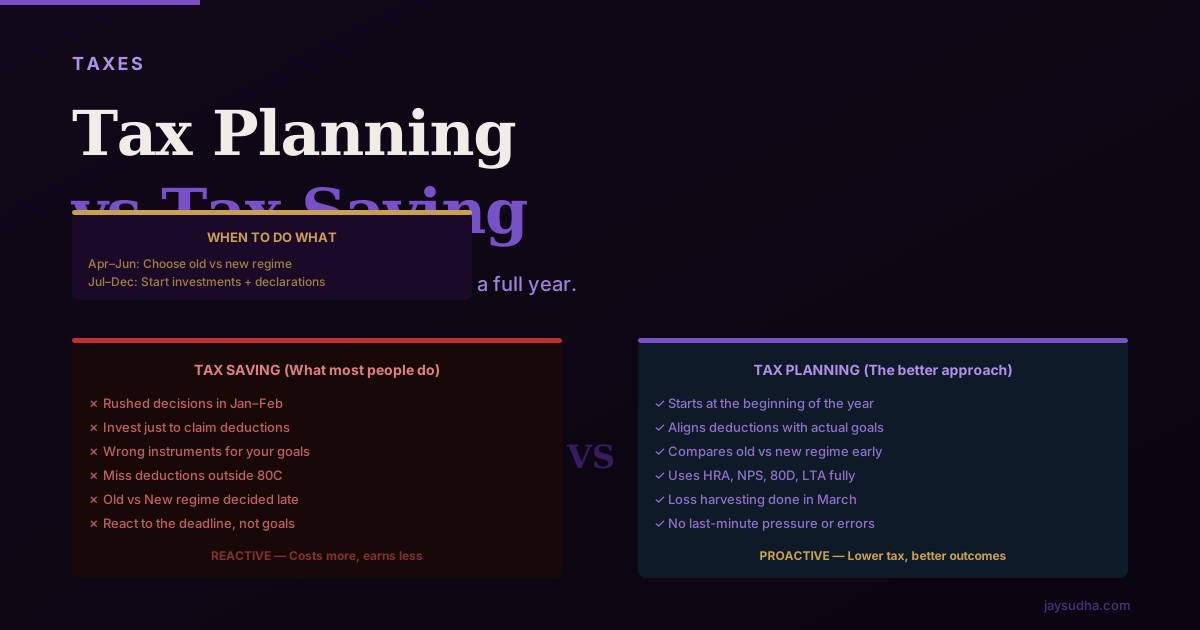
Direct answer: Tax saving is a once-a-year scramble to use up Section 80C before March 31; tax planning is the year-round work of picking your regime early, timing income and advance tax, and choosing investments on their own merit rather than for the deduction alone. The deduction ends up the same size either way — the difference shows up in the quality of what you bought and how much stress it cost you.
Every January and February, India's financial services industry runs at full capacity. Insurance agents call. Bank relationship managers push ELSS funds. Accountants field a surge of questions. Most of this activity is people scrambling to deploy their Section 80C limit before the financial year ends.
This is tax saving. It is not tax planning.
Tax saving is reactive — deciding where to put ₹1.5 lakh at the last moment to claim the deduction. Tax planning is proactive — looking at your income, deductions, and obligations for the full year and making decisions that minimize your tax liability optimally.
The difference in outcome is real.
What tax saving looks like in practice
A typical 80C scramble looks like this:
- January arrives and the taxpayer realizes they've used only ₹40,000 of the ₹1.5 lakh limit
- They need to deploy ₹1.1 lakh before March 31 to maximize the deduction
- Under time pressure, they buy whatever their insurance agent recommends (often a ULIP or traditional plan with high charges) or the nearest ELSS fund without comparing options
- They feel relieved the problem is solved
Several things went wrong here. The investment was chosen under deadline pressure, not on merit. The best ELSS options were not compared. The person may have bought insurance they don't need or that doesn't fit their profile. And they may have bought all of this without checking whether the old tax regime even makes sense for them this year.
Tax saving fills the deduction slot. Tax planning fills it well.
The old regime versus new regime decision
This is the most consequential tax decision for most salaried Indians, and it's one that should be made at the start of the financial year — not when the employer asks for investment declarations in January.
New tax regime: Lower slab rates, but most deductions are not available. No 80C, no 80D (health insurance premium), no HRA exemption, no home loan interest deduction. The standard deduction of ₹75,000 applies.
Old tax regime: Higher base rates, but all major deductions apply. 80C up to ₹1.5 lakh, HRA exemption, 80D up to ₹25,000 (₹50,000 for senior citizen parents), home loan interest deduction under 24(b) up to ₹2 lakh for self-occupied property.
The breakeven point moved a long way when the new regime's slabs were widened, and it has stayed there for FY 2026-27. On a ₹15 lakh salary, deductions now have to clear roughly ₹5.44 lakh — over and above the old regime's ₹50,000 standard deduction — before the old regime saves more tax despite its higher base rates. Below that, the new regime wins. Older guides still quote a ₹3.75 lakh breakeven at this income; that figure belongs to a slab structure that no longer exists.
The calculation at the start of the year:
Take your estimated annual income. List deductions you will actually use:
- EPF employee contribution (already deducted, counts toward 80C)
- Home loan principal repayment (counts toward 80C)
- Life insurance premiums you're already paying
- HRA you actually claim
- Health insurance premiums
- Home loan interest
Add them up. On a ₹15 lakh salary, if the total is well above ₹5.44 lakh, stay on the old regime. If it's well below — or if you don't have a home loan and rent in a non-HRA city — the new regime is likely better. Run the same comparison at your own income rather than borrowing this one: the breakeven rises as income rises.
This decision, made in April with full information, produces a better outcome than making it in January under deadline pressure.
What year-round tax planning actually involves
Income timing and structuring
If you're self-employed or have variable income, the timing of when income arrives matters. Income received in one financial year versus the next affects the year's total and your applicable slab rate. This is not tax evasion — it's legitimate scheduling of invoices or payments within the same overall transaction.
Advance tax compliance
Salaried employees with significant non-salary income (capital gains, interest income, rental income, freelance income) are required to pay advance tax in four installments: 15% by June 15, 45% by September 15, 75% by December 15, and 100% by March 15.
Missing installments triggers interest under Sections 234B and 234C. Planning your advance tax at the start of the year based on expected income avoids this entirely. The calculation is straightforward once you have your income estimate.
Capital gains planning
Long-term capital gains (LTCG) on equity above ₹1.25 lakh per year are taxed at 12.5% (set by Budget 2024, confirmed unchanged in Budget 2026). Short-term capital gains on equity are taxed at 20%, also unchanged. These rates have now held steady across two budgets, but "unchanged this year" is not a permanent guarantee — recheck before large redemptions in future years.
Two planning applications: first, if you have unrealized LTCG approaching ₹1.25 lakh, consider whether booking some gains and reinvesting makes sense — you use the exemption limit without changing your investment position materially. Second, if you have capital losses, they can offset gains — but the timing of when you realize losses versus gains in the same year matters.
Salary structuring (for those who can influence it)
For employees with flexibility in how their CTC is structured, components like meal allowance (₹26,400/year), leave travel allowance (LTA), telephone and internet reimbursements, and NPS employer contribution (deductible under 80CCD(2) up to 14% of basic plus DA where your tax is computed under the new regime, or 10% under the old regime for a non-government employer — one of the very few levers that still works in the new regime) can reduce taxable income legitimately.
This is worth raising with HR — most companies have structured salary plans available, but they don't automatically enroll employees.
ELSS timing within the year
If you're using the old regime and ELSS for 80C, consider a monthly SIP into ELSS throughout the year rather than a lump sum in February. You avoid the end-of-year scramble, you benefit from rupee cost averaging, and you don't need to make a large one-time decision under pressure.
The investment outcome is also typically better — a ₹1.5 lakh lump sum in February versus twelve ₹12,500 monthly investments through the year usually produces similar terminal value, but the SIP approach removes timing risk.
The planning calendar
April–May: Decide old versus new regime. Submit investment declaration to employer if required. Set up monthly ELSS SIP if using old regime. Confirm advance tax obligations if you have non-salary income.
June: First advance tax installment if applicable.
July–August: File the previous year's ITR — the non-audit deadline is 31 July for ITR-1 and ITR-2, and 31 August for ITR-3 and ITR-4. Review whether your year-to-date income is tracking above or below your estimate. Adjust advance tax plan if needed.
September: Second advance tax installment.
October–November: Review whether you've used your deductions as planned. If 80C is underfunded at this point, there's still time to course-correct without a January scramble. Review if any capital gains booking makes sense before year-end.
December: Third advance tax installment. Final year-end review.
January–February: Invest remaining 80C amount if any — but this should be the cleanup, not the main event.
March: File advance tax if applicable. Make final decisions on tax-saving investments.
Limitations and What Can Change
This article's numbers — the ₹1.5 lakh 80C cap, the regime breakeven math, the advance tax instalment dates — reflect the rules in force for FY 2026-27 (assessment year 2027-28). Budget 2026 moved none of them: the slabs, the ₹75,000 new-regime standard deduction, the Section 87A rebate and the 80C ceiling all carried over from the previous year unchanged. Three things can still move under you:
- The Finance Act changes annually. Budgets have altered slab rates, rebate thresholds, and deduction caps before and will again. Re-run your regime comparison every April on the current year's figures rather than reusing last year's conclusion.
- The Income-tax Act, 1961 has already been replaced. The Income-tax Act, 2025 came into force on 1 April 2026, renaming "Assessment Year" to "Tax Year" and renumbering sections (80C becomes Section 123, for instance) as part of a 819-to-536-section consolidation. It does not change the deduction amounts described here, and it has no bearing on an AY 2026-27 return covering FY 2025-26 — but the section numbers in this article will need relabelling once Tax Year 2026-27 (the income you are earning right now) becomes the relevant filing period, in mid-2027.
- Everything here is general information, not personalised advice. Your actual regime breakeven, advance tax liability, and ESOP or capital-gains timing depend on your full financial picture. For anything beyond routine 80C/80D planning, confirm the specifics with a CA before acting.
What tax planning is not
Tax planning is not tax evasion. It is not claiming deductions for expenses that didn't happen. It is not hiding income. All of that is illegal.
Tax planning is using deductions and exemptions that the law explicitly provides, in the way they were designed to be used, with advance thought rather than last-minute reaction.
The government put the 80C deduction in the law. Using it fully is not aggressive — it's the intent. The question is only whether you're using it well (appropriate instruments, planned early) or poorly (mismatched products, chosen under pressure).
Good tax planning leaves you with the same tax outcome as last-minute tax saving — but with better investments, less stress, and no insurance you didn't actually need.
How Last-Minute Tax Saving Costs More Than Just Tax
The January-February scramble has a financial cost beyond the immediate tax liability. When you invest in ELSS in February:
-
No rupee cost averaging: A lump sum in February misses eleven months of SIP averaging. In a falling market year, this means you buy at higher average prices than if you had spread the investment.
-
Insurance trap: Under time pressure, many taxpayers buy a traditional endowment or ULIP plan pushed by their relationship manager or insurance agent. These products have 15–25% first-year charges (mortality cost + agent commission) that quietly erode returns. The typical endowment plan returns 4–5% IRR — worse than a savings account over the lock-in period, once internal charges are factored in.
-
Wrong product choice: If you're already in the new regime, buying ELSS for 80C provides zero tax benefit — but you've locked the money for 3 years. This error happens when people invest on autopilot without rechecking their regime selection.
-
Over-investment in 80C: Many employees already fill their ₹1.5 lakh 80C through EPF contributions (12% of basic) without realising it. A ₹50,000/month basic salary generates ₹6,000/month EPF = ₹72,000/year automatically. Adding ₹1.5 lakh of ELSS on top doesn't add more 80C benefit — only ₹78,000 of additional 80C room exists. Every rupee over ₹78,000 in additional ELSS is excess investment for which no extra deduction exists.
A Better Investment Declaration Process
Instead of the February scramble, here is what year-round planning looks like in practice:
April:
- Calculate your likely income for the year (salary, projected bonuses, rental income estimate)
- Run old regime vs new regime comparison using estimated deductions
- Submit declaration to employer at start of year
- Start monthly ELSS SIP if using old regime (₹12,500/month = ₹1.5L by March)
- Review employer NPS contribution — request HR to set up if not already active
May–June:
- Confirm health insurance renewals; obtain premium receipt for 80D
- If advance tax applicable (non-salary income > ₹10,000 annual liability), pay first instalment by June 15
- Ensure home loan statement is expected from lender in January/February
September:
- Pay advance tax second instalment by September 15 (cumulative 45%)
- Review capital gains year-to-date — consider whether loss harvesting or gain booking makes sense
November–December:
- Submit investment proofs to employer (most employers allow November–January)
- Final SIP review — are you on track for ₹1.5L 80C?
- Pay advance tax third instalment by December 15 (cumulative 75%)
January–February:
- Final 80C top-up if needed (should be small, not the main event)
- Verify Form 26AS — check all TDS credits are appearing
- Renew any expiring insurance
March:
- Final advance tax instalment by March 15 (100%)
- Check if annual LTCG is approaching ₹1.25 lakh — consider whether tax harvesting makes sense
- PPF deposit by March 31 if doing annual contribution
The Specific People Who Benefit Most from Tax Planning vs Tax Saving
High earners (₹30L+ salary): At 30% marginal rate, every ₹1 lakh of deduction saves ₹30,000. The absolute value of planning is highest here. NPS employer contribution, full 80C, 80D with family plan, home loan interest — these add up to ₹3–4 lakh in deductions, saving ₹90,000–₹1,20,000 annually.
Freelancers and consultants: Unlike salaried employees, they have no automatic TDS system managing their advance tax. Missing quarterly advance tax (June, September, December, March) incurs 234B/234C interest. Planning their income quarterly and paying advance tax is essential — the interest cost for missing all instalments on a ₹5 lakh annual tax liability is approximately ₹20,000+. This is also a working-capital problem, not just a tax one: advance tax is due on income you may not have collected yet if clients pay late, so freelancers with lumpy receivables should set aside the estimated instalment the day an invoice is raised, not the day it's paid.
Dual-income households: Two working spouses can each use their full 80C limit (₹1.5L each = ₹3L total), claim separate 80D deductions, and potentially split home loan interest and principal claims. A dual-income couple in the 30% bracket with these deductions structured correctly saves ₹1.5–2 lakh annually compared to the same total household income in a single name.
Employees with ESOPs: ESOP taxation in India is complex — perquisite tax arises at exercise (added to salary, taxed at slab rate), and capital gains tax arises at sale. Planning the exercise date relative to holding period (short-term vs long-term) and income level in that year matters significantly. ESOPs in high-income years can create unexpectedly large tax bills without planning.
What Deductions Actually Require Year-Round Action
Some deductions require decisions before March 31 with irreversible consequences. Others can be claimed in ITR even without advance action:
| Deduction | Year-round action required? | Can be claimed in ITR even without telling employer? |
|---|---|---|
| 80C (ELSS, PPF) | Yes — investment must happen before March 31 | Yes |
| HRA exemption | No — just keep rent receipts | Yes |
| 80D (health insurance) | Yes — premium must be paid in that FY | Yes |
| 80CCD(1B) NPS | Yes — contribution by March 31 | Yes |
| 24(b) home loan interest | No — just get annual statement from lender | Yes |
| 80CCD(2) employer NPS | Yes — requires employer to contribute | Only if employer contributed |
| Advance tax payment | Yes — quarterly deadlines are firm | N/A — penalty if missed |
The items where employer action is required (like 80CCD(2)) need to be arranged at the start of the year. The investment-based deductions (80C, 80CCD(1B)) need to be invested by March 31. Documentation-based deductions (HRA, 80D, 24(b)) can be claimed in ITR if you have the proofs.
This is why the planning calendar starts in April, not January.
Putting this into practice
A real example
Two people each save ₹46,800 in tax through 80C. One puts ₹1.5 lakh a year into ELSS (three-year lock, ~11% long-term); the other into an endowment plan (~4.5%, fifteen-year lock). Same tax saved — but over fifteen years that stream compounds to roughly ₹23 lakh in ELSS versus about ₹9.7 lakh in the endowment. Tax saving without planning is the more expensive choice.
A common mistake
Optimising the deduction while ignoring the product's return, liquidity, and lock-in.
When this doesn't apply
If you're firmly on the new regime, the game shifts from "chase deductions" to "keep it simple." Don't contort your finances for deductions you can no longer claim — compare regimes first, then plan.
Jay's operating note: Tax saving asks "how do I pay less this year?" Tax planning asks "how do I keep more over ten?" They're different questions, and the products sold in February answer the wrong one.
Your decision checklist
- Old vs new regime compared on your actual numbers
- Only deductions you'll genuinely use
- Product quality judged independently of the tax break
- Lock-in and liquidity acceptable for your goals
- Planned in April, not finalised in March
- Revisit every financial year as rules and your income change
Review rhythm
- Quarterly: check whether advance tax is due on any non-salary income, and confirm planned investments are actually going in rather than being deferred.
- Annually: re-run old vs new regime on the year's numbers, judge each product on return and lock-in (not the tax break), and set next year's plan in April.
Frequently Asked Questions
Sources and references
- Income Tax Department — Section 80C Deductions
- AMFI — Categorization of Mutual Fund Schemes (ELSS Lock-in)
- Income Tax Department — Objective and Scope of the New Income-tax Act, 2025
- Income Tax Department — Deductions (Section 80CCD(2) employer NPS limits)
Rules, rates, and thresholds in India change over time. Always confirm the current position with the official source above before acting on it.