The Financial Documents Every Indian Household Should Keep — and Where to Keep Them
A disorganized document setup delays ITR filings, loses deductions and complicates loans and emergencies. What Indian households keep, why and how long.
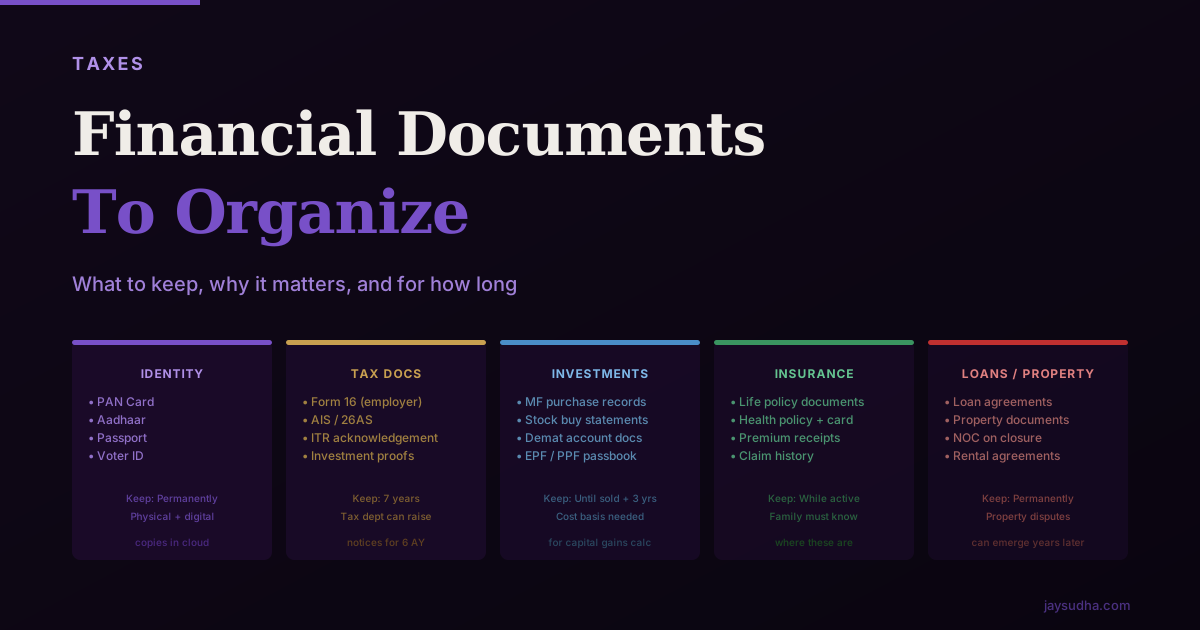
Financial documents sit at the intersection of two universal behaviors: everyone knows they should organize them, and very few people actually do.
The cost of disorganization accumulates quietly. Missing Form 16 when the employer has changed. Not knowing which ITR to reference during a loan application. Scrambling to find a property document during a registration. Being unable to prove cost basis when selling old mutual fund units.
None of these are catastrophic individually. Together, they create a low-level friction that costs time, sometimes money, and occasionally — during a family medical emergency or a legal complication — causes serious problems.
Here is what to keep, organized by category.
Category 1: Identity and PAN documents
PAN card (Permanent Account Number) Your PAN is required for virtually every significant financial transaction in India: opening bank accounts, investing, filing taxes, buying property, opening demat accounts. Keep the original in a safe place and store a scanned color copy in a secure digital location.
If your PAN card is old (laminated, small format), consider applying for a PAN card reprint via the NSDL or UTIITSL portal — the newer versions are more widely accepted.
Aadhaar The Aadhaar number is increasingly linked to tax filings, banking, and financial transactions. Keep a physical copy of your Aadhaar card. For digital uses, note the difference between your actual Aadhaar card and a Virtual ID (VID) — the VID is a temporary, revocable 16-digit number that can be used instead of your Aadhaar number for most purposes, protecting the underlying number from exposure.
Passport Relevant for foreign remittances, NRI taxation, and some investment transactions. Keep it accessible and note the expiry date in your calendar a year before it lapses.
Category 2: Income tax documents
ITR acknowledgments (ITR-V) Keep every ITR-V (the acknowledgment document you receive after filing) permanently. This is your legal record of having filed. If there is ever a question about a particular year's return, the ITR-V is your primary reference.
Form 16 (Parts A and B) Issued by your employer by June 15 each year. Part A confirms TDS deducted; Part B shows the detailed salary breakdown including allowances, perquisites, and deductions claimed. Keep Form 16 for at least seven years — you may need it during scrutiny or loan applications.
If you change employers, collect Form 16 from each employer. Even if each employer deducted TDS correctly, you'll need both documents when filing because your total income includes both.
Form 16A The TDS certificate for income other than salary — FD interest, rent, professional fees. Banks issue Form 16A for TDS deducted on FD interest. Keep these — they help reconcile TDS credits in your Form 26AS.
Form 26AS and Annual Information Statement (AIS) Download your Form 26AS and AIS from the income tax portal (incometax.gov.in) each year before filing. These aggregate all TDS credits, high-value transactions, and information that the government has about your income. Discrepancies between these and your return are a common cause of notices.
Keep downloaded copies of Form 26AS and AIS for each year you file.
Tax computation sheets and challans If you calculate taxes manually or use a CA, keep the computation sheet. If you paid advance tax or self-assessment tax, keep the Challan 280 receipt — this is proof of payment and is needed to claim the credit while filing.
Capital gains statements For mutual funds, the consolidated capital gains statement from CAMS or KFintech covers all transactions across fund houses. Download it for each financial year before filing. For stocks, your broker issues capital gains reports — download these before each filing.
Category 3: Investment records
Mutual fund account statements Consolidated Account Statements (CAS) from CAMS or KFintech provide a complete picture of your MF portfolio. Download an annual statement and keep it. These are also important for tracking cost basis — critical when you eventually redeem units and need to calculate LTCG.
Demat account statements Annual holding statements from your depository participant (CDSL or NSDL, accessed via your broker). Keep these as a record of what you held at the end of each year.
Physical gold purchase receipts If you have physical gold, keep the purchase receipts. When sold, these establish the original cost for capital gains calculation. Without them, proving cost basis is difficult.
Sovereign Gold Bond (SGB) certificates Keep digital or printed certificates for all SGBs you hold. Note the maturity date — SGBs have an 8-year term but can be redeemed after 5 years at specified windows.
NPS statement Annual transaction statement from your NPS trust. Keep these — NPS contributions under 80CCD(1B) up to ₹50,000 are a deduction, and you'll need records when you eventually draw down the corpus.
Category 4: Property documents
Property documents are the single category where loss creates the most serious legal and financial complications. These should be stored with extreme care — ideally in both physical and digital form.
Original sale deed (conveyance deed) This proves ownership. It is the foundational document. There is no substitute for the original. Store it in a fireproof safe or bank locker. A registered sale deed can be retrieved from the sub-registrar's office but the process is time-consuming and not guaranteed.
Index 2 (stamp duty paid receipt) Evidence that stamp duty was paid during property registration. Required for loan applications and future sale.
Property tax receipts Annual municipal property tax receipts. Keep the most recent five years at minimum. These establish continuous tax payment and are required during property sale.
Home loan sanction letter and statement of account The sanction letter sets out the original loan terms. The annual statement of account shows outstanding principal and interest paid — needed for 80C (principal repayment) and Section 24(b) (interest deduction) claims during ITR filing.
Society or RWA documents Membership certificates, share certificates (in cooperative housing societies), allotment letters, possession letters. These are distinct from the sale deed and may be required during property-related transactions.
Category 5: Insurance documents
Life insurance policy documents Keep the original policy bond for all active life insurance policies. This includes any nomination forms. In the event of a claim, the original document is required. If you have old policies from pre-digital era, confirm these are still active and correctly linked to your current contact details and nominee.
Health insurance documents Policy copy, member ID cards, and cumulative bonus records (no-claim bonus accumulated over years). During a claim, having prior year documents helps establish the bonus amount.
Vehicle insurance Current policy with registration certificate (RC book). Keep previous year's policy for reference if a claim arises after renewal.
The digital backup system
Physical documents can be destroyed in a fire, flood, or theft. A parallel digital system is essential.
A practical structure:
- Scan all critical documents at reasonable resolution (300 DPI is sufficient for most purposes)
- Store in a folder structure organized by category and year
- Keep in at least two locations — a cloud storage service and an external drive stored separately from your computer
For the cloud, use encrypted storage (most mainstream cloud providers offer this) or use a password manager to secure access.
Ensure at least one trusted family member knows where these digital backups are stored and how to access them. Documents that exist but cannot be found during an emergency are functionally unavailable.
The annual document review
Once a year — aligned with ITR filing season, April–June — spend 30 minutes:
- Collect Form 16 from employer
- Download Form 26AS and AIS
- Download capital gains statements from CAMS/KFintech and broker
- File any new insurance policies, bank account documents, investment confirmations received during the year
- Confirm that the previous year's ITR acknowledgment is stored
This ritual prevents the gradual document disorganization that makes financial administration unnecessarily complicated.
How Long to Keep Each Document Category
A precise retention guide for Indian households:
| Document | Minimum Retention | Why |
|---|---|---|
| ITR acknowledgment (ITR-V) | Permanent | Proof of compliance; no expiry on need |
| Form 16 (Parts A and B) | 7 years | Income tax scrutiny window is up to 6 years |
| Form 26AS / AIS downloads | 7 years | Reconciliation evidence if scrutiny notice arrives |
| Capital gains statements | 8 years from transaction | Capital loss carry-forward period; cost basis for old investments |
| Property sale deed | Permanent | Ownership proof; may be needed decades later |
| Challan 280 receipts (advance/self-assessment tax) | 7 years | Proof of payment if assessed |
| Bank account statements | 10 years | Income verification, high-value transaction documentation |
| Insurance policy bonds | Duration of policy + 3 years | Claim disputes |
| Investment account statements | Until all investments are redeemed + 8 years | Cost basis, capital gains calculation |
| Home loan statements | Duration of loan + 7 years | 24(b) claims and 80C principal claims |
The 6-year scrutiny window explained: Under Section 149, the Income Tax Department can issue a reassessment notice within 3 years of the relevant assessment year for most cases. For cases involving income exceeding ₹50 lakh that has escaped assessment, this extends to 10 years. Keeping documents for 7 years covers the standard 3-year window plus a buffer.
Organising for ITR Filing: The Document Checklist
When sitting down to file your ITR in June/July, these are the documents to have ready:
Income documents:
- Form 16 (Part A and B) from each employer
- Bank interest certificates or statements for all accounts (savings + FD)
- Dividend income statements from demat or directly from companies
- Capital gains statement from broker (equity transactions)
- Capital gains statement from CAMS/KFintech (mutual fund transactions)
- Rental income records (rent agreement, rental receipts received)
- Any freelance income: invoices issued + TDS certificates (Form 16A) from clients
Deduction documents (old regime):
- ELSS fund statement showing investment amounts
- PPF passbook showing annual contribution
- EPF statement showing employee contribution (usually visible on salary slip)
- Life insurance premium receipts
- Health insurance premium receipts (own + parents)
- Home loan annual statement (interest + principal split)
- NPS account statement showing contributions under 80CCD(1B)
- Rent receipts + landlord PAN (for HRA exemption if not given to employer)
- Children's school fee receipts
- Education loan interest certificate (for 80E)
Tax payment records:
- Challan 280 receipts for all advance tax payments made during the year
- Form 26AS downloaded (confirms all TDS credits)
- AIS downloaded (to check for any income you may have missed)
The Family Emergency Use Case: Why Document Organisation Matters Beyond Tax
A scenario most families don't plan for: a major illness or sudden death. In that situation, whoever takes over financial management needs to find:
- Active bank accounts and their approximate balances
- Active investments (demat account, mutual funds, FD, PPF)
- Active insurance policies (life, health, vehicle)
- Property documents and any home loan outstanding
- PAN and Aadhaar for the individual
- Existing ITR filings (for income verification, loan NOCs, etc.)
A household with organised, accessible documents allows a family member to take action within days. A household without this faces months of bureaucracy discovering what exists, contacting institutions, and reconstructing records.
The minimum family document brief should include:
- Names and account numbers of all active bank accounts
- Names and login details (or contact details) for all investment accounts
- Active insurance policy numbers and customer IDs
- Location of original property documents
- PAN numbers and Aadhaar of all family members
- Contact details of CA if any
This brief can be stored securely — in a sealed envelope with a trusted family member, or in a password-protected document whose access details are known to the right person.
NPS Statements and Why They Need Special Attention
NPS statements are often neglected because the account is not accessible until retirement. But NPS requires active documentation for two reasons:
-
80CCD(1B) claims: Contributions above the 80C limit (up to ₹50,000 under the old regime) need the NPS statement to show exactly what was contributed each year.
-
Nomination accuracy: NPS nominations must be verified periodically. The nomination details at NPS Trust determine who receives the corpus in case of the subscriber's death. Ensure the nomination is current and matches family status.
Annual NPS statements are available through the Central Recordkeeping Agency (CRA) registered for your account — Protean eGov Technologies (formerly NSDL) or KFin Technologies. Keep a downloaded copy each year.
The AIS Data That Surprises Most Filers
When first-time AIS reviewers open their Annual Information Statement, several entries regularly cause confusion:
High-value bank transactions: Any single credit or debit above ₹50,000 in cash (or ₹10 lakh in banking) may appear. If you made an FD deposit, transferred funds for property purchase, or received a one-time payment, it shows in AIS. These are informational — they don't automatically trigger tax — but they must be reconciled with your return.
Foreign remittances (LRS): If you sent money abroad for education, travel, or investments under Liberalised Remittance Scheme, it appears in AIS. The IT department doesn't tax remittances themselves, but it flags large amounts for verification that the source is legitimate taxed income.
Credit card high-value spends: If you spent more than ₹10 lakh annually via credit card, this transaction total may appear in AIS as a high-value transaction reported by your card issuer. No additional tax is triggered, but the department may query the income source.
Mutual fund purchases: AIS shows total amounts invested in mutual funds, not just redemptions. This is informational — the tax event is at redemption, not at purchase.
Seeing these entries for the first time is startling. The appropriate action is to verify that your income declaration supports the activity shown. If everything is from legitimate declared income, no additional action is required. If something appears incorrect, submit AIS feedback.
For a genuine discrepancy you cannot explain, get a CA to look at it before you respond to any notice.
Frequently Asked Questions
Sources and references
- Income Tax Department — Section 149 (Reassessment Time Limits)
- RBI — Master Direction on KYC (Record Retention)
- AMFI — Download Consolidated Account Statement (CAS)
Rules, rates, and thresholds in India change over time. Always confirm the current position with the official source above before acting on it.