How Your CIBIL Score Is Calculated — and What Actually Moves It
Your credit score is a formula with specific inputs. Knowing them tells you which levers to pull and which common money myths you can safely ignore.
Your CIBIL score is a three-digit number between 300 and 900 that lenders use to assess how reliably you've handled credit in the past. It influences whether you get approved for a loan, what interest rate you're offered, and even some landlord and employer background checks.
Like most scores, it feels opaque until you understand what goes into it. Once you do, it becomes a system you can manage — not game, but manage.
The four bureaus, and why CIBIL matters most
India has four licensed credit information companies: CIBIL (TransUnion CIBIL), Experian, Equifax, and CRIF High Mark. Each maintains its own score using its own algorithm, and each lender chooses which bureau's data to pull.
CIBIL has the largest market share and is most commonly checked by lenders, which is why "CIBIL score" has become synonymous with credit score in Indian usage. But your scores may differ across bureaus if different lenders report to different bureaus. It's worth checking all four annually.
How the CIBIL score is calculated
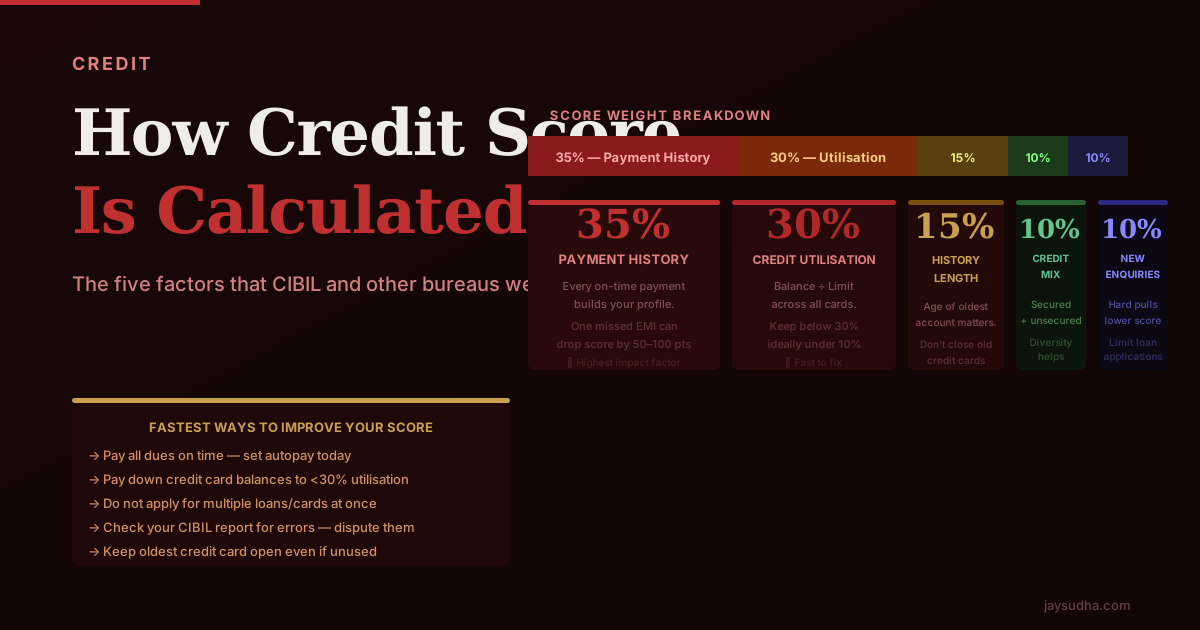
CIBIL doesn't publish its exact algorithm, but based on regulatory disclosures and industry knowledge, the major factors are:
Payment history (approximately 35% weight)
Whether you've paid your EMIs and credit card minimum dues on time. This is the single most influential factor.
A late payment stays on your report for several years. One or two late payments on an otherwise clean file cause a moderate hit. Multiple late payments or a default causes severe damage. Missing payments is the fastest way to damage a score; consistent on-time payments is the most reliable way to build one.
The definition of "late": any payment due date missed. Even a one-day delay is recorded as late. Setting up auto-pay for the minimum amount eliminates this risk entirely.
Credit utilization (approximately 30% weight)
The ratio of your current credit card balances to your total credit limits. A ₹20,000 balance on a card with a ₹1 lakh limit is 20% utilization.
The widely cited threshold is 30% — staying below this is recommended. In practice, lower is better for the score. At 10% or below, utilization contributes positively. Above 30%, it starts working against you. Above 50%, the impact is significant.
This factor is the fastest to change in either direction. Pay down balances this month and the score reflects it next billing cycle.
Counterintuitive but important: If your utilization is high because your credit limits are low relative to spending, requesting a credit limit increase (without increasing spending) mechanically improves this ratio. Most lenders allow this after 12–18 months of good payment history.
Credit history length (approximately 15% weight)
How long your credit accounts have been open. The score considers the age of your oldest account, your newest account, and the average age across all accounts.
This is the factor most people inadvertently damage by closing old credit cards. Closing an old card removes its history from the average age calculation and can drop your score noticeably, particularly if it was your oldest account.
Keep old cards open, even if you rarely use them. Occasional small transactions (followed by immediate payment) keep the account active without building debt.
Credit mix (approximately 10% weight)
Whether you have a mix of credit types: secured loans (home loan, car loan), unsecured loans (personal loans), and revolving credit (credit cards). Lenders prefer to see that you can handle different types of credit responsibly.
This is the lowest-impact factor and the one least worth optimizing directly. Don't take a loan you don't need just to improve your credit mix. If you have only credit cards, the score isn't heavily penalized — this factor is a mild bonus, not a requirement.
New credit inquiries (approximately 10% weight)
Each time a lender does a hard inquiry (when you apply for a loan or card), it shows up on your report. Multiple inquiries in a short period suggest credit-seeking behavior and reduce the score modestly — typically 5–10 points per hard inquiry, recovering over 12 months.
Practical implication: Don't shotgun loan applications. Research lenders first, then apply to your top choice or two, not ten simultaneously. Rate-shopping for home loans is an exception — multiple inquiries within a 30-day window for the same type of loan are often treated as a single inquiry.
What does not affect the score
Things that commonly generate concern but are not factors:
- Income level — A high earner with bad payment history has a lower score than a low earner with clean history. Income doesn't appear in the credit score formula.
- Savings, FDs, investments — Not reported to credit bureaus, not factored in.
- Soft inquiries — Checking your own score, employers checking, pre-approved offers. These don't affect the score.
- Debit card use — Only credit products are tracked.
- Current bank balance — Not a factor.
Reading your credit report
The score is the summary; the report is the detail. Get a free copy of your CIBIL report annually at www.cibil.com (you're legally entitled to one free copy per year from each bureau).
Check for:
Incorrect late payments: Occasionally a lender reports a payment as late due to processing delays even when it wasn't. These can be disputed — the bureau is required to investigate within 30 days.
Accounts you don't recognize: Could indicate identity theft or an error. Dispute immediately.
Closed accounts still showing as open: Can inflate apparent debt levels. Verify and request correction if needed.
The "days past due" column: Shows the worst delinquency on each account. Even one "90+ days past due" entry causes substantial score damage.
The practical path to improving a CIBIL score
If your score is above 750: Maintain it. Pay on time, keep utilization low, don't close old cards, don't apply for credit you don't need.
If your score is 650–750: Set up auto-pay for all accounts, reduce utilization to below 30%, and let time and consistent behavior do the work. Within 12 months, meaningful improvement is typical.
If your score is below 650 due to past defaults: The recovery path is longer. Make on-time payments on all current accounts without exception. After 12 months, consider a secured credit card (backed by an FD with the issuing bank) to rebuild credit activity. After 24 months of clean behavior, the score should recover to a usable range.
There are no legitimate shortcuts. Any product or service claiming to "instantly fix" a credit score is either ineffective or fraudulent.
The score follows behavior. Manage the behavior; the score follows.
Building a credit file from scratch
If you have no credit history — what bureaus classify as "NH" (No History) or "NA" (Not Applicable) — you cannot get a CIBIL score at all. Lenders typically treat this as higher risk than a mediocre score, because there is no behavioral data to evaluate.
Two paths work reliably in India:
Secured credit card: Apply for a credit card against an FD you already hold with the issuing bank. HDFC, SBI, Axis, Kotak, and most other large banks offer this. The credit limit is typically 80–90% of the FD amount. Use the card for small, regular purchases — utility bill payments, subscriptions — and pay the full balance before the statement close date each month. After 12 months of activity, you will have a usable credit score. After 18–24 months, you can convert to an unsecured card if the issuer allows it, freeing your FD.
Credit builder loan (small personal loan): Some NBFCs and newer-generation lenders offer small personal loans (₹5,000–₹25,000) specifically designed for thin-file customers. The repayment behavior is reported to the bureaus. Make every payment on time, clear the loan, and you have an installment credit account in your history — which also improves your credit mix.
The key principle: you need at least one credit account reporting for six consecutive months before most bureaus can generate a score. Start with a secured card, use it for small recurring expenses, and pay it in full every month. That is the full strategy.
How to dispute errors on your report
Errors in credit reports are more common than most people realise. Lenders occasionally misreport payment dates, banks fail to close accounts in the bureau system after you repay, and data entry errors create accounts that do not belong to you.
The formal dispute process:
Step 1: Download your report. Visit www.cibil.com for the CIBIL report (one free copy per year; additional copies are paid). For Experian, Equifax, and CRIF High Mark, visit their respective websites. Each bureau provides a separate report, and the dispute must go to the specific bureau where the error appears.
Step 2: Identify the error precisely. Note the account number, lender name, and the specific field that is wrong — for example, "payment reported late for June 2023 was paid on time" or "loan account X was closed in January 2024 but still shows as open and overdue."
Step 3: Raise a dispute online. CIBIL's website has a Dispute Resolution section. You log in, select the account with the error, describe the dispute, and submit it along with supporting documentation — bank statements, payment receipts, or the loan closure certificate from the lender.
Step 4: Wait for investigation. Under RBI guidelines, the bureau is required to investigate within 30 days. The bureau contacts the relevant lender, which verifies or rejects the claim. If the lender confirms the error, it is corrected in the next reporting cycle.
Step 5: Escalate if needed. If the dispute is rejected and you believe the rejection is incorrect, get a letter from the bank confirming the correct information and resubmit it to the bureau. For persistent unresolved issues, the RBI's Banking Ombudsman accepts complaints about credit information companies.
Correcting a disputed error can improve your score meaningfully, particularly if the error involves a false late payment or a ghost account showing outstanding balances.
Why your scores differ across bureaus
It is common to have meaningfully different scores at different bureaus — sometimes by 30–50 points. Three reasons explain this:
Not all lenders report to all bureaus. A lender may report to CIBIL and Experian but not to CRIF High Mark. That account and its history simply will not exist in the bureau that was not reported to. If a high-limit, well-managed credit card is missing from one bureau's file, that bureau will calculate a different — often lower — score.
Reporting timing differs. Some lenders report monthly, others quarterly. A lender that has not yet reported your recent payments will show an older snapshot at one bureau while another already reflects the current, lower balance.
Scoring algorithms differ. Each bureau uses proprietary models. The same underlying data can produce different scores when different weights are applied to the same factors.
The practical implication: check all four bureaus annually. If you are applying for a significant loan, find out which bureau your lender uses — you can ask directly — and check that specific report at least 90 days before applying. Discrepancies at the lender's chosen bureau are the only ones that immediately affect that application, but maintaining clean files at all bureaus protects you long-term.
When Score Improvement Plateaus: Breaking Through Common Sticking Points
Many people report that their score seems to stall in a particular range — for example, hovering between 720 and 735 for several months despite consistent on-time payments. Common reasons and solutions:
Stall at 700–720: Usually indicates an older negative mark (a DPD-30 or DPD-60 from 2–4 years ago) that is still moderately weighted. Solution: patience plus sustained clean behaviour. The negative entry's weight diminishes with time. Also check utilisation — even 25–30% can create a ceiling at this range.
Stall at 730–745: Often a combination of adequate-but-not-excellent utilisation (15–25%), moderate credit history length (4–6 years average age), and limited credit mix. Optimising utilisation to under 10% and, if you haven't yet, establishing a second credit account (either a second card or a small secured loan) can push past this range.
Stall at 750–760: Paradoxically common. At this level, the score is already "good" by most standards, and further improvement requires the combination of extremely low utilisation (under 5%), very clean recent payment history (24+ months of STD), and age of accounts growing. This is the long-term maintenance phase — short of reducing utilisation to near-zero and waiting, there is no quick action.
For all stalls, one diagnostic step: pull the full CIBIL report (not just the score) and look at which specific factor is lowest in your score components. CIBIL's report includes a factor analysis section that shows relative performance on payment history, utilisation, account age, credit mix, and enquiries. Address the weakest-rated factor directly.
Frequently Asked Questions
Sources and references
Rules, rates, and thresholds in India change over time. Always confirm the current position with the official source above before acting on it.