How Credit Utilization Affects Your Credit Score
Credit utilization is a top factor in your CIBIL score. Learn how it is calculated, what the thresholds mean in India, and how to manage it well.
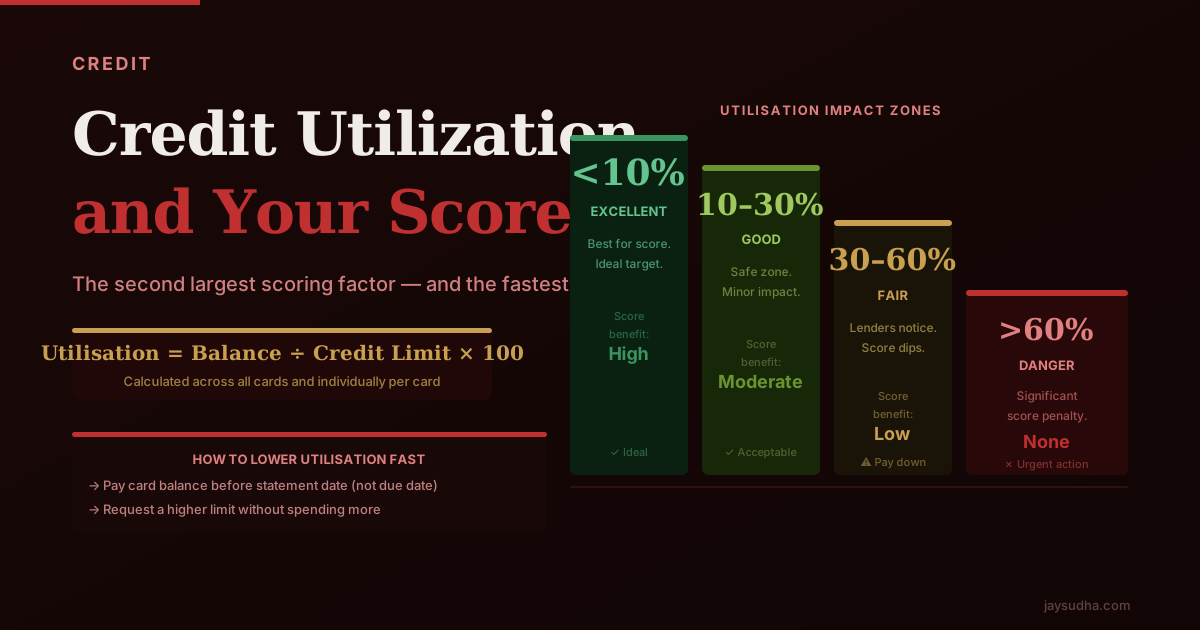
Credit utilization is one of the most impactful and most manageable components of your credit score. In scoring models used by Indian credit bureaus — CIBIL, Experian, Equifax, and CRIF High Mark — utilization typically accounts for a significant portion of your score calculation, often second only to payment history.
Understanding it is not complicated. Managing it deliberately is even simpler once you know the mechanism.
What credit utilization actually measures
Credit utilization measures how much of your revolving credit you are currently using. Revolving credit means credit cards and credit lines — not personal loans, home loans, or car loans, which are installment credit and calculated differently.
The formula:
Credit Utilization = (Total Outstanding Credit Card Balances ÷ Total Credit Card Limits) × 100
If you have two credit cards with a combined limit of ₹2,00,000 and outstanding balances totalling ₹40,000, your utilization is 20%.
Aggregate vs per-card utilization
Two numbers matter, not one:
Aggregate utilization looks at all your cards combined. A ₹40,000 balance against ₹2,00,000 in total limits = 20%.
Per-card utilization evaluates each card individually. A single card that is nearly maxed out is flagged even if your overall average is fine.
Here is an example:
| Card | Outstanding Balance | Credit Limit | Per-Card Utilization |
|---|---|---|---|
| HDFC Regalia | ₹5,000 | ₹1,00,000 | 5% |
| SBI SimplyCLICK | ₹45,000 | ₹50,000 | 90% |
| Axis ACE | ₹0 | ₹50,000 | 0% |
| Total | ₹50,000 | ₹2,00,000 | 25% |
Overall utilization is 25% — within acceptable range. But the SBI card at 90% utilization is flagged as a high-risk signal. Lenders and scoring models treat a near-maxed card as evidence of financial stress, regardless of the aggregate picture.
What the thresholds mean
Credit bureaus do not publish exact cutoffs with precise point impacts. Based on available research and common observed patterns:
| Utilization Range | Likely Signal to Scoring Models |
|---|---|
| Below 10% | Excellent — scores consistently highest here |
| 10% to 30% | Good — within the generally recommended range |
| 30% to 50% | Moderate concern — score likely lower than at 10–20% |
| 50% to 75% | Significant negative signal |
| Above 75% | High-risk territory — material score penalty |
| Above 90% | Near-maxed — treated as a serious derogatory signal |
The relationship is continuous rather than binary. 31% is not sharply worse than 29%, but the trend across the range is consistent: lower is better.
What gets reported to the bureau
This is where most people make an error in how they manage their cards.
Credit bureaus do not see your real-time balance. They see the balance reported by your bank — which typically happens when your monthly statement closes, not when you make a payment.
The practical implication: If your statement closes on the 15th of the month, and you have ₹40,000 outstanding on that date, the bureau sees ₹40,000 — even if you pay it off in full before the payment due date on the 5th of the next month.
Paying by the due date keeps you out of late payment territory. Paying before the statement closing date is what reduces reported utilization.
If you are preparing your credit profile for a loan application — say, a home loan in 3 months — paying down your card balances a week before the statement close date is more effective than paying on the due date.
The impact on loan eligibility in India
When you apply for a home loan, car loan, or personal loan, lenders pull your credit report. High credit card utilization shows up prominently. Two things happen:
- A higher utilization score reduces your CIBIL or bureau score, which directly affects approval chances and the rate you are offered.
- High outstanding balances increase your apparent fixed obligations, which affects your Debt-to-Income (DTI) ratio — another key lending metric.
This means that even if your income is strong and your payment history is perfect, carrying ₹80,000 on a ₹1,00,000 credit card limit is a visible negative signal to any lender reviewing your file.
How to manage credit utilization deliberately
1. Pay before the statement closing date
Identify the statement closing date for each of your credit cards. If you can clear or significantly reduce the balance before that date, the lower balance is what gets reported. This is the single most effective timing-based strategy.
2. Request a credit limit increase
If your HDFC card has a ₹50,000 limit and you consistently spend ₹20,000 per month on it, your per-card utilization is 40%. If you request a limit increase to ₹1,00,000 and get it, the same ₹20,000 spend becomes 20% utilization — without changing your behaviour.
Most Indian card issuers allow limit increase requests through their mobile apps or net banking. Some may do a soft credit inquiry (no impact on score). Others may do a hard inquiry. Ask or read the terms before requesting.
3. Keep old cards open and occasionally active
When you close a credit card, your total available credit drops. The same outstanding balance now represents a higher utilization percentage against a smaller total limit.
A card with no annual fee is almost always worth keeping open, even if you rarely use it. Using it for a small, routine transaction every few months keeps it active without changing your spending behaviour meaningfully.
4. Distribute balances if you carry them
If you currently carry a balance, spreading it across multiple cards reduces per-card utilization even when aggregate utilization stays the same.
₹50,000 on one card with a ₹60,000 limit = 83% utilization on that card. ₹50,000 spread across four cards with ₹60,000 limits each = 21% aggregate, ~20% per card.
This does not reduce what you owe. But it reduces the utilization signal until you pay it down.
5. Avoid applying for multiple cards at once
Each credit card application triggers a hard inquiry on your credit report. Multiple inquiries in a short period, combined with high utilization, creates a double negative signal. Space out applications by at least 6 to 12 months where possible.
What high utilization does not permanently damage
Unlike a missed EMI or a default, high credit utilization has no memory in the scoring model. Once you pay down the balance and it is reported, the utilization calculation resets. There is no scarring effect the way there is with a 90-day late payment, which remains on your report for years.
This makes utilization one of the fastest-responding variables in your credit profile. Behavior changes in one billing cycle produce visible results within one or two reporting cycles.
Common mistakes with utilization
Paying the minimum only. The minimum payment keeps you current on payments, but the remaining balance continues to drive high utilization. Payment history is protected; utilization is not.
Checking the score, not the statement. Your credit score reflects reported data, not current behavior. If your statement just closed with a high balance, your score reflects that — even if you paid it off the next day.
Closing a card after paying it off. This feels like clean financial hygiene, but it reduces your total available credit and increases utilization on other cards. Unless the card has a high annual fee with no benefit, leave it open.
Ignoring per-card utilization. An overall 25% utilization average can still contain a card at 80% utilization that is pulling your score down independently.
The practical takeaway
Credit utilization is a lever, not a variable you are stuck with. The mechanism is simple: lower balances relative to limits produce better scores. The timing — paying before statement close rather than before due date — is what most people miss. And the impact, both positive and negative, registers within one to two billing cycles.
For anyone planning a significant credit application in the next six to twelve months, optimizing utilization is the highest-ROI action available in the credit file.
Utilisation and Home Loan Applications: A Timing Strategy
If you are planning to apply for a home loan in the next 3–6 months, managing your credit utilisation during that window matters more than at any other time.
Here is a practical pre-loan-application utilisation strategy:
Three months before application:
- Calculate current utilisation on each card and in aggregate
- If any card is above 30% utilisation, begin directing surplus cash toward paying it down
- Do not close any old cards — this reduces total available credit and spikes utilisation on remaining cards
One month before application:
- Pay down all credit card balances to below 10% utilisation if possible
- Do not apply for any new credit (new card, personal loan) — this triggers hard inquiries
- Ensure at least one card is reporting activity (a ₹500 grocery payment that gets paid in full) to show active credit use
Two weeks before application:
- Make a final payment on any card that has a statement close date coming up
- The goal is for the statement that gets reported to the bureau just before the lender pulls your report to show utilisation below 10%
A borrower planning a ₹60 lakh home loan who reduces utilisation from 55% to under 10% in the two months before application may improve their CIBIL score by 30–50 points. On a 20-year ₹60 lakh loan, a score improvement that gets a 0.25% better rate saves approximately ₹2.5 lakh in total interest.
The Limit Increase Strategy: Step-by-Step
Requesting a credit limit increase is one of the most underused utilisation management tools in India. Banks often approve it for good customers without a hard inquiry.
How to request a limit increase at major Indian banks:
HDFC Bank: Log into SmartHub/NetBanking → Cards section → Request limit increase. HDFC sometimes does a soft inquiry for existing customers. Typically approved for customers with 12+ months of clean payment history and no recent missed payments.
SBI Card: Available via the SBI Card mobile app or netbanking. The bank reviews payment history and income. If your income has grown since the card was issued, mention this.
Axis Bank: Available via the Axis Bank mobile app under Credit Card Management. Axis generally approves incremental increases of 20–50% for good customers.
ICICI Bank: Via iMobile or the ICICI website. The bank checks your CIBIL score as part of the review (may be a soft inquiry).
When to request: After at least 12 months of on-time payments, after any income increase (you can provide updated salary slips if asked), and when you know you will not miss any payments in the near future.
When not to request: If you are likely to spend more because the limit is higher, or if you are in a financially stressed period and already struggling to pay existing balances.
A successful limit increase on your primary card may require no increase on your secondary card — the combined limit improvement achieves the utilisation benefit you need.
Special Cases: Supplementary Card Holders and Joint Accounts
If you hold a supplementary (add-on) credit card on a family member's primary card, the spending on that supplementary card contributes to the primary cardholder's utilisation — not yours. Your own credit file typically doesn't benefit from responsible use of a supplementary card you hold.
To build your own utilisation management track record, you need a primary card in your own name. The supplementary card is useful as a payment tool; it is not a credit-building tool for the supplementary holder.
For joint credit accounts (less common in India for credit cards, but exists for some products), both account holders' credit reports are affected by the account's utilisation and payment history. This means a co-holder's spending decisions affect your score. Be aware of this if you share a joint credit facility.
Utilisation and the Statement Close Date: A Practical Calendar
Most people know to keep utilisation below 30%. Fewer know that the timing of when they pay — relative to the statement close date — determines what the bureau actually sees.
Here is a practical example using a card with a statement close date on the 15th of each month and payment due date on the 5th of next month:
Standard behaviour (pay on due date): You spend ₹40,000 during the month. On the 15th, the statement closes — the bank reports ₹40,000 outstanding to the bureau. You pay ₹40,000 on the 5th of next month. The bureau saw ₹40,000 outstanding at reporting time. If your limit is ₹1 lakh, they saw 40% utilisation.
Optimised behaviour (pay before statement close): You spend ₹40,000 during the month. On the 13th, you pay ₹35,000. On the 15th, the statement closes — the bank reports ₹5,000 outstanding. The bureau sees 5% utilisation. You pay the remaining ₹5,000 by the 5th with no interest charges.
Same spending. Same total amount paid. Different utilisation reported to the bureau — 40% vs 5%.
To implement this, identify the statement close date for each of your credit cards. This is printed on every statement and available in your bank's app under "Card Details" or "Billing Cycle." Set a calendar reminder 2–3 days before the statement close date as a prompt to make a partial or full payment.
This timing strategy is most valuable when you are preparing for a loan application within the next 2–3 months. In steady-state financial management, avoiding missed payments is always more important than optimising payment timing — but for borrowers actively seeking credit, the statement-close timing detail can make a meaningful difference.
Frequently Asked Questions
Sources and references
Rules, rates, and thresholds in India change over time. Always confirm the current position with the official source above before acting on it.