Credit Score vs Credit Report: What's the Difference and Why Both Matter
A credit score is a number. A credit report is the full story. Both matter when you apply for a loan — here's how they work together.
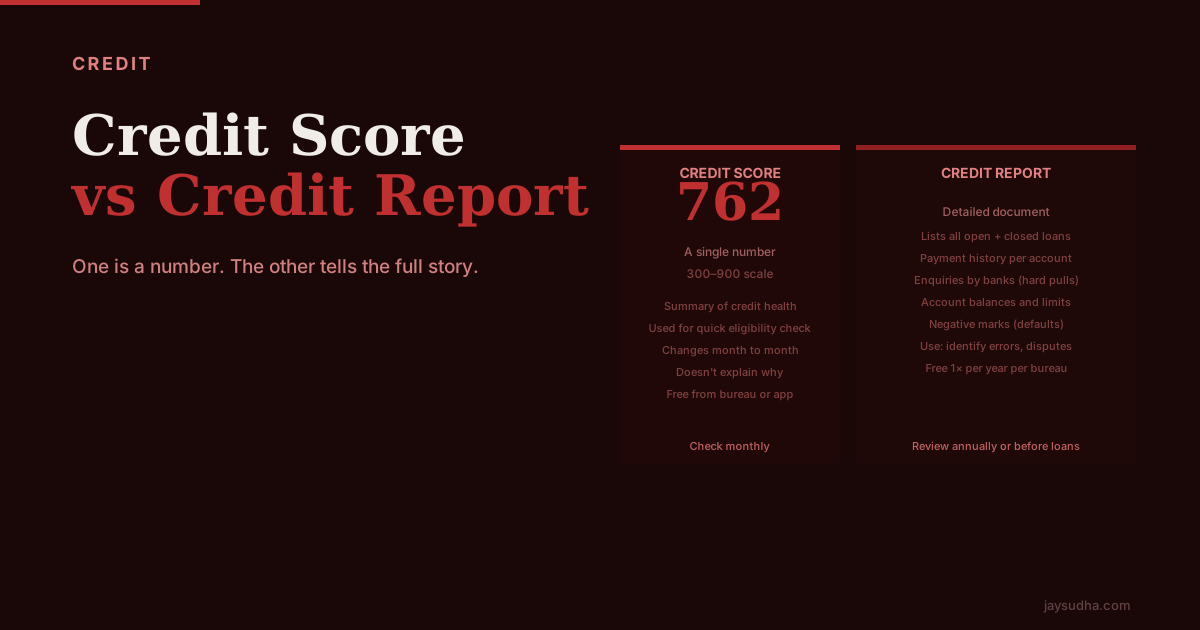
The two terms get used interchangeably in casual conversation, but a credit score and a credit report are not the same thing. They're related — one is derived from the other — but they serve different purposes and matter at different points in the lending process.
Understanding the distinction is practical, not academic. Lenders use both, in sequence, and knowing how they work together helps you manage your credit more intelligently.
What a Credit Report Is
A credit report is a complete record of your borrowing and repayment history. It is compiled by a credit bureau (TransUnion CIBIL, Experian, Equifax, or CRIF High Mark) from information that lenders submit every month.
A credit report contains:
- Personal information: Name, PAN, date of birth, addresses, contact details as submitted by your lenders
- Account-level details: Every credit account you've had — loans, credit cards, overdraft accounts — with the lender's name, account type, opening date, credit limit or loan amount, current balance, and the full payment history month by month
- Enquiry history: Every time a lender pulled your credit report because you applied for a loan or credit card (hard enquiries)
- Default history: Any accounts that were written off, settled for less than the full amount, or where the lender filed suit for recovery
The report covers your entire credit history from when you first took any credit product. For most people, this means everything going back to the first loan or credit card they ever had.
Credit reports don't expire in the way that might make you think. Negative entries — late payments, defaults — remain on file for several years. Accounts in good standing stay even longer.
What a Credit Score Is
A credit score is a three-digit number calculated from the data in your credit report at a specific point in time. It's a summary, not a document. The score condenses all that information into a single number so lenders can quickly sort applications.
Each bureau calculates its own score using its own algorithm:
- CIBIL score: 300 to 900
- Experian: 300 to 900
- Equifax: 300 to 900
- CRIF High Mark: similar scale
The scores won't be identical across bureaus even for the same person, because the underlying report data may differ slightly (different lenders report to different bureaus) and the algorithms are different.
How the Score Is Calculated
CIBIL doesn't publish its exact formula, but the broad categories and approximate weights are publicly known — and they're similar across bureaus globally:
- Payment history (~35%): Whether you pay on time is the single biggest factor. One 90-day late payment can drop a score by 50–100 points.
- Credit utilisation (~30%): How much of your available credit limit you're currently using. If your total credit card limit is ₹2 lakh and your current outstanding is ₹1.6 lakh, your utilisation is 80% — that's high and it pulls the score down. Below 30% is generally considered healthy.
- Credit age (~15%): How long you've had credit. Older accounts help. This is why closing your oldest credit card can sometimes hurt your score.
- Credit mix (~10%): Having a mix of secured (home loan, car loan) and unsecured credit (credit card, personal loan) is seen as positive, within reason.
- New enquiries (~10%): Multiple hard enquiries in a short period signal credit-hungry behaviour to lenders. Each hard enquiry can reduce your score slightly for a few months.
These weights are approximate. The actual algorithm factors in more variables and their interaction. But these five categories are the main drivers.
What the Score Numbers Mean
General guidance (not a guarantee for any specific lender's criteria):
| Score Range | What It Suggests |
|---|---|
| 750–900 | Strong. Most lenders will consider your application; you're likely to get better rates. |
| 700–749 | Decent. Most standard loan products available, though not always the best rates. |
| 650–699 | Borderline. Some lenders may approve with conditions; rates may be higher. |
| Below 650 | Likely to face rejections from mainstream lenders. May need to address underlying issues first. |
A score of 750 or above opens most doors. A score above 800 typically gets you offered the best interest rates lenders have. A score below 650 doesn't mean you can't get credit — it means you'll pay more for it and face more rejections.
These ranges are approximate. Different lenders set different thresholds. An NBFC focused on personal loans might approve a 620; a public sector bank for a home loan might require 750+.
How They Work Together in a Loan Application
When you apply for a loan, the lender's process typically has two stages:
Stage 1 — Score screening: The lender pulls your credit report from a bureau, extracts the score, and does an initial filter. If the score is below their minimum threshold, the application may be rejected at this stage without a human even reviewing it. This is fast and automated.
Stage 2 — Detailed underwriting: If the score passes the filter, a credit officer reviews the full report. This is where nuance enters. The officer looks at:
- What specific accounts are driving the score up or down
- Whether there are any recent defaults or settlements (even if the score has recovered)
- The pattern of payments — one bad year four years ago looks different from chronic recent lateness
- Employment verification and income documents
- Your FOIR (debt obligations as a percentage of income) — which is calculated separately, not from the credit report
A high score gets your application past stage 1. The full report determines what happens in stage 2 — and sometimes a report with a technically acceptable score gets rejected because of something specific the officer sees in the details.
When Score and Report Can Tell Different Stories
The score is a snapshot calculated from the current report. But the report contains history, and history has context that the score doesn't capture.
Good score, concerning report pattern: Someone who had significant defaults 6–7 years ago and has since cleaned up their history might have a score around 720–730 — not bad. But if a lender looks at the report and sees that the recovery happened very recently and there are old write-offs, they might treat that differently than a score of 720 that was earned through 10 years of consistent clean behaviour.
Score temporarily higher than underlying health: If you haven't applied for any credit in two years, your score might look clean simply because there's no recent negative data, not because your financial habits are strong.
Report shows a closed account still listed as open: This can suppress your score below what it should actually be, and only reviewing the report reveals it. The score won't tell you why it's lower than expected — you need the report for that.
Multiple hard enquiries in a short period: This shows up in the report as a pattern of credit-seeking behaviour even if the score impact is modest. A lender reviewing the report sees you applied for three personal loans in two months; the score might only reflect a drop of 15 points but the pattern itself is a flag.
Why You Need to Look at Both
People who only track their credit score — which is most people — are managing half the picture. The score tells you your current standing. The report tells you why you're there and what a lender will actually see when they do a detailed review.
If you're planning to apply for a significant loan in the next 6–12 months, the right approach is:
- Pull your credit report (free annually from each bureau — see the previous article)
- Read through it for errors, closed accounts still open, payments incorrectly marked late
- Fix any errors through the dispute process
- Then track your score as a confirmation that the corrections have taken effect
If you only track the score, you won't know there's an error until a lender tells you your application was rejected.
Conversely, if you only look at the detailed report and ignore the score, you won't know what the automated first-pass filter will do with your application. Lenders won't necessarily tell you what score threshold they use — they just filter.
How the Credit Report Is Used Beyond Loan Applications
Most people think of the credit report as a home loan or personal loan document. It is increasingly used in other contexts:
Rental agreements: Major property management platforms and landlords in metro cities increasingly run credit checks on prospective tenants. A CIBIL score below 650 or a report showing active defaults can result in a rental application being declined. This is particularly relevant in Bengaluru, Mumbai, and NCR where professional property management is widespread.
Employment background checks: Certain industries — banking, financial services, fintech, insurance — routinely check credit reports as part of background verification for employees handling financial products or significant sums. A history of defaults or settlements can be a flag in these sectors. This is not universal across industries but is standard practice in the financial sector.
Telecom contracts: Post-paid telecom providers occasionally run credit checks for high-value plans. This is a soft inquiry and does not affect your score but requires you to pass a basic credit review.
Business loans from PSU banks: When a sole proprietor or small business owner applies for a business loan from a public sector bank, the proprietor's personal CIBIL report is almost always checked. The personal credit profile serves as a proxy for business creditworthiness, though the firm also builds a separate commercial credit record of its own.
The Timing Factor
Credit reports update monthly as lenders submit new data. But the update timing varies — a payment you made last week might not appear in the report for three to four weeks, depending on when your lender's reporting cycle runs.
Credit scores recalculate each time the bureau generates a report (which is when someone requests it or when there's a significant data update). The score you see today might differ from the score a lender pulls tomorrow, even without you doing anything, simply because a new monthly payment has been recorded.
This matters when you're applying for credit: a loan payment you just made, or a credit card balance you just paid down, might not be reflected in the score yet. If timing is important, ask your lender when they plan to pull the report and try to ensure recent positive actions have had time to be recorded.
Practical Use of Both
For someone with no near-term borrowing plans: check your credit report once a year from each bureau to catch errors early. You don't need to obsessively monitor the score number.
For someone planning a major loan in 6–12 months: Pull reports from all four bureaus now. Fix any errors. Then monitor your CIBIL score monthly (free on several platforms) to confirm the repairs have landed and to track your progress on reducing utilisation or building a longer payment history.
For someone who just had a loan or credit card rejected: Don't guess why. Pull the report and read it. The score tells you it's low; the report tells you what's pulling it down. That's what you need to address.
The score is useful shorthand. The report is the document that actually matters.
Free vs Paid Score Tracking: What Each Gives You
A practical clarification on the multiple ways to access your credit score and report in India, since the options are confusing:
Bureau websites (CIBIL, Experian, Equifax, CRIF): Provide the official free annual report and score. The CIBIL website specifically shows the score only within a paid subscription or the one-time paid report option; the free annual report is the full credit report but may not always display the score prominently depending on the interface. Experian India typically includes the score with the free annual report.
Third-party platforms (Paisabazaar, BankBazaar, OneScore, CRED, Fi Money): These perform a soft inquiry using your PAN and provide a real-time credit score (usually Experian or CRIF-based) for free. They do not affect your score. The score shown may differ from your CIBIL score by 10–50 points because of different algorithms and data. Useful for tracking direction month-to-month.
Bank apps: HDFC, ICICI, SBI, Axis, and most large banks show your CIBIL score within their mobile apps if you opt in. These perform a soft inquiry. Convenient but shows only the score, not the full report.
CIBIL paid subscription (₹550–₹1,200/year): Provides monthly score updates, alerts for new inquiries or accounts opened, and unlimited report access. Recommended for people actively rebuilding credit, recovering from fraud, or within 6–12 months of a major loan application.
The right combination for most people: free quarterly report from official bureau sites (staggered across bureaus), supplemented by monthly soft-inquiry score checks on a third-party platform to track direction.
Frequently Asked Questions
Sources and references
Rules, rates, and thresholds in India change over time. Always confirm the current position with the official source above before acting on it.