Form 16 Explained: What It Is and How to Use It for ITR Filing
Form 16 is the salary TDS certificate your employer must give you. Understanding its two parts helps you file your ITR accurately and claim deductions.
Every salaried employee who has TDS deducted should receive Form 16 from their employer. It's not just a document — it's the primary input for filing your income tax return accurately.
What Is Form 16?
Form 16 is a Tax Deduction at Source (TDS) certificate issued by your employer. It certifies:
- How much salary was paid to you during the financial year
- How much TDS was deducted from your salary
- How much TDS has been deposited with the government
It's the employer's official statement of your salary and the taxes already paid on your behalf.
Form 16 Has Two Parts
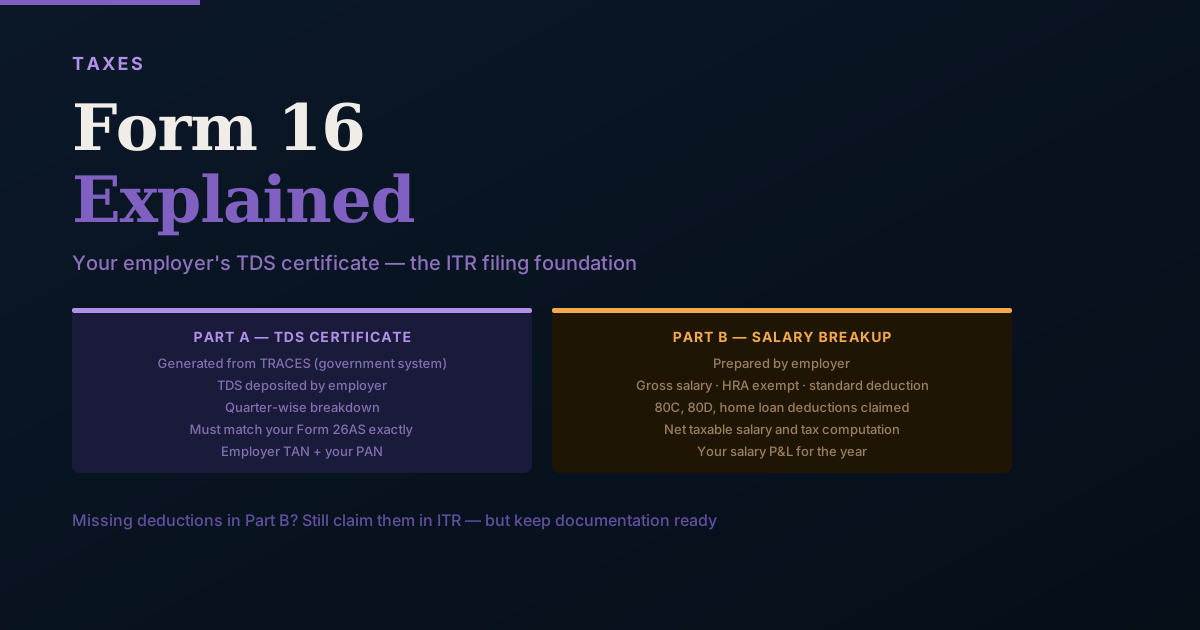
Part A — TDS Certificate (Generated from TRACES)
Part A is a standardised certificate generated by the government's TDS system (TRACES). It contains:
- Employer's TAN (Tax Deduction and Collection Account Number)
- Your PAN
- Assessment year and period
- Total TDS deposited by the employer
- Quarter-wise TDS deposition details
Key use: This amount is what you see in your Form 26AS. Part A data is authoritative for TDS credit purposes.
Part B — Salary Breakup and Deductions
Part B is prepared by the employer (not TRACES). It contains:
- Gross salary components (basic, HRA, allowances, perquisites)
- Exempt HRA amount
- Standard deduction (₹50,000 under the old regime, ₹75,000 under the new)
- Deductions claimed by employee (80C, 80D, 80CCD, home loan, etc.)
- Net taxable salary after all deductions
- Tax computation and TDS deducted
Part B is your salary P&L for the year — what went in, what was exempt, what you claimed, and what tax resulted.
How to Use Form 16 for ITR Filing
Step 1: Verify Part A against Form 26AS Download your Form 26AS from the I-T portal. The TDS amount in Part A must match what's in 26AS. Any discrepancy needs to be resolved with your employer before filing. For a full walkthrough of matching Form 16 against both Form 26AS and AIS — including a practical reconciliation table and what to do for each type of mismatch — see Form 16 vs AIS vs Form 26AS.
Step 2: Enter salary details from Part B ITR-1 (or ITR-2 for multiple income sources) requires you to enter:
- Gross salary from employer
- Exempt allowances (HRA, LTA etc.)
- Standard deduction amount
- Net salary after deductions
Step 3: Cross-check deductions Did you submit all declarations (80C investments, home loan certificate, rent receipts) to your employer? Part B should reflect them. If any deductions are missing from Part B, you can still claim them directly in your ITR — the deduction is your right, not contingent on employer declaration.
Step 4: Account for other income Form 16 only covers salary income. Other income (bank interest, capital gains, rental income, freelance income) must be added separately when filing ITR.
Step 5: Verify tax computation Part B shows the tax computed by your employer. Cross-check this against your own calculation. Discrepancies can arise from different computation of HRA exemption, or deductions your employer missed.
Common Form 16 Issues
Missing TDS credit in 26AS: Your employer deducted TDS but didn't deposit it or filed incorrect details. This is an employer failure — not your liability to pay again, but it must be resolved with the employer before filing.
Wrong PAN on Form 16: Results in TDS not being credited to your account. Get the employer to issue a corrected Form 16 with the correct PAN.
Part B missing deductions: If you submitted proofs for 80C, home loan, etc., but they're not reflected, you can still claim them in ITR — but you'll need documentation ready in case of scrutiny.
Multiple employers: Add salary from all Form 16s. Final tax computation covers total income across all employers.
Reading Form 16 Part B Line by Line
Part B follows a standardised format that mirrors the Schedule S (Salary) section in your ITR. Here is what each line means:
Gross Salary: Total of all salary components before any deductions — basic, HRA, special allowance, LTA, arrears, perquisites, everything.
Perquisites under Section 17(2): Non-cash benefits provided by the employer — company car, rent-free accommodation, ESOP benefits, club membership, etc. These are valued and added to taxable income.
Profits in lieu of salary under Section 17(3): Includes joining bonuses received from a new employer, severance payments, or compensation for termination. All taxable.
Allowances to the extent exempt under Section 10: This is where HRA exemption, LTA exemption, standard deduction, and other exempt allowances are subtracted.
Standard Deduction: ₹50,000 per year under the old regime; ₹75,000 per year under the new regime. Every salaried employee gets this automatically.
Net Salary: After removing exempt allowances and standard deduction — the portion your employer computed as taxable salary from this employer.
Deductions under Chapter VI-A: Shows the deductions your employer accounted for — 80C investments you declared, 80D premiums, home loan interest, NPS contribution, etc.
Taxable Salary: Net salary minus Chapter VI-A deductions. This is the amount on which your employer computed the tax.
Tax on Total Salary, Rebate u/s 87A, Cess: The final tax computation, with the Section 87A rebate applied if your taxable income is within the limit (₹5 lakh under old regime, ₹12 lakh under new regime).
Old Regime vs New Regime in Form 16
From FY 2023-24 onwards, Form 16 Part B indicates which tax regime was used for TDS computation. If your employer computed TDS under the new regime, you will see a box or field noting "New Tax Regime" with the standard deduction of ₹75,000 applied and no Chapter VI-A deductions.
If your employer used the old regime (because you opted for it and submitted investment proofs), you will see the full deduction schedule in Part B.
Key implication: If you switch regimes at ITR filing time — for example, your employer deducted TDS under the new regime but you choose old regime in your ITR — you must recalculate the tax liability under the old regime, account for your deductions, and either claim a refund or pay the difference as self-assessment tax.
Worked Example: Reconciling Form 16 with Your ITR
Scenario: Priya, salaried in Bengaluru. Her Form 16 shows:
- Gross salary: ₹14,00,000
- HRA received: ₹3,60,000; HRA exempt (calculated by employer): ₹1,80,000
- Standard deduction: ₹50,000
- Net salary: ₹11,70,000
- 80C declared to employer: ₹1,50,000
- 80D declared: ₹25,000
- Taxable income per employer: ₹9,95,000
- TDS deducted: ₹1,15,960 (old-regime tax on ₹9,95,000: ₹12,500 + ₹99,000 = ₹1,11,500, plus 4% cess)
Now Priya realises she also contributed ₹50,000 to NPS under 80CCD(1B) — which she forgot to declare to her employer. She can still claim this deduction in her ITR.
Her ITR computation:
- Taxable income per Form 16: ₹9,95,000
- Less 80CCD(1B) not declared to employer: ₹50,000
- Revised taxable income: ₹9,45,000
- Tax on ₹9,45,000 (old regime): ₹2.5–5L at 5% = ₹12,500; ₹5–9.45L at 20% = ₹89,000; total ₹1,01,500 + 4% cess = ₹1,05,560
- TDS already deducted: ₹1,15,960
- Refund due: ₹1,15,960 − ₹1,05,560 = ₹10,400
The refund is exactly what the forgotten deduction is worth: ₹50,000 claimed against her 20% slab, plus 4% cess — ₹50,000 × 20% × 1.04 = ₹10,400. That is the general rule for any deduction you add at filing time that your employer never saw: its value is the deduction multiplied by your marginal slab rate and the cess, not some separate number.
This is why checking Form 16 carefully and then adding missing deductions in your ITR matters.
When You Don't Have Form 16
If your employer hasn't issued Form 16 by June 15, or if you changed jobs and the previous employer is unresponsive, you can still file your ITR using:
- Salary slips for all 12 months — calculate gross salary, HRA received, and other components
- Form 26AS — shows TDS deducted by employer; use this for TDS credit
- AIS (Annual Information Statement) — shows salary as reported by your employer to the government
However, without Form 16 Part B, you have to manually calculate all exemptions and deductions. The risk is higher for errors. If your employer consistently fails to provide Form 16, report the issue to your local Income Tax Officer — employers are legally obligated to issue it by June 15.
Tax Saved by Correctly Using Form 16
Consider two employees each earning ₹12 lakh gross salary under the old regime. Employee A correctly declares all deductions via Form 16; Employee B doesn't submit proofs.
| Item | Employee A | Employee B |
|---|---|---|
| HRA exemption | ₹1,20,000 | ₹0 |
| Standard deduction | ₹50,000 | ₹50,000 |
| 80C investments | ₹1,50,000 | ₹0 |
| 80D health insurance | ₹25,000 | ₹0 |
| Taxable income | ₹8,55,000 | ₹11,50,000 |
| Tax + cess | ₹86,840 | ₹1,63,800 |
| Difference | — | ₹76,960 extra TDS |
Employee B will get a refund when filing ITR (assuming they claim the deductions then), but has parted with ₹76,960 in TDS unnecessarily throughout the year. That's money that could have been invested for several months.
Section 10(14) Allowances in Form 16
Part B of Form 16 may show various allowances exempted under Section 10(14) — a section covering special allowances for expenses incurred in performing duties. Common ones:
- Conveyance allowance: If provided for commuting to work, exempt up to ₹19,200/year under the old regime (note: standard deduction has effectively replaced this for most employees)
- Medical reimbursement: Actual medical bills reimbursed by employer, up to ₹15,000/year (mostly replaced by standard deduction now)
- Children's education allowance: ₹100/month per child (up to 2 children) = ₹2,400/year maximum
- Hostel expenditure allowance: ₹300/month per child = ₹7,200/year maximum
These are small amounts but verify your Form 16 includes them if your salary structure contains these components.
Advance Tax Implications of Form 16
If you have income beyond your salary (freelancing, rental income, capital gains), your Form 16 TDS may not be sufficient to cover total annual tax liability. In such cases:
- Advance tax should have been paid in four instalments: June 15 (15%), September 15 (45%), December 15 (75%), March 15 (100%)
- Any shortfall — total tax liability minus TDS (from Form 16) minus advance tax paid — becomes self-assessment tax, payable before filing ITR
- Interest under Section 234B applies on shortfall from April 1 if total advance tax paid was less than 90% of total liability
Form 16 is the anchor document for your ITR — the employer's certified account of what your salary was and what taxes were paid. Using it correctly, cross-checking it against Form 26AS, and supplementing it with your own deductions that the employer didn't account for, is the complete approach to accurate and optimal ITR filing.
Keeping Form 16 and How Long to Retain It
Form 16 should be retained for at least 7 years. The reopening windows are shorter than they used to be, and the old "6 years ordinarily, 10 years for serious cases" rule of thumb no longer describes them. The Finance (No. 2) Act, 2024 cut the limits sharply, and the Income-tax Act, 2025 — in force since 1 April 2026 — carries the shortened version forward: a reassessment notice under Section 280 must generally be issued within 4 years and 3 months from the end of the tax year, stretching to 6 years and 3 months where the income that escaped assessment is ₹50 lakh or more. A seven-year retention habit comfortably covers both. Check the department's reassessment guidance for the current position before you discard anything, since these limits have been rewritten twice in five years.
Store both digital and physical copies:
- The original employer-issued Form 16 (download from the employer's payroll portal or receive by email)
- A local backup (PDF on your computer + cloud storage)
For employees who changed jobs multiple times, maintain Form 16 from every employer for the full retention period — you may receive scrutiny notices years later for any year where income was complex or underreported.
Form 16 for Loan Applications
Banks and financial institutions require Form 16 as income proof for:
- Home loans and top-up loans
- Personal loans above certain thresholds
- Car loans
- Loan against property
Lenders typically ask for Form 16 from the last 2–3 assessment years. The "salary" figures in Form 16 Part B are the income figures that determine your loan eligibility. A Form 16 that shows high deductions (reducing taxable income significantly) may actually reduce your assessed loan eligibility in some banks' calculations, since they look at gross salary rather than taxable income.
Important for ITR filing: Some banks accept the ITR (income tax return with computation) as income proof in place of or alongside Form 16, particularly for self-employed individuals. For salaried employees, Form 16 is the primary document.
Perquisites Commonly Seen in Form 16 Part B
Section 17(2) perquisites are non-cash benefits provided by your employer. Common ones that appear in Form 16:
ESOP (Employee Stock Options): When you exercise ESOPs, the difference between the exercise price and the FMV at exercise date is a perquisite. This is added to your salary and taxed at slab rate. The employer must compute this and include it in Form 16 Part B. The perquisite value becomes your cost basis for future capital gains calculation when you sell the shares.
Rent-free accommodation: If your employer provides housing (rare, but common in some industries), the notional rental value is a taxable perquisite based on government formula.
Company car for personal use: If you use a company-owned vehicle for personal purposes, the perquisite is valued at ₹1,800–₹3,300/month depending on engine capacity and whether a driver is provided.
Meals above ₹50/meal: Employer-subsidised cafeteria meals costing the employer more than ₹50 per meal are taxable perquisites on the excess.
Understanding what appears in the perquisites section of Form 16 helps you verify that your employer hasn't inadvertently included or excluded items, and that the perquisite valuations are correct.
If a figure on your Form 16 looks wrong, raise it with payroll first — and if it still doesn't reconcile, a CA can confirm whether the discrepancy affects your filing.
Frequently Asked Questions
Sources and references
- Income Tax Department, Government of India
- Reserve Bank of India (RBI)
- Income Tax Department — Reassessment Proceedings (notice and time limits)
Rules, rates, and thresholds in India change over time. Always confirm the current position with the official source above before acting on it.