ELSS vs PPF: Which Tax-Saving Investment Should You Choose?
ELSS and PPF both save tax under 80C but are fundamentally different instruments. The right choice depends on your time horizon and return expectations.
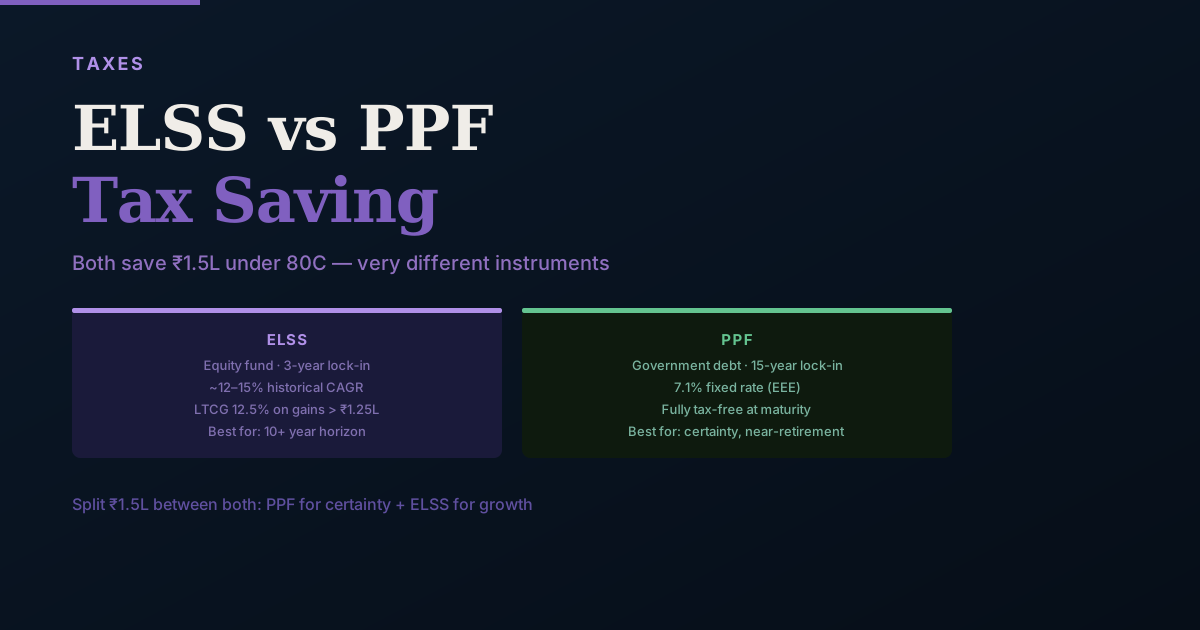
Section 80C allows deductions up to ₹1.5 lakh per year, and both ELSS and PPF are popular choices within this limit. They are fundamentally different instruments, and choosing between them requires understanding what you're trading off.
First, Check Which Tax Regime You're On
This question comes before ELSS-vs-PPF, and it's now the most important one: Section 80C deductions only apply under the old tax regime. Since the new regime became the default, anyone filing under it gets no 80C benefit — ELSS and PPF still work as investments, but neither reduces your tax.
So the real decision tree is:
- New regime (lower slabs, no deductions): choose ELSS or PPF purely as investments, not tax-savers. For most long-horizon investors, judging them on their own merits — not a tax break — is the right lens.
- Old regime (claiming HRA, 80C, 80D, home-loan interest): the ELSS-vs-PPF tax-saving comparison below fully applies.
Run both regimes through a tax calculator once a year — the better regime depends on how many deductions you actually claim.
The Core Difference
PPF (Public Provident Fund) is a government-backed fixed-income savings instrument. Your contributions earn a government-declared interest rate (currently 7.1% p.a.), and the maturity proceeds are tax-free. It's a guaranteed, risk-free product.
ELSS (Equity Linked Savings Scheme) is an equity mutual fund with a mandatory 3-year lock-in per investment lot. Returns depend on stock market performance — higher potential return, with corresponding volatility.
Side-by-Side Comparison
| Feature | ELSS | PPF |
|---|---|---|
| Nature | Equity mutual fund | Government debt instrument |
| Lock-in | 3 years per SIP/lump sum | 15 years (with partial withdrawals from year 7) |
| Returns | Market-linked (~12–15% historical CAGR) | Fixed rate (7.1% currently) |
| Risk | Moderate to high | Zero (government backed) |
| Minimum investment | ₹500 (most funds) | ₹500/year |
| Maximum for 80C | ₹1.5 lakh (shared limit) | ₹1.5 lakh |
| Tax on maturity | LTCG 12.5% on gains > ₹1.25L/year | Completely tax-free (EEE) |
| Tax treatment | EET (taxed at exit, but partial exemption) | EEE (exempt at all stages) |
The Return Difference Over Time
Assuming ₹1.5 lakh/year invested:
| Period | PPF @ 7.1% | ELSS @ 12% (conservative) | ELSS @ 15% (optimistic) |
|---|---|---|---|
| 10 years | ~₹21.5L | ~₹28.8L | ~₹34.5L |
| 15 years | ~₹40.9L | ~₹74.9L | ~₹98.6L |
| 20 years | ~₹66.8L | ~₹149.4L | ~₹224.5L |
(All figures approximate. ELSS returns are not guaranteed.)
Over 20 years, the equity compounding difference is dramatic. However, these are not comparable on a risk-adjusted basis — PPF's 7.1% is certain; ELSS returns include years where your corpus may drop 30–40%.
When PPF Makes More Sense
- Near-retirement investors (10 years or less to retirement): Capital preservation matters more than growth
- Those who cannot tolerate volatility: Equity drawdowns of 30–40% are real and recurring
- Goal with a fixed deadline: Child's education in 8 years → PPF gives certainty
- Conservative tax savers: Want EEE treatment without managing market exposure
When ELSS Makes More Sense
- Young earners (20s–early 40s) with 15+ year horizon
- Those comfortable with equity exposure who already understand market cycles
- Building a retirement corpus where time smooths out volatility
- Investors who don't need 15-year lock-in but want tax savings — ELSS's 3-year lock-in is the shortest of all 80C options
A Practical Combination
Many investors benefit from splitting their ₹1.5 lakh 80C allocation:
- ₹50,000–75,000 in PPF for the guaranteed, tax-free base
- ₹75,000–1,00,000 in ELSS for equity growth potential
This gives you the certainty of PPF plus the growth potential of equity, without fully committing to either.
Note: EPF contributions also count toward 80C. If your EPF already fills ₹1.5 lakh, additional ELSS or PPF investments won't give additional 80C benefit.
PPF Mechanics Worth Knowing
- Tenure: 15 financial years, extendable indefinitely in 5-year blocks (with or without further contributions).
- Limits: ₹500 minimum to ₹1.5 lakh maximum per year; deposits above ₹1.5 lakh earn no interest.
- Liquidity: partial withdrawal is allowed from year 7, and a loan against the balance is available between years 3 and 6.
- Timing trick: deposit before the 5th of the month — PPF interest is calculated on the lowest balance between the 5th and month-end, so an early-month deposit earns that month's interest.
ELSS Lock-In: Each SIP Locks Separately
A subtle point: the 3-year lock-in applies to each investment lot, not the SIP as a whole. A ₹12,500 monthly ELSS SIP started in April means April's units unlock after 3 years, May's a month later, and so on — your final instalment stays locked until 3 years after it was invested. Plan around this if you intend to redeem near the lock-in boundary.
And once units unlock, don't redeem reflexively. ELSS is a diversified equity fund; if the money is still earmarked for a long-term goal, holding it as equity usually beats booking gains at the 3-year mark just because you can.
What Happens at ELSS Redemption: Tax Calculation
When you redeem ELSS units after the 3-year lock-in, the gains are Long-Term Capital Gains (LTCG) on equity, taxed at 12.5% on gains above ₹1.25 lakh per financial year.
Example: Vikram invested ₹1.5 lakh in ELSS in April 2022 (lump sum). In May 2025, the value has grown to ₹2.25 lakh.
- Total gain: ₹75,000
- LTCG exemption: First ₹1,25,000 of LTCG across all equity is tax-free
- Since ₹75,000 < ₹1.25 lakh: zero LTCG tax
If Vikram also redeemed equity shares with ₹80,000 gain the same year:
- Combined LTCG: ₹75,000 (ELSS) + ₹80,000 (shares) = ₹1,55,000
- Taxable LTCG: ₹1,55,000 − ₹1,25,000 = ₹30,000
- Tax at 12.5%: ₹3,750 + 4% cess = ₹3,900
PPF Interest Rate History and Outlook
PPF interest rates are declared by the government quarterly (though they have been stable for several years). Historical rates give context:
| Period | PPF Rate |
|---|---|
| FY 2012-13 | 8.8% |
| FY 2015-16 | 8.7% |
| FY 2017-18 | 8.0% |
| FY 2019-20 | 8.0% → 7.9% |
| FY 2020-21 to present | 7.1% |
The 7.1% rate has been unchanged since April 2020, even through periods when bank FD rates rose. Whether the government revises PPF rates upward depends on fiscal policy — the rate is not market-linked.
Important: PPF interest is calculated on the minimum balance between the 5th and last day of each month. A deposit on April 3 earns April's interest; a deposit on April 7 does not earn April's interest (the minimum balance between April 5 and April 30 was lower before the deposit). Making deposits before the 5th of each month, especially April, maximises annual interest.
Old Regime Breakeven: Is ELSS/PPF Worth Staying On?
A critical calculation for anyone currently using 80C investments to justify staying on the old regime:
Scenario: Income ₹15 lakh. ELSS + EPF + insurance fills ₹1.5 lakh 80C. No HRA (owns home, no loan).
New regime tax on ₹15L − ₹75K standard deduction = ₹14.25L:
- Tax on ₹14.25L: ₹20K + ₹40K + ₹33,750 = ₹93,750 + 4% cess = ₹97,500
Old regime tax on ₹15L − ₹50K standard − ₹1.5L 80C = ₹13L:
- Tax on ₹13L: ₹12,500 + ₹1,00,000 + ₹90,000 = ₹2,02,500 + 4% cess = ₹2,10,600
The old-regime slab breakdown: ₹2.5–5L: ₹12,500; ₹5–10L: ₹1,00,000; ₹10–13L: ₹90,000. Total: ₹2,02,500. With cess: ₹2,10,600.
Old regime pays ₹1,13,100 MORE in tax even with full 80C utilised and only standard deduction in new regime!
This means if you have no HRA exemption and no home loan interest deduction, the new regime wins by a large margin even with full 80C utilisation. ELSS and PPF as investments remain excellent — but they are not enough by themselves to justify the old regime at ₹15 lakh income.
The old regime makes sense at ₹15 lakh only if you also have:
- HRA exemption (significant rent, metro city)
- Home loan interest deduction (₹2 lakh under 24(b))
- 80D premium (₹25,000–50,000)
- NPS deduction under 80CCD(1B) (₹50,000)
With all of these combined: ₹1.5L + ₹2L + ₹50K + ₹25K + ₹50K = ₹4.75L in deductions — that changes the math significantly in favour of the old regime.
NPS as an Alternative to PPF in the New Regime
Under the new regime, both ELSS and PPF lose their tax-saving value. The surviving deduction is employer NPS contribution under 80CCD(2) — up to 14% of Basic+DA.
Comparison: PPF vs NPS under new regime
| Feature | PPF (new regime) | NPS Tier I (employer, new regime) |
|---|---|---|
| Tax benefit | None (just an investment) | 80CCD(2) — deductible even in new regime |
| Returns | 7.1% guaranteed | Market-linked (equity + debt blend) |
| Liquidity | Partial from year 7 | Very low until age 60 |
| Tax on maturity | Tax-free | 60% tax-free; 40% must buy annuity (taxable) |
If you're in the new regime, maximising employer NPS contribution (80CCD(2)) is the primary remaining deduction lever. PPF continues as a good guaranteed-return savings vehicle but loses tax advantage vs new regime.
The Real Question: ELSS vs PPF vs NPS for Long-Term Wealth
For someone in their 30s with 25+ years to retirement, the wealth accumulation lens is more important than the short-term tax lens:
- PPF at 7.1% for 25 years: ₹1.5 lakh/year → corpus ≈ ₹1.02 crore (fully tax-free)
- ELSS at 12% for 25 years: ₹1.5 lakh/year → corpus ≈ ₹2.5 crore (LTCG tax applies on redemption above ₹1.25L/year)
- NPS at 10% for 25 years (equity-heavy): ₹1.5 lakh/year → corpus ≈ ₹1.62 crore (60% tax-free withdrawal; 40% annuity)
At a 12% ELSS return, the corpus is 2.5x the PPF corpus. Even after paying LTCG tax on redemptions, equity compounding over 25 years overwhelms the tax advantage of PPF's EEE structure.
But this assumes emotional discipline during market downturns — the PPF investor never faces a year where their balance shows -30%. The ELSS investor does. Whether you can maintain the investment during a 30-40% drawdown without panic-selling is as important as the return differential.
PPF Extension Beyond 15 Years: How It Works
After PPF's mandatory 15-year tenure completes, you have three options:
- Close the account and withdraw everything: Entire corpus (principal + interest) is tax-free.
- Extend without contribution for 5 years: Balance continues earning PPF interest without further deposits. You can make withdrawals from the corpus (up to 60% per extension period). Good if you want the interest but don't need to add more.
- Extend with contributions for 5 years: Continue depositing up to ₹1.5 lakh/year and earn interest. Additional contributions still qualify for 80C under old regime. The 5-year block is renewable indefinitely.
The extension option without contribution is particularly useful for retirees: the corpus keeps earning 7.1% tax-free while you draw down gradually.
A note on loans against PPF: Between years 3 and 6 of any PPF block (including extension blocks), you can take a loan against the balance. The loan is 25% of the balance at the end of the second year preceding the loan year. Interest rate: 2% above PPF rate. This is an emergency liquidity option — not a recommended strategy, but available if needed.
ELSS Across Market Cycles: What the Data Shows
ELSS category performance over various market cycles (illustrative):
The Sensex has gone through several 30–50% drawdown periods (2000-01 dot-com bust, 2008-09 global financial crisis, 2020 COVID crash) followed by complete recoveries and new highs. An investor who held through each of these periods and continued SIPs during the drawdowns accumulated significantly more units at lower NAVs, enhancing long-term returns.
Key data points for equity compounding in India:
- Nifty 50 CAGR over 25 years (1999-2024): approximately 12–14% (varies by exact period)
- An investor who started a ₹10,000 SIP in Nifty 50 index fund in 2000 would have over ₹1.5 crore by 2024 on ~₹29 lakh total investment
- The same ₹10,000/month in PPF over the same period: approximately ₹65–70 lakh
These numbers are retrospective — they don't guarantee future performance. But they illustrate why time in the market matters more than timing, and why the 3-year ELSS lock-in, far from being a drawback, is actually a feature — it prevents premature redemption during corrections.
Past performance is exactly that — past. For how much of your 80C to put in equity versus a guaranteed instrument, that allocation call is worth making with a SEBI-registered investment adviser who knows your full picture.
Frequently Asked Questions
Sources and references
- Income Tax Department, Government of India
- Reserve Bank of India (RBI)
- Association of Mutual Funds in India (AMFI)
Rules, rates, and thresholds in India change over time. Always confirm the current position with the official source above before acting on it.