Template
F&O & Intraday Trading Journal
A broker’s P&L screen shows gross profit; the bank account shows what is left after STT, exchange charges, the SEBI fee, stamp duty, GST and brokerage, which on options can be a large share of the gross. The tax side is just as easy to misread, because F&O and intraday results are taxed differently and turnover for a tax audit is not the sum of contract values. This journal takes one row per round-trip trade, prices every charge from the trade date, and turns the log into net P&L, the statistics that show whether a method works, and turnover worked out the way the ICAI guidance note describes — for your own review and for your CA.
₹1,499 on Gumroad · Google Sheets (your own copy) · Filled example · Quick Start Guide (PDF) · Delivered by email — see what’s inside below.
What it does
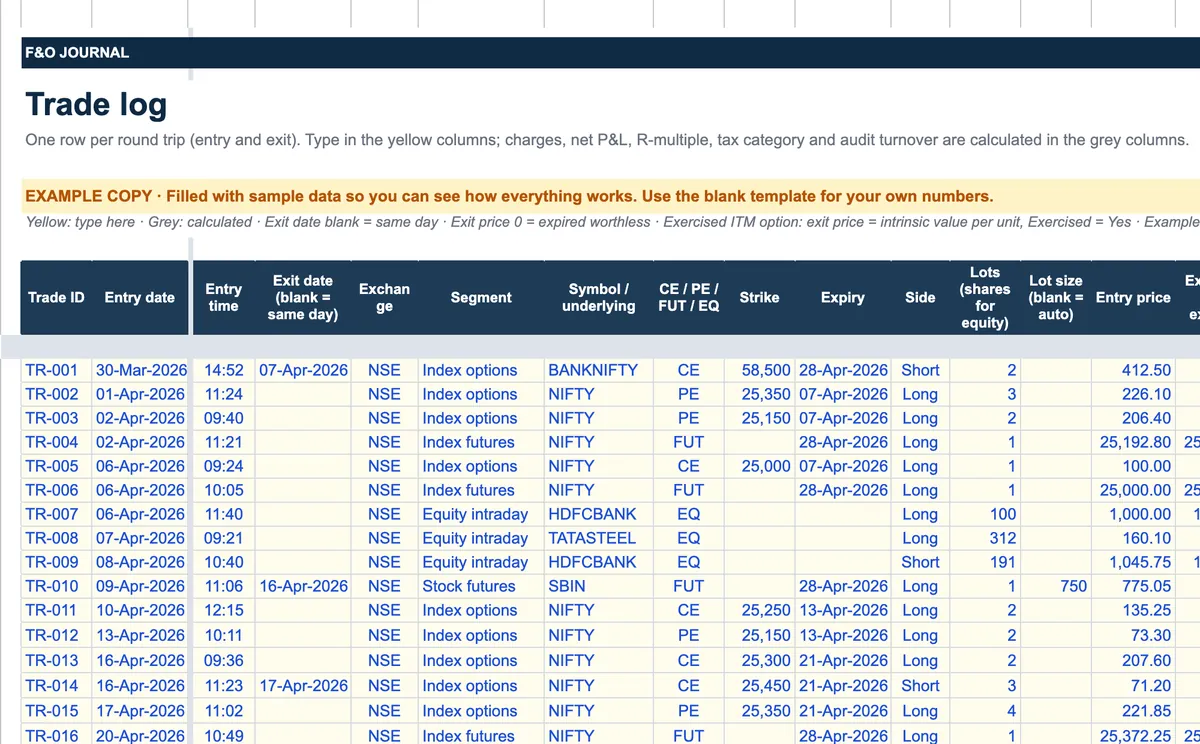
Setup takes your name, broker, capital, risk per trade, daily loss limit, tax year and tax-audit settings, and the lists behind every dropdown. Trade Log takes one row per round trip — entry and exit dates and times, exchange, segment, underlying, option type, strike, expiry, side, lots, prices, setup and mistake tags — and calculates the charges, net P&L, R-multiple, tax category and turnover of each trade. Charges are looked up by trade date: STT, exchange charges, IPFT, the SEBI fee, stamp duty, GST, DP charges and brokerage for Zerodha, Groww, Upstox, Angel One, Dhan or a custom plan, with exercised and expired options treated separately. Contract Notes is an optional zone for pasting contract-note charges to compare with the journal. Daily Summary follows every trading day with cumulative equity, drawdown and breaches of the daily loss limit. Performance splits results by setup, segment, direction, weekday and time slot, and puts a rupee cost on each mistake tag. Tax & Turnover gives the ICAI-method turnover, speculative (intraday) and non-speculative (F&O) results, the audit tests, the set-off rules and the due dates, for discussion with a CA. Charges & Rates lists every rate with the circular or regulation it comes from, and includes a calculator that prices a trade before it is placed.
Who it’s for
- Retail traders in index and stock options, futures and intraday equity in India.
- Traders who want to see how much of the gross P&L goes in STT and charges.
- Anyone preparing turnover and P&L figures for a CA before the audit and return dates.
Fields included
How to use it
- In Setup, type your broker, capital, risk per trade, daily loss limit and the tax year.
- After each trade, add one row in Trade Log with its details, setup tag and any mistake tag.
- Optionally paste contract-note charges to compare them with the journal’s own figures.
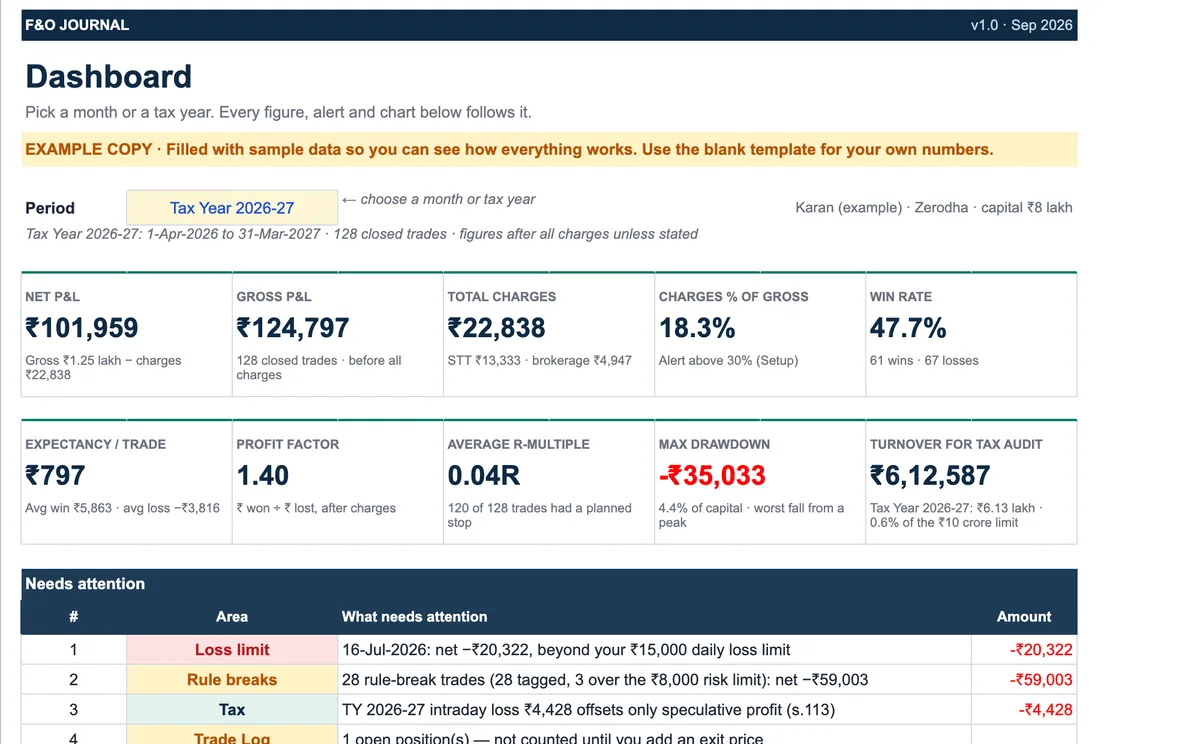
- Pick a month or tax year on the Dashboard to read net P&L, charges, win rate, expectancy and drawdown.
- Before the audit and return dates, take the Tax & Turnover figures to your CA.
Preview
₹1,499
Get it on Gumroad ↗Google Sheets (your own copy) · Filled example · Quick Start Guide (PDF) · Delivered by email
Sold by Jay Sudha. Checkout and delivery by Gumroad.
Example workflow
The EXAMPLE file is a fictional trader’s tax year 2026-27 so far, on ₹8 lakh of capital: 128 closed trades. The gross P&L is ₹1,24,797, the charges take ₹22,838 of it — 18.3%, with STT alone at ₹13,333 — and the net P&L is ₹1,01,959. The trader won 47.7% of trades, with a profit factor of 1.40 and an average of 0.04R, and the worst run from a peak cost ₹35,033. The flags are what a broker’s screen does not show: on 16 July the day’s loss of ₹20,322 went past the ₹15,000 daily limit, 28 trades carry a rule-break tag, and an intraday loss of ₹4,428 can be set off only against speculative profit. Turnover for the tax audit, by the ICAI method, stands at ₹6,12,587 — far below the contract values traded.
Frequently Asked Questions
Reviews
No reviews yet.
Bought this template? Review it
I read every review and publish it here, with the name you give, once I have matched your email to a Gumroad purchase. Your email is never shown. Privacy Policy