Template
Bardana Book — Gunny Bag Register
Bags are money that walks out of the godown. They go to farmers before harvest and come back with paddy, go to agents and buyers who may or may not return them, tear, get used in the mill, and are bought on credit from suppliers who expect to be paid. This book keeps both sides: how many bags of each type are in the godown, with each farmer and with each party, and what is owed to each bag supplier, bill by bill.
₹999 on Gumroad · Google Sheets (your own copy) · Filled example · Quick Start Guide (PDF) · Delivered by email — see what’s inside below.
What it does
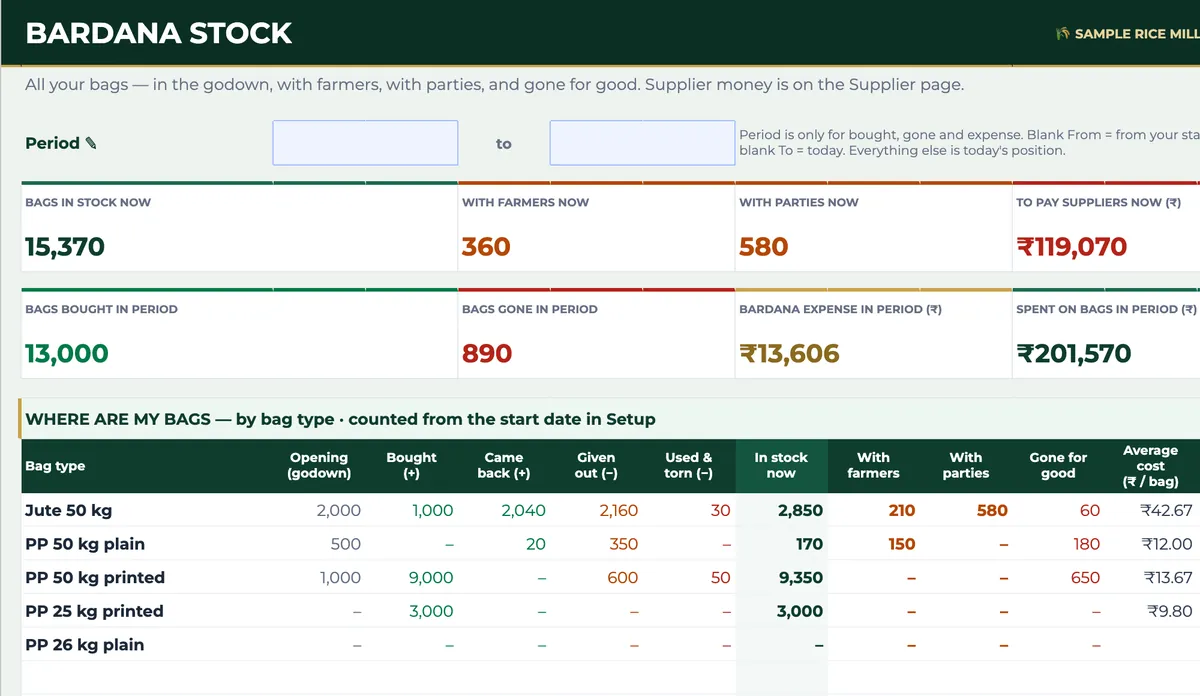
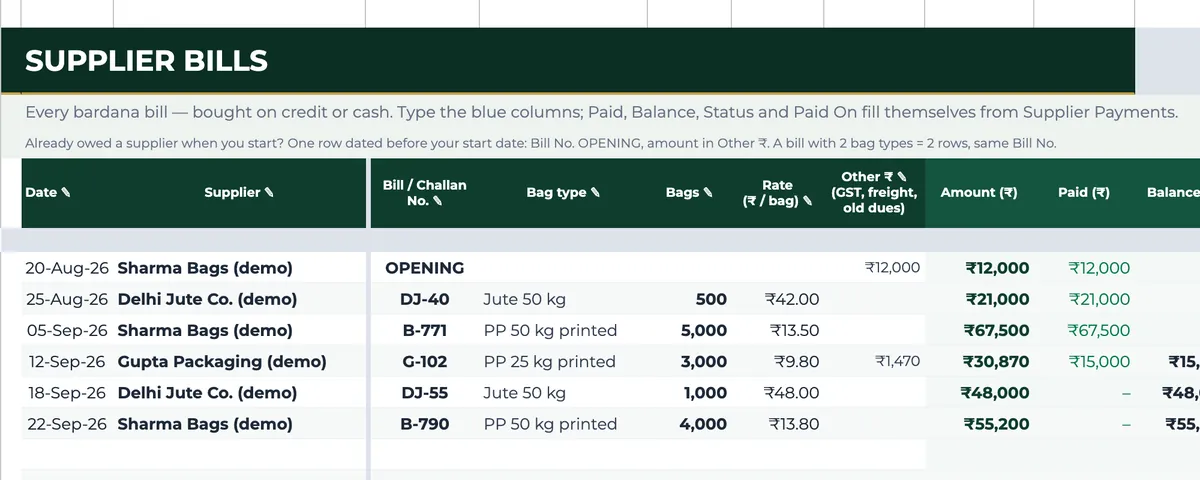
Setup is filled once: a start date with the godown count on that date as opening stock, your bag types (jute and PP sizes, editable), your suppliers, and your parties, each marked “returns bags” or “keeps bags”. Farmers takes one row each time bags go to a farmer or come back with paddy; Parties does the same for agents, buyers and other mills; Used & Torn records bags that leave stock any other way — torn, used in the mill or sold as scrap. Stock then adds it up by bag type — opening plus bought plus came back, less given out, less used and torn — for bags in the godown now, alongside bags with farmers, with parties and gone for good, the average cost per bag, and which farmers and parties hold the most. Bags given to a “keeps bags” party leave your stock for good. On the money side, Supplier Bills takes every bardana bill, credit or cash, and Supplier Payments takes money paid to a supplier without picking a bill: each payment clears that supplier’s oldest bills first, and paid, balance, status and paid-on date fill themselves. The Supplier tab shows whom to pay, the unpaid bills and every supplier’s account, and bardana expense for any period.
Who it’s for
- Rice mills and grain traders who lend bags to farmers before the paddy comes in.
- Godown in-charges who count bags by type and need the book to agree with the count.
- Owners paying bag suppliers who want to know which bills are still open.
Fields included
How to use it
- In Setup, set the start date, type the godown count on that date as opening stock, and list bag types, suppliers and parties (returns or keeps bags).
- Record bags going to and coming back from farmers in Farmers, and to and from parties in Parties.
- Record torn, used and scrapped bags in Used & Torn.
- Type each bardana bill in Supplier Bills and each payment in Supplier Payments; payments clear the oldest bills first.
- Read Stock for bags by type and who holds them, and Supplier for whom to pay.
Preview
₹999
Get it on Gumroad ↗Google Sheets (your own copy) · Filled example · Quick Start Guide (PDF) · Delivered by email
Sold by Jay Sudha. Checkout and delivery by Gumroad.
Example workflow
The EXAMPLE file is a sample mill’s September 2026. It started with 2,000 jute bags in the godown, bought 1,000 more, got 2,040 back from farmers and parties, gave 2,160 out and used or tore 30, which leaves 2,850 jute bags in stock at an average cost of ₹42.67 a bag. Across all bag types the godown holds 15,370 bags, farmers have 360 and parties 580. On the supplier side, a jute supplier’s bill for 1,000 bags at ₹48 and a PP supplier’s bill for 4,000 bags at ₹13.80 are still unpaid, a packaging bill of ₹30,870 has ₹15,000 paid against it, and ₹1,19,070 is owed to suppliers in all — the payments made so far have already cleared each supplier’s older bills without anyone picking which bill they were for. The same file flags one farmer whose rows show more bags returned than given.
Frequently Asked Questions
Reviews
No reviews yet.
Bought this template? Review it
I read every review and publish it here, with the name you give, once I have matched your email to a Gumroad purchase. Your email is never shown. Privacy Policy