Template
Rice Mill Profit per Quintal
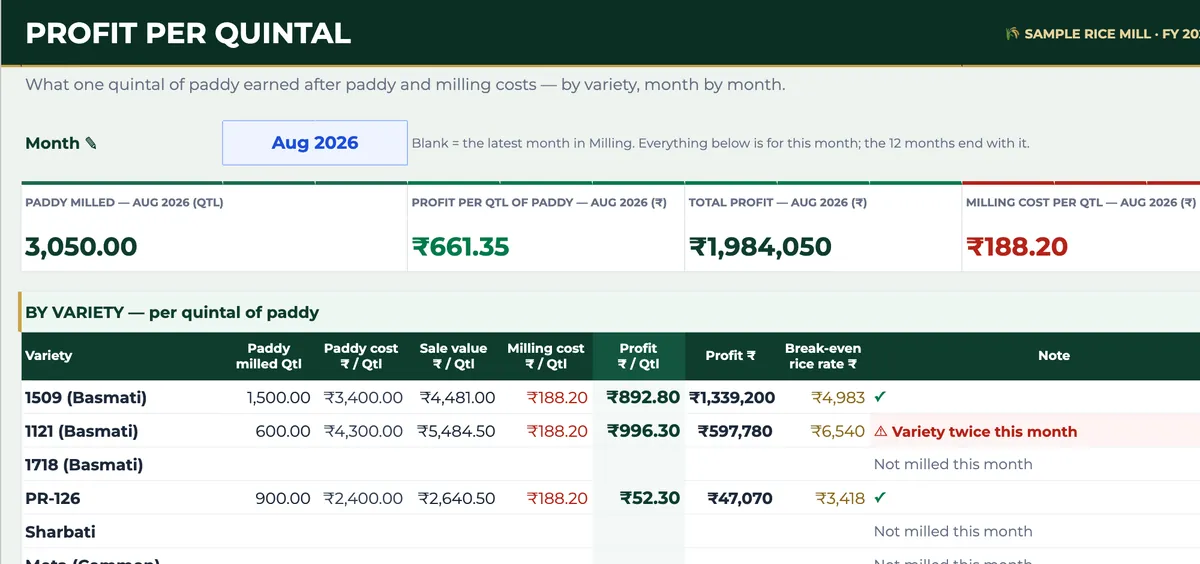
A mill’s monthly accounts say whether the month made money; they rarely say which paddy made it. This workbook works it out per quintal of paddy milled. For each variety it adds up the sale value of everything a quintal gives — rice and every by-product, at that month’s rates and your own outturn percentages — takes off the landed paddy cost, and takes off the month’s running costs spread over all the paddy milled. The result is profit per quintal and total profit by variety, month by month, with the rice rate at which each variety would only break even.
₹1,499 on Gumroad · Google Sheets (your own copy) · Filled example · Quick Start Guide (PDF) · Delivered by email — see what’s inside below.
What it does
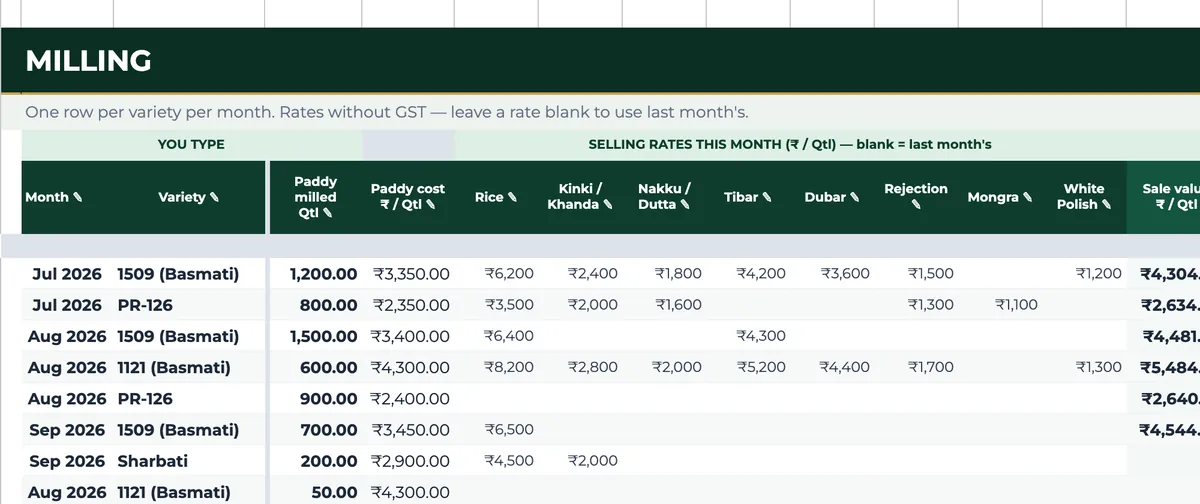
Four working tabs sit behind the Start Here page. Setup holds your varieties and, for each, the outturn of every item from one quintal of paddy — rice, kinki or khanda, nakku or dutta, rice bran, husk, tibar, dubar, rejection, mongra and white polish — with a From date, so a new season’s percentages apply to new months without rewriting old ones. Milling takes one row per variety per month: quintals milled, the landed paddy cost per quintal and that month’s selling rates, where a blank rate carries last month’s forward. Month Costs takes the month’s husk and rice bran rates and what running the mill cost: labour and palledari, power, diesel, bags, repairs and spares, staff salary, interest, freight on sales, selling costs and other. Profit then does the arithmetic for any month you pick: sale value per quintal of paddy as the sum of each item’s outturn times its rate, milling cost per quintal as the month’s costs divided by all paddy milled, profit per quintal and in total for each variety, where the month’s money went item by item, one quintal broken down line by line, the break-even rice rate, and the last twelve months. A status column on Milling names what is missing — a variety entered twice in a month, a month with no costs yet, a variety with no outturn set.
Who it’s for
- Rice mill owners and partners who want to know which variety carried the month.
- Managers deciding what paddy to buy more of next season, on margin rather than on volume.
- Mills whose accounts show one profit figure for the year and nothing per variety.
Fields included
How to use it
- On Start Here, type the business name and the date your financial year starts (1 April in India).
- In Setup, list your varieties and the outturn % of each item per quintal of paddy; add a dated row when a season changes the outturn.
- Each month, add one row per variety in Milling: quintals milled, landed paddy cost per quintal and that month’s selling rates (leave a rate blank to reuse last month’s).
- Add the month in Month Costs: husk and rice bran rates and every running cost from your books.
- Pick the month on Profit to read profit per quintal and total profit by variety, the milling cost per quintal and the break-even rice rate.
- Clear any ⚠ message in the Milling status column before relying on the month.
Preview
₹1,499
Get it on Gumroad ↗Google Sheets (your own copy) · Filled example · Quick Start Guide (PDF) · Delivered by email
Sold by Jay Sudha. Checkout and delivery by Gumroad.
Example workflow
The EXAMPLE file is a sample mill’s July to September 2026. In August it milled 3,050 quintals of three varieties, and the month’s running costs of ₹5,74,000 came to ₹188.20 per quintal. 1509 Basmati, landed at ₹3,400, gave items worth ₹4,481 per quintal and earned ₹892.80 a quintal after milling cost — ₹13,39,200 on 1,500 quintals. 1121 Basmati earned ₹996.30 a quintal. PR-126, landed at ₹2,400, gave ₹2,640.50 of sale value and cleared its paddy and milling cost by ₹52.30 a quintal, or ₹47,070 on 900 quintals. All three were profitable, but one of them was carrying almost none of the month. The same file shows the checks at work: a second 1121 row in August is flagged, September has milling rows but no Month Costs yet, and Sharbati has no outturn in Setup — each of those rows says what it is missing.
Frequently Asked Questions
Reviews
No reviews yet.
Bought this template? Review it
I read every review and publish it here, with the name you give, once I have matched your email to a Gumroad purchase. Your email is never shown. Privacy Policy