Template
Paddy Hulling Profit Calculator
The rate agreed for paddy is not the rate a mill ends up paying. Paddy bought at 17% moisture and hulled at 13% loses weight before it reaches the huller, and the money paid for that water is spread over fewer quintals. This calculator settles one batch at a time: you type the paddy rate, the weighbridge quantity, the purchase and target moisture, your processing costs and the recovery and rate of each product, and it returns the driage, the effective rate per quintal of dry paddy, net profit, cost per kg of rice, and the highest paddy rate and lowest rice rate at which the batch still breaks even.
₹999 on Gumroad · Google Sheets (your own copy, with a worked batch) · Quick Start Guide (PDF) · Delivered by email — see what’s inside below.
What it does
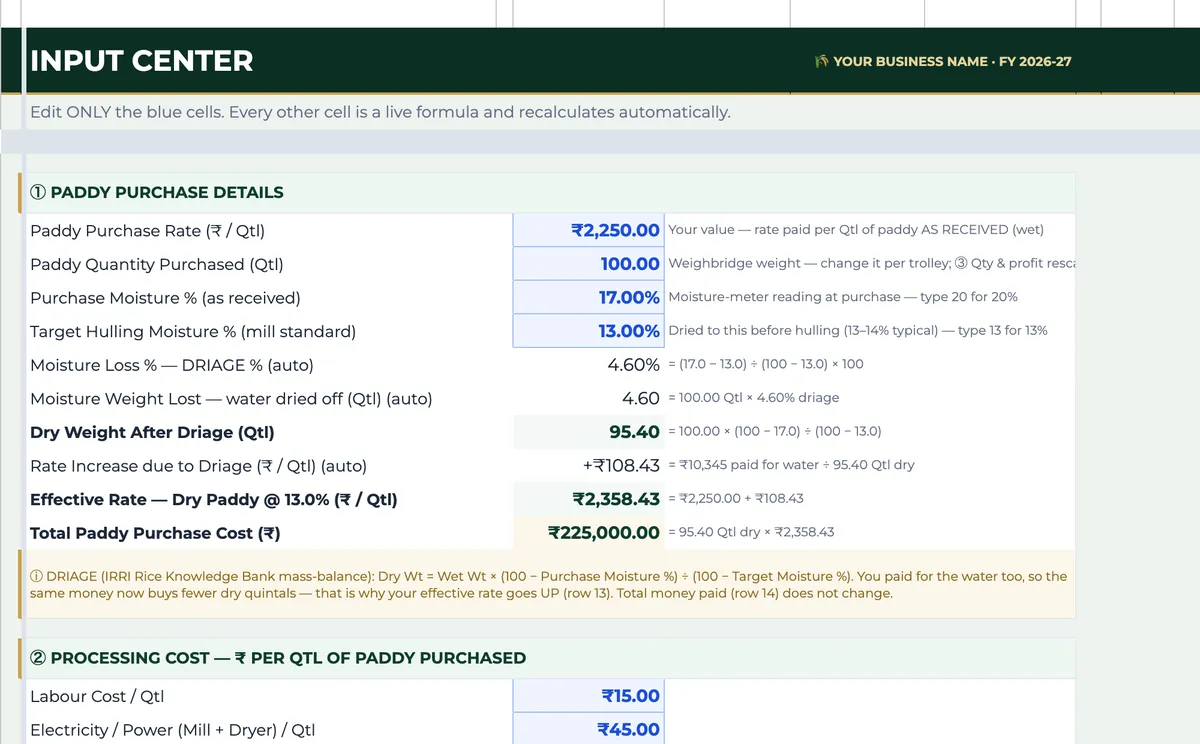
Everything starts on the Input Center tab, where only the blue cells take typing. The first block works out driage with the dry-matter formula — dry weight equals wet weight × (100 − purchase moisture) ÷ (100 − target moisture) — and the Moisture & Driage tab puts that side by side with the common shortcut of subtracting moisture points, so you can see how much dry paddy the shortcut invents. The second block adds processing cost per quintal: labour, power for the mill and dryer, bags, loading, unloading and miscellaneous, plus agent commission and truck freight, which the sheet charges only when you set the paddy source to Agent. The third block takes a recovery percentage and a selling rate for each of eight products — rice, polish, bhussi, dwar, nakku, khanda, rejection and tiwar, all renameable — and checks that they add up to your target. From there the Dashboard states in one line whether the batch made money; Profit Analysis splits revenue and cost by line and bridges them to net profit; Scenario Planner moves the purchase rate, moisture and rice rate up and down; Daily Planner scales the batch to trolleys per day and a month and a year; Recovery Benchmark sets your rice out-turn against the FCI ratio, kept as an editable value; and Report prints the batch on one page.
Who it’s for
- Rice millers and partners who buy paddy every day and want the profit on a trolley before paying for it.
- Purchase in-charges comparing a farmer’s offer with an agent’s, where commission and freight change the answer.
- Anyone buying paddy at high moisture who wants the drying loss priced into the rate instead of guessed.
- Mill owners who need a one-page batch statement for a partner, an accountant or the bank.
Fields included
How to use it
- On Start Here, type your mill name and the date your financial year starts; the Dashboard heading and the Report pick them up.
- In the Input Center, type the paddy rate per quintal as received, the weighbridge quantity, and the purchase and target hulling moisture.
- Fill your processing costs per quintal and set Paddy Source to Farmer or Agent — commission and truck freight apply only to agent paddy.
- Type the recovery % and selling rate of each product; the total is checked against your target (99% in the example).
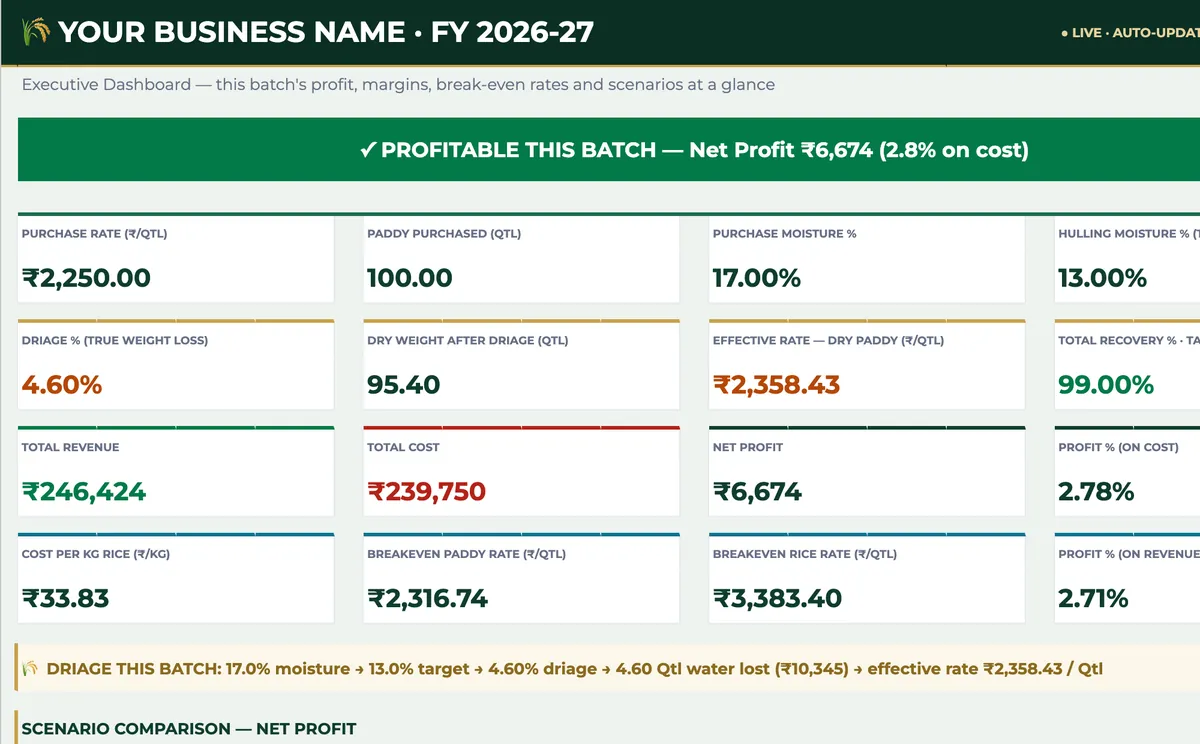
- Read the Dashboard: net profit, effective dry-paddy rate, cost per kg of rice and both break-even rates.
- Try better and worse conditions in Scenario Planner, then scale the batch to trolleys per day in Daily Planner.
- Print or save the Report tab as a PDF when someone else needs to see the batch.
Preview
₹999
Get it on Gumroad ↗Google Sheets (your own copy, with a worked batch) · Quick Start Guide (PDF) · Delivered by email
Sold by Jay Sudha. Checkout and delivery by Gumroad.
Example workflow
The calculator ships with a worked batch in its blue cells, meant to be typed over. It buys 100 quintals of agent paddy at ₹2,250 a quintal at 17% moisture and hulls it at 13%. Driage comes to 4.60%, so 95.40 quintals of dry paddy are left and the effective rate rises by ₹108.43 to ₹2,358.43 a quintal; the shortcut of subtracting moisture points would have said 4.00% and counted 0.60 quintal of paddy that does not exist. Processing, commission and freight add ₹147.50 a quintal, making the total cost ₹2,39,750. With rice at 60% recovery and ₹3,500 a quintal and the other seven products making up the rest of a 99% recovery, revenue is ₹2,46,424 and the batch earns ₹6,674, or 2.78% on cost. The break-even line then says the same paddy at that moisture could not have been bought above ₹2,316.74, and the rice could not have sold below ₹3,383.40. Scenario Planner shows how thin that is: ₹50 more for the paddy, three moisture points higher and rice ₹150 cheaper turn it into a loss of ₹15,509.
Frequently Asked Questions
Reviews
No reviews yet.
Bought this template? Review it
I read every review and publish it here, with the name you give, once I have matched your email to a Gumroad purchase. Your email is never shown. Privacy Policy