Budgeting on Variable Income India: A System for Freelancers and Self-Employed
How to build a budget that works when income changes month to month — the floor income method, income smoothing, and advance tax for Indian freelancers.
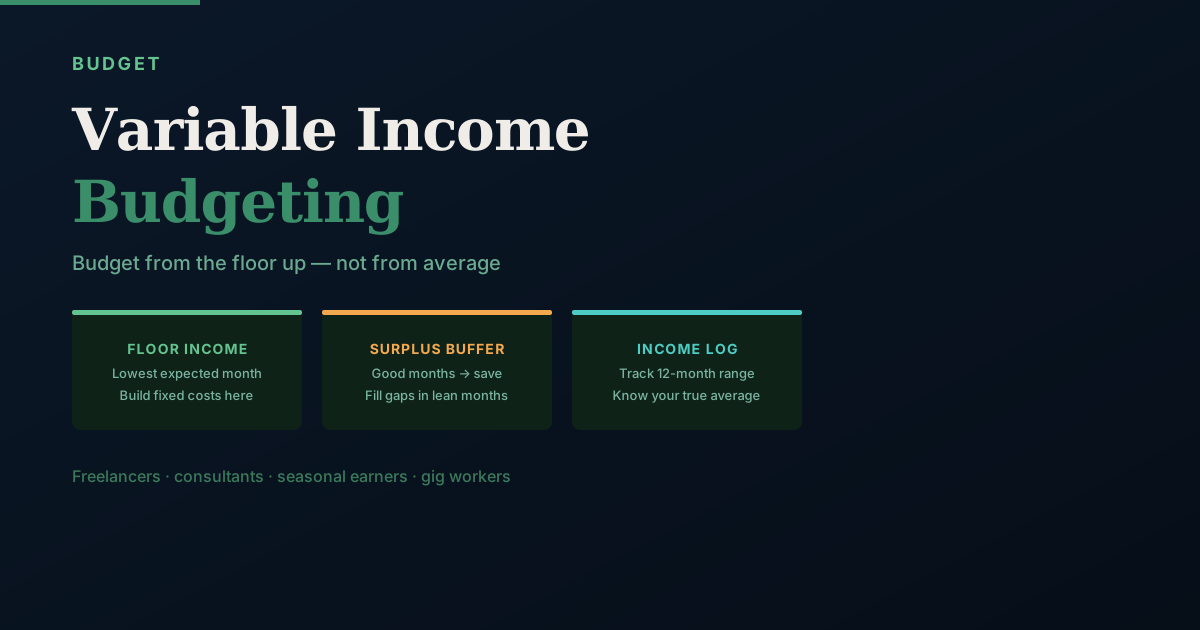
A fixed salary allows a fixed budget. Variable income — from freelancing, consulting, commission-based work, or business ownership — requires a different architecture. The approach most freelancers use (budgeting based on the best recent month) fails in slow months. The approach that works is based on floor income and tiered allocation.
I have run businesses tied to a harvest cycle, where income is genuinely lumpy by design, not by bad luck — and the floor-income idea is exactly the discipline that made it survivable: plan against the worst realistic month, not the best one you happen to remember.
The floor income concept
Floor income is the minimum you have reliably earned across the past 12 months. Not the average — the minimum.
If your monthly income over the past year was: ₹60k, ₹90k, ₹45k, ₹1.2L, ₹55k, ₹80k, ₹40k, ₹1L, ₹75k, ₹65k, ₹50k, ₹85k — your floor income is ₹40,000.
Your essential expenses budget must fit within this floor. If they don't, you have a structural deficit and need to either cut essential expenses or raise floor income before any other financial planning makes sense.
The tiered allocation order
When income arrives (whether at a fixed date or irregularly), allocate it in this order:
Tier 1 — Fixed essentials: Rent/EMI, utilities, insurance premiums, school fees, groceries, transport. These are paid first, from the floor income budget.
Tier 2 — Advance tax set-aside: Approximately 25–30% of each payment received above floor goes into a dedicated advance tax savings account. Do not touch this money. It belongs to the government.
Tier 3 — Emergency fund (if not yet complete): If your emergency fund is below the 6-month target, any surplus above Tiers 1–2 goes here first.
Tier 4 — Investments: SIPs, PPF contributions, NPS — funded after Tiers 1–3 are covered.
Tier 5 — Discretionary: Dining, entertainment, travel. Only funded with what remains after Tiers 1–4.
In a strong month (₹1.2 lakh), Tiers 1–4 are funded and there is room for discretionary spending. In a weak month (₹40k), only Tiers 1–2 are funded, SIPs are skipped or reduced, and discretionary spending is minimal.
The income smoothing account
Many variable income earners find it helpful to maintain an income smoothing account — a separate savings account that acts as a buffer.
The mechanism: every payment received goes into the smoothing account first. Each month, you transfer a fixed "salary" to yourself (equal to your floor income or slightly above) regardless of what arrived that month. In high-income months, the surplus builds in the smoothing account. In low-income months, you draw from the balance.
This converts variable income into a consistent monthly "salary" for budgeting purposes. The buffer account should never fall below your floor income times two or three months.
Planning for advance tax with variable income
The advance tax system assumes you can predict your annual income, which is difficult when income is irregular. A practical approach:
- After each quarter ends, estimate your year-to-date income and project the year's total.
- Calculate the estimated tax on the projected total.
- Check how much advance tax you have already paid.
- Pay enough to meet the required cumulative percentage for that due date.
The "safe harbour" rule allows you to pay advance tax based on the previous year's tax liability — paying 100% of last year's tax in advance avoids 234B/C interest even if this year's income turns out higher.
Keep 25–30% of every payment in a separate account. Pay it on due dates. What remains after March 31 tax payment is yours.
What to do with irregular large payments
When a large project payment arrives — ₹5 lakh for a completed contract — resist the temptation to spend the windfall immediately. The tiered approach still applies:
- Set aside advance tax component immediately (25–30%)
- If emergency fund is incomplete, top it up
- Park the investment portion in a liquid fund or sweep FD until you can determine the regular allocation amount
- Leave discretionary spending for what genuinely remains
Variable income creates feast-or-famine psychology that leads to overspending in good months and stress in lean months. The smoothing account and tiered allocation convert that psychology into a more stable financial operating system.
A Worked Household Example
Deepa is a graphic designer in Bangalore who left full-time employment in 2023 and now works with three to five clients at a time. Her income over the past 12 months:
| Month | Income |
|---|---|
| April | ₹42,000 |
| May | ₹78,000 |
| June | ₹95,000 |
| July | ₹1,12,000 |
| August | ₹38,000 |
| September | ₹67,000 |
| October | ₹1,05,000 |
| November | ₹83,000 |
| December | ₹44,000 |
| January | ₹91,000 |
| February | ₹72,000 |
| March | ₹1,18,000 |
Her floor income: ₹38,000 (August was the worst month).
Her essential fixed expenses: Rent ₹16,000, groceries ₹6,000, utilities ₹2,500, health insurance ₹1,800, internet and phone ₹1,200. Total: ₹27,500. These fit comfortably within the ₹38,000 floor, leaving ₹10,500 for advance tax provisioning even in the worst month.
Her smoothing account: Every client payment hits a dedicated savings account (she uses a zero-balance savings account with no minimum balance requirement). On the 1st of each month, she transfers ₹65,000 to her primary spending account — which she treats as her fixed "salary." Over the year, she received ₹9,45,000 total. She transferred ₹7,80,000 to herself as 12 × ₹65,000. The remaining ₹1,65,000 sits in the smoothing account as the buffer for a slow start to next year.
Setting Up a Separate Account for Business Income
The account structure for a freelancer is worth building deliberately:
Account 1 — Client receipts (current or savings): All invoices are raised to this account number. Clients pay here. Nothing is spent from this account directly.
Account 2 — Advance tax provision account: On receipt of any payment, Deepa immediately transfers 28% to this account. She chose 28% (slightly above the 25% floor) because she has some capital gains from an index fund she sold. The money in this account belongs to the government; she does not include it in her mental accounting of available funds.
Account 3 — Operating/spending account: The fixed monthly transfer (her "salary") goes here. All day-to-day expenses and EMIs are paid from here.
Account 4 — Emergency fund: Liquid mutual fund, 6 months of essential expenses (~₹1.65 lakh). Untouched except for genuine emergencies.
This four-account structure is not complex to maintain. Most banks allow multiple savings accounts. The separation removes the temptation to spend advance tax money in a good month.
Managing GST Obligations Alongside Advance Tax
For freelancers and consultants whose annual turnover exceeds ₹20 lakh (₹10 lakh for some service categories), GST registration is mandatory. For those registered:
- GST collected from clients (typically 18% on services) is not your income — it belongs to the government.
- GSTR-1 (outward supplies) and GSTR-3B (summary return) are filed monthly or quarterly depending on your turnover.
- Input Tax Credit on business expenses reduces the GST payable.
The practical implication for cash flow: if you invoice a client ₹1,00,000 + 18% GST = ₹1,18,000 total, only ₹1,00,000 is your income. The ₹18,000 needs to be provisioned separately for remittance. Many freelancers mistakenly treat the gross receipt as their income and run into difficulty when the GST return is due.
A simple rule: maintain a third sub-account or earmark specifically for GST collected. Never count it in your income.
Variable Income and Investments: The SIP Dilemma
SIPs are designed for fixed monthly investments — which is convenient for salaried earners but awkward for variable income earners. Two approaches work:
Option 1 — SIP from the smoothing account transfer. Since Deepa pays herself a fixed ₹65,000 "salary" each month, she can run a ₹10,000 SIP auto-debit on the 5th just like a salaried employee. The smoothing account makes this possible.
Option 2 — Invest a percentage of each receipt. If no smoothing account exists, invest 15–20% of every client payment within 48 hours of receiving it, directly into a liquid fund or index fund via lump sum. This is less disciplined than a SIP in terms of timing but ensures investment happens proportional to income rather than waiting for a fixed date.
For NPS and PPF, which have annual deposit amounts rather than monthly mandates, the variable income earner can accumulate in a liquid fund throughout the year and make lump sum contributions in January–February to meet the annual target.
The Emotional Dimensions of Variable Income Budgeting
Two psychological traps are particularly common:
The good month bonus mindset: When October brings ₹1,05,000, it feels like a windfall. The natural impulse is to upgrade something — a better phone, a vacation, a restaurant splurge. The tiered allocation interrupts this: advance tax first, emergency fund top-up if needed, investments next. What remains after these is genuinely available for improved lifestyle. This sequence changes the psychology from "I earned a lot, so I should spend" to "I followed the system and the remainder is genuinely mine."
The lean month panic: August at ₹38,000 feels catastrophic if there is no smoothing account. The salary account sits at an unusually low number; everything feels precarious. With a smoothing account that has absorbed previous good months, the August withdrawal still results in the same ₹65,000 personal salary. The panic is absent because the system is working as designed.
Health Insurance and Benefits Without an Employer
One frequently overlooked consequence of variable/freelance income is the loss of employer-sponsored health insurance. A salaried professional may have a ₹5 lakh family floater provided by the employer at no cost. A freelancer has no such coverage.
For Indian freelancers and consultants, health insurance is a significant fixed expense that must be planned for explicitly:
A standard individual mediclaim policy (sum insured ₹5 lakh) for someone aged 30–35 costs approximately ₹6,000–10,000/year through insurers like Star Health, HDFC ERGO, or Niva Bupa. A family floater (self + spouse + two children, ₹10 lakh sum insured) costs ₹18,000–30,000/year. A super top-up policy (deductible-based, adding another ₹20–30 lakh coverage) adds ₹8,000–15,000/year.
This annual premium is a fixed obligation that should sit in Tier 1 of the tiered allocation — not a discretionary expense to skip in a lean month. Missing a health insurance premium causes lapse or waiting periods, which can be catastrophic if a health event follows.
Practically: build the annual premium into your monthly sinking fund. A ₹24,000 annual premium divided by 12 is ₹2,000/month allocated to the insurance sinking fund. The premium payment when due draws from this fund rather than disrupting the month's cash flow.
Retirement Savings Without EPF
Salaried employees benefit from mandatory EPF contributions — a form of forced savings that builds over a career. Freelancers and self-employed individuals have no equivalent.
This makes voluntary retirement saving both more important and more difficult for variable income earners. Without EPF, the entire retirement corpus must come from deliberate savings choices.
Two instruments are particularly well-suited for self-employed retirement savings in India:
NPS (National Pension System): Open to any Indian citizen. Minimum ₹1,000/year contribution. Tax deductible under Section 80CCD(1) up to 20% of gross income (for self-employed, within the overall 80CCD limit). Additional ₹50,000 deduction under 80CCD(1B) over and above the 80C limit — relevant even under the old regime. The portfolio is long-dated and equity-oriented for younger contributors. Lock-in until age 60 (with partial withdrawal provisions for specific needs). Managed through any NPS-registered Point of Presence (PoP) or via eNPS online.
PPF: Long-standing fixed-return instrument. Currently 7.1% per annum, compounded annually. EEE status — investments, returns, and maturity proceeds are all tax-free. Maximum ₹1.5 lakh/year. 15-year lock-in with partial withdrawal from year 7. Not equity-linked, so returns are lower but predictable. An excellent complement to an NPS account, providing the stability portion of the retirement portfolio.
The recommended approach for a freelancer targeting retirement savings: open both a PPF and an NPS account, contribute what is affordable each year, and treat these contributions as part of Tier 4 in the tiered allocation — funded after essentials, taxes, and emergency fund, before purely discretionary spending.
Related calculatorbudget calculator
Frequently Asked Questions
Sources and references
- Goods and Services Tax — Official GST Portal, Government of India
- Income Tax Department, Government of India
Rules, rates, and thresholds in India change over time. Always confirm the current position with the official source above before acting on it.