How to Categorise Your Expenses and What the Data Tells You
Categorising expenses is the foundation of every working budget. Learn which categories to use, how to handle tricky transactions, and what spending shows.
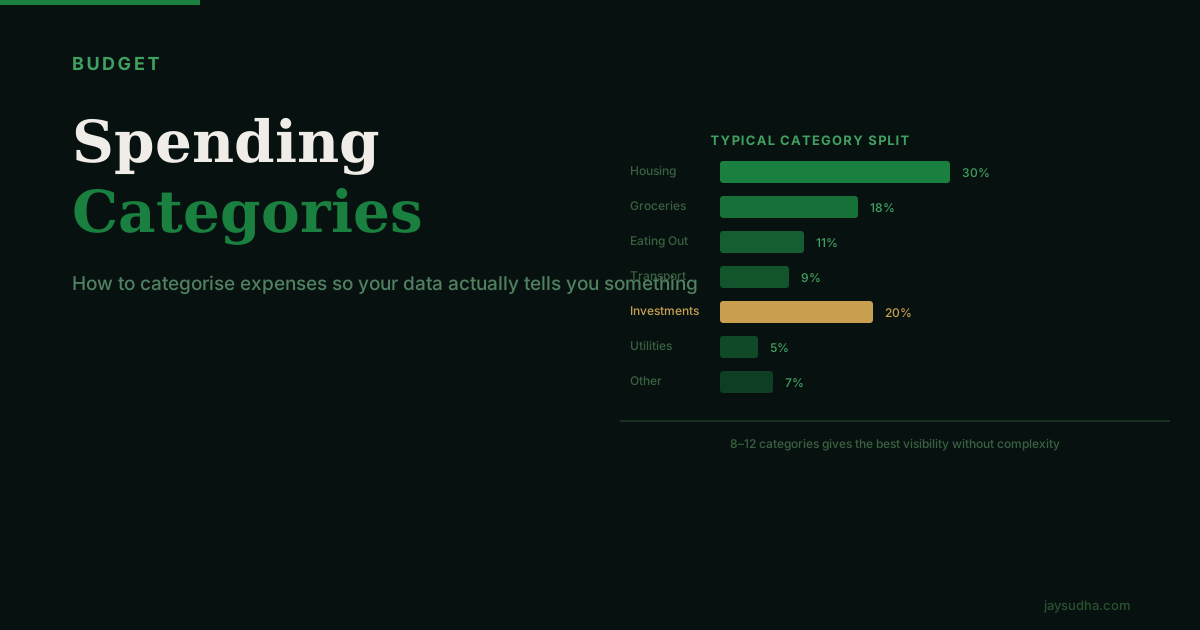
Most budget breakdowns fail not because people spend too much, but because the categories they use don't tell them anything useful. "Miscellaneous" growing every month. "Other" absorbing what should be specific line items. Categories so broad you can't tell whether your grocery spend includes the pharmacy or not.
Getting categories right is not glamorous work. But the payoff is real: a properly categorised six-month history tells you more about your financial habits than any amount of willpower journaling.
The Purpose of Categories
A category isn't just a label. It's a decision unit. When you review your spending, you make decisions at the category level: this category is fine, this one is too high, this one I want to grow.
That means categories need to be:
Actionable — you can actually change spending in this category if you decide to. "Eating out" is actionable. "Food" (which combines eating out and groceries) is not, because the fix for overspending on restaurants is different from the fix for overspending on groceries.
Meaningful — the amount is large enough to matter. It doesn't make sense to have a category for "newspapers" if that's ₹150/month. Fold it into Media or a general miscellaneous.
Consistent — the same transaction type goes to the same category every time. If a grocery delivery goes to Food one month and Online Shopping another, you can't track trends.
A Practical Category System for Indian Households
Here is a starting framework. Adapt it to your situation — the goal is a system you'll maintain, not the theoretically perfect taxonomy.
Housing (typically 25–35% of income)
Everything related to where you live:
- Rent or home loan EMI
- Maintenance charges
- Property tax (if you pay quarterly or annually, divide by 12 and set aside monthly)
- Home insurance premium
- Repairs and maintenance (plumber, electrician, painting)
Note on home loan EMI: Some people split this into principal and interest components for net worth tracking purposes. For day-to-day budgeting, treating the full EMI as a housing cost is simpler and works fine.
Food and Groceries (typically 15–25%)
- Supermarket and kirana purchases
- Fruits and vegetables
- Online grocery orders (BigBasket, Blinkit, Zepto)
- Dairy delivery
Keep eating out as a separate category — see below.
Eating Out and Food Delivery (typically 5–15%)
- Restaurants, cafés, and QSRs
- Swiggy, Zomato, and similar platforms
- Coffee shops
- Office canteen and outside meals
This warrants its own category because it's the most elastic food expense — it can be cut significantly when needed, whereas groceries cannot. Combining it with groceries hides that option.
Transport (typically 5–12%)
- Petrol or diesel (log by fill-up amount, not per-journey)
- Metro and bus passes
- Ola and Uber
- Auto-rickshaw and taxi fares
- Vehicle loan EMI (if applicable — many people prefer to put this under Loans)
- Parking and tolls
If you have a vehicle loan, decide whether EMI goes here or under Loans and be consistent.
Utilities (typically 2–5%)
- Electricity
- Water and piped gas
- Cooking gas (LPG cylinder)
- Internet (broadband and mobile data)
- Mobile phone plan
Utilities are largely fixed or fixed-ish. Tracking them separately helps you notice if an electricity bill is unusually high or if you're paying for internet speeds you don't need.
Healthcare (variable, budget ₹2,000–5,000/month for a family)
- Doctor consultations
- Medicines and pharmacy bills
- Lab tests and diagnostics
- Health insurance premium (if not covered by employer)
- Dental and optical expenses
Healthcare is lumpy — you may spend nothing for three months and then have a large expense. A monthly budget here should be thought of as an average across the year rather than a hard monthly cap.
Children's Education and Activities (if applicable)
- School fees
- Coaching and tuition
- Books, stationery, uniforms
- School transport
- Extracurricular classes (sports, music, coding)
For most families with school-going children, this is a substantial fixed cost. Separating it makes the budget reflect reality — it's a non-negotiable expense with its own dynamics.
Savings and Investments (target: 20–30% of income)
This is not technically a spending category — it's money leaving your account before it can be spent. But it belongs in your budget tracker for two reasons: to confirm investments are actually happening and to see your savings rate at a glance.
Track:
- Monthly SIP contributions
- PPF deposits
- NPS contributions
- Emergency fund top-ups
- Any other regular savings
Insurance Premiums (if not auto-categorised under specific types)
- Term life insurance
- Vehicle insurance
Health insurance premium can go here or under Healthcare — pick one and be consistent.
EMIs and Loan Repayments (if not already under Housing/Transport)
If you have a personal loan, consumer durable loan, or education loan not captured elsewhere, list those EMIs here. This category gives you a quick view of your total debt service load.
Subscriptions and Digital Expenses (typically 1–3%)
- Netflix, Amazon Prime, Disney+, other OTT
- Music streaming (Spotify, JioSaavn)
- Software subscriptions (Microsoft Office, Adobe)
- Cloud storage (Google One, iCloud)
- News and magazine subscriptions
- App purchases
This category is worth tracking because subscriptions are easy to forget. Six months of statements often reveal services that haven't been used in months.
Personal Care and Grooming
- Salon and barbershop visits
- Beauty and skincare products
- Gym membership
- Personal hygiene products (toothpaste, soap, shampoo — though many put these in groceries)
Shopping and Discretionary
Everything that doesn't fit neatly elsewhere:
- Clothing and footwear
- Electronics and gadgets
- Home furnishings
- Books (non-school), games
- Gifts purchased for others
Some people split this further — a Clothing category, a Gifts category — depending on how large these amounts typically are.
Irregular and Annual Expenses
This is the category most budgets forget, and it's why January feels financially punishing in many households.
Annual expenses that need to be smoothed monthly:
- Vehicle insurance renewal
- Property tax
- Annual subscriptions
- Vacation and travel
- Festival spending (Diwali gifts, festival-related purchases)
- Home repairs and painting
Calculate the expected annual total for all of these, divide by 12, and transfer that amount monthly to a separate "irregular expenses" savings bucket. When the expense hits, you have the money. This is the cure for the "unplanned expense" that blows every budget.
What Your Spending Pattern Tells You
Once you have three months of properly categorised data, the numbers reveal things willpower alone doesn't.
The savings rate number is the most important single metric. Take total savings and investments divided by total income. If it's above 20%, you're building real financial capacity. If it's below 10%, the budget review should focus on finding five to eight percentage points — not through suffering, but through specific category decisions.
Look for the categories where spending varies most month to month. High variance categories are where most financial surprise comes from. If eating out varies between ₹3,000 and ₹12,000 month to month, that's a category to watch — it's pulling your budget in unpredictable directions.
Look for categories where you're paying for things you don't use. Subscriptions not accessed. Gym membership with no visits. TV package with channels nobody watches. These aren't moral failures — they're just friction that needs removing.
Housing plus transport plus debt payments together tells you your fixed obligation ratio. If this exceeds 50% of income, you have very little flexibility to absorb shocks or save aggressively. Below 40% is comfortable. Below 30% gives you real room to build.
The gap between what you intend to spend and what you actually spend is the most useful data point of all. In every category where actual is consistently higher than intended: either the intention was unrealistic (adjust the budget) or the behaviour needs to change (adjust the habit). Knowing which it is requires data.
Handling Tricky Transactions
Some transactions don't fit neatly anywhere. Here's how to handle the common ones:
ATM cash withdrawals: If you routinely use cash for small purchases, track what that cash goes toward and allocate it to the relevant categories at month end. If you can't reconstruct it, create a "Cash spending" category and accept that it's a tracking limitation — it shouldn't be a significant number if most spending is digital.
Amazon and Flipkart orders: These are multi-category traps. A single order might have groceries, electronics, and household supplies. Options: (a) classify by the primary item, (b) split the transaction in your tracker if the amounts are large enough to matter, or (c) have a single "Online Shopping" category and accept the loss of granularity. Most people choose (c) and it works fine unless online shopping is significant.
Petty cash and very small purchases: Don't chase every ₹20 transaction. Below some threshold (typically ₹100–200), just accept a small tracking error rather than spending time you won't recover.
Salary advance or bonus: This is income, not a spending category. Track it as income in the month received.
Credit card vs UPI transactions: Categorise by what was purchased, not by payment method. A restaurant bill paid by credit card still goes in Eating Out.
Setting Up the System
The minimum setup is a single Google Sheets tab with columns: Date, Description, Amount, Category, Notes.
At month end, export your bank statement and credit card statement, paste into the sheet, and assign categories. Once you've done this for three months, the patterns become clear enough to set realistic category budgets going forward.
The temptation is to start with a detailed budget and then track against it. The better sequence is the reverse: track first, observe patterns for three months, then set a budget based on what you actually spend rather than what you imagine you spend. Budgets built on real data have a much higher chance of working.
The India-Specific Category: Family Transfers and Social Obligations
Most Western budgeting frameworks omit a category that is significant for many Indian professionals: money sent to or spent on family outside the immediate household.
This includes:
- Monthly transfer to parents (₹5,000–20,000 is common for professionals supporting aging parents)
- Contributions to a sibling's education or household expenses
- Gifts for relatives' weddings, children's naming ceremonies, housewarming events
- Contribution to a family function (pooja, death anniversary, festival)
These expenses resist simple categorisation. They are partly voluntary and partly obligatory. They carry strong social and emotional weight. But they are real cash outflows that belong in your category system.
A practical approach: create a "Family and Social" category with a realistic monthly average based on your last 12 months. For months with a major family event (wedding, large festival), the category will exceed the average — which is fine and expected. Track it at the category level rather than trying to further subdivide it into "parents' monthly" and "wedding gift for cousin" subcategories, unless the amounts are large enough to warrant that.
What this category reveals over time: households that have never tracked it often discover they are sending 8–12% of take-home to family and social obligations. This is not wrong — these are real priorities. But knowing the number converts it from a vague drain to a funded, explicit commitment.
Category Benchmarks for Indian Households
Once you have 3 months of categorised data, compare your percentages against these indicative ranges for metro households. These are not targets — they are reference points. Your actual numbers will vary by city, family size, and housing situation.
| Category | Low Range | Typical Range | High Range | Notes |
|---|---|---|---|---|
| Housing (rent/EMI) | 20% | 28–35% | 45%+ | Mumbai and Delhi skew high |
| Food (groceries) | 7% | 10–15% | 18% | Family size matters |
| Dining and delivery | 3% | 6–12% | 18% | The most controllable food category |
| Transport | 4% | 7–12% | 15% | Vehicle EMI pushes this high |
| Utilities + phone | 2% | 4–6% | 8% | AC-heavy summers spike electricity |
| Healthcare | 1% | 2–4% | 8% | Lumpy — average across the year |
| Education (children) | 0% | 5–12% | 20% | Private school costs in metros |
| Personal care | 1% | 2–4% | 7% | Premium salons and skincare skew high |
| Entertainment + subscriptions | 1% | 3–5% | 8% | |
| Family and social | 2% | 5–10% | 15% | First-generation earners skew high |
| Savings and investments | 5% | 18–25% | 40%+ | This should be the ambition |
The two numbers worth comparing every quarter: your housing percentage (is it controllable or structurally fixed?) and your savings percentage (is it improving over time?). Every other category is a lever that affects these two outcomes.
Frequently Asked Questions
Sources and references
Rules, rates, and thresholds in India change over time. Always confirm the current position with the official source above before acting on it.