Section 80C Deductions: The Complete Guide for Salaried Indians
Section 80C lets you cut taxable income by up to ₹1.5 lakh via investments and expenses. Learn what qualifies and how to use it without locking up cash.
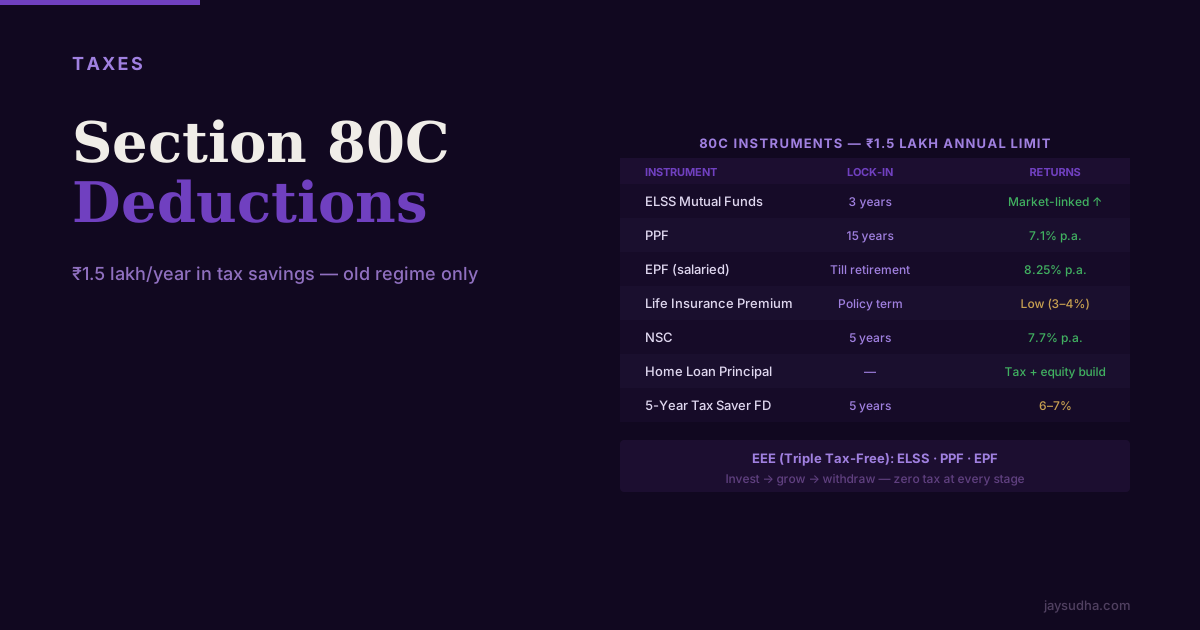
Section 80C is the most widely used tax deduction in India — and also one of the most misunderstood. Many people make 80C investments in a rush in January or February, locking money into products they don't fully understand, just to "save tax."
The result is portfolios cluttered with insurance-investment hybrids, long lock-ins for small benefits, and liquidity tied up in the wrong instruments.
This guide explains what 80C actually covers, how to claim it properly, and how to use it intelligently — so tax saving and financial planning point in the same direction.
What Section 80C Does
Section 80C of the Income Tax Act allows you to deduct up to ₹1,50,000 from your gross total income in a financial year. This reduces the amount of income on which you pay tax.
Example:
- Gross total income: ₹9,00,000
- 80C investments: ₹1,50,000
- Taxable income: ₹7,50,000
If you're in the 20% bracket, ₹1.5 lakh in 80C deductions saves ₹30,000 in tax. If you're in the 30% bracket, the saving is ₹45,000.
The deduction requires no special process — you declare your 80C investments in your ITR filing. Salaried employees can also provide proof to their employer to have TDS reduced throughout the year.
A note on the section number. The Income-tax Act, 2025 replaced the 1961 Act from 1 April 2026, and it renumbers this deduction: for FY 2026-27 (AY 2027-28) onwards, what everyone calls 80C sits in Section 123 read with Schedule XV. The ₹1.5 lakh ceiling, the eligible list and the old-regime-only restriction are all unchanged. Employers, banks and fund houses still print "80C" on their certificates, so this guide keeps that name.
What Qualifies Under 80C
The list is longer than most people realise:
Investment Products
Small savings rates (PPF, NSC, SCSS, SSY) are reset every quarter. The figures below are the July–September 2026 rates, which the Finance Ministry left unchanged for the ninth quarter running — check the current quarter's notification before you rely on them.
ELSS (Equity Linked Savings Scheme): Mutual fund schemes that invest primarily in equities and come with a mandatory 3-year lock-in. Among the most efficient 80C instruments — potentially higher returns than other options, shortest lock-in among tax-saving instruments, and can build long-term wealth. Monthly SIP into an ELSS counts toward 80C (each SIP instalment starts its own 3-year lock-in).
PPF (Public Provident Fund): Government-backed savings with a 15-year lock-in, currently earning 7.1% per annum — a rate unchanged since the April–June 2020 quarter. EEE status — contribution, accumulation, and maturity are all tax-free. Partial withdrawal permitted from year 7. Safe, but illiquid. Annual contribution minimum ₹500, maximum ₹1.5 lakh.
EPF (Employee Provident Fund): Your employee contribution to EPF (12% of basic salary) qualifies for 80C. Voluntary additional contributions (VPF) also qualify. This is often the largest 80C claim for salaried employees and requires no additional investment decision — it's already happening automatically.
NPS (National Pension System) — Tier I: Contributions to NPS Tier I qualify under 80C (up to ₹1.5 lakh limit), and additionally an extra ₹50,000 is available under 80CCD(1B), which is separate from and additional to the 80C ceiling. Lock-in until retirement (with partial withdrawal exceptions). On maturity, 40% must be used to purchase an annuity.
ULIP (Unit Linked Insurance Plan): Insurance products with investment components. Qualify for 80C if premium paid is up to 10% of the sum assured. Lock-in is 5 years. Generally not recommended for pure tax saving — the cost structure often makes them less efficient than separating insurance (term plan) and investment (ELSS).
Tax Saving Fixed Deposit: Bank FDs with a 5-year lock-in qualify for 80C. Interest is taxable (unlike PPF). Returns are currently around 6.5–7.5% per annum (varies by bank). Safe and liquid after 5 years. No premature withdrawal allowed during lock-in.
Sukanya Samriddhi Yojana (SSY): For girl children below age 10. Contributions qualify for 80C. Currently earning 8.2% per annum — joint-highest among small savings schemes, alongside SCSS. Account matures when the girl turns 21. EEE status — fully tax-free at all stages.
Senior Citizen Savings Scheme (SCSS): Only for those aged 60+. Quarterly interest payouts (currently 8.2% per annum). 5-year tenure, extendable by 3 years. Interest is taxable. Contributions qualify for 80C.
NSC (National Savings Certificate): Post Office scheme, 5-year lock-in, currently earning 7.7% per annum. Interest is compounded but paid on maturity. Each year's accrued interest (except the final year) also qualifies for 80C deduction. Useful for those who want safety without a 15-year lock-in.
Non-Investment Expenses
These expenditures also qualify for 80C — many people don't realise these count without any additional investment:
Home Loan Principal Repayment: The principal component of your home loan EMI qualifies for 80C. The interest component qualifies separately under Section 24(b). If your EMI is ₹50,000 and the principal portion is ₹15,000 in the early years, that ₹15,000 goes toward your 80C limit.
Stamp Duty and Registration on Property: Paid in the year of property purchase, these qualify under 80C. This is a one-time benefit in the year of purchase.
Children's Tuition Fees: School and college tuition fees paid for up to two children qualify for 80C. This must be tuition fees — development fees, admission fees, hostel charges, and transport fees do not qualify. Only for full-time courses at Indian institutions.
Life Insurance Premium: Premiums paid on life insurance policies for yourself, spouse, and children qualify — provided the premium is up to 10% of sum assured (policies issued after April 2012). This includes term plans, endowment plans, and whole life plans, but not the investment component of ULIPs (that's handled separately).
What Does NOT Qualify Under 80C
Expensive mistakes to avoid:
- Contributions to the new tax regime taxpayers (80C is only for old regime)
- Health insurance premiums (those go under 80D)
- Principal repayment on home loan before completion certificate (under construction)
- Provident Fund contributions above the statutory limit for self-employed
- NSC accrued interest in the final year of maturity
The ₹1.5 Lakh Ceiling: How to Think About It
The ₹1.5 lakh 80C ceiling means all 80C instruments combined cannot give you a deduction beyond ₹1.5 lakh. There's no benefit to investing ₹2 lakh in ELSS — the extra ₹50,000 doesn't give an additional deduction.
Check your EPF first. Most salaried people with moderate to good incomes are already contributing ₹50,000–1,50,000 annually to EPF through salary deductions. This is your starting point — you may need to invest far less in additional 80C instruments than you think.
Calculate available 80C headroom:
₹1,50,000 − Annual EPF employee contribution − Tuition fees paid − Home loan principal portion = Remaining 80C to fill
Choosing the Right Instruments
For most investors under 50 years old:
| Instrument | Lock-in | Why it Works |
|---|---|---|
| ELSS (via monthly SIP) | 3 years | Equity exposure, wealth creation, shortest lock-in |
| PPF | 15 years | Guaranteed, EEE status, good for conservative part of portfolio |
| NPS Tier I (for additional 80CCD(1B)) | Till retirement | Separate ₹50k deduction, adds retirement corpus |
Avoid:
- ULIPs — high costs, complex structures; buying term + ELSS separately is almost always better
- Endowment/money-back policies solely for 80C — the insurance component is expensive and the returns are low
- Multiple tax-saving FDs without considering that interest is taxable
If you have very long goals (15+ years): PPF is excellent. The 15-year lock-in is less of a problem if the goal is retirement or a child's education.
If you want flexibility: ELSS with a 3-year rolling lock-in gives you the most liquidity among 80C instruments while maintaining equity upside.
Timing Your 80C Investments
Don't wait until January–March. The rush to invest in the last quarter leads to lump-sum investments in whatever is easily available — often ULIPs pushed by agents, or random ELSS funds chosen without research.
For ELSS: Start a monthly SIP in April, at the beginning of the financial year. ₹12,500/month adds up to ₹1.5 lakh by March. This also rupee-cost-averages across market levels.
For PPF: April 1–5 deposits maximise the return for that year (interest is calculated on the minimum balance between the 5th and last day of the month — depositing before the 5th of April ensures 12 months of interest for that year).
Claiming 80C When Filing ITR
Under the old regime, 80C deductions are claimed in Chapter VI-A of your ITR. You declare the amounts under each eligible category. You are not required to attach investment proofs at the time of filing — but you must be able to produce them if asked.
Maintain a folder of:
- ELSS fund statements
- PPF passbook or statement
- Life insurance premium receipts
- Children's school fee receipts
- Home loan certificate from bank (showing principal and interest split)
The amount you declare must match what you actually invested. Claiming more than you invested is tax fraud.
Section 80C, used correctly, is one of the most reliable ways to reduce tax liability for salaried Indians. Used mindlessly — by buying whatever the nearest insurance agent recommends in February — it can create unnecessary lock-ins and poor returns that cost far more than the tax saved.
What Happens Beyond 80C: The Additional Deductions
The ₹1.5 lakh 80C ceiling is not the end of the deduction opportunity. Several sections provide deductions on top of 80C:
Section 80CCD(1B) — Additional NPS deduction: An extra ₹50,000 deduction for contributions to NPS Tier I, completely separate from the 80C ceiling. This is available only under the old regime.
Combined maximum: ₹1,50,000 (80C) + ₹50,000 (80CCD(1B)) = ₹2,00,000 in investment-based deductions.
At 30% tax bracket: ₹60,000 annual tax saving from these two sections alone.
Section 80D — Health insurance premiums:
- Self + spouse + dependent children: up to ₹25,000 per year
- Parents below 60: additional ₹25,000
- Parents above 60 (senior citizens): additional ₹50,000
- Maximum for family with senior citizen parents: ₹25,000 + ₹50,000 = ₹75,000
Section 24(b) — Home loan interest: Up to ₹2,00,000 per year on a self-occupied property; no cap for let-out property.
Section 80CCD(2) — Employer NPS contribution: Up to 14% of Basic+DA under new regime; 10% under old regime. Deductible even in new regime. Not subject to 80C ceiling.
A Full Deduction Stack Example
Ramesh, 38, earns ₹20 lakh gross salary. Old regime. He has maximised his deduction opportunities. All the tax below is computed on the FY 2026-27 (AY 2027-28) position — Budget 2026 retained the slabs, the ₹75,000 new-regime standard deduction and the ₹60,000 Section 87A rebate that Budget 2025 introduced:
| Deduction | Section | Amount |
|---|---|---|
| EPF contribution (12% of ₹8L basic) | 80C | ₹96,000 |
| ELSS SIP (top-up to ₹1.5L) | 80C | ₹54,000 |
| Total 80C | ₹1,50,000 | |
| NPS Tier I personal contribution | 80CCD(1B) | ₹50,000 |
| Health insurance (self + family) | 80D | ₹25,000 |
| Parents' health insurance (senior citizen) | 80D | ₹50,000 |
| Home loan interest | 24(b) | ₹2,00,000 |
| HRA exemption (₹15K/month rent, non-metro) | 10 | ₹68,000 |
| Standard deduction | Standard | ₹50,000 |
| Total reductions from gross income | ₹5,93,000 |
Taxable income: ₹20L − ₹5,93,000 = ₹14,07,000
Tax on ₹14,07,000 (old regime):
- ₹2.5–5L: ₹12,500
- ₹5–10L: ₹1,00,000
- ₹10–14.07L: 30% × ₹4.07L = ₹1,22,100
- Total: ₹2,34,600 + 4% cess = ₹2,43,984
Compare with new regime (₹20L − ₹75K std deduction = ₹19.25L): Tax: ₹20K + ₹40K + ₹60K (on the ₹4–8L, ₹8–12L, ₹12–16L slabs) + 20% on ₹3.25L (₹16–19.25L) = ₹20K + ₹40K + ₹60K + ₹65,000 = ₹1,85,000 + cess = ₹1,92,400
Old regime saves: ₹0 — new regime actually wins here by about ₹51,584, despite Ramesh having ₹5.43L of deductions above the standard deduction (₹5,93,000 total less the ₹50,000 standard deduction).
Employer NPS (Section 80CCD(2)) would lower the tax further — but it is available in both regimes (and is more generous in the new regime, where the cap is 14% of basic versus 10%), so it does not flip the result. The new regime stays ahead at this income with this deduction set.
If employer NPS under new regime (14% = ₹1,12,000 deductible): new regime taxable becomes ₹19.25L − ₹1.12L = ₹18.13L. Tax drops significantly. New regime advantage grows.
The calculation is genuinely close and depends on specific numbers. This is why running actual numbers every April matters.
Why ULIPs Are Almost Never the Best 80C Instrument
ULIPs (Unit Linked Insurance Plans) are frequently pushed at the January investment rush. They qualify for 80C (premium up to 10% of sum assured), but the economics are usually poor:
ULIP cost structure:
- Year 1 premium allocation charge: 5–25% of premium (varies by product)
- Policy administration charge: ₹100–500/month
- Fund management charge: 1.35% per annum (regulatory cap)
- Mortality charge: varies by age (increases every year)
Compare to ELSS:
- No entry load
- Fund management expense: 0.5–1.5% per annum (for direct plans, lower)
- No mortality charge
- 3-year lock-in vs ULIP's mandatory 5-year lock-in
A ₹1.5 lakh ULIP premium in Year 1 where 15% is the allocation charge: only ₹1,27,500 is actually invested. The ₹22,500 charge is gone. Your break-even on returns requires significantly higher gross returns than an equivalent ELSS investment.
The separation principle: buy term insurance separately (cheap, transparent, pure coverage); invest in ELSS or PPF separately (transparent, purpose-built investment vehicles). ULIPs bundle these suboptimally.
The only case for ULIPs: some older products with low charges and long tenures, held by people who genuinely needed the combination. For new investors today, the case is very difficult to make.
EPF Voluntary Provident Fund (VPF): The Underused 80C Top-Up
Voluntary Provident Fund allows employees to contribute more than the statutory 12% EPF contribution. VPF contributions:
- Earn the same EPF interest rate (8.25% for FY 2025-26, the third year running at that rate; EPFO has not yet declared the FY 2026-27 rate)
- Are fully qualifying under 80C (within ₹1.5L limit)
- Are tax-free on maturity (EEE status, same as EPF)
- Are deducted directly from salary
VPF is a superior alternative to a tax-saving FD for the portion of 80C not used by EPF:
- Tax-saving FD interest is taxable; VPF/EPF interest is tax-free
- VPF rate (8.25%) > most tax-saving FD rates (6.5–7.5%)
- VPF has the same EEE treatment as EPF
How to set up VPF: Submit a written request to your employer/HR specifying the additional percentage or amount you want deducted from salary and credited to your EPF account. It can be set up at the start of any financial year.
The only downside: like EPF, VPF is relatively illiquid — withdrawal before 5 years of service triggers tax on the withdrawal.
Putting this into practice
A real example
In the old regime, filling the ₹1.5 lakh 80C limit — say EPF ₹50,000, ELSS ₹50,000, PPF ₹50,000 — saves ₹46,800 in tax at the 30% slab. But buying an endowment policy purely for the deduction can lock you into 4–5% returns for 15 years. The deduction is not worth a bad product.
A common mistake
Rushing to buy tax-saving products in March, and choosing the deduction over the quality of the underlying investment.
When this doesn't apply
80C only helps in the old regime. If you've opted for the new regime, most 80C deductions don't apply — so don't lock money away for a benefit you won't actually receive. Compare both regimes on your real numbers first.
Jay's operating note: 80C should be filled with things you'd own anyway — EPF, a term plan, ELSS — not products that get sold to you every February.
Your decision checklist
- Old regime confirmed (otherwise 80C is mostly irrelevant)
- EPF contribution counted first
- Remainder filled with ELSS or PPF, not endowment plans
- Total kept at or under ₹1.5 lakh
- Done early in the year, not in a March panic
- Revisit each financial year, and whenever you change jobs or regimes
Review rhythm
- Quarterly: track how much of the ₹1.5 lakh limit your EPF and existing SIPs have already filled, so nothing is left to a March scramble.
- Annually: re-compare old vs new regime on your real numbers, then route any remaining 80C room into ELSS or PPF rather than a product sold to you in February.
Frequently Asked Questions
Sources and references
- Income Tax Department — deductions under Chapter VI-A
- Income Tax India — Act, rules & circulars
- EPFO — EPF interest rate declarations
- National Savings Institute — small savings scheme interest rates
Rules, rates, and thresholds in India change over time. Always confirm the current position with the official source above before acting on it.