Belated ITR Filing: What You Lose and How to File After July 31
You can file your income tax return after the July 31 deadline, but you lose some rights and pay a late fee. Here is what changes and how to file.
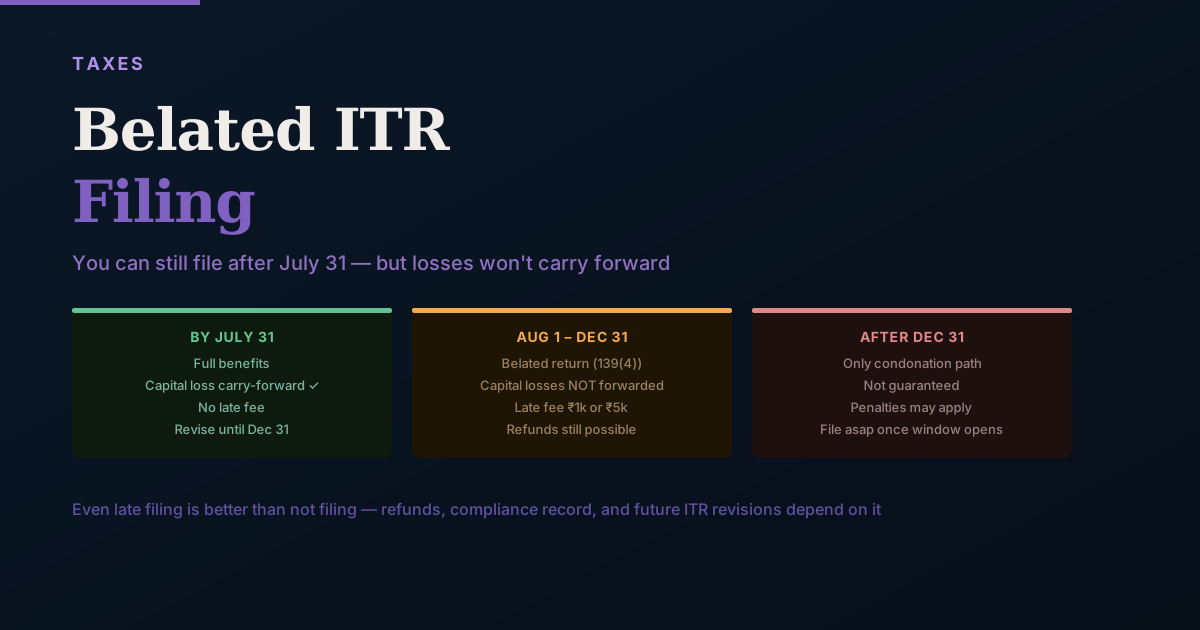
Missing the July 31 income tax filing deadline happens — the year gets busy. You can still file, but the later you file, the more you lose. Here's what changes after July 31.
The Filing Windows
| Period | Return Type | Section |
|---|---|---|
| By July 31 (August 31 if you have non-audit business or professional income) | Original/on-time return | 139(1) |
| Day after the due date – December 31 | Belated return | 139(4) |
| Up to March 31 following | Revised return (of an on-time or belated filing) — free until December 31, then a ₹1,000 or ₹5,000 fee | 139(5) / 263(5), fee under 428(b) |
| After that | Updated return (ITR-U), or condonation of delay | 139(8A) / 119(2)(b) |
Two things about that table have changed recently, and both matter before you assume you are late.
July 31 is no longer everyone's date. From AY 2026-27, taxpayers with business or professional income who are not subject to audit — the ITR-3 and ITR-4 crowd — file by August 31, a month later than salaried and other non-business filers, who stay on July 31. If you freelance, check which date is actually yours before panicking.
The section numbers have moved — and one window moved with them. The Income-tax Act, 2025 took effect on 1 April 2026, and from tax year 2026-27 onwards the return-filing rules live in Section 263: 263(1) for the original return, 263(4) for the belated one, 263(5) for a revision, 263(6) for an updated return. The late-filing fee is now Section 428, and the interest sections were renumbered too.
Most of that is pure renumbering — the belated deadline is still nine months from the end of the tax year, and the fee is still ₹1,000 or ₹5,000. One thing genuinely changed. The Finance Act 2026 rewrote Section 263(5) to stretch the revision window from nine months to twelve, and rewrote Section 428 to put a price on the extra three. Both changes took effect on 1 April 2026, which means they apply to tax year 2026-27 — the year most readers of this page are dealing with. The detail is below, under "Less Room to Revise".
Apart from that, this page keeps the familiar 1961-Act names — 139(4), 234A, 234F — which is still how the portal, your CA and everyone else talks about them.
If the IT department extends a deadline (which happens in many years), the extension applies to all deadlines proportionally.
What You Lose by Filing Late
1. Ability to Carry Forward Capital Losses
If you have capital losses (short-term or long-term) from stocks or mutual funds, you can normally carry these forward for 8 years and set them off against future capital gains.
This benefit is lost if you file late. Capital losses cannot be carried forward if the return is filed after the due date.
Exception: losses from house property can still be carried forward even in a belated return.
2. Late Filing Fee (Section 234F)
| Income | Fee if filed after your due date |
|---|---|
| Up to ₹5 lakh | ₹1,000 |
| Above ₹5 lakh | ₹5,000 |
This is a flat fee — not linked to tax due. Even if you have no tax liability (full TDS deducted), the fee applies.
3. Interest on Tax Due (Section 234A)
If you have any tax payable (not already paid via TDS/advance tax):
- Interest at 1% per month (or part of month) from the due date to the date of filing
- This adds up quickly over months of delay
4. Less Room to Revise — and the Last Three Months Are Not Free
You can revise a belated return, and the outer deadline is the same one an on-time filer has: twelve months from the end of the tax year — so 31 March following — or the completion of assessment, whichever comes first. That window used to close at nine months, on 31 December. The Finance Act 2026 substituted a new Section 263(5) in the Income-tax Act, 2025 running to twelve months, and made the matching change to the old Act's Section 139(5).
The extra three months are priced. Under Section 428(b) of the Income-tax Act, 2025, a revised return furnished beyond nine months from the end of the tax year — in practice, any revision filed on or after 1 January — carries a fee of ₹1,000 if your total income does not exceed ₹5 lakh, and ₹5,000 in any other case. Revise on or before 31 December and there is no fee at all. The 1961 Act picked up a matching charge in the same amounts, as a newly inserted Section 234-I, for the years it still governs.
So what late filing costs you here is runway — and, if you use the last stretch of it, cash. File at the end of August and you have four months of free revision ahead of you, plus three more that cost ₹5,000. File on 30 December and the free window is gone in two days: you still have three months, but every one of them is priced, and you are reconciling AIS entries and 26AS mismatches against a clock.
What You Don't Lose
- The right to a refund (you can still get TDS refund on a belated return)
- The ability to claim deductions (80C, 80D, HRA, etc.) — these remain available
- The basic benefit of filing (compliance, clean record)
How to File a Belated Return
The process is identical to filing on time — through the Income Tax e-filing portal (incometax.gov.in):
- Log in to your ITR portal account
- Select the appropriate ITR form (ITR-1, ITR-2, or ITR-3 depending on income sources)
- Fill in income, deductions, and tax details
- The system automatically identifies this as a belated return under 139(4)
- Late fee of ₹1,000 or ₹5,000 (as applicable) will be added automatically
- Submit and e-verify (Aadhaar OTP, net banking, etc.)
Should You File Even If You Have No Tax to Pay?
Yes, for multiple reasons:
- A clean filing record matters for loan applications, visa applications, and ITR verification
- Refunds due can only be processed after filing
- Future compliance (revised returns, scrutiny responses) is easier with a filed return on record
- Wilfully not filing when required is a prosecutable offence under Section 276CC, not merely a fee — Section 271F, which used to impose a ₹5,000 penalty, has not applied since AY 2018-19
If you're a salaried employee with only one employer and TDS has been correctly deducted, filing is relatively straightforward. Even a belated filing is far better than non-filing.
The Full Cost of Filing Late: Worked Example
Consider Rohit, a salaried employee with ₹12 lakh gross income, no HRA, standard 80C and 80D deductions under the old regime. His actual tax liability after deductions is ₹1,02,000. TDS deducted by employer was ₹95,000.
If Rohit files on July 31 (on time):
- Tax due: ₹7,000 (₹1,02,000 − ₹95,000)
- No late fee
- No Section 234A interest
- Total extra cost: ₹7,000
If Rohit files on October 31 (3 months late):
- Tax due: ₹7,000
- Section 234A interest: 1% × ₹7,000 × 3 months = ₹210
- Late filing fee (Section 234F): ₹5,000 (income above ₹5 lakh)
- Total extra cost: ₹12,210
If Rohit files on December 15 (4.5 months late):
- Section 234A interest: 1% × ₹7,000 × 5 months = ₹350
- Late filing fee: ₹5,000
- Total extra cost: ₹12,350
For this example the penalty is modest. But if Rohit also had ₹50,000 of capital losses from equity mutual funds, those cannot be carried forward on a belated return — a loss of a future tax offset worth ₹6,250 at 12.5% LTCG rate.
Section 234A Interest: How It Actually Calculates
Section 234A interest applies only if there is a tax amount outstanding (meaning tax payable was not covered by TDS or advance tax). The formula:
Interest = 1% × Outstanding Tax × Number of months (or part thereof) from due date to filing date
If Rohit owed ₹7,000 and filed on October 15: that's 2 full months and part of a third. "Part of a month" counts as a full month in 234A. So: 1% × ₹7,000 × 3 months = ₹210.
If your total TDS deducted equals or exceeds your actual tax liability, Section 234A does NOT apply even on a belated return — there is no outstanding tax. The Section 234F late fee, however, still applies regardless of whether you owe tax.
Condonation of Delay After December 31
After December 31, you cannot make a first filing for the year at all — the belated window is shut. Be clear about what that does and does not close off: if you had already filed something, you can still revise it up to March 31, on payment of the Section 428(b) fee described above. What is gone is the ability to put a return on record for the first time.
If you never filed, two routes remain, and they do very different jobs.
The first is an updated return (ITR-U), under Section 139(8A) — Section 263(6) from tax year 2026-27. The window is long: 48 months, so roughly four years past the deadline you missed. The price is a surcharge on the tax, rising the longer you leave it — 25% if you file within 12 months of the end of the assessment year, 50% within 24, 60% within 36, 70% within 48. You get one shot per year; there is no revising an ITR-U.
The catch that decides most cases: an updated return can only ever increase what you owe. You cannot use it to claim a refund, to enlarge one you already claimed, or to report a loss. So if the reason you want to file is that money is owed to you, ITR-U is not the door.
That leaves condonation of delay under Section 119(2)(b) of the Income Tax Act.
How it works:
- Submit an application to the Jurisdictional Principal Commissioner of Income Tax (PCIT)
- State genuine hardship reasons (medical emergency, natural disaster, technical issues, etc.)
- The PCIT has discretion to allow or reject the application
- This is not guaranteed — and since ITR-U cannot produce a refund, rejection means the refund stays unclaimed
Why condonation matters most:
- If you have a TDS refund due from a year where you didn't file, condonation is the only path to claiming it
- Refunds are not automatically processed — you must file to claim them
- Refund claims through condonation are typically processed after approval
The window is small and the process is bureaucratic. This is why December 31 is the true last-chance date for a first filing, and the one you should plan around — not a technicality.
Revised Return vs Belated Return: The Interaction
A revised return under Section 139(5) corrects an already-filed return. A belated return under Section 139(4) is the first filing, done late.
You can revise a belated return, and the revision window now closes three months after the belated one does — 31 March rather than 31 December. The two deadlines are no longer the same date, which is the single most common thing people get wrong about this.
The second most common thing people get wrong is assuming those three months are free. They are not. A revision furnished after December 31 costs ₹1,000 if your total income is ₹5 lakh or less, ₹5,000 if it is above — the Section 428(b) fee. December 31 is still the date to aim at; March 31 is the date you buy.
Example timeline for FY 2026-27 (tax year 2026-27, AY 2027-28):
- July 31, 2027: Last date for the original return if you are salaried or otherwise non-business
- August 31, 2027: Last date for the original return if you have non-audit business or professional income
- Up to December 31, 2027: Window for belated filing. December 31, 2027 is also the last day to revise a return you have already filed without paying a fee
- January 1 to March 31, 2028: Revision still open for any return already filed, on time or belated, but Section 428(b) charges ₹1,000 (total income up to ₹5 lakh) or ₹5,000 (above it). No first filing possible
- After March 31, 2028: No voluntary filing; only ITR-U (which cannot produce a refund) or the condonation route
If you file a belated return in September and discover an error in November, you can revise it for nothing. If you file in December and discover an error in January, you can still revise it — but it now costs you ₹5,000 unless your total income is ₹5 lakh or less, you are down to your last few weeks, and you no longer have the option of filing fresh.
ITR Form Selection for Belated Returns
The ITR form used for a belated return is the same as you would have used for a timely return. If you are a salaried employee who sold mutual fund units during the year, you still need ITR-2 — filing belated does not simplify or change your form requirement.
The income tax portal automatically marks the return as Section 139(4) (belated) based on the filing date. You don't need to manually select this — it is determined by when you file.
What Changes When You Switch Jobs and File Late
A common scenario: job change mid-year, one employer doesn't issue Form 16 promptly, you lose track of the deadline.
For a job-change year where two employers issued TDS:
- You need both Form 16s to file accurately
- Your old employer may not have known your expected income from the new employer — combined income may push you into a higher slab
- The TDS from each employer may be insufficient for the combined income
- Tax is due on the combined income; interest under 234A applies from August 1 if not paid
In this scenario, even a moderately late belated return — filed in August or September — may owe only a few thousand rupees in interest. The Section 234F fee is fixed at ₹5,000 regardless of how many months late you are (for income above ₹5 lakh). Filing promptly after getting both Form 16s is the right action.
Specific Losses You Cannot Carry Forward on a Belated Return
The capital loss carry-forward restriction is the most financially significant consequence of late filing. What specifically cannot be carried forward:
- Short-term capital losses on equity shares or equity mutual funds — these can normally offset STCG or LTCG in future years
- Long-term capital losses on equity — these can offset LTCG in future years (note: pre-Budget 2018 LTCG from equity was exempt, so LTCL carry-forward was less relevant; since Budget 2024 put equity LTCG at a flat 12.5% — still the rate for FY 2026-27 — it matters more)
- Short and long-term capital losses on debt mutual funds, gold, property, or other assets
What CAN be carried forward even in a belated return:
- Loss from house property (Section 24(b) excess loss)
If you have significant unrealised losses in your equity portfolio — for example, ₹2 lakh in unrealised losses on equity shares — and you plan to realise them to offset future gains, you must file your ITR on time in the year you realise the loss. A belated return permanently forfeits the carry-forward for that year's losses.
Practical Steps to File a Belated Return
- Log in to incometax.gov.in with your PAN and password (register if first time)
- Download your AIS and Form 26AS — review for any income you may have forgotten
- Collect all income documents — Form 16 (salary), bank interest statements, capital gains reports from broker/mutual fund platform, rental income records
- Select the correct ITR form — ITR-1 for simple salary only; ITR-2 if you have capital gains or multiple properties; ITR-3/4 for business income
- Fill in all income heads — salary, other sources (FD interest, savings interest), capital gains if any
- Claim all eligible deductions — 80C, 80D, HRA, home loan interest — all still available in a belated return
- Compute tax liability — the portal does this automatically once you enter figures
- Pay any outstanding tax via Challan 280 (self-assessment tax) before submitting the return
- Late fee of ₹1,000 or ₹5,000 is added automatically based on income level
- Submit and e-verify immediately using Aadhaar OTP (fastest method)
Section 234F: Late Filing Fee Explained
Section 234F was introduced from FY 2017-18 onwards. It replaced the earlier ₹5,000 penalty under Section 271F (which required adjudication) with a straightforward automatic fee:
| Income Level | Late Filing Fee |
|---|---|
| Total income up to ₹5 lakh | ₹1,000 |
| Total income above ₹5 lakh | ₹5,000 |
The fee is payable before filing — the system adds it as self-assessment tax at the time of filing. If you try to file a belated return without paying 234F, the portal will flag it.
Key points about 234F:
- It applies even if you have zero tax liability (your TDS covered everything)
- The ₹1,000 vs ₹5,000 threshold is total income — and total income is the figure arrived at after your Chapter VI-A deductions (Chapter VIII under the Income-tax Act, 2025), not the gross total income before them. It is easy to get this backwards; the pre-deduction figure has its own name, gross total income
- It does not apply if your total income is below the basic exemption limit — ₹4 lakh under the new regime (raised by Budget 2025 and left there by Budget 2026), or ₹2.5 lakh under the old regime, ₹3 lakh if you are 60–79 and ₹5 lakh if you are 80 or above
- Even if the IT Department extends the deadline (as they frequently do), 234F only applies after the extended deadline, not the original due date
Getting a Refund on a Belated Return
Refunds are fully available on belated returns. If TDS was over-deducted — common for salaried employees who changed jobs or had large deductions not claimed with employer — the refund is processed after ITR processing.
Refund interest (Section 244A): If you're getting a refund:
- Refund interest is paid at 0.5% per month (6% per year) on the refund amount
- Interest is calculated from April 1 of the assessment year to the date of refund for returns filed on time
- For belated returns: interest is calculated only from the date of filing to the date of refund — you lose the April 1 start date
Example: Filed belated return in October. Refund of ₹20,000 received in December. Interest = 0.5% × 2 months × ₹20,000 = ₹200, vs ₹900 if filed on time (from April to December = 9 months × 0.5% × ₹20,000).
The refund amount is the same; the interest earned on it is less for a belated return. Not a major factor if the refund is small, but for large refunds it can be meaningful.
If you've missed multiple years or the amounts involved are significant, a CA can help you sort out exactly what's still filable and what the penalty exposure looks like.
Frequently Asked Questions
Sources and references
- Income Tax Department, Government of India
- Income Tax Department — Income Tax Returns (belated, revised and updated return time limits under Section 139 and Section 263)
- Income Tax Department — Income-tax Act, 2025 (FAQs on Interplay and Transition, and Act text)
- Income-tax Act, 2025 (No. 30 of 2025), Gazette of India, 21 August 2025 — Section 263(4) and 263(5) as originally enacted
- Finance Act, 2026 (No. 4 of 2026), Gazette of India, 30 March 2026 — s. 66 substituting Section 263(5) and s. 96 substituting Section 428
Rules, rates, and thresholds in India change over time. Always confirm the current position with the official source above before acting on it.