Fixed vs Variable Expenses: The Structure Behind Your Spending
Understanding which of your expenses are fixed and which vary month to month is the first step to building any budget that works.
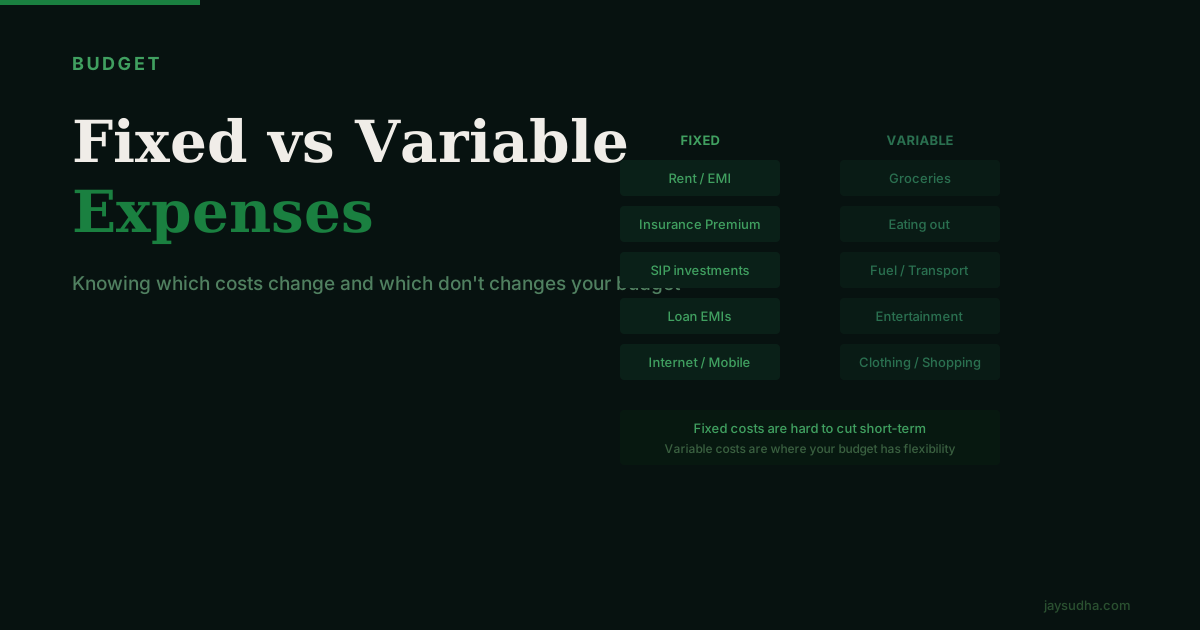
When someone says "I need to cut my spending," the first thing worth establishing is: what kind of spending are we talking about?
Some of your monthly expenses will be exactly the same every month no matter what you do. Others are largely up to you. These two categories behave completely differently when you're trying to manage a budget, and treating them the same way is what makes most budgeting attempts feel ineffective.
This is the distinction between fixed and variable expenses — and once you see it clearly, it changes how you think about financial flexibility.
Fixed Expenses: What They Are
A fixed expense is one where the amount is set in advance and doesn't vary with your monthly behaviour. You don't choose each month whether to pay it or how much to pay — it's already decided.
Common fixed expenses for Indian households:
- Rent — you agreed to ₹22,000/month, it's ₹22,000 every month
- Home loan EMI — same amount every month for the tenure
- Car/vehicle loan EMI — set amount until the loan is cleared
- School or college fees — often billed quarterly or annually but effectively fixed commitments
- Health insurance premium — annual but predictably fixed
- Term life insurance premium — same every year
- Vehicle insurance — annual
- SIP (Systematic Investment Plan) — you set the amount, it auto-debits
- Recurring Deposits — fixed monthly commitment
- Streaming subscriptions — Netflix, Prime Video, Hotstar, Spotify
- Cloud storage, software subscriptions — Google One, iCloud
- Internet and broadband — fixed monthly plan
- Phone plan — even postpaid bills are largely predictable if you don't go over plan limits
The defining characteristic: if you skip the month's variable spending, that money stays in your account. If you skip a fixed expense without formally cancelling or restructuring it, you still owe it — and potentially face penalties.
Variable Expenses: What They Are
Variable expenses are the ones where you decide, consciously or not, how much to spend each month. They fluctuate based on your choices, circumstances, and habits.
Common variable expenses for Indian households:
- Groceries and household supplies — varies based on what you buy, where you shop, how many people you're feeding
- Dining out and food delivery — Swiggy, Zomato, restaurants
- Fuel — depends on how much you drive and fuel prices
- Cab and auto rides — Ola, Uber usage
- Clothing and accessories — some months you buy nothing, some months you spend ₹5,000
- Personal care — salon, grooming products
- Entertainment — movies, events, concerts
- Gifts — festivals, birthdays, weddings (these can be large and irregular)
- Household repairs and maintenance — comes in unpredictably
- Medical out-of-pocket — prescriptions, doctor visits beyond what insurance covers
- Hobbies and leisure activities
- Travel and holidays
The lever here is behaviour. If you cook at home more this month, groceries might go up slightly while dining costs fall significantly. If you skip a vacation month, that ₹15,000 stays in your account.
The Semi-Variable Category
Some expenses have a fixed floor but can vary above it. Electricity is the clearest example — there's a base charge, but your bill changes based on AC usage, appliances, the season. A household in Delhi in summer might pay ₹3,500/month in electricity while the same household pays ₹800/month in winter.
Other semi-variable expenses:
- Grocery bills — you'll always spend something, but the amount swings by 30–40%
- Phone bills — a postpaid plan has a base, but roaming, international calls, or exceeding your data plan push the bill up
- Petrol — there's a rough baseline if you commute, but weekend driving adds to it
For planning purposes, semi-variable expenses are best treated as variable — set a realistic budget range for each rather than a single number.
Why This Distinction Matters
Fixed Costs Set Your Floor
Add up all your fixed expenses for one month and you have your minimum monthly outflow — the number below which you literally cannot drop your spending without breaking commitments or facing consequences.
For a household in a Tier-1 city with a home loan, this floor is often ₹45,000–70,000 before they've bought a single grocery item or paid a single utility bill. For a household with three school-going children, school fees alone can add ₹15,000–25,000 to the fixed floor.
Knowing this number is important. It tells you how much of your income is already spoken for before the month even begins.
Variable Costs Are Your Levers
If you need to tighten spending in a given month — a car repair came up, a medical bill, an unexpected expense — the variable category is where you actually have room to move. Cutting dining out by ₹3,000 is achievable in 30 days. Cutting your rent isn't.
This is why budgeting advice that says "cut back on coffee" is partially true but limited — you can and should reduce variable costs when needed, but the ceiling on those savings is set by your fixed cost floor.
The Fixed Cost Trap
Here's the pattern that causes long-term financial difficulty: lifestyle inflation tends to show up as increased fixed costs.
Every time you take on a new EMI, sign a longer lease, enrol a child in a more expensive school, or add a subscription, you're raising your fixed cost floor. The problem is that fixed costs are sticky in both directions — they go up easily (one decision), but coming back down requires time, effort, sometimes penalties, and difficult conversations.
A household that earns ₹1.2 lakh/month and has ₹85,000 in fixed monthly commitments has very little real flexibility — even though on paper they earn well. A household earning the same ₹1.2 lakh with ₹50,000 in fixed costs has real breathing room.
The difference isn't income. It's accumulated fixed cost decisions over time.
A Practical Reference for Indian Households
Here's a simple categorisation framework:
| Category | Type | Notes |
|---|---|---|
| Rent / Home loan EMI | Fixed | Housing is almost always the largest fixed cost |
| Vehicle loan EMI | Fixed | Set for loan tenure |
| School/college fees | Fixed (periodic) | Quarterly or annual billing, but committed |
| Health insurance premium | Fixed (annual) | Set at policy renewal |
| Term/life insurance | Fixed (annual) | — |
| SIP / RD | Fixed (self-imposed) | Treat as fixed to protect savings habit |
| Streaming subscriptions | Fixed | Worth auditing annually |
| Internet / broadband | Fixed | Predictable |
| Phone plan | Semi-fixed | Minor variation possible |
| Groceries | Variable | Highest-frequency variable cost |
| Dining out / food delivery | Variable | Often the most significant lever |
| Fuel / transport | Semi-variable | Floor from commute, ceiling from discretionary travel |
| Electricity / gas | Semi-variable | Seasonal variation |
| Clothing / shopping | Variable | Entirely discretionary |
| Travel / holidays | Variable | Periodic large spend |
| Entertainment | Variable | — |
| Gifts / festivals | Variable | Irregular but predictable by calendar |
| Medical out-of-pocket | Variable | Unpredictable timing |
How Fixed Costs Change Through Life Stages
Your fixed cost structure is not static — it changes significantly with life events, and understanding where you are on this path helps with planning.
Single, renting: Fixed costs often relatively lower. Rent, phone, maybe a vehicle loan, basic subscriptions. This is typically the phase of maximum financial flexibility — and often the one where it's least appreciated.
Married, dual income, renting: Fixed costs rise with a larger home, potentially a second vehicle, more subscriptions, higher lifestyle baseline. But two incomes provide a buffer.
Young children: School fees begin. These are non-trivial fixed costs — ₹8,000–25,000/month per child in private schools in cities — and they run for 15+ years. This is often the point where households first feel their fixed cost floor rising in a way that's hard to reverse.
Home purchase: The biggest single jump in fixed costs, potentially adding ₹30,000–60,000+ per month to the floor depending on the loan size and the city. This decision locks in a cost for 15–25 years and has the most long-term consequences.
Middle-aged with multiple EMIs: The cumulative effect of adding loans over time. Vehicle loans, home loan, possibly an education loan. Fixed costs at this stage are often at their career peak.
Post-debt, pre-retirement: Once major loans are cleared, fixed costs drop significantly. This is often when savings rates jump sharply — not because income rose, but because the fixed cost burden fell.
Subscription Creep: A Specific Fixed Cost Problem
Subscriptions deserve their own mention because they've become one of the most common ways fixed costs grow unnoticed.
The reason subscriptions accumulate: each one is small, auto-billing removes the payment friction, free trials convert to paid plans, and we keep thinking we might use each service "next month."
A household with Netflix (₹649), Prime Video (₹299), Hotstar (₹899 billed as ~₹75/month), Spotify (₹119), Swiggy One (₹299), Zomato Gold (₹250), two news apps (₹150), iCloud storage (₹75), and a password manager (₹99) is spending roughly ₹2,015/month on subscriptions — about ₹24,180/year. Each item individually seems trivial. Collectively it's not.
The right discipline here is a quarterly subscription audit: check your bank statement and UPI autopay list, identify every recurring charge, and actively decide whether to keep each one.
A Quick Exercise: Find Your Fixed Cost Floor
Take your last three months of bank statements. Mark every recurring charge that was the same (or nearly the same) each month. Add them up. That's your fixed cost floor.
Then look at what's left. That's the maximum possible variable spending — the actual discretionary space you're working within.
For most urban Indian households, this exercise is clarifying and occasionally surprising. Many people discover their fixed cost floor is 60–70% of their income, which means all the worry about discretionary spending is happening in a very narrow band.
If that's your situation, the most impactful financial decisions aren't about coffee — they're about which fixed commitments you take on next.
The Decision Framework Before Adding a New Fixed Cost
Because fixed costs are sticky and long-lasting, the decision to add a new one deserves more scrutiny than a single purchase of the same value.
Before any new commitment that will recur monthly (new EMI, upgraded apartment, additional insurance, new subscription tier, new school with higher fees), run through three questions:
1. What does this do to my fixed cost ratio? Add the new monthly commitment to your current fixed costs total. Divide by take-home income. If the ratio moves above 55%, the decision deserves more scrutiny. If it moves above 65%, it is likely a structural problem.
2. Is this reversible and at what cost? A gym membership cancelled in month 2 costs one month's notice. A 3-year car loan cannot be reversed without a foreclosure penalty and remaining obligation. A home loan commitment runs 15–25 years. Reversibility determines how costly a mistake is.
3. What variable spending would this replace or restrict? A new fixed cost has to come from somewhere. If taking on a ₹12,000/month car EMI means dining, entertainment, and clothing budget each drop by ₹4,000, you are explicitly trading discretionary flexibility for a fixed commitment. Know this tradeoff before agreeing to it.
This framework does not block all new fixed commitments — home loans, insurance, and school fees are legitimate and important. It makes the decision conscious. The difference between a well-structured household and a fragile one often comes down to how carefully these commitments were evaluated before the paperwork was signed.
Fixed Costs in a Freelance or Self-Employed Household
For freelancers and business owners, the fixed vs variable analysis has an additional layer: some of your business expenses are fixed (coworking rent, software subscriptions, accountant retainer) while your income itself is variable. This combination — variable income meeting fixed costs — is the defining financial stress of self-employment.
The implication for budgeting:
Your personal fixed cost floor must be funded from your minimum expected monthly income, not your average. If your average monthly take-home is ₹1.2 lakh but your worst-month income is ₹60,000, your personal fixed costs should be designed around ₹60,000 — not ₹1.2 lakh. The surplus in good months funds the business emergency fund, personal investments, and the buffer for slow months.
Business fixed costs behave differently from personal fixed costs. Coworking membership and software subscriptions are business fixed costs — real obligations, but potentially cuttable in a prolonged slow period without the consequences of missing a home loan EMI. Identify which of your business fixed costs can be suspended (month-to-month coworking) versus which are contractually locked (annual software licences).
The advance tax timing makes "fixed" feel variable: Advance tax payments of ₹1–2 lakh in March, June, September are large, infrequent, and feel variable — but they're actually predictable obligations. Treat them as the largest "fixed" line item in your quarterly budget. The tax buffer habit (setting aside 25-30% of each payment as it arrives) converts them from quarterly shocks into simple transfers.
Reducing Fixed Costs Without Disrupting Daily Life
The most effective fixed cost reductions rarely require dramatic lifestyle changes. The high-value targets:
Annual subscription audit (30 minutes, once a quarter): Open your bank statement and UPI autopay list. Look for every charge that repeated in the last 3 months. Create a list. Now go through each one and ask: "Did I use this at least 6 times in the past 3 months?" If not, cancel it. Most people find ₹1,000–3,000/month in subscriptions they have no actual relationship with.
Insurance premium optimisation (once a year, at renewal): If you have multiple insurance policies — health insurance through employer plus a personal policy, vehicle insurance on a car you rarely drive, life insurance from a bank that sold you a ULIP — review whether each is appropriate. Over-insured coverage on infrequently used assets, and duplicate health cover, are common sources of unnecessary fixed cost. Compare and right-size at renewal, not mid-term.
Credit card annual fee review: Premium credit cards with ₹5,000–10,000 annual fees are worth keeping only if you use the specific benefits consistently. Calculate the rupee value of benefits you actually used last year. If it's less than the fee, downgrade.
Home loan prepayment to reduce EMI: A lump-sum partial prepayment on a home loan can reduce either the EMI or the tenure. Reducing the EMI reduces your fixed cost floor. If you receive a business windfall (a large project, a bonus, a tax refund), routing ₹2–5 lakh to home loan prepayment can reduce your monthly EMI by ₹3,000–8,000 permanently — equivalent to a permanent income increase of that amount.
Frequently Asked Questions
Sources and references
Rules, rates, and thresholds in India change over time. Always confirm the current position with the official source above before acting on it.