Annual Financial Planning: Setting Goals and Building Your Budget for the Year
A year-end review and next-year plan takes 2-3 hours but shapes every financial decision for the next 12 months. Here's exactly what to cover.
Most financial decisions — which insurance to take, how much to invest, whether to take on a new EMI — are made reactively, in the moment, without a reference frame.
An annual financial plan creates that reference frame. When a spending opportunity or financial decision comes up in May, you can ask: does this fit what I decided in January? That question alone prevents most impulse financial decisions that look regrettable six months later.
The plan itself doesn't need to be long. It needs to be specific enough to guide decisions. One hour of preparation and one hour of actual planning — that's a reasonable investment for a document that governs the next 12 months.
When to Do It
Two natural timings:
December/January (calendar year): Good for setting lifestyle and investment goals, reviewing the past year's spending patterns, and making decisions about the next year before it's already underway. Psychologically, January feels like a fresh start — use that.
March/April (financial year): Essential for tax planning. This is when you decide which tax regime to opt for, whether you've maximised your 80C investments, whether your HRA claim is documented, and whether the new financial year's TDS will be calculated correctly. The March financial year review is more compliance-focused.
Do both. They serve different purposes.
Step 1: The Past-Year Review
Before planning forward, look at what actually happened. Pull 12 months of bank statements and your investment account summaries.
Questions to answer:
Did income grow as expected? Compare this year's total take-home to last year's. If you got a raise, did you save the increment or absorb it into spending? This is the first signal of lifestyle inflation.
What was the actual savings rate? Total money invested/saved this year ÷ total income. Many people who "feel" like they save well discover they're at 12–15% when they thought they were at 25%. Or vice versa.
Did net worth increase? Add up assets (bank balances, investments, EPF, property equity) and subtract debts (outstanding loan balances, credit card dues). Did this number go up? By how much? This is the real measure of financial progress.
What debts were cleared? Any loan closed this year? Good. What loans remain? Note the outstanding balance and current EMI for each.
What unexpected expenses hit? Car repair, medical bill, sudden travel, appliance replacement. How much did these total? Did they come from a buffer fund (good) or from depleting investments (not ideal)?
What investment decisions were made? New SIPs started? Funds switched? Lump sum investments? Insurance policies bought or lapsed? NPS contributions?
What tax was paid? Anything unexpected? Advance tax paid, refund received, any demand notice? If tax was surprising, understand why so this year's planning can account for it.
Step 2: Set Specific Annual Goals
Here is where most people go wrong. They write goals like "save more" or "invest in the stock market." These aren't goals — they're intentions. They give you nothing to measure against in December.
Useful goals are specific, time-bound, and have a number attached.
Bad: "Save more money this year." Good: "Invest ₹72,000 in equity index funds through a ₹6,000/month SIP."
Bad: "Pay off some credit card debt." Good: "Clear the outstanding ₹45,000 HDFC card balance by June."
Bad: "Build an emergency fund." Good: "Reach ₹1,50,000 in liquid mutual fund emergency fund by September."
Goal categories to cover:
Savings and Investment Targets
- Total amount to invest this year (by category: equity, debt, PPF, NPS)
- Specific SIP amounts and fund names
- Any lump sum investments planned (tax refund going into index fund, bonus going into NPS)
- Target for adding to or completing emergency fund
Debt Payoff Plan
- List each loan with outstanding balance and EMI
- For any loan you want to accelerate, how much extra will you pay and when?
- Any loan you want to foreclose this year?
- Target to not add any new loans (or target for the loan you're planning — vehicle, property)?
Major Purchases
- Planned significant purchases: laptop, appliance upgrade, vehicle, furniture
- Cost estimate and planned month
- Funding source: sinking fund, savings, or income in that month?
Major Life Events
- Wedding (yours or family's that you're contributing to)
- Baby or new addition to household
- School admission change or fee increase
- Parent health situation that may require funding
- International travel
Each of these has a financial dimension. Size the cost now, not when the event is 3 weeks away.
Step 3: Tax Planning for the Year
Do this in March for the upcoming financial year, but also revisit in April when the new financial year begins.
Choose your tax regime: For most salaried employees, this choice is made at the start of the financial year and locks you in for TDS purposes. New regime (no deductions, lower rates for many brackets) vs old regime (80C, HRA, home loan interest deductions available).
Run the numbers. Both regimes exist for a reason — which one saves you more depends on your specific numbers.
Plan your 80C investments: Under old regime, ₹1.5 lakh of 80C investment is a real tax saving. If you're in the 30% bracket, ₹1.5 lakh of 80C investment saves ₹45,000 in tax. EPF contributions count. PPF counts. ELSS counts. Life insurance premiums count. Home loan principal repayment counts. Don't scramble for this in February — that's tax saving, not tax planning. Decide in April.
Check HRA documentation: If you're paying rent and claiming HRA exemption, rent receipts should be collected through the year. Your landlord's PAN is required if annual rent exceeds ₹1 lakh. Get this straight from April, not February.
Home loan interest: If you have a home loan, the interest portion is deductible under Section 24 (up to ₹2 lakh for a self-occupied property under old regime). Get the provisional interest certificate from your bank at the start of the year.
NPS contribution: Additional ₹50,000 deduction available under Section 80CCD(1B) over and above the 80C limit (old regime). If you're not contributing to NPS, calculate whether the tax saving justifies the lock-in.
The One-Page Financial Plan
Here's a template you can fill in each year. One page. Refer back to it monthly.
| Section | What to Write |
|---|---|
| Income | Monthly take-home (primary + secondary sources) |
| Savings Rate Target | Target % of income to invest/save |
| Investment Plan | SIP amounts, fund names, NPS/PPF contributions |
| Debt Status | Each loan: outstanding balance, EMI, target payoff |
| Emergency Fund Status | Current balance, target balance |
| Major Expenses Planned | Event, estimated cost, month expected, funding source |
| Tax Plan | Old or new regime? 80C plan? HRA documented? |
| Insurance Review | Is health cover adequate? Any changes needed? |
| Net Worth Target | Where do you want to be by December? |
| 3 Main Priorities | The three things that matter most this year |
The "3 Main Priorities" line is the most important. Every year has a different financial flavour — one year it's clearing a loan, another it's building an emergency fund, another it's maximising investments. Know what this year's three things are.
Step 4: Insurance Review
Annual financial planning is the right time to review insurance coverage.
Health insurance: Is your family floater sum insured adequate? A ₹5 lakh cover for a family of four in a city like Bangalore or Mumbai is tight — hospitalisation costs have risen significantly. Reassess whether to increase the base cover or add a super top-up plan (much cheaper than increasing base sum insured).
Did you add a family member this year (marriage, new child, parent)? They need to be added to the policy.
Term life insurance: Is the sum insured still adequate given your current income, debts, and dependents? A ₹50 lakh term policy taken when you earned ₹6 lakh/year may be insufficient if you now earn ₹15 lakh. Generally, coverage of 10–15x annual income is the baseline.
Vehicle insurance: Due for renewal? Compare quotes. Third-party cover is mandatory; own damage cover is your choice based on vehicle age and value.
Monthly Check-ins vs Quarterly Reviews
The annual plan isn't a set-and-forget document.
Monthly check-in (15 minutes): Did investments happen as planned? Did any large unplanned expense hit? Is the month's net cash flow roughly in line with the plan?
Quarterly review (45 minutes): Are you on track for the annual goals? Any goal that needs to be revised upward or downward? Any tax planning actions required by the quarter? How does net worth look vs January?
Annual plan (2–3 hours): Full retrospective and new year planning.
Most financial disruptions aren't sudden — they're slow drifts that become visible only when you look. Regular reviews make the drift visible early, when it's still easy to correct.
When Income Is Variable
For freelancers, consultants, and business owners, annual planning works differently because income is uncertain.
Plan conservatively. Base your investment and expense plan on a figure you're confident you'll earn in a bad year — say, the lowest income month of the past year multiplied by 12. If income comes in higher, direct the surplus to investments or debt payoff as it arrives.
Save a fixed percentage of every receipt. Rather than planning a fixed monthly investment, commit to investing 20–25% of every income receipt within 24 hours of receiving it. This builds the saving habit into the cash flow pattern rather than fighting against income irregularity.
Build a larger buffer. Variable income households need more buffer than salaried ones — aim for 3 months of buffer (not just 1–2) and a full 6-month emergency fund.
What Good Annual Planning Feels Like
After three to four years of consistent annual planning, you'll notice that financial decisions become faster and less stressful. When someone asks "should we go to Thailand this year?", you know whether it's in the plan and whether the finances support it. When your boss asks if you want to accept a project that requires relocation, you have a clear sense of the financial implications.
The plan doesn't make decisions for you. It gives you a framework within which your actual values and priorities can make clearer decisions.
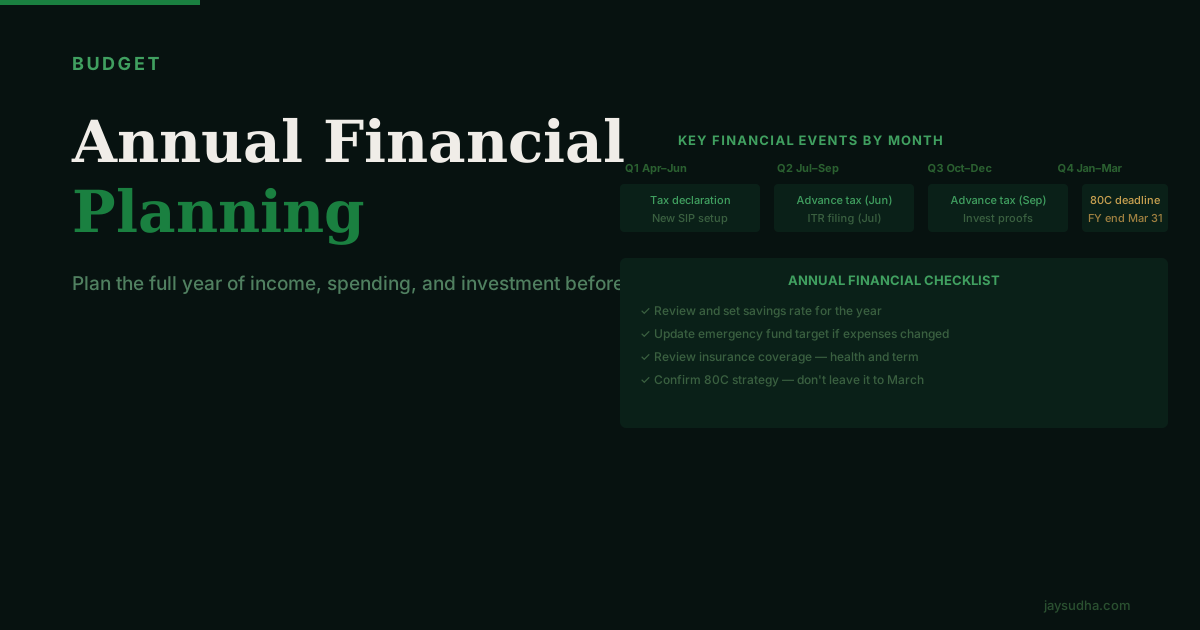
The Financial Year Calendar: Key Indian Dates to Plan Around
An annual financial plan for an Indian household is incomplete without mapping the key compliance and financial calendar dates:
April 1: New financial year begins. This is the moment to:
- Decide tax regime (new vs old) for TDS purposes — submit to employer if you've been on the old regime or want to switch
- Update SIP amounts (especially if income changed after appraisal)
- Start fresh tracking for the new financial year
- Review insurance coverage (family floater sum insured, term life coverage adequacy)
June 15: First advance tax instalment due (15% of estimated annual tax). Relevant for freelancers, consultants, and salaried employees with significant non-salary income.
July 31: Deadline for filing ITR without penalty for most individual taxpayers (may be extended — check current year notification). Gather Form 16, Form 26AS, and all investment proofs in June.
September 15: Second advance tax instalment (45% cumulative).
October: Review health insurance renewal. Many health policies renew in October–November. Compare whether to stay with current insurer or switch (switching is allowed at renewal without break-in). Check if cover is adequate — consider super top-up.
December 15: Third advance tax instalment (75% cumulative).
January 31 – March 31: 80C investment completion window under old regime. If PPF, ELSS, or insurance contributions are needed to reach ₹1.5 lakh, the February–March window often creates a scramble. Planning April means avoiding the last-minute lump sum that disrupts March cash flow.
March 15: Final advance tax instalment (100%).
March 31: Last date for:
- 80C investments under old regime
- Belated ITR for previous year (with penalty)
- Any deductible investments (NPS 80CCD(1B), health insurance premium)
- Closing financial year books for self-employed
Building these dates into a calendar at the start of April each year means compliance events are planned rather than reactive, and the associated cash needs are provisioned in advance.
Frequently Asked Questions
Sources and references
Rules, rates, and thresholds in India change over time. Always confirm the current position with the official source above before acting on it.