Emergency Fund Before Investing: Why Sequence Matters in Personal Finance
Why an emergency fund comes before investing: the forced-sale problem, how much to save, where to keep it, and how to build it alongside your SIPs.
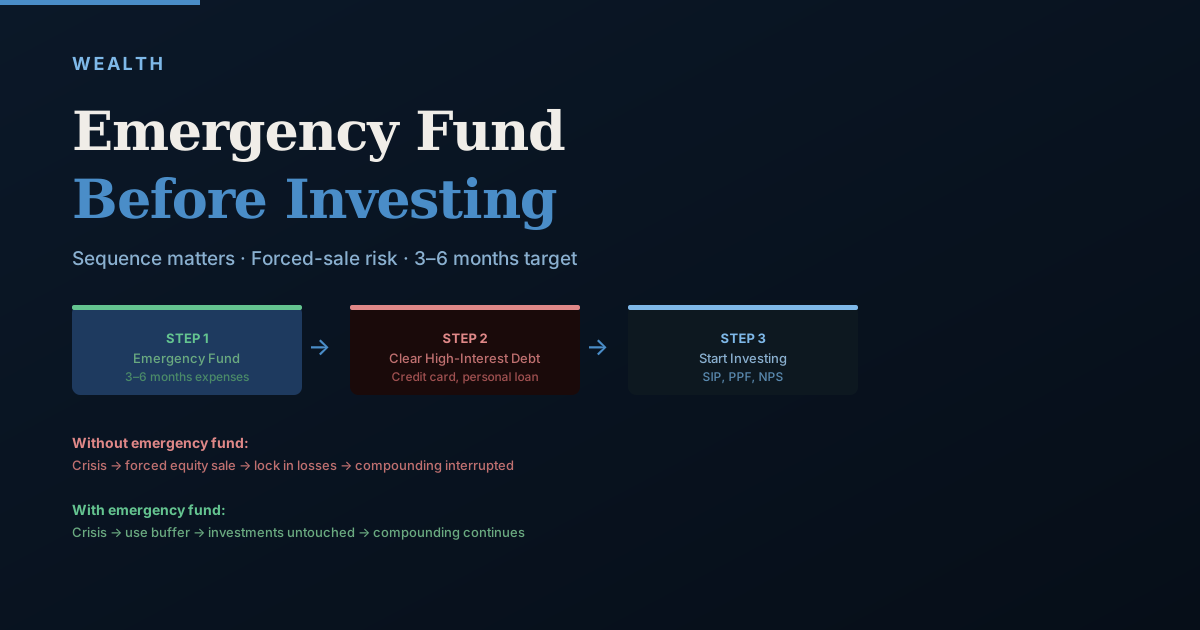
One of the most common personal finance mistakes in India is investing in equity mutual funds while having no emergency fund. The logic feels counterproductive at first — shouldn't you get your money working as soon as possible? The problem is in the failure mode.
The forced-sale problem
A SIP in an equity fund is excellent for long-term wealth building. The returns compound over time and benefit from rupee cost averaging. But equity funds are volatile — in a market downturn, your ₹1 lakh SIP corpus might show ₹75,000 on screen.
Now a financial emergency arrives: medical expense, loss of job, a major repair. You need ₹50,000 urgently.
With no emergency fund, you are forced to redeem your equity mutual fund. You sell at ₹75,000 — not because you chose to, but because you had no choice. You lock in a 25% loss and the money that would have compounded over 15 years is gone.
The emergency fund's job is to prevent this. It absorbs shocks so your investment corpus never needs to be touched for emergencies.
How much emergency fund do you need
The target is 3–6 months of essential expenses — not income.
Essential expenses are: rent/EMI, groceries, utilities, insurance premiums, school fees, transport, and medical basics. Do not include savings, investments, discretionary spending, or luxuries.
| Employment type | Emergency fund target |
|---|---|
| Stable salaried, single income | 3 months of expenses |
| Salaried, sole earning member of family | 4–5 months |
| Self-employed / freelancer | 6 months |
| Business owner, variable income | 6 months minimum |
Example: a household with essential monthly expenses of ₹40,000 should target ₹1.2–2.4 lakh in the emergency fund.
Where to keep it
The emergency fund has one requirement above all others: immediate access without penalty.
Good options:
High-yield savings account: SFB (Small Finance Banks) like AU, ESAF, or Ujjivan often offer 5–7% on savings accounts. Immediate access, DICGC insured up to ₹5 lakh.
Sweep-in FD: Most banks offer sweep-in fixed deposits that earn FD rates but automatically break to fund transactions when your savings account balance falls below a threshold. Combines accessibility with better returns.
Liquid mutual fund: Redemptions processed within 1 business day (same-day for amounts up to ₹50,000 at some fund houses). Returns slightly better than savings account — 6–7% range. Minimal exit load.
Avoid: Equity funds (too volatile), long-tenure FDs with early withdrawal penalties, PPF (5-year lock-in for partial withdrawal), and NPS (restricted withdrawal rules).
Building the emergency fund: the practical sequence
Step 1: If you are starting from zero, open a dedicated savings account or liquid fund account. Label it "Emergency Fund" — not your salary account.
Step 2: Pause new SIPs temporarily (or reduce them) to accelerate emergency fund building.
Step 3: Direct a fixed amount per month — whatever you can — until the target is reached. If you have ₹10,000 per month available, the full ₹10,000 goes to the emergency fund until the target is met.
Step 4: Once the target is reached, resume or start SIPs at full throttle.
This sequence — emergency fund first, then investing — means your investment decisions are never forced by cash urgency.
"But isn't my SIP the emergency backup?"
This reasoning is common and flawed. Your equity SIP at month 6 might be worth less than what you put in. Equity funds should be treated as untouchable for 7+ years for the compounding to work properly.
Using equity investments as backup funds defeats both purposes: it exposes your emergency to market risk, and it interrupts compounding at the worst possible time (crises often coincide with market downturns).
The question of high-interest debt
If you carry high-interest debt — credit card balance at 36–42% annualised, personal loan at 18%+ — the sequence becomes:
- Build a minimal emergency fund first (₹50,000–1 lakh)
- Aggressively pay down high-interest debt
- Build the full emergency fund
- Then invest
Paying 3% monthly interest on a credit card outstanding balance while investing in an equity fund that earns 1% monthly in a good month is mathematically backwards.
For the full view of how these foundations feed into longer-term wealth building, see the guide on building wealth in India.
What counts as an emergency — and what does not
Defining this clearly upfront prevents the fund from quietly being depleted on non-emergencies.
Genuine emergencies:
- Sudden medical expense not covered by insurance (hospitalisation, surgery, dental emergency)
- Job loss or a sudden income gap (especially important for single-income households)
- Major essential appliance failure (refrigerator, washing machine — things that directly affect daily function)
- Urgent travel for a family emergency
- Vehicle breakdown that prevents you from reaching work
- Sudden home repair (plumbing failure, water damage, electrical fault)
Not emergencies:
- A discounted sale on electronics or a gadget upgrade
- A last-minute "investment opportunity"
- A vacation you hadn't planned or budgeted
- An unexpected bill that was actually predictable (annual insurance premium, school fees — these belong in a sinking fund, not the emergency fund)
The rule of thumb: if you could have planned for it, it is not an emergency. If a financial event is predictable even if not precisely scheduled — car service, annual subscriptions, festive spending — it should be covered by a separate sinking fund, not from emergency reserves.
Sinking fund vs emergency fund — the distinction most people miss
A sinking fund is a savings pot for predictable but irregular expenses. An emergency fund is for genuinely unpredictable events. Mixing them is the most common reason an emergency fund never stays full.
Examples of sinking fund categories:
- Car service and insurance renewal
- Annual insurance premiums (health, life, vehicle)
- Festive and wedding gifts
- Laptop replacement fund (for those whose work depends on one)
- School fee instalments
Estimate the annual cost of each, divide by 12, and set aside that amount monthly into a labelled sub-account or recurring deposit. This prevents predictable expenses from "eating" your emergency fund when they arrive.
Sizing for different life stages
The 3–6 month rule is a starting point. Your actual target should reflect your specific risk exposure:
Single, renting, no dependents: 3 months is often adequate — lower fixed obligations, easier to cut spending quickly if income falls.
Married, one income, children: 6 months minimum. A job loss with school fees, EMIs, and dependent healthcare is a high-impact event. The cost of a disruption is asymmetrically large.
Freelancer or self-employed with variable income: 6–9 months. Income gaps are common and can be multi-month. The emergency fund here also partially functions as a revenue smoothing buffer.
Double-income household: 3–4 months is often sufficient, since a complete income loss (both jobs simultaneously) is less likely. However, if both incomes go to the same employer or industry, maintain closer to 6.
Pre-retirement (within 5 years of stopping work): Start building toward 12–18 months of expenses. Sequence-of-returns risk means you do not want to sell investments in the first year or two of retirement during a market correction.
Replenishing after use
Many people build the fund, use it once, and then never fully rebuild — the account stays at ₹60,000 when the target is ₹2 lakh. This destroys the protection.
After any withdrawal:
- Treat replenishment as the top priority, ahead of investments.
- Set a specific timeline — "I'll rebuild to the full amount in 4 months."
- Redirect any investment surplus (tax refund, bonus, freelance windfall) to the fund first until the target is restored.
The fund is not a one-time build. It needs active maintenance.
Insurance as a complement, not a substitute
A common question: "If I have health insurance and term insurance, do I still need an emergency fund?"
Yes — they serve different functions. Insurance covers specific insured events with a claim settlement lag. An emergency fund covers cash flow gaps in the interim, co-pays and sub-limits not covered by health insurance, non-medical emergencies (which insurance doesn't cover), and income disruption between a claim filing and payout. Even a ₹10 lakh health insurance policy might have ₹1–2 lakh in non-covered expenses (non-network hospital, excluded procedures, deductibles) that you need immediate cash for. A strong insurance portfolio and a full emergency fund are complementary, not alternatives.
A worked example: the real cost of skipping the fund
Priya, 28, earns ₹80,000/month, starts a ₹15,000/month SIP in an equity index fund with zero emergency fund. After 14 months (₹2.1 lakh invested), her mother needs emergency surgery costing ₹1.8 lakh. The market happens to be down 20% — her fund value is ₹1.7 lakh.
She redeems the whole holding and gets approximately ₹1.7 lakh. There is no capital gains tax to pay — she is sitting on a loss, not a gain — but she has crystallised that ₹40,000 loss permanently, and she is still ₹10,000 short of the ₹1.8 lakh bill. She covers the gap with a personal loan at 16%.
Counter-scenario: same Priya spends the first 5 months building a ₹1.8 lakh emergency fund (₹36,000/month, pausing her SIP). The same medical event is covered in full from the emergency fund, with no investment interruption and no loss crystallised. Her SIP then continues unbroken for the next 10+ years.
The 5-month delay in starting to invest costs far less than a forced equity redemption at a market low plus high-interest debt.
How the emergency fund interacts with your investment accounts
When you have both an emergency fund and investments, the order of operations during a crisis matters:
- Use the emergency fund first — that is its purpose.
- Draw on liquid funds (not equity) if the emergency fund is depleted — liquid mutual funds return capital the next business day and don't carry market risk. They act as a second tier.
- Never touch equity SIPs during a crisis unless there is genuinely no other option — the compounding loss from interrupting equity at a market low is much larger than it appears.
- Never borrow against your mutual fund portfolio (loan against MF units) for day-to-day emergencies — these facilities exist but carry interest costs and reduce your collateral.
For salaried employees: your PF is not an emergency fund
A common misunderstanding is treating EPF as a backup emergency fund. EPF partial withdrawals are allowed for specific purposes (marriage, education, illness, home purchase) but require documentation, processing time, and tax implications on withdrawal before 5 years of continuous service.
EPF is a long-term retirement corpus. Its illiquidity and purpose-restrictions make it unsuitable as an emergency fund. Build a separate liquid emergency fund independently.
The mental accounting that makes emergency funds work
Research consistently shows that people manage money better when it is in separate, labelled accounts versus a single large balance. A single account gives you permission to spend based on the aggregate balance. Separate accounts create psychological constraints.
Practical implementation:
- Open a separate savings account at a different bank (or at minimum a different account at the same bank) labelled or mentally named "Emergency Fund"
- Do not attach a debit card to this account if possible — add friction to access
- Set a standing instruction to auto-transfer a fixed amount each month until the target is reached
- After reaching the target, keep the standing instruction at ₹0 but leave the account intact
The act of opening a separate account is more important than finding the highest interest rate. The goal is a fund you will not touch unless it is a genuine emergency — structure the account to make casual dipping difficult.
Rebuilding the fund faster: windfalls and income spikes
Bonuses, tax refunds, freelance windfalls, and annual increments are the fastest ways to build or rebuild the emergency fund — if you direct them there before they integrate into spending.
A practical rule: the first ₹1 lakh of any windfall goes to the emergency fund if it is below target. Only once the fund is full does a windfall flow to investments or discretionary goals.
This rule prevents the common pattern where someone receives a ₹1.5 lakh bonus, buys an appliance for ₹50,000, takes a holiday for ₹40,000, and invests the remaining ₹60,000 — all while their emergency fund sits at ₹30,000. The sequence matters.
Emergency fund for joint households
In a household with two earning members, the emergency fund target should reflect the worst-case scenario: what if both incomes were disrupted simultaneously? This is rare but possible (both in the same organisation, a health emergency affecting both, a family bereavement requiring extended leave).
For most dual-income households, 3–4 months covers this adequately — not the 6-month target recommended for a single income. However, if both earners are in the same sector or company, increase the target to 5–6 months to account for sector-specific downturns.
The exact sequence and target here are general guidance, not a personalised plan — if you are carrying complex debt or an irregular income on top of this decision, a fee-only financial planner can size the number to your actual situation rather than a rule of thumb.
Related calculatorsavings calculator
Frequently Asked Questions
Sources and references
Rules, rates, and thresholds in India change over time. Always confirm the current position with the official source above before acting on it.