Wealth Building in India: 7 Practical Rules for Strong Long-Term Money Decisions
Wealth building in India is not about picking the best stocks. It is a system built on savings discipline, protection, and steady asset accumulation.
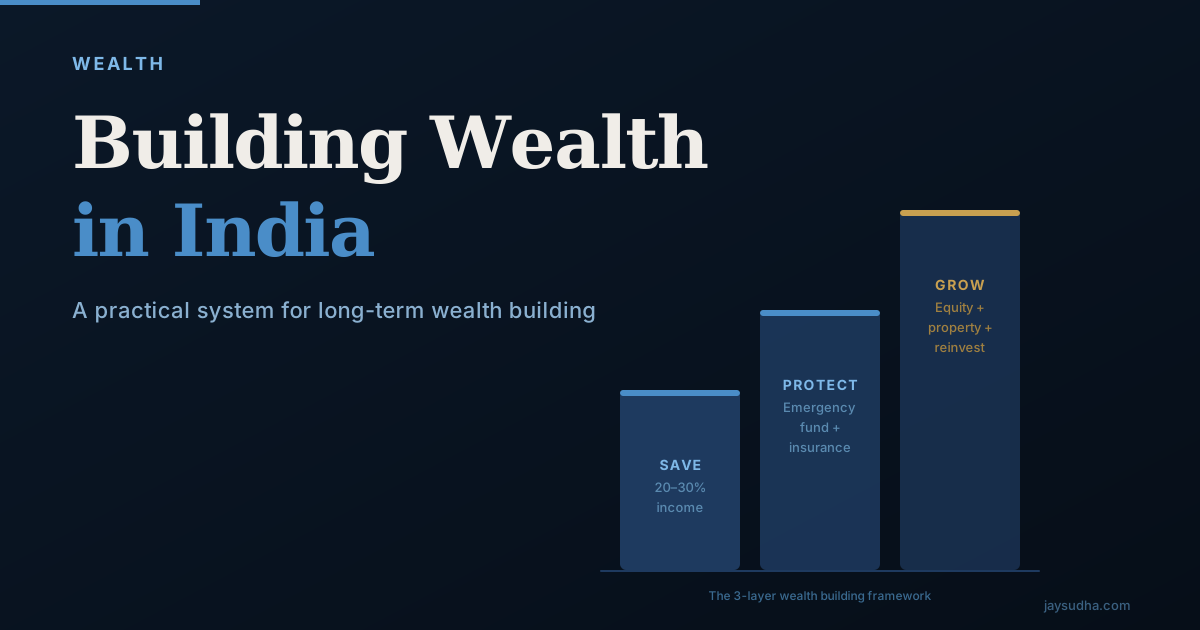
Wealth building in India gets treated as an investment problem. Which mutual fund should I pick? When should I buy a flat? Is gold better than equity right now? These questions are real, but they come second.
The actual challenge of wealth building is not investment selection. It is building and maintaining the system that converts income into assets, month after month, regardless of market conditions, life events, or income changes.
This article covers that system — the seven rules that determine whether wealth builds over time or stays stuck despite reasonable income.
Rule 1: Understand what wealth actually is
Wealth is not income. You can earn ₹25 lakh per year and have near-zero wealth if lifestyle expenses rise with income. Wealth is the stock of assets you have accumulated — the sum of what you own minus what you owe.
Net worth is the measure that matters. Assets include your EPF balance, PPF, mutual fund portfolio, savings, FDs, real estate equity, and any other holdings. Liabilities include your home loan outstanding, personal loan, car loan, and credit card balance you carry.
Wealth is not how much you earn. It is the difference between what you own and what you owe — and the direction that number is moving.
The single most important habit in wealth building is tracking net worth every six months. Not obsessively, not constantly — but consistently. If your net worth is not growing, you are not building wealth, regardless of how large your salary has become.
Rule 2: Income is the raw material, not the outcome
Salary, business income, freelance earnings — these are your raw material. They create the capacity to build wealth. They do not create wealth on their own.
The conversion happens through the savings rate: the fraction of income that goes toward assets rather than consumption. A person earning ₹15 lakh with a 35% savings rate (₹5.25 lakh invested annually) will have more wealth at 45 than a person who earns ₹25 lakh with a 10% savings rate (₹2.5 lakh invested annually).
The arithmetic is simple:
| Annual Income | Savings Rate | Annual Wealth Added |
|---|---|---|
| ₹15 lakh | 35% | ₹5.25 lakh |
| ₹25 lakh | 20% | ₹5 lakh |
| ₹30 lakh | 12% | ₹3.6 lakh |
| ₹20 lakh | 30% | ₹6 lakh |
Note: These are simplified illustrations. Investment returns and compounding add significantly to actual outcomes over time.
The implication is that increasing your savings rate by 5 percentage points often has more impact on long-term wealth than getting a 20% salary hike that gets absorbed into lifestyle.
Rule 3: Build the foundation before building the portfolio
Most wealth building advice starts with investment. That is the wrong starting point. Before any meaningful investment, three foundations need to be in place.
Emergency fund: Three to six months of essential expenses in a liquid, accessible account. Essential expenses are rent or home loan EMI, groceries, utilities, insurance premiums, and other spending that cannot stop even if income stops. Keep this in a savings account plus liquid mutual funds — not in equity.
Without an emergency fund, a job loss, medical emergency, or family crisis forces you to liquidate investments at potentially bad times. The emergency fund's job is to prevent that.
Term life insurance: If anyone depends on your income — spouse, children, parents — you need a pure term life insurance policy. The sum assured should be at least 10–15 times your annual income. A 30-year-old in good health can get ₹1 crore coverage for ₹8,000–₹12,000 per year. This is not an investment. It is protection.
Health insurance: One hospitalization can wipe out years of savings. A family floater health insurance policy with ₹10–15 lakh coverage, plus a super top-up for higher amounts, is non-negotiable. Verify the fine print on waiting periods and exclusions.
Once these three are in place, investments are adding to wealth. Before they are in place, investments are exposure without a safety net.
Understanding how compounding works is foundational before committing to long-term investments. The timeline matters more than most people expect.
Rule 4: Automate the savings before you can spend them
Manual savings — putting money aside after spending — rarely works consistently. The behavioral tendency is to spend what is visible.
The structure that actually works is paying yourself first: investing before discretionary spending reaches your account.
Set up automatic SIPs (Systematic Investment Plans) scheduled within the first week of salary credit. A common date is the 5th or 7th of each month. This means the investment happens before the money is counted as "available."
The same logic applies to EPF — you never see this money because it is deducted before salary reaches your account. That automatic structure is why many people accumulate more in EPF than in voluntary investments, despite similar amounts.
Design your salary flow intentionally:
- Salary credited (1st)
- SIP deducted automatically (5th–7th)
- EMIs deducted (via standing instructions, 5th–10th)
- What remains is for living expenses
This structure removes the decision to invest every month — which means it actually happens every month.
Rule 5: Invest in assets that can compound over decades
Wealth building in India requires exposure to assets that grow over long time horizons. The two primary asset classes for Indian household wealth building are:
Equity mutual funds via SIP: Long-term equity investing through diversified mutual funds (index funds or well-managed active funds) provides exposure to business growth over decades. SIP averages out the cost of entry over market cycles. The key variable is time — equity SIPs held for 15–20 years have historically produced substantially better outcomes than shorter holding periods. Past performance does not guarantee future returns.
PPF (Public Provident Fund): Government-backed, tax-free returns, sovereign guarantee. The current interest rate is set quarterly by the government and has historically been competitive with fixed deposits. The 15-year lock-in forces long-term discipline. PPF is a strong fixed-income component of wealth building, particularly for those in higher tax brackets.
EPF (Employees' Provident Fund): For salaried employees, EPF is automatically building a significant corpus. The employer contribution plus the interest rate (around 8.25% currently) makes this an underappreciated wealth-building tool. VPF (Voluntary Provident Fund) allows additional contributions at the same rate.
Real estate: A primary residence bought at a reasonable price relative to income provides housing security and long-term asset appreciation. Investment in additional properties requires higher capital and comes with liquidity risk. Many Indian households over-concentrate in real estate at the expense of liquid, diversified assets.
The goal is not to pick the single "best" asset — it is to build a mix that includes growth (equity), safety (PPF/FD), and protection (insurance), appropriate for your age and risk tolerance.
Rule 6: Avoid lifestyle inflation with every income increase
The most common reason wealth does not build despite rising income is lifestyle inflation: the pattern of increasing spending immediately and fully whenever income rises.
The mechanics are familiar. Salary goes from ₹12 lakh to ₹18 lakh. Rent moves from a one-bedroom to a two-bedroom apartment. The car upgrades. Dining and weekend spending increases. Club memberships and premium subscriptions accumulate. Within a year, the new salary feels exactly as tight as the previous one.
Every time income rises, wealth building multiplies only if the savings rate holds or improves. If the savings rate falls, the income increase is essentially being used to fund a more expensive lifestyle — not to accelerate financial progress.
A practical rule: when income increases, direct at least 50–70% of the increase toward higher savings before increasing discretionary spending. If your SIP was ₹15,000 at ₹12 lakh income, increase it to at least ₹22,000–₹25,000 when income reaches ₹18 lakh — before spending the increase on anything else.
This is not about deprivation. It is about keeping the gap between income and expenses widening, not narrowing, as income grows.
If you are not sure whether you are saving enough relative to income, the guide on savings rate explains how to calculate it and what benchmarks are reasonable.
Rule 7: Reduce high-cost debt before building wealth elsewhere
Debt at high interest rates destroys wealth faster than investments build it. This is not a behavioral principle — it is arithmetic.
A personal loan at 16% costs ₹16 for every ₹100 borrowed annually. An equity SIP expected to return 12% (with significant uncertainty) earns ₹12 per ₹100 invested annually. While the personal loan exists, continuing that SIP instead of paying off the loan is a guaranteed net negative.
The sequence for debt management in wealth building:
| Debt Type | Typical Interest | Priority vs Investing |
|---|---|---|
| Credit card outstanding | 36–42% | Clear immediately, highest priority |
| Personal loan | 14–20% | Prioritize repayment strongly |
| Car loan | 9–13% | Can run alongside SIP in most cases |
| Home loan | 8.5–10% | Invest alongside; home loan is often worth maintaining for asset building |
The exception is a home loan, where the asset you are buying has its own long-term value and you are building equity simultaneously. This is worth running alongside equity SIPs for most people in the accumulation phase.
What wealth building actually looks like over time
For a salaried professional starting at 28 with ₹10–12 lakh annual income, a practical wealth-building trajectory looks like this:
Years 1–3: Build emergency fund, get term life and health insurance in place, start SIP at 15–20% of take-home, clear any personal loan debt. Net worth may start negative (student loan, car loan, early career borrowing) and moves toward zero.
Years 4–10: Emergency fund maintained, SIPs running consistently and growing with income, EPF accumulating, PPF contributions regular, home loan if applicable building equity. Net worth turns positive and starts compounding.
Years 11–20: The compounding effect becomes visible. SIP corpus has grown significantly. EPF is substantial. Home equity has increased. Multiple asset classes are working simultaneously.
Years 20+: Financial options expand significantly. Whether to retire early, change careers, support parents fully, or fund children's education becomes a choice rather than a constraint.
The timeline is not guaranteed. It depends on income trajectory, savings rate, investment returns, family obligations, and unexpected events. But the direction is consistent when the system runs.
Wealth is a system, not luck
The people who build meaningful wealth in India over 20–30 years are not necessarily the highest earners or the sharpest investors. They are the ones who built a consistent system:
- Savings rate stayed above 25% through most of their careers
- Insurance was in place before it was needed
- Investments ran automatically through market cycles
- Lifestyle grew, but more slowly than income
- High-cost debt was cleared aggressively and not repeated
There is no luck in that system. There is discipline, delayed gratification, and the recognition that wealth building is a decades-long project — not a quarterly performance review.
A note on ITR and GST compliance as wealth-building infrastructure
For salaried employees, ITR filing is largely straightforward — Form 16 from the employer summarises TDS, and the pre-filled ITR in the income tax portal reduces effort. But for self-employed professionals, freelancers, and business owners, ITR and GST compliance are not just legal obligations — they are foundational to wealth-building capacity.
A clean ITR history with declared income is required for home loan eligibility, and income declared over 2–3 years is what lenders use to compute eligible loan amounts. Freelancers and consultants who do not file ITR or declare income informally find themselves locked out of formal credit — which means they cannot leverage home loans to build real estate wealth, cannot access business credit lines, and pay higher interest rates when they do borrow.
Filing ITR annually, even when it results in a refund or zero liability, maintains a documented income trail. For GST-registered businesses above the threshold (currently ₹20 lakh for services; ₹40 lakh for goods in most states), timely GSTR-3B and GSTR-1 filings maintain credit eligibility and avoid penalties that directly reduce the savings available for investment. Compliance is a boring but real component of the wealth-building system.
Frequently Asked Questions
Sources and references
- Goods and Services Tax — Official GST Portal, Government of India
- Income Tax Department, Government of India
- Reserve Bank of India (RBI)
Rules, rates, and thresholds in India change over time. Always confirm the current position with the official source above before acting on it.