Compounding for Beginners: 9 Simple Lessons That Make Money Growth Clear
Compounding for beginners explained with Indian SIP examples and real numbers. Why time matters more than amount, and the mistakes that slow you down.
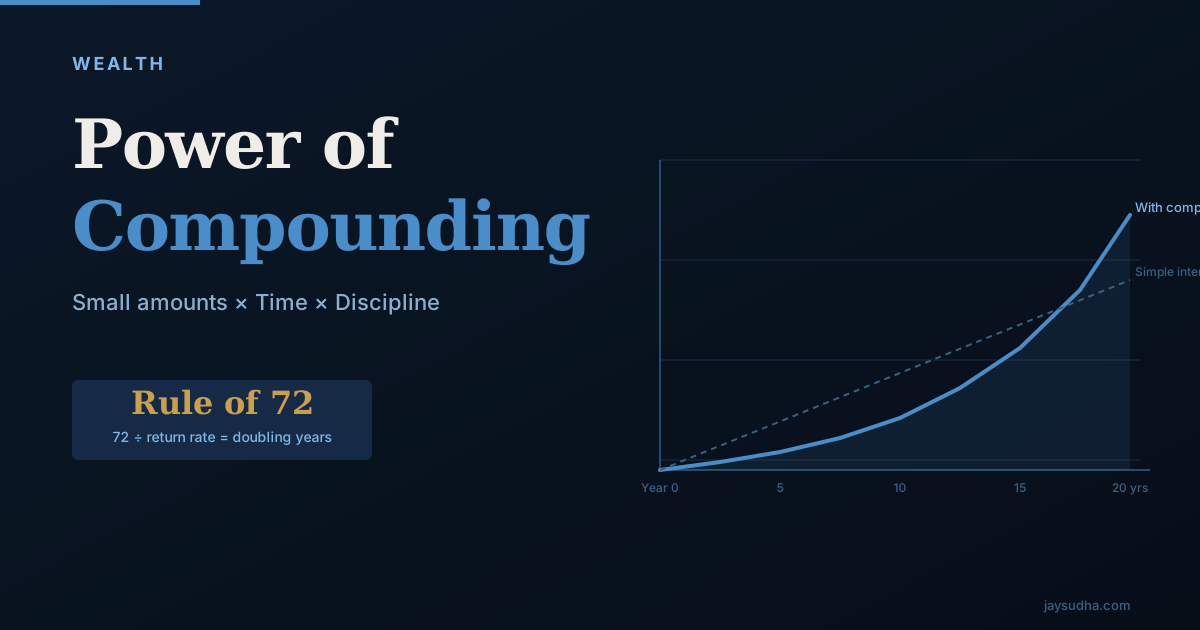
Compounding is described as the "eighth wonder of the world" so often that the phrase has become almost meaningless. More useful than the quote is a clear explanation of what compounding actually does with your money — and why the timing of when you start matters more than most people expect.
This is that explanation, built around Indian money examples.
Lesson 1: Compounding means earning returns on returns
Start with the basic mechanics.
You invest ₹1,00,000. It earns 10% in year one. You now have ₹1,10,000.
In year two, you earn 10% not on your original ₹1,00,000, but on ₹1,10,000. That gives you ₹1,21,000.
In year three, 10% on ₹1,21,000 gives you ₹1,33,100.
If returns were simple (not compounding), you would earn ₹10,000 every year and have ₹1,30,000 after three years. With compounding, you have ₹1,33,100. The difference is ₹3,100.
That gap seems small. Over 20 years, the same ₹1,00,000 at 10% simple interest would be ₹3,00,000. At 10% compound interest, it would be ₹6,72,750. The compounding version produces more than double.
Over 30 years: simple interest gives ₹4,00,000. Compound interest gives ₹17,44,940.
This is the compounding effect — small differences in the early years, dramatic differences over long periods.
Lesson 2: Time is more important than the amount you invest
This is the most counterintuitive lesson in personal finance.
Consider two people:
Priya starts investing ₹5,000 per month in a SIP at age 25. She continues until age 55 — 30 years.
Rajan waits until 35 to start investing. He invests ₹10,000 per month — double Priya's amount — until age 55. That is 20 years of investing.
Assuming 12% annual returns (for illustration only — equity returns are variable and not guaranteed):
- Priya invests ₹18 lakh total (₹5,000 × 360 months) and ends up with approximately ₹1.76 crore.
- Rajan invests ₹24 lakh total (₹10,000 × 240 months) — more money — and ends up with approximately ₹99 lakh.
Priya invests less money and ends up with significantly more — purely because she started 10 years earlier and gave compounding more time.
In compounding, the early years feel unproductive. The later years feel like acceleration. The early years are what make the later years possible.
Lesson 3: The Rule of 72 tells you how fast money doubles
A simple mental tool for compounding: divide 72 by the annual return rate to find how many years it takes for money to double.
| Annual Return | Years to Double |
|---|---|
| 6% (FD-like returns) | 12 years |
| 7.1% (PPF rate currently) | ~10 years |
| 8% | 9 years |
| 10% | 7.2 years |
| 12% (equity long-term estimate) | 6 years |
Note: These are illustrative based on assumed consistent returns. Equity returns are variable; FD and PPF rates are subject to change.
A ₹10 lakh corpus at 7.1% (PPF) doubles roughly every 10 years. At 60, if you started at 30, that principal has gone through three doublings: ₹10 lakh → ₹20 lakh → ₹40 lakh → ₹80 lakh (approximate, assuming consistent returns and no withdrawals).
Lesson 4: SIP is compounding in a practical format
A SIP (Systematic Investment Plan) is not a product — it is a method. You invest a fixed amount every month into a mutual fund. The fund grows over time, and your regular contributions keep adding to the growing base.
The SIP structure serves compounding in two ways:
First: Returns earned by the fund reinvest and compound within the fund. Every rupee of growth itself earns future growth.
Second: Regular contributions mean you are constantly adding to the compounding base, especially in the early years when contributions matter most relative to corpus size.
A practical SIP example for compounding illustration:
₹5,000 per month SIP at 12% assumed annual returns (illustrative only):
| Duration | Amount Invested | Approximate Value |
|---|---|---|
| 5 years | ₹3 lakh | ₹4.08 lakh |
| 10 years | ₹6 lakh | ₹11.6 lakh |
| 15 years | ₹9 lakh | ₹25 lakh |
| 20 years | ₹12 lakh | ₹49.9 lakh |
| 25 years | ₹15 lakh | ₹95 lakh |
| 30 years | ₹18 lakh | ₹1.76 crore |
Notice: between year 20 and year 30, the same ₹5,000 monthly investment adds roughly ₹1.26 crore in the last 10 years — more than the entire previous 20 years combined. This is the compounding curve in action.
These figures use assumed consistent returns for illustration. Actual mutual fund returns are variable and depend on market performance.
Lesson 5: Debt compounds against you just as powerfully
Compounding is neutral. It works for you in investments. It works against you in debt.
Credit card outstanding balance at 3% per month compounds into 42% annual interest. A ₹50,000 credit card balance left unpaid for a year grows to approximately ₹71,000 — a ₹21,000 cost for ₹50,000 of borrowing.
A personal loan at 18% annual interest: every ₹1 lakh borrowed costs ₹18,000 in year one interest alone.
The implication is direct: high-interest debt is compounding against you every month it exists. Paying it off first is not just discipline — it is often the mathematically correct financial move, yielding a guaranteed return equal to the debt interest rate.
Your savings rate determines how much goes into the compounding engine each month — it is the most controllable variable in the process.
Lesson 6: Starting small is better than not starting
One of the most common compounding mistakes is waiting until you have "enough to invest."
There is no threshold at which compounding begins. Even ₹500 per month in a SIP starts the compounding clock. The value of starting at ₹500 and increasing to ₹5,000 over time is substantially higher than starting at ₹5,000 a few years later.
| Start Age | Monthly SIP | 30-Year Result (at 12% assumed) |
|---|---|---|
| 25, with ₹2,000 | ₹2,000 | ~₹70 lakh |
| 30, with ₹5,000 | ₹5,000 | ~₹87 lakh |
| 25, ₹2,000 growing to ₹5,000 by age 30 | Increasing | Substantially higher |
Illustrative only. Actual returns depend on fund performance.
The point is not the exact number. It is that earlier entry into compounding, even at small amounts, produces outsized long-term effects compared to delayed entry at larger amounts.
Lesson 7: Withdrawing early resets the clock
Every time you withdraw from a long-term compounding investment, you remove not just the amount withdrawn but all future compounding on that amount.
If you withdraw ₹2 lakh from a mutual fund that was 10 years away from maturity, you do not lose ₹2 lakh — you lose the ₹2 lakh plus everything it would have compounded into over the next 10 years. At 12% return, ₹2 lakh for 10 more years becomes approximately ₹6.2 lakh.
This is why financial planners distinguish between the emergency fund (separate, liquid) and long-term investments. The emergency fund exists so you never need to break compounding investments in a crisis.
A practical rule: money you might need in the next three to five years should not be in equity investments where compounding runs optimally over longer periods. Long-term compounding requires long-term staying power.
Lesson 8: Stopping a SIP during market downturns is the most expensive mistake
Market downturns feel like the worst time to keep investing. They are actually among the better times, because prices are lower and each SIP installment buys more units.
Stopping a SIP during a 20% market correction means you miss the recovery phase. If markets fall and then recover 30% over the next two years, the SIPs you missed during the bottom contributed nothing to that recovery.
The behavioral pull is strong. It takes conscious discipline to keep SIPs running during periods when the portfolio is showing negative returns. But the data across multiple market cycles shows that investors who stay consistently invested through downturns tend to produce significantly better long-term outcomes than those who pause and restart.
Compounding does not need you to be smart about market timing. It needs you to stay invested long enough for time to do the work.
If you want the bigger picture of what compounding contributes to — building long-term financial independence — the guide on financial independence India explains how savings rate and time interact over a full career.
Lesson 9: Patience is the only technique that cannot be reverse-engineered
There is no shortcut to compounding. No investment product, trading strategy, or financial product can compress the 20–30 year compounding curve into five years without taking on corresponding risk.
Products that claim to replicate the benefits of long-term compounding in short periods are either implying higher risk, charging high fees that erode the return, or making claims that are not sustainable.
The only genuine compounding technique is patience: starting early, investing consistently, not touching the corpus, and letting time work. This is not exciting advice. It is the advice that actually works.
For most Indian professionals building long-term wealth:
- Start a SIP in a diversified equity fund as early as possible, even small
- Increase it annually, especially when income rises
- Keep an emergency fund so you never need to break the SIP
- Do not check the portfolio every week
- Give it at least 15–20 years
The compound interest formula does not care whether you understand it or find it interesting. It works whether you are watching or not — as long as the money stays invested.
Compounding in practice: PPF over 15 years with ₹10,000/month
A PPF example grounds compounding in a familiar, low-risk Indian instrument. Suppose you invest ₹10,000 per month in PPF (₹1.2 lakh per year, well under the ₹1.5 lakh annual limit) starting at age 28.
At 7.1% compounded annually (current rate; subject to government revision):
| Year (Age) | Total Deposited | Approximate Corpus |
|---|---|---|
| 5 (Age 33) | ₹6 lakh | ₹7 lakh |
| 10 (Age 38) | ₹12 lakh | ₹16.7 lakh |
| 15 (Age 43, maturity) | ₹18 lakh | ₹31.5 lakh |
The ₹31.5 lakh corpus is entirely tax-free — no tax on contributions (80C deduction in old regime), no tax on interest, no tax on maturity. The difference between total deposited (₹18 lakh) and maturity corpus (₹31.5 lakh) is ₹13.5 lakh in pure compounding gain, accumulated entirely without tax drag.
If you then extend with contributions for another 5 years, the corpus at 20 years is approximately ₹53 lakh. The 5-year extension added ₹21.5 lakh — nearly as much as the entire first 10 years, because the compounding base is now much larger.
The "just keep adding" power: why contribution consistency matters more than timing
A common compounding mistake is waiting for the "right time" to start or increase a SIP. Markets look high — wait for a correction. Income is tight this month — skip the instalment.
But compounding is not sensitive to timing precision. It is sensitive to time in market.
Consider two investors who each contribute ₹72,000 per year (₹6,000/month) for 20 years at an assumed 12% return:
- Investor A contributes every month without exception: final corpus approximately ₹59.5 lakh
- Investor B skips about 10% of her contributions — a little over one month a year on average: final corpus approximately ₹53.6 lakh
The 10% contribution drop-off creates a ~10% final corpus gap, but the compounding also reduces the power of the future contributions that do happen, because the base was lower in the formative early years. The actual gap is larger than a simple 10% reduction.
The practical lesson: a missed SIP instalment is not just one month's contribution lost. It is one month's contribution plus all the compounding that contribution would have generated over the remaining years. For a ₹6,000 instalment with 15 years remaining at 12%, that one missed instalment is worth approximately ₹32,900 in final corpus terms.
Frequently Asked Questions
Sources and references
Rules, rates, and thresholds in India change over time. Always confirm the current position with the official source above before acting on it.