Setting Financial Goals India: From Vague Intentions to Funded Targets
How to turn vague financial intentions into specific, time-bound, funded goals — with the monthly savings math and prioritisation for Indian households.
"Save more money" is an intention, not a goal. It has no target amount, no deadline, and no monthly savings number. Without a monthly savings number, it cannot inform any budget decision.
The shift from intention to goal is specific, time-bound, and funded.
The four elements of a useful financial goal
1. Name: What is this goal? Car down payment, emergency fund, home down payment, child's higher education, retirement.
2. Target amount: How much, specifically? ₹5 lakh. ₹20 lakh. ₹2 crore.
3. Target date: When do you need this money? June 2027. April 2030. Age 60.
4. Monthly savings requirement: Working backwards from amount and date, how much do you need to save each month?
Monthly savings = Target amount / Months remaining (simplified, before investment returns)
For a ₹4 lakh car down payment needed in 30 months: ₹4,00,000 / 30 = ~₹13,300/month.
This monthly number is the budget line. If it does not fit, either extend the timeline, reduce the target, or increase income.
Three horizon buckets
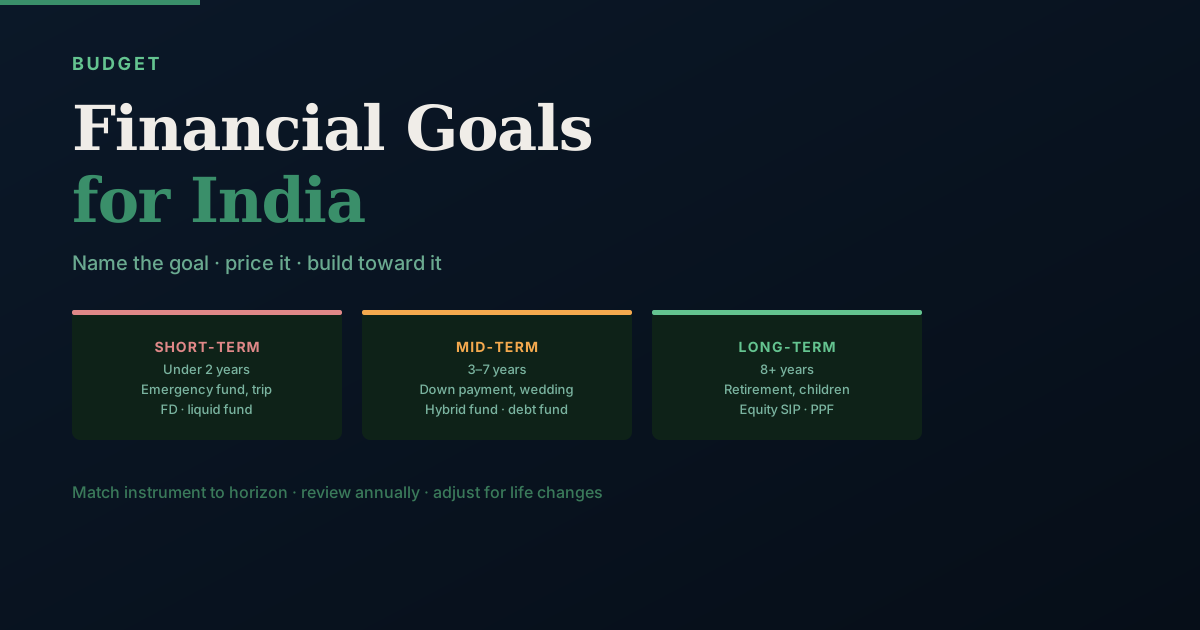
Short-term (0–2 years): Emergency fund top-up, vacation, appliance replacement, upcoming medical or family event. These need liquid, stable instruments — recurring deposits, short-duration debt funds, liquid funds.
Medium-term (3–7 years): Car purchase, home down payment, wedding expenses, child's school fees (near future). Slightly more return potential is acceptable. Conservative hybrid or debt mutual funds work here.
Long-term (8+ years): Child's higher education, retirement corpus. Long horizons allow equity allocation — accepting volatility in exchange for higher growth potential.
Writing your goal list
A goal list for a typical Indian dual-income household might look like:
| Goal | Target Amount | Timeline | Monthly Need |
|---|---|---|---|
| Emergency fund (complete) | ₹1.5 lakh | 8 months | ₹19,000 |
| Car down payment | ₹3 lakh | 24 months | ₹12,500 |
| Home down payment | ₹15 lakh | 5 years | ₹20,000 |
| Child's education | ₹30 lakh | 12 years | ₹12,500 (at 8% return) |
| Retirement | ₹3 crore | 25 years | ₹22,600 (at 10% return) |
Total monthly savings required: ₹86,600. If combined take-home is ₹1.5 lakh, that is about 58% — unrealistically high, which is exactly why a household usually cannot fund every goal at once and must prioritise.
Prioritising when goals compete
If total savings capacity is ₹40,000/month against ₹86,600 required, you must prioritise:
- Emergency fund first — non-negotiable
- Retirement next — time is the only variable that cannot be recovered
- Goals with firm deadlines (school fees) before discretionary goals (vacation)
- Long-horizon goals can accept a lower monthly contribution if income is expected to grow
The goal is not to fund every goal from day one — it is to have a written plan and to increase allocations as income grows.
Funded vs unfunded status
Mark each goal as funded (monthly allocation exists) or unfunded (intention only, no allocation). An unfunded goal is wishful thinking. A funded goal is a plan.
The gap between funded and unfunded goals is the honest assessment of where your finances actually stand.
Adjust Goal Amounts for Inflation
A subtle but costly error is setting the target at today's price for a goal that's years away. A course costing ₹15 lakh today won't cost ₹15 lakh in 12 years — at 8% education inflation it's around ₹38 lakh, and at 10% closer to ₹47 lakh. Plan for the future cost, or you'll reach the deadline with a fraction of what you need.
Quick rule: future cost ≈ today's cost × (1 + inflation)^years. Assume 6–7% general inflation, and 8–10% specifically for education and healthcare.
Use the SIP Math, Not Simple Division
Dividing target by months (the quick estimate above) ignores the returns your money earns on the way — which makes long-term goals look harder than they are. For anything beyond ~3 years, the monthly investment needed is much lower because compounding does part of the work.
Example: ₹30 lakh in 12 years.
- Simple division: ₹30,00,000 ÷ 144 = ₹20,833/month.
- With a 10% SIP return: roughly ₹10,800/month — almost half.
The longer the horizon and higher the expected return, the bigger this gap. Use a free SIP goal calculator (on most AMC and broker sites) so you don't over-save for distant goals at the expense of nearer ones.
Review Once a Year
Goals aren't set-and-forget. Once a year — the start of the financial year in April works well — re-run each one:
- Has the target cost changed?
- Are you on track, ahead, or behind?
- Did your income rise? Route part of any raise into under-funded goals before lifestyle absorbs it.
- Has a goal become irrelevant, or a new one appeared?
A goal reviewed annually stays realistic; one set once and forgotten quietly drifts out of reach.
India-Specific Goals Most Households Overlook
Many Indian households focus on the standard five (emergency fund, car, home, child's education, retirement) and miss some goals that carry real financial weight:
Parents' healthcare corpus: If your parents are in their late 50s or 60s with no independent retirement savings, their healthcare costs can land on you suddenly and be large. An ageing parent without comprehensive health insurance, hitting a cardiac event or a knee replacement, can cost ₹4–10 lakh out of pocket even with partial coverage. A dedicated "parents' healthcare reserve" — even ₹3–5 lakh in a liquid fund — absorbs these without derailing your retirement savings.
Wedding fund (yours or sibling's): Indian weddings, even modest ones, involve real costs — venue, catering, invitations, clothing, travel. Even a "simple" wedding in a metro city rarely costs less than ₹5–10 lakh for the hosting family. If this is 3–4 years away, a recurring deposit of ₹8,000–₹15,000/month can fund it without disruption. Failing to plan for it means scrambling for a personal loan at 12–18% just when you should be celebrating.
Home maintenance corpus: If you own a home, a major repair — waterproofing, replumbing, lift replacement in a society — is when rather than if. Society maintenance levies can suddenly demand ₹50,000–₹1,00,000 per flat for major repairs. A dedicated home maintenance sinking fund of ₹1,000–2,000/month avoids the shock.
Career transition fund: A growing number of professionals in India change fields, take sabbaticals, or move to entrepreneurship. A career transition fund — 6–12 months of personal expenses — is distinct from an emergency fund (which is for involuntary disruptions). It funds voluntary risk-taking that might otherwise feel financially impossible.
Worked Example: A Joint-Family Household Goal Table
Arjun and Priya live in Hyderabad with Arjun's parents. Combined take-home: ₹1,65,000/month. Here is their current goal table, built with realistic numbers:
| Goal | Today's Cost | Future Cost (Inflated) | Timeline | Monthly Need |
|---|---|---|---|---|
| Emergency fund (complete) | ₹2,00,000 | — | 10 months | ₹20,000 |
| Car (down payment ₹2L) | ₹2,00,000 | ₹2,20,000 | 18 months | ₹12,200 |
| Parents' healthcare reserve | ₹5,00,000 | — | 36 months | ₹13,900 |
| Child's higher education | ₹20,00,000 | ₹44,00,000 (8% inflation, 10 yr) | 10 years | ₹22,500 (at 9% return) |
| Home down payment | ₹25,00,000 | ₹30,50,000 (4% inflation, 5 yr) | 5 years | ₹42,600 (at 7% return) |
| Retirement (combined) | ₹3,50,00,000 | — | 22 years | ₹36,700 (at 10% return) |
Total monthly savings required: ₹1,47,900 — about 90% of take-home. Far too high to fully fund today.
Their priority decision: Emergency fund first (non-negotiable). Parents' healthcare reserve (time-sensitive; parents are 62). Car down payment (deferred 6 months; use existing car). Home down payment (timeline extended to 7 years, reducing monthly need to ₹28,200). Education and retirement funded at minimum viable level until income grows.
Revised funded total: ₹20,000 + ₹13,900 + ₹22,500 + ₹28,200 + ₹18,000 = ₹1,02,600/month. Still high but manageable when the emergency fund goal completes in 10 months (freeing ₹20,000 which routes to the car fund).
This is real financial planning: not all goals funded immediately, but all goals named, costed, and prioritised with a written sequence.
The Right Instruments for Each Horizon — India-Specific
The goal horizon should determine where the savings sit:
0–12 months (emergency fund, short buffer): Liquid mutual funds (same-day or T+1 redemption) or a high-yield savings account. The priority is liquidity and capital protection. Returns of 6–7% are secondary. ICICI Pru Liquid, HDFC Liquid, and similar are commonly used; returns are taxed as per income slab for short holding periods.
1–2 years (car down payment, near-term travel, appliance): Short-duration debt funds or recurring deposits in a nationalised/private bank. 6.5–7.5% returns, predictable, no equity risk. For an RD: most banks now allow opening digitally via net banking in minutes.
3–5 years (home down payment, wedding, sibling's higher education): Conservative hybrid funds (30–35% equity) or debt mutual funds. The equity component provides some growth advantage; the debt component reduces volatility. CRISIL Hybrid 35+65 index is a useful benchmark. Alternatively, SCSS for senior citizens as part of the parents' healthcare goal.
5–10 years (child's education, early career transition): Balanced advantage funds or Flexi-cap index funds. A Nifty 500 index fund via monthly SIP is a low-cost, well-diversified choice for this horizon. At 7+ years, equity volatility usually averages out.
10+ years (retirement, child's distant education): Equity-heavy allocation — Nifty 50 index SIP, mid-cap index, international diversification through Nifty Next 50 or a US index fund. PPF is excellent for retirement: currently 7.1% tax-free, EEE status (exempt at investment, accumulation, and withdrawal), with 15-year lock-in that forces long-term discipline. EPF contribution also compounds in this bucket.
Common Goal-Setting Mistakes
Setting goals in round numbers without a calculation: "I want ₹1 crore for retirement" without working backward to a monthly SIP is an aspiration, not a plan. The calculation takes five minutes with any SIP calculator.
Not separating joint-family and personal goals: In households where parents are financially dependent, their healthcare and living cost needs are a financial goal for the earning children — even if they have never been explicitly framed that way. Name them and fund them.
Treating EPF as retirement and nothing else: EPF is an excellent retirement savings vehicle, but withdrawal rules for non-retirement purposes (home purchase, medical, education) exist. Clarify which portion of EPF is "reserved" for retirement and which might be accessed earlier, so your retirement goal calculation is accurate.
Ignoring goal sequencing: Some goals are prerequisites for others. An emergency fund is a prerequisite for everything — without it, a medical event forces you to liquidate the investment you were building toward a home down payment. The sequence matters.
Communicating Goals in a Two-Income Household
Many households have two earners but no shared goal list. Each person has their own sense of what they're working toward — and the two senses may not align.
Common misalignment patterns:
- One partner prioritises home purchase; the other prioritises travel and experiences
- One sees retirement as the primary long-term goal; the other sees the child's education as the priority
- One has an informal financial commitment to parents that the other does not know the size of
The goal-setting exercise is also a communication exercise. A joint goal-setting conversation — even once a year — establishes which goals are shared, which are individual but respected, and how the household savings will be allocated across them.
A practical structure for a two-income household goal list:
| Goal | Owner | Monthly Need | Account/Instrument |
|---|---|---|---|
| Emergency fund (shared) | Joint | ₹10,000 | Liquid mutual fund (joint account) |
| Home down payment (shared) | Joint | ₹25,000 | Debt fund (joint SIP) |
| Child's education (shared) | Joint | ₹8,000 | Equity SIP (minor's folio) |
| Retirement (Person A) | A | ₹12,000 | NPS + PPF (A's accounts) |
| Retirement (Person B) | B | ₹10,000 | NPS + PPF (B's accounts) |
| Parents' support reserve (A's parents) | A | ₹5,000 | FD in A's name |
| Travel and experiences (shared want) | Joint | ₹6,000 | Savings account goal sub-account |
This table makes the individual and shared nature of each goal explicit, names the instrument, and ensures both people understand the full picture of where household money is going. Misalignment usually shrinks when both people can see the complete allocation clearly.
Related calculatorsavings calculator
Frequently Asked Questions
Sources and references
Rules, rates, and thresholds in India change over time. Always confirm the current position with the official source above before acting on it.