Zero-Based Budgeting: What It Is and When It Works
Zero-based budgeting assigns every rupee a purpose before the month starts. The method, its trade-offs, and where it beats simpler budgeting approaches.
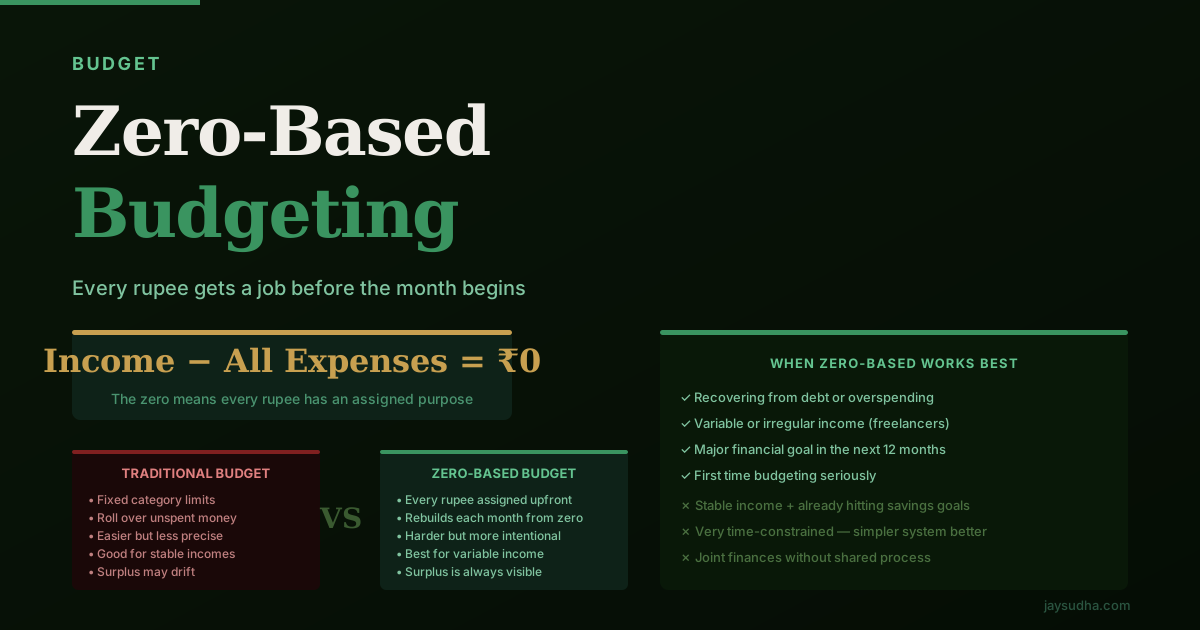
Zero-based budgeting is a method where every rupee of income is assigned a specific purpose before the month begins. Income minus all allocations equals zero — not because everything is spent, but because every rupee is directed somewhere intentional, including savings, SIPs, and EMI payments.
This is not primarily a cost-cutting tool. It is a planning discipline. The value is not in the numbers themselves but in the act of deciding before spending, rather than reviewing after.
The core principle
A conventional approach subtracts known expenses from income and observes what remains. Zero-based budgeting reverses this: you start with take-home income, then systematically allocate every rupee to a category until the balance is zero.
Here is a simplified example with ₹60,000 monthly take-home:
| Category | Monthly Allocation |
|---|---|
| Rent | ₹18,000 |
| Groceries and household | ₹7,000 |
| Utilities (electricity, gas, broadband) | ₹3,000 |
| Transport (fuel/metro) | ₹3,500 |
| Phone | ₹800 |
| OTT and subscriptions | ₹600 |
| Emergency fund SIP | ₹4,000 |
| Equity mutual fund SIP | ₹6,000 |
| NPS or PPF contribution | ₹2,000 |
| EMI payment (personal loan) | ₹5,000 |
| Dining out | ₹2,500 |
| Personal care | ₹1,500 |
| Clothing and miscellaneous | ₹3,000 |
| Buffer / unplanned | ₹3,100 |
| Total | ₹60,000 |
Every rupee has a job. The ₹3,100 in buffer is intentional — not left over, but assigned. If the month ends with ₹800 of buffer unused, that ₹800 is redirected before the next month begins, usually to savings or debt repayment.
What zero-based budgeting does well
Forces explicit trade-offs. When every rupee is allocated, overspending in one category requires a visible reduction in another. This makes the cost of a discretionary choice apparent — dining out more means investing less, or vice versa — rather than invisible.
Makes savings and investment a first-line item. In unstructured spending, savings is what remains after spending. In zero-based budgeting, SIP contributions and savings are allocated before discretionary categories. This sequencing matters. Research consistently shows that people who save first save more than people who save what is left.
Particularly effective for debt payoff. When you are repaying a personal loan, credit card balance, or home loan prepayment, zero-based budgeting lets you allocate an aggressive repayment amount at the start of the month, see exactly how it affects every other category, and track progress clearly month to month.
Catches spending drift early. Monthly allocation reviews flag increases before they become embedded. A new streaming subscription or a price increase noticed in January costs less — both literally and in terms of budget adjustment — than the same expense discovered in an annual review.
Where zero-based budgeting creates friction
Time and maintenance cost. Allocating at the start of each month takes 30 to 60 minutes. Adjusting mid-month when reality diverges from the plan requires time. For people with simple, stable finances, this maintenance cost may exceed the marginal benefit.
Irregular income. Zero-based budgeting assumes income is known before allocation. Freelancers, self-employed professionals, and anyone with a variable salary face a specific challenge: you cannot allocate what you do not yet know. The workaround is to budget on last month's income (or a conservative estimate), and treat additional income as a windfall allocated to pre-defined priorities. This works, but it adds complexity.
Can feel punishing rather than useful. When actual spending differs from the plan — an unexpected vehicle repair, a medical bill, a last-minute travel expense — the process of re-allocating categories can feel punishing rather than helpful. This triggers abandonment in people who experience budget deviations as failures rather than as corrections. Zero-based budgeting works if you adjust and continue. It fails if deviation causes abandonment.
When zero-based budgeting is the right choice
It produces the most value when:
- You are in an active debt repayment phase and want to maximize the monthly allocation
- Your spending has become opaque — you are genuinely unsure where money is going
- Your income changed recently (promotion, job change, income cut) and your spending patterns have not adjusted
- You are building toward a specific near-term financial goal that requires deliberate monthly allocation: emergency fund, home down payment, large purchase
- Your savings rate is consistently lower than your intention suggests it should be
It is less necessary when:
- Income is stable, your savings rate is where you want it, and there is no active high-interest debt
- You are already tracking spending with a simpler system that produces the results you want
- The monthly setup consistently does not happen — any system you will not maintain is worse than a simpler system you will
How to implement it in India
Step 1: Calculate your net monthly take-home. This is salary credit, not CTC. Include side income only if it is reliable enough to plan around.
Step 2: List fixed and committed obligations first. Rent, EMIs, insurance premiums, fixed SIPs. These are non-negotiable allocations. Sum them.
Step 3: Allocate savings and investment goals next. Before discretionary spending, assign rupees to emergency fund, investment SIPs, and any specific savings goal. Treat these as expenses, not leftovers.
Step 4: Allocate discretionary categories. Groceries, dining, transport, entertainment, clothing. These are the flexible buckets where adjustments happen.
Step 5: Confirm the total equals zero. If it does not, adjust discretionary categories until it does. Every unallocated rupee gets assigned.
Step 6: Track during the month. Review UPI transaction history against categories, or use a Google Sheets tracker. The setup is only useful if you check it mid-month.
Simpler alternatives
50/30/20 rule — 50% of take-home to needs, 30% to wants, 20% to savings and debt. One decision per broad category, not per line item. Less precise, significantly lower maintenance.
Pay-yourself-first — Automate all savings and investment contributions on payday. Spend the remainder without a formal budget. Works well when the savings rate is already at the right level and discretionary spending is not the problem.
Spending tracker without a budget — Track every transaction and review patterns monthly. No pre-allocation. Useful for building awareness without a structural constraint.
The practical summary
Zero-based budgeting is not superior by default to other approaches. It is a tool suited to specific financial situations — debt payoff, income transition, goal-focused savings, and opacity in current spending. The method produces its best results when implemented consistently over several months, not as a one-off exercise.
The right budgeting method is the one you will maintain across months that are easy and months that are not. If zero-based budgeting fits your situation and temperament, it is one of the most effective cash flow tools available.
A Complete ZBB Month: Worked Example
Priya earns ₹75,000 take-home in Chennai. She is in a debt repayment phase — a personal loan at 15% with ₹1.8 lakh outstanding. Here is her zero-based budget for July:
Income: ₹75,000
| Category | Allocation | Notes |
|---|---|---|
| Rent | ₹18,000 | Fixed |
| Groceries | ₹6,500 | Slightly above usual — Eid in family |
| Utilities (electricity, gas, broadband, phone) | ₹3,800 | Summer; AC running |
| Transport (fuel + Ola) | ₹4,000 | Capped strictly |
| Health insurance premium | ₹1,200 | Monthly equivalent |
| Personal loan EMI | ₹7,500 | Scheduled repayment |
| Personal loan extra prepayment | ₹5,000 | Voluntary, debt payoff focus |
| SIP (index fund) | ₹8,000 | Non-negotiable |
| Emergency fund top-up | ₹3,000 | Still building |
| Dining out | ₹2,000 | Hard cap this month |
| Personal care | ₹1,500 | |
| Clothing | ₹0 | Deferred this month |
| Gifts and occasions | ₹2,000 | One birthday |
| Subscriptions | ₹600 | Netflix mobile only |
| Irregular expenses buffer | ₹2,000 | Vehicle service expected |
| Buffer / unplanned | ₹7,400 | Residual, assigned not spare |
| Savings for next month's insurance renewal | ₹2,500 | Annual premium due September |
| Total | ₹75,000 |
Every rupee allocated. The ₹7,400 buffer is named — it sits in the salary account and if unused, rolls to the next month's irregular buffer. It is not available for impulse spending; it is the named residual that keeps the budget at zero.
Mid-month check (15th): Transport has run ₹2,800 of the ₹4,000 with two weeks left. Priya notes this and consciously chooses metro over Ola for the rest of the month.
Month-end result: Transport came in at ₹4,200 (₹200 over). Dining came in at ₹1,750 (₹250 under). Net: on plan. The ₹7,400 buffer was untouched. It transfers to the irregular fund.
The extra ₹5,000 prepayment reduced her personal loan outstanding from ₹1,80,000 to approximately ₹1,69,750 — about ₹5,250 of principal from the scheduled EMI (the rest of the ₹7,500 EMI was interest at 15%) plus the ₹5,000 extra payment. Keeping up an extra prepayment like this clears the loan well ahead of schedule and saves a meaningful amount of interest over its life.
Zero-Based Budgeting With a Joint Family Contribution
Many Indian professionals contribute to a joint family household, which adds a layer ZBB must accommodate explicitly. In Priya's case, her parents live in a different city and she sends ₹8,000/month for household and medical expenses. This is a fixed, non-negotiable allocation that comes before discretionary spending — so in her real ZBB, it sits in the committed obligations section alongside rent.
The point: ZBB requires naming every obligation, including family support. Households that run ZBB without naming informal family obligations find the budget "mysteriously" running short — because the transfer was treated as a situational expense rather than a fixed commitment.
Tools for Running ZBB in India Without a Paid App
Zero-based budgeting does not require a subscription. The tools needed are already free:
Google Sheets template approach: Create one tab per month. Row 1: Income. Rows 2 onwards: one row per category with planned allocation, actual spend, and variance columns. Formula at the bottom: =Income - SUM(all allocations) should equal 0. When it does not, adjust allocations until it does.
Tracking mid-month: add a "spent so far" column and update it weekly from your bank statement or UPI history. Any category running hot is visible in real time.
PhonePe and Google Pay summaries: Both apps show monthly spending summaries by merchant. Not by category, but you can map merchants to your ZBB categories manually. Useful as a quick sanity check.
Bank statement download mid-month: Most Indian banks now allow statement download for any date range through the mobile app. Downloading a partial month statement on the 15th and categorising it takes 10 minutes and gives a clear mid-month picture.
The most common reason ZBB fails is the check-in step: people set up the allocation and then do not look again until month end. The allocation is the plan; the check-in is the execution. A mid-month 10-minute review prevents the end-of-month scramble to reconcile where the money went.
Adapting ZBB for Months With Irregular Income
The specific challenge for variable income earners: you cannot allocate income you haven't received. Two approaches:
Last month's income method: Base the current month's ZBB on what arrived in your bank account last month. Any income that arrived this month above last month's total is a "windfall" allocated to a pre-defined priority order (emergency fund → investments → discretionary). This turns unpredictable income into a predictable allocation process.
Conservative forecast method: At the start of the month, estimate conservatively what income will arrive (floor income from the variable income framework). Build the ZBB on this number. If income exceeds the forecast, the surplus is explicitly allocated at the time it arrives — not left unassigned.
Both methods work. The key is that no money is ever "unallocated." In ZBB, every rupee — including the surplus from a good month — gets a job the moment it is confirmed.
Related calculatorbudget calculator
Frequently Asked Questions
Sources and references
Rules, rates, and thresholds in India change over time. Always confirm the current position with the official source above before acting on it.