Tax Brackets Explained: Marginal vs. Effective Rate in India
A common myth is that a higher tax slab can leave you worse off. It cannot. How India's marginal slabs work and why marginal vs effective rate matters.
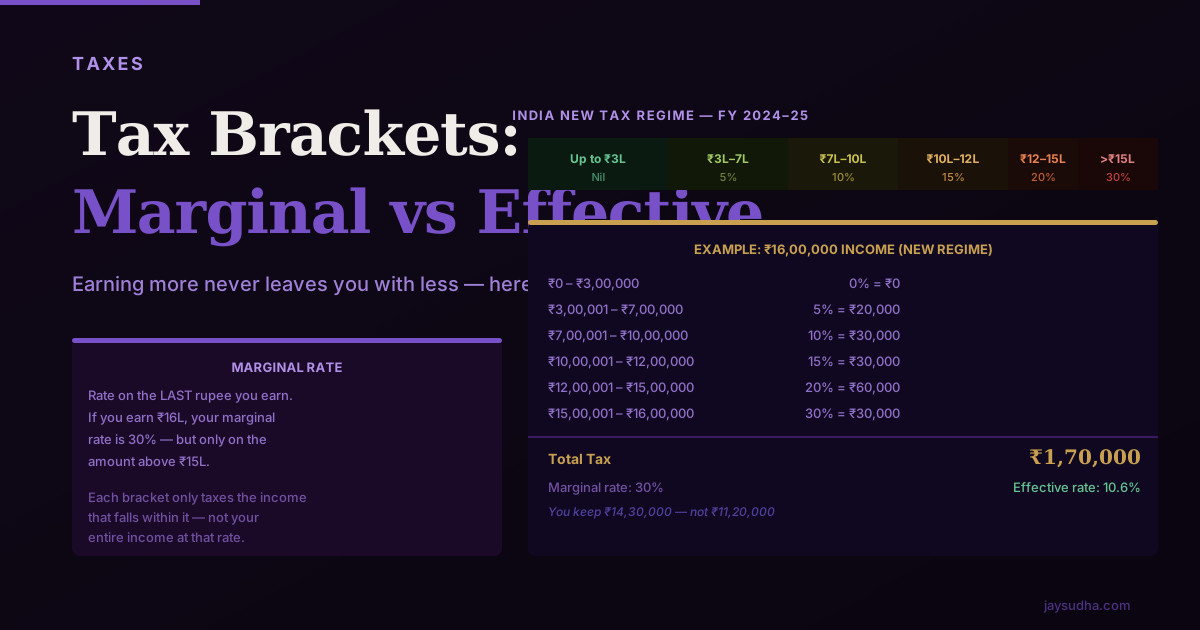
The most persistent tax planning misconception in India — and globally — is that crossing into a higher slab reduces total take-home pay. This is not how progressive, marginal tax systems work. Understanding the difference between marginal and effective rates is foundational to making sound decisions about income, deductions, timing, and regime choice.
How tax slabs actually work
India's income tax system is progressive and marginal. "Progressive" means higher incomes face higher rates. "Marginal" means those higher rates apply only to income above each threshold — not to all income.
New Tax Regime — FY 2026-27
Under the new tax regime (FY 2026-27 / AY 2027-28 — Budget 2026 left the slabs untouched), after the standard deduction of ₹75,000 for salaried employees:
| Slab | Tax Rate | On taxable income from | To |
|---|---|---|---|
| 1st | 0% | ₹0 | ₹4,00,000 |
| 2nd | 5% | ₹4,00,001 | ₹8,00,000 |
| 3rd | 10% | ₹8,00,001 | ₹12,00,000 |
| 4th | 15% | ₹12,00,001 | ₹16,00,000 |
| 5th | 20% | ₹16,00,001 | ₹20,00,000 |
| 6th | 25% | ₹20,00,001 | ₹24,00,000 |
| 7th | 30% | ₹24,00,001 and above | — |
Important: Under the new regime, taxable income up to ₹12 lakh qualifies for the Section 87A rebate, effectively making the tax liability zero. Just above ₹12 lakh, marginal relief under the same section caps the income-tax at the amount by which taxable income exceeds ₹12 lakh — the full slab tax only takes over from about ₹12,70,588. There is no cliff here; the section below works through the numbers.
A worked example: ₹16 lakh taxable income (new regime)
If your taxable income after standard deduction is ₹16,00,000:
| Slab | Income in slab | Tax rate | Tax |
|---|---|---|---|
| 0–4 lakh | ₹4,00,000 | 0% | ₹0 |
| 4–8 lakh | ₹4,00,000 | 5% | ₹20,000 |
| 8–12 lakh | ₹4,00,000 | 10% | ₹40,000 |
| 12–16 lakh | ₹4,00,000 | 15% | ₹60,000 |
| Total | ₹1,20,000 |
Plus 4% cess: ₹4,800. Total tax: ₹1,24,800.
Marginal rate: 15% (the slab your last rupee fell into). Effective rate: ₹1,24,800 ÷ ₹16,00,000 = 7.8%.
You are legally in the "15% slab" but you pay an average of 7.8% on your total income. These are different numbers answering different questions.
The slab myth
A common version: "If I earn ₹1 more and cross into the next slab, my whole salary gets taxed at the higher rate and I take home less."
This is wrong. Only the rupees above each slab threshold are taxed at the higher rate. The income below each threshold remains taxed at the original rates. Crossing a slab threshold is never financially harmful — it means more income, and only the marginal rupees face the higher rate.
There is one genuine threshold effect in India: the ₹12 lakh Section 87A rebate. Below ₹12 lakh taxable income, tax is effectively zero. Above it the rebate is withdrawn — but not all at once. Section 87A carries its own marginal relief, which caps your income-tax at the amount by which taxable income exceeds ₹12 lakh. For someone on ₹12.5 lakh taxable income, the slab tax of ₹67,500 is cut back to ₹50,000 — the excess over ₹12 lakh — which with 4% cess comes to ₹52,000, not the ₹70,200 the raw slabs suggest. Planning around this threshold is still worth doing, and the section below shows why.
Why marginal rate matters for financial decisions
Your marginal rate is the rate that applies to each additional rupee — from a bonus, freelance income, rental income, or investment returns. It is also the rate at which deductions save you money.
Under the old regime, deduction value scales with marginal rate:
- ₹1.5 lakh in 80C investments at 5% marginal rate → saves ₹7,500 in tax
- ₹1.5 lakh in 80C investments at 20% marginal rate → saves ₹30,000 in tax
- ₹1.5 lakh in 80C investments at 30% marginal rate → saves ₹45,000 in tax
Note which rates those are. 80C is an old-regime deduction, and the old regime's rate ladder is 5%, 20% and 30% — it contains no 10% band. The 10% rate belongs to the new regime's ₹8–12 lakh slab, where 80C cannot be claimed at all, so a "10% saving on 80C" is not a combination the law allows.
Higher marginal rates increase the absolute value of every eligible deduction. This is why taxpayers in the 30% slab — those with taxable income above ₹10 lakh under the old regime — benefit most from systematic 80C, 80D, HRA, and NPS utilisation.
Income timing decisions: A freelance project, rental receipt, or capital gain realised in a year when your income is lower is taxed at a lower marginal rate. Timing discretionary income events — such as selling property, timing an NPS partial withdrawal, or receiving a large bonus — toward lower-income years can reduce lifetime tax meaningfully.
Regime selection: The new regime offers lower slab rates but eliminates most deductions. The old regime has higher slab rates but allows 80C, 80D, HRA, NPS, and home loan interest deductions. The better choice depends on your marginal rate under each regime and on how far your old-regime deductions carry you. Note that both regimes give a salaried employee a standard deduction — ₹75,000 under the new regime, ₹50,000 under the old — so the hurdle is not ₹75,000 of deductions but that ₹25,000 gap plus enough 80C, 80D, HRA, NPS and home loan interest to outweigh the new regime's lower rates. A simple breakeven calculation compares tax liability under each regime for your specific income and deductions.
Effective rate vs. marginal rate — which to use when
Use effective rate to understand your total tax burden for a year — how much of your total income went to taxes. Useful for year-on-year comparison and overall budget planning.
Use marginal rate to evaluate any specific financial decision: a new income source, a deduction, a withdrawal, a timing choice. Every rupee-at-the-margin decision is evaluated at the marginal rate, not the effective rate.
The two are frequently confused because they both use the phrase "tax rate." They answer different questions:
- Effective rate answers: "What fraction of my total income was paid in tax this year?"
- Marginal rate answers: "What will this specific decision cost me in tax?"
Surcharge and cess
For incomes above ₹50 lakh, a surcharge applies — 10% between ₹50 lakh and ₹1 crore, 15% between ₹1 crore and ₹2 crore, and 25% above ₹2 crore under the new regime. The old regime runs one step further, to 37% above ₹5 crore; the new regime caps out at 25%. Marginal relief applies at each surcharge threshold too, so crossing one never costs more than the income that took you across it. This surcharge is applied to the computed tax, not to income directly.
A 4% health and education cess applies to all taxpayers on the total income tax (including surcharge). When calculating effective rates, always include cess in the numerator.
Old regime slabs for reference (FY 2026-27)
| Slab | Rate |
|---|---|
| Up to ₹2.5 lakh | 0% |
| ₹2.5 to ₹5 lakh | 5% |
| ₹5 to ₹10 lakh | 20% |
| Above ₹10 lakh | 30% |
The old regime's 30% slab kicks in at ₹10 lakh, compared to 15% at ₹12 lakh under the new regime. This difference, combined with the deduction value at 30%, determines which regime is more efficient for a given profile.
The practical takeaway
Tax slabs in India are additive and marginal. Moving up a slab never produces less after-tax income. The only place the arithmetic bends is the Section 87A rebate at ₹12 lakh, and marginal relief keeps even that to a few thousand rupees. Your effective rate is always lower than your highest marginal slab rate. Understanding both numbers clearly allows you to evaluate the tax impact of each financial decision rather than avoiding income or deferring productive choices out of a misread of how the system works.
The ₹12 Lakh Threshold: A Kink, Not a Cliff
The Section 87A rebate is the one place in the new regime where the smooth slab arithmetic bends. It is widely described as a cliff — cross ₹12 lakh of taxable income by a single rupee and a ₹60,000-odd bill supposedly lands on you. That is not what the law says. The ₹12 lakh ceiling arrived with Finance Act 2025 and now sits in section 156(2) of the Income-tax Act, 2025 — the provision readers still know as Section 87A — which carries a marginal relief clause alongside the rebate itself. Finance Act 2026 left both untouched, so the drop is cushioned.
The rule in plain words: once taxable income crosses ₹12 lakh, your income-tax is capped at whatever you earned above ₹12 lakh. The statute rebates the difference between the slab tax and that excess.
Worked example: ₹12,10,000 taxable income
What the cliff story predicts — the raw slab tax:
| Slab | Income in slab | Tax rate | Tax |
|---|---|---|---|
| 0–4 lakh | ₹4,00,000 | 0% | ₹0 |
| 4–8 lakh | ₹4,00,000 | 5% | ₹20,000 |
| 8–12 lakh | ₹4,00,000 | 10% | ₹40,000 |
| 12–12.1 lakh | ₹10,000 | 15% | ₹1,500 |
| Slab tax | ₹61,500 |
₹61,500 plus 4% cess (₹2,460) = ₹63,960.
What you actually pay:
- Income above the threshold: ₹12,10,000 − ₹12,00,000 = ₹10,000
- The slab tax of ₹61,500 exceeds that ₹10,000, so marginal relief rebates the difference: ₹61,500 − ₹10,000 = ₹51,500
- Income-tax payable: ₹10,000
- 4% cess on ₹10,000: ₹400
- Total: ₹10,400
Earning ₹10,000 past the threshold costs ₹10,400 — not ₹63,960.
Where the relief runs out
Relief only bites while the slab tax is bigger than the excess. Above ₹12 lakh the slab tax is ₹60,000 plus 15% of the excess, so the two meet where 60,000 + 0.15E = E — an excess of ₹70,588. Past roughly ₹12,70,588 of taxable income the ordinary slab tax is already the smaller number and marginal relief has nothing left to do.
| Taxable income | Slab tax | Tax after marginal relief | Plus 4% cess |
|---|---|---|---|
| ₹12,00,000 | ₹60,000 | ₹0 (full ₹60,000 rebate) | ₹0 |
| ₹12,10,000 | ₹61,500 | ₹10,000 | ₹10,400 |
| ₹12,25,000 | ₹63,750 | ₹25,000 | ₹26,000 |
| ₹12,50,000 | ₹67,500 | ₹50,000 | ₹52,000 |
| ₹12,70,588 | ≈₹70,588 | ≈₹70,588 (relief exhausted) | ≈₹73,412 |
| ₹13,00,000 | ₹75,000 | ₹75,000 (no relief due) | ₹78,000 |
What this means in practice:
For a salaried employee with gross salary around ₹13 lakh:
- Gross salary ₹13,00,000 − ₹75,000 standard deduction = ₹12,25,000 taxable
- Slab tax ₹63,750; excess over ₹12 lakh ₹25,000; marginal relief ₹38,750
- Tax: ₹25,000 + 4% cess = ₹26,000
Versus someone earning ₹12,75,000 gross:
- ₹12,75,000 − ₹75,000 = ₹12,00,000 taxable
- 87A rebate applies: ₹0 tax
So the ₹25,000 of extra salary costs ₹26,000 in tax and leaves the higher earner ₹1,000 behind — not the ₹66,300 a cliff reading of the slabs would predict.
The residual effect — real, but small
Inside the relief band every extra rupee of income is matched by a rupee of income-tax, plus 4 paise of cess (there is no marginal relief on cess). Take-home pay is therefore flat from ₹12 lakh to about ₹12.7 lakh of taxable income, drifting down by the cess alone. The worst case is a shortfall of roughly ₹2,824, and you are back ahead of your ₹12 lakh take-home by around ₹12,73,900 of taxable income.
That is the honest version: the ₹12 lakh mark is a genuine kink — a stretch where a raise buys you nothing — but it is a ₹2,800 speed bump, not a ₹62,400 cliff.
One carve-out worth knowing: the rebate and its marginal relief apply only to income taxed at slab rates. Tax on income charged at special rates — equity capital gains under Sections 111A and 112A, for instance — sits outside the rebate entirely and is payable regardless.
Planning around the kink: because each rupee in the ₹12,00,000–₹12,70,588 band effectively costs ₹1.04 in tax, shaving taxable income back to ₹12 lakh is unusually valuable — one of the few stretches of the income scale where a rupee of deduction is worth more than a rupee (the surcharge thresholds, which carry their own marginal relief, behave the same way). If your taxable income sits in that band under the new regime, consider whether employer NPS contribution under 80CCD(2), which remains available in the new regime, can bring it to ₹12 lakh or below. On ₹12.5 lakh taxable, a ₹50,000 employer NPS contribution takes you to ₹12 lakh: zero tax instead of ₹52,000. Above roughly ₹12.7 lakh the effect fades and ordinary marginal-rate thinking takes over again.
Multi-Year Marginal Rate Planning
Your marginal rate today may not be your marginal rate in 5 years. Recognising this opens planning opportunities:
Pre-retirement: Income often peaks in the last 10 years of a career. Deferring taxable events (NPS withdrawal, property sale, large capital gains realisation) to retirement years when income is lower can materially reduce lifetime tax.
High-income year: A large one-time payment (ESOP vesting, bonus, property sale) in a single year can push you into the 30% slab temporarily. If you have flexibility in timing the receipt, spreading it across two financial years avoids the slab concentration. Note: this only applies where you genuinely have receipt timing flexibility — not all income can be deferred.
Variable income earners (freelancers, consultants): A project delivered in March vs April falls in different financial years and different income totals. Advance planning of invoice timing (within the legitimate scope of when work is delivered) can smooth income across years and keep both years in lower slabs rather than having one high year and one low year.
The Effective Rate Across Income Levels (New Regime, FY 2026-27)
Here's what effective rates actually look like, after standard deduction of ₹75,000:
| Gross Salary | Taxable Income | Tax + Cess | Effective Rate on Gross |
|---|---|---|---|
| ₹5,00,000 | ₹4,25,000 | ₹0 (87A rebate) | 0% |
| ₹8,00,000 | ₹7,25,000 | ₹0 (87A rebate) | 0% |
| ₹12,75,000 | ₹12,00,000 | ₹0 (87A rebate) | 0% |
| ₹15,00,000 | ₹14,25,000 | ₹93,750 + cess = ₹97,500 | 6.5% |
| ₹20,00,000 | ₹19,25,000 | ₹1,85,000 + cess = ₹1,92,400 | 9.6% |
| ₹25,00,000 | ₹24,25,000 | ₹3,07,500 + cess = ₹3,19,800 | 12.8% |
| ₹30,00,000 | ₹29,25,000 | ₹4,57,500 + cess = ₹4,75,800 | 15.9% |
The effective rate climbs slowly, reflecting how the marginal rate only applies to income in each slab. Even at ₹30 lakh gross salary, the effective rate is ~16%, not the 30% marginal rate. This is the core insight that separates informed tax thinking from the slab confusion most people carry.
Deductions and Their Value at Different Marginal Rates
Every rupee of deduction saves money equal to your marginal rate. 80C, 80D and Section 24(b) are all old-regime deductions, so the only rates that can apply to them are the old regime's own ladder — 5%, 20% and 30%:
| Marginal Rate (old regime) | 80C Saving (₹1.5L) | 80D Saving (₹25K) | 24(b) Interest (₹2L) |
|---|---|---|---|
| 5% | ₹7,500 | ₹1,250 | ₹10,000 |
| 20% | ₹30,000 | ₹5,000 | ₹40,000 |
| 30% | ₹45,000 | ₹7,500 | ₹60,000 |
At 5% marginal rate, ₹1.5 lakh invested in ELSS saves ₹7,500 in tax. At 30%, it saves ₹45,000. This is also why regime choice is income-sensitive: deductions are worth six times more at 30% than at 5%.
Conversely, at the 5% end of that ladder the old regime barely pays for itself. Someone with ₹4–8 lakh of taxable income owes nothing at all under the new regime once the Section 87A rebate is applied, so the effort of maintaining investment proofs, tracking deduction limits, and staying on the old regime for a few thousand rupees of deduction value is hard to justify — the new regime's simplicity has real value.
Marginal Rate Thinking for Investment Withdrawals
When you withdraw from a corpus — NPS partial withdrawal, EPF withdrawal, ELSS redemption, bank FD maturity — the marginal rate at the time of withdrawal determines the tax cost.
NPS partial withdrawal: 25% of employee contribution can be withdrawn tax-free for specific purposes (children's education, critical illness, marriage). Balance at final withdrawal: 60% is tax-free; 40% must purchase an annuity (annuity income is taxable at slab rate in the year of receipt).
EPF withdrawal before 5 years: Taxed as salary income in the year of withdrawal — at your marginal rate for that year. If you withdraw ₹5 lakh from EPF in a high-income year when you're at 30%, the tax cost is ₹1.5 lakh + cess. If you withdraw in a low-income year (career gap, sabbatical), the same ₹5 lakh may be taxed at 5% or even 0%.
Timing matters for all taxable withdrawals. The decision of when to take out money from a tax-deferred account is as important as the investment decision itself.
The Effective Rate as a Communication Tool
When discussing your tax situation with a CA, employer, or family member, the effective rate is the number that communicates your actual burden:
"My marginal rate is 30%" tells you the rate on the last rupee. "My effective rate is 11%" tells you what fraction of total income went to tax.
Both numbers are correct and useful for different conversations. Understanding which one to use — and why they differ — is part of becoming financially literate about your own tax situation.
Note: Tax slabs and rates are subject to annual change through the Union Budget. Consult the latest Income Tax Department notifications or a qualified CA for advice specific to your situation.
Frequently Asked Questions
Sources and references
- Income Tax Department, Government of India
- Memorandum Explaining the Provisions in the Finance Bill, 2025 — new regime slab rates for AY 2026-27 and the Section 87A rebate and marginal relief limits raised to Rs 12,00,000
- Income-tax Act, 2025 (No. 30 of 2025), Gazette of India — section 156(2) (rebate and marginal relief), section 202(1) (new regime slab rates) and section 19(1) Table Sl. No. 2 (₹75,000 standard deduction under section 202(1), ₹50,000 otherwise)
- Finance Act, 2026 (No. 4 of 2026), Gazette of India — section 3(1) charges tax year 2026-27 at the First Schedule Part I-B rates; Part I-B Paragraph A (old regime slabs), section 3(4)(b) Table Sl. No. 10 and Paragraph F Table 1 (surcharge), section 3(5) (surcharge marginal relief), section 3(15) (4% health and education cess). It leaves sections 156 and 202(1) of the Income-tax Act, 2025 unamended
Rules, rates, and thresholds in India change over time. Always confirm the current position with the official source above before acting on it.