Salary Restructuring for Tax Savings: What Employees Can Legitimately Do
Your salary structure decides how much tax you pay. Knowing which components are tax-exempt helps you negotiate smarter, within what the law allows.
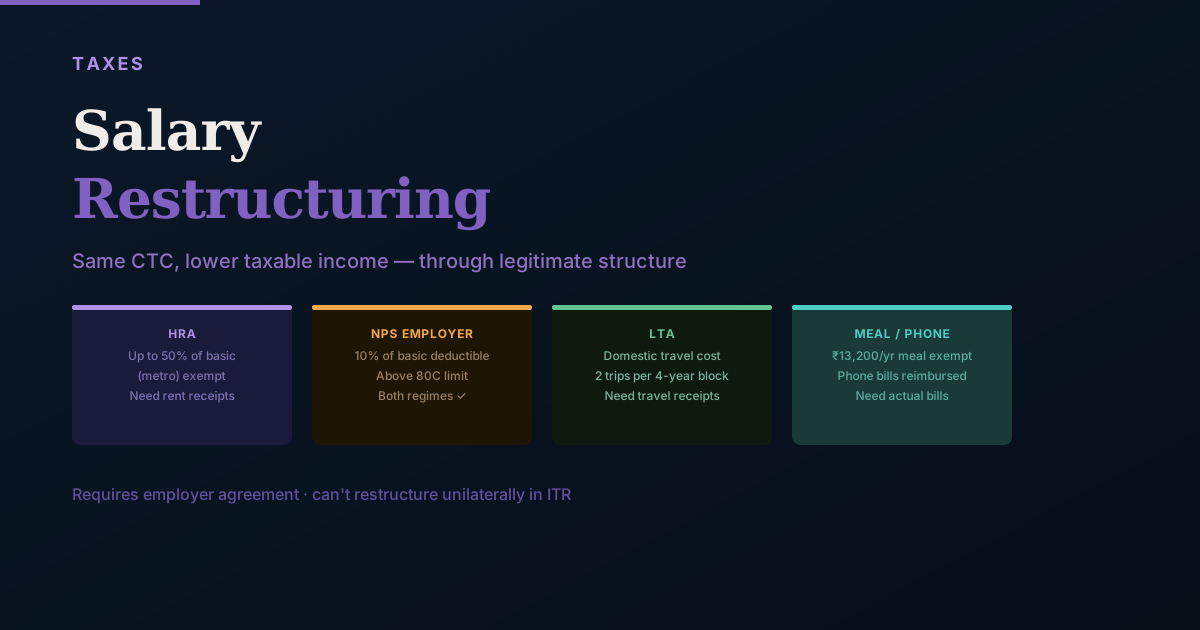
Your gross salary and your taxable salary can differ significantly depending on how your CTC is structured. Several components of salary are either fully or partially exempt from income tax — but you can only benefit if those components are included in your salary package.
Why Salary Structure Matters
Two employees earning the same CTC (₹18 lakh/year) can have very different tax liabilities depending on how that CTC is structured:
- Employee A: 100% basic salary → pays tax on full ₹18L (minus standard deduction)
- Employee B: CTC includes HRA, food coupons, LTA, NPS employer contribution → taxable income could be ₹3–4L lower
Old Regime vs New Regime — This Changes Everything
Before optimising anything, know this: most salary exemptions only work under the old tax regime. Under the new regime (now the default), HRA, LTA, meal coupons, and professional-development reimbursements are not exempt. What survives in the new regime is short but powerful:
- Employer NPS contribution under 80CCD(2) — available in both regimes, and the ceiling is higher in the new regime (14% of Basic+DA vs 10% in the old).
- Standard deduction — ₹75,000 under the new regime (vs ₹50,000 old).
- A few exit benefits like gratuity and leave encashment.
So the strategy splits cleanly:
- Old regime: stack HRA, LTA, meal coupons, NPS, and reimbursements — the full toolkit below.
- New regime: the big lever is employer NPS; most other allowances become taxable, so optimise for take-home and the higher NPS ceiling instead.
This is exactly why 80CCD(2) is the one component worth fighting for regardless of regime.
Key Tax-Efficient Salary Components
1. House Rent Allowance (HRA)
If you live on rent, HRA is the most commonly used exemption.
Exemption calculation (lowest of three):
- Actual HRA received
- 50% of basic+DA (metro cities: Mumbai, Delhi, Chennai, Kolkata) or 40% (other cities)
- Actual rent paid minus 10% of basic+DA
To claim: maintain rent receipts, provide landlord's PAN if annual rent exceeds ₹1 lakh.
2. Leave Travel Allowance (LTA)
Exempt for actual domestic travel expenses, twice in a block of 4 calendar years (current block: 2022–2025).
- Only travel costs qualify (flights, trains, buses) — not hotel or food
- Journeys must be within India
- Receipts required for reimbursement
3. Food/Meal Coupons
Sodexo, Edenred, or similar meal vouchers up to ₹50/meal, 22 working days = ₹1,100/month = ₹13,200/year is exempt.
4. Phone and Internet Reimbursement
Actual phone and internet bills reimbursed by employer are tax-exempt. Not "allowance" — must be actual reimbursement of documented bills.
5. NPS Employer Contribution (Section 80CCD(2))
The most powerful underused component:
- Employer contribution to NPS (Tier 1) is deductible up to 10% of Basic+DA under the old regime — and up to 14% under the new regime
- Available in BOTH old and new tax regimes (one of the very few that is)
- Does not reduce the ₹1.5 lakh 80C limit
- Not added to "in-hand" salary — goes directly to NPS account
Example: If Basic = ₹7 lakh/year, employer NPS = 10% = ₹70,000 additional deduction on top of 80C.
6. Car Lease / Driver Allowance
For employees with cars: company-leased vehicles provide structured tax benefit. Chauffeur allowance up to specified limits is partially exempt.
7. Professional Development Allowance
Books, professional subscriptions, and course fees reimbursed by employer are tax-exempt (requires actual expense documentation).
What You Cannot Do
- You cannot inflate HRA without actually paying rent
- You cannot claim LTA without actual travel
- Salary structure changes require employer cooperation — you cannot do this unilaterally in your ITR
- Misrepresenting rent paid (claiming rent for accommodation you own, or paying rent to family members without arms-length arrangement) is illegal
How to Restructure: The Conversation with HR
If your company offers a flexible benefits or cafeteria plan:
- Request your current salary breakup and the company's permitted structuring options
- Calculate the tax benefit of shifting components (HRA increase, NPS employer contribution addition)
- Submit a formal restructuring request within the company's policy window (usually once a year)
If your company doesn't offer flexible structuring:
- Focus on Section 80C investments (ELSS, PPF), 80CCD(1B) personal NPS contribution, health insurance under 80D, and home loan deductions — all of which are in your control regardless of salary structure
Leave Encashment and Gratuity: Tax Treatment
Two salary components that many employees ignore until they're received:
Leave Encashment (on resignation vs retirement):
- Received while in service (resignation): Fully taxable at slab rate, no exemption. Added to salary income in the year received.
- Received at retirement (from government employer): Fully exempt
- Received at retirement (from private employer): Exempt up to ₹25 lakh (revised from ₹3 lakh to ₹25 lakh for retirements on or after April 1, 2023). Amount above ₹25 lakh is taxable.
If you're resigning with accumulated leave and receiving leave encashment, this is fully taxable. Plan around this: if the encashment is large and falls in a year when other income is also high, your marginal rate on the encashment may be 30%. In some cases, choosing to reduce leave balance before resignation (by taking actual leave) is more efficient than receiving the monetary encashment.
Gratuity:
- From government employer: fully exempt
- From private employer covered under Payment of Gratuity Act: exempt up to ₹20 lakh
- From private employer not covered under the Act: exempt up to half of last drawn monthly salary × completed years of service, subject to ₹20 lakh cap
Gratuity is paid on completing 5 years of service. Planning: if you're close to a year completion (e.g., 4 years 10 months), consider whether completing the full year before resigning is worth the additional 2 months for the full gratuity claim.
A Worked HRA Example
Basic+DA ₹6,00,000/year, HRA received ₹3,00,000, rent paid ₹2,40,000/year, living in a metro:
- Actual HRA: ₹3,00,000
- 50% of Basic+DA: ₹3,00,000
- Rent − 10% of Basic+DA: ₹2,40,000 − ₹60,000 = ₹1,80,000
Exempt = the lowest = ₹1,80,000; the remaining ₹1,20,000 of HRA is taxable. The binding constraint is usually rent paid — if your rent is low relative to salary, much of your HRA is taxed no matter how it's labelled.
Paying Rent to Family — The Legitimate Version
You can claim HRA for rent paid to a parent who owns the home — a common, legal arrangement — but only if it's genuine:
- The property is owned by the family member, not you.
- Money actually changes hands (a monthly bank transfer).
- The recipient declares the rent as income in their own ITR.
What's not allowed: fabricating rent, paying a spouse for a jointly occupied home, or routing money that comes straight back. Done properly, rent to a parent in a lower bracket can shift income within the family tax-efficiently; done as a paper fiction, it's exactly what scrutiny notices look for.
Worked Full Example: Two Salary Structures, Same CTC
Consider two employees, both with ₹18 lakh CTC, both in Bengaluru (non-metro for HRA), both under old regime.
Employee A — All Basic:
- Basic: ₹18,00,000
- No HRA, no meal coupons, no NPS
- Standard deduction: ₹50,000
- Taxable salary: ₹17,50,000
- 80C (EPF contribution 12% of 18L): ₹1,50,000 (EPF contribution fills 80C)
- 80D: ₹25,000
- Taxable income: ₹15,75,000
- Tax: ~₹2,85,000 + 4% cess ≈ ₹2,96,400
Employee B — Optimised Structure:
- Basic: ₹9,00,000; HRA: ₹4,50,000; Meal coupons: ₹13,200; Phone/internet: ₹30,000; NPS employer: ₹90,000 (10% of basic); Remaining: ₹3,16,800 special allowance
- CTC same: ₹18,00,000
- HRA exemption (renting at ₹20,000/month in Bengaluru): Rent = ₹2,40,000; 40% of basic = ₹3,60,000; Rule 2 = ₹2,40,000 − ₹90,000 = ₹1,50,000 → exempt = ₹1,50,000
- Exempt meal coupons: ₹13,200
- Taxable salary: ₹18L − ₹1,50,000 HRA − ₹13,200 meals − ₹90,000 NPS (80CCD(2)) − ₹50,000 std deduction = ₹14,96,800
- 80C (EPF = 12% of ₹9L basic = ₹1,08,000; plus additional ₹42,000 ELSS) = ₹1,50,000
- 80D: ₹25,000
- NPS 80CCD(1B): ₹50,000
- Taxable income: ₹14,96,800 − ₹2,25,000 = ₹12,71,800
- Tax: ~₹1,94,040 + cess ≈ ₹2,01,802
Annual tax saving: ₹2,96,400 − ₹2,01,802 = ₹94,598 from the same ₹18 lakh CTC.
The 80CCD(2) NPS Calculation in Detail
This is the single most powerful salary restructuring tool available in both regimes. Let's be precise:
Old regime: Employer NPS contribution up to 10% of Basic + DA is deductible under 80CCD(2) New regime: Employer NPS contribution up to 14% of Basic + DA is deductible under 80CCD(2)
The deduction is not subject to the ₹1.5 lakh 80C limit. It is completely separate.
Example at ₹10 lakh basic:
| Regime | Max employer NPS % | Max NPS deduction |
|---|---|---|
| Old | 10% | ₹1,00,000 |
| New | 14% | ₹1,40,000 |
At 30% tax bracket, ₹1 lakh NPS deduction = ₹30,000 tax saving. At 14% of a ₹10L basic (new regime), the saving is ₹42,000.
Important caveat: Employer NPS contribution is not added to take-home salary. It goes directly to your NPS Tier I account. The money is locked until retirement (with limited exceptions). This is not a cost-free benefit — you are deferring compensation into a pension fund. But for those who are already planning for retirement and want to reduce current tax, it is genuinely powerful.
Section 10(14) Special Allowances Worth Knowing
Section 10(14) lists allowances that are exempt from tax when used for specific purposes. Under the old regime, some are worth negotiating into your salary structure:
Children's education allowance: ₹100/month per child, maximum 2 children = ₹2,400/year. Small but free.
Hostel expenditure allowance: ₹300/month per child, maximum 2 children = ₹7,200/year. For employees with children in hostel-based schools.
Uniform allowance: If your job requires a specific uniform (hospital staff, flight crew, security), actual costs reimbursed for uniform maintenance are exempt. Requires genuine wear-and-care expenses.
Daily allowance for official tours: Bona fide travel allowances given specifically for official tours are exempt. Not "travel allowance" as a regular salary component — only payments directly tied to official travel.
These allowances are individually small. In aggregate across multiple components, they can add ₹20,000–30,000 per year of exempt income at no additional cost to the employer.
The Perquisite Rules for Company Cars
If your employer provides a company car (owned or leased by the company) and allows personal use, the perquisite is valued as follows:
For car up to 1600 CC:
- Driver provided: ₹2,700/month perquisite value
- No driver: ₹1,800/month perquisite value
For car above 1600 CC:
- Driver provided: ₹3,300/month
- No driver: ₹2,400/month
These are very low valuations relative to the actual cost of owning a car. A company car with a ₹25,000/month lease is taxed as only ₹2,700/month perquisite — saving potentially ₹22,000+/month in post-tax cost compared to buying the car yourself.
This is why car leasing through employer (where permitted) is one of the most efficient tax-saving benefits for high-income employees. It requires the company to have a structured car lease policy.
How to Approach the HR Conversation
If your company offers flexible benefit plans (FBP) or cafeteria compensation:
-
Ask HR for the salary component menu: Know what components are available, their tax treatment, and whether they require actuals or allow declarations.
-
Prioritise components by tax efficiency per rupee:
- NPS employer contribution (highest efficiency — 100% of declared amount saves proportionate tax)
- HRA (if you pay meaningful rent)
- Meal coupons (low admin burden, modest benefit)
- Phone/internet (requires actual bills)
-
Submit your restructuring request at the company's allowed window (usually at appraisal or at start of financial year).
-
For NPS employer contribution specifically: This requires a separate request to add your employer as a subscriber in your NPS account and set up direct contribution flow. Your HR/payroll team needs to configure this in payroll. It's slightly more work but the benefit is disproportionately large.
If your employer doesn't have an FBP policy, direct your energy to the variables you control: your own 80C investments, 80CCD(1B) personal NPS contribution, health insurance under 80D, and home loan deductions. These don't require employer cooperation and can still save ₹60,000–₹1,50,000 in tax annually depending on income level and deduction mix.
The exact savings depend on your slab, structure, and regime — model your own numbers with a CA before requesting a restructure from HR.
Frequently Asked Questions
Sources and references
Rules, rates, and thresholds in India change over time. Always confirm the current position with the official source above before acting on it.