Professional Tax in India: Who Pays, How Much, and When
Professional tax is a state-level tax on employment and self-employment income. It's small but mandatory, and the rate and method vary by state.
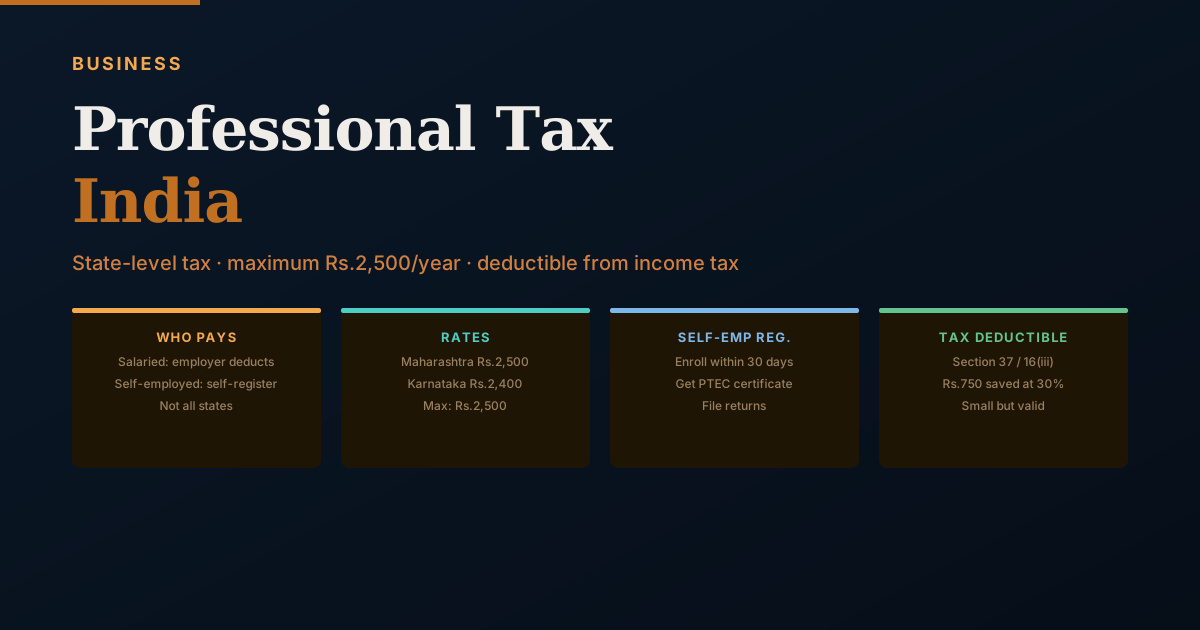
Professional tax is a state government tax on income earned from profession, employment, trade, or employment. It's small — maximum Rs.2,500/year — but mandatory in states that levy it.
Which States Levy Professional Tax?
Professional tax is levied by: Maharashtra, Karnataka, Andhra Pradesh, Telangana, West Bengal, Tamil Nadu, Gujarat, Madhya Pradesh, Chhattisgarh, Odisha, Kerala, Assam, Meghalaya, Tripura, Bihar, Jharkhand, Sikkim, and others.
States without professional tax include: Delhi, Uttar Pradesh, Rajasthan, Punjab, Himachal Pradesh, Haryana, Uttarakhand, Jammu & Kashmir.
Rates by Major States
| State | Annual Max | Monthly (Approx) |
|---|---|---|
| Maharashtra | Rs.2,500/year | Rs.200-208/month |
| Karnataka | Rs.2,400/year | Rs.200/month |
| West Bengal | Rs.2,500/year | Up to Rs.208/month |
| Tamil Nadu | Rs.1,200/year | Rs.100/month |
| Gujarat | Rs.2,500/year | ~Rs.200/month |
Actual rates are slab-based by income level within each state. Check your state's professional tax schedule for exact slabs.
For Salaried Employees
Your employer deducts professional tax from your salary monthly and deposits it with the state government. This should appear on your salary slip under deductions.
If your employer is not deducting it (in a state where it applies), you may need to register and pay directly.
For Self-Employed Professionals
Registration:
- Register with the state's professional tax authority (Commercial Tax Department or Labor Department depending on the state)
- Obtain a Professional Tax Enrollment Certificate (PTEC)
- Pay the annual professional tax per the state schedule
Payment methods vary by state — most now offer online payment through the state's commercial tax portal.
If you have employees, you must also deduct and deposit professional tax from their salaries and obtain a Professional Tax Registration Certificate (PTRC).
Professional Tax and Income Tax
Professional tax paid is a deductible expense:
- Salaried employees: deducted under Section 16(iii) of the Income Tax Act
- Self-employed: treated as a business expense under Section 37
Given the small amounts involved (Rs.2,500 max), the income tax saving on professional tax is Rs.750-800 (at 30% bracket) — small but legitimate.
Compliance Requirements
For self-employed in states with professional tax:
- Register within 30 days of starting the profession
- File periodic returns as per state schedule (monthly, quarterly, or annual depending on state)
- Pay by due date to avoid late fees and interest
Penalties vary by state but typically include interest and fines for late payment or non-registration.
PTEC vs PTRC — Don't Confuse the Two
Two different certificates, and a business owner with staff needs both:
- PTEC (Professional Tax Enrollment Certificate): covers your own professional tax as the proprietor or professional. You enrol once, then pay your own slab annually.
- PTRC (Professional Tax Registration Certificate): required only if you have employees. It authorises you to deduct professional tax from their salaries and deposit it with the state.
A solo freelancer needs only PTEC. The moment you hire your first salaried employee, add PTRC.
A Freelancer Example (Maharashtra)
A Mumbai-based consultant earning above ₹10,000/month:
- Enrols for PTEC on the state commercial-tax portal within 30 days of starting.
- Pays ₹2,500 for the year (Maharashtra's cap; the salaried schedule is ₹200/month with ₹300 in February to total ₹2,500, while enrolled professionals generally pay a flat ₹2,500 annually).
- Claims the ₹2,500 as a deduction when filing income tax.
Net cost after the deduction (30% bracket): roughly ₹1,700 for the year. Small — but non-registration can cost far more in penalties.
Who Is Often Exempt
Many states exempt specific categories — commonly senior citizens above 65, parents or guardians of a person with a disability, and members of the armed forces. Exemptions are state-specific, so check your state's schedule rather than assuming.
The Real Risk Is Forgetting, Not the Amount
Because the sum is tiny, professional tax is the compliance item people most often ignore — until a penalty notice arrives. States typically charge interest (around 1.25% per month in several states) plus a flat penalty for late enrolment or payment, which can quickly exceed the tax itself. Set a recurring annual reminder near your state's due date and clear it alongside your other yearly filings.
State-by-State Deep Dive: Registration Portals and Due Dates
Professional tax compliance is entirely state-administered, and the portals, slabs, and due dates differ meaningfully. Here are the specifics for major states:
Maharashtra:
- Portal: mahagst.gov.in (under Professional Tax)
- PTEC annual payment: Rs.2,500 for salary/remuneration above Rs.10,000/month; lower slabs for lower income
- Payment due: by 30 June each year for enrolled professionals
- Late fee: 1.25% per month on outstanding amount, plus possible prosecution for persistent default
- Note: The February salary deduction for employees is Rs.300 instead of the regular Rs.200 to ensure the full annual Rs.2,500 is collected
Karnataka:
- Portal: Bapot.kar.nic.in (under Professional Tax)
- Rate: Rs.200/month = Rs.2,400/year for income above Rs.15,000/month; lower slabs below that
- Self-employed professionals pay annually via the portal; employers deduct monthly
- PTRC holders (with employees) must file monthly returns; PTEC holders may have annual filing
West Bengal:
- Portal: wbprofessiontax.gov.in
- Rate structure is progressive; maximum Rs.2,500/year for income above Rs.40,000/month
- Self-employed professionals register online; annual payment in July
Tamil Nadu:
- Portal: tnprofessiontax.gov.in
- Rate: Rs.1,200/year for income above Rs.75,001/month (various slabs below)
- Half-yearly payment due: within 30 days of each half-year
- Unlike Maharashtra, Tamil Nadu's maximum is Rs.1,200 — significantly lower
Andhra Pradesh and Telangana:
- Each state has separate administration post-bifurcation
- Rate: Up to Rs.2,500/year with a detailed income slab schedule
- Online filing available through respective state commercial tax portals
Gujarat:
- Portal: taxpayment.gujarat.gov.in (Professional Tax section)
- Rate: Up to Rs.2,500/year; slabs vary by income band
- Annual payment for most enrolled professionals
Professional Tax Slabs: Worked Example (Maharashtra)
For a freelance IT consultant in Mumbai with monthly billing averaging Rs.1.5 lakh:
| Month | Monthly Income | PT Deducted |
|---|---|---|
| April to January | Rs.1,50,000 | Rs.200/month × 10 = Rs.2,000 |
| February | Rs.1,50,000 | Rs.300 |
| March | Rs.1,50,000 | Rs.200 |
| Annual Total | Rs.2,500 |
For a self-employed professional (not employee), Maharashtra levies a flat Rs.2,500 annual PTEC payment rather than the monthly slab schedule. Register, pay once for the year, claim the Rs.2,500 deduction in ITR.
Professional Tax for Multiple States: When You Work Across Geographies
A common scenario: a consultant based in Karnataka who provides services to clients in Maharashtra and delivers some work from both cities. Which state's professional tax applies?
Professional tax is based on where you carry on your profession — your principal place of business, not where your clients are located. If you are based in Bengaluru and work remotely for Mumbai clients, Karnataka's professional tax applies.
If you genuinely maintain two offices — say, a Bengaluru home office and a Mumbai coworking membership where you work regularly — the answer is less clear. In practice, most professionals pay professional tax in their state of residence/primary business. There is no formal mechanism for "double professional tax" on the same income stream for a single-location business.
If you've moved states during the year, close the professional tax registration in the old state (after settling dues) and register in the new state within 30 days of commencing the profession there.
Professional Tax for LLP and Pvt Ltd
Business entities — LLPs and Private Limited Companies — also have professional tax obligations, but with an important distinction from individual professionals:
The entity itself pays professional tax on behalf of its designated partners or directors (typically a fixed annual amount for the entity, separate from the personal professional tax of each individual).
The entity must deduct professional tax from employee salaries and remit it as an employer/PTRC holder.
So an LLP has three professional tax obligations potentially:
- The LLP's own enrollment (PTEC) — the entity's professional tax
- Each designated partner's personal professional tax (their own PTEC)
- PTRC to deduct and deposit professional tax from any salaried employees
A Pvt Ltd company has similar obligations: company PTEC, each director's personal PTEC if they are also practising professionals, and PTRC for employees.
The company secretary or CA managing your compliance should handle all three, but as a business owner, knowing these three exist prevents a situation where you've paid only one and missed the others.
Professional Tax and Income Tax: The Full Deduction Picture
Professional tax's tax deductibility is simple but worth spelling out clearly:
Salaried employees: Professional tax deducted from salary is deductible under Section 16(iii) of the Income Tax Act. This deduction reduces your gross salary before applying the standard deduction and computing tax under the head "Salaries." It is claimed automatically when your employer provides Form 16 — the salary income figure in the certificate already accounts for the professional tax deducted.
Self-employed professionals: Professional tax paid is a business expense deductible under Section 37. It reduces your taxable business income.
Tax saving: At the 30% tax bracket with 4% cess, Rs.2,500 in professional tax saves Rs.780 in income tax. The net cost of professional tax compliance is approximately Rs.1,720 (Rs.2,500 minus Rs.780 tax saving). For lower income brackets, the saving is proportionally less.
New tax regime: The new income tax regime (default from FY 2023-24) does not allow most deductions, but professional tax deduction under Section 16(iii) for salaried employees and Section 37 for self-employed continues to apply. It is not one of the deductions disallowed under the new regime.
Compliance Timeline: Setting Annual Reminders
Given how easily professional tax gets forgotten, set a recurring annual reminder in your calendar:
| State | Annual Reminder Date | Action |
|---|---|---|
| Maharashtra | June 20 | Check PTEC payment due, pay online at mahagst.gov.in |
| Karnataka | April 30 | Pay annual PTEC if enrolled as self-employed professional |
| West Bengal | July 31 | Pay annual PT at wbprofessiontax.gov.in |
| Tamil Nadu | August 1 | Pay first half-year (April-September) |
| Gujarat | March 31 | Annual PT payment |
These dates are approximate guidelines — verify current due dates on your state's portal each year, as states occasionally revise them.
Professional Tax for Freelancers Who Changed States Mid-Year
If you relocated from Bengaluru to Mumbai during the financial year, your professional tax obligations straddle two states. Here is how to handle it:
Step 1 — Close the Karnataka registration: File any pending returns, pay dues up to your last active month in Karnataka, and apply to cancel the PTEC. Karnataka's portal (bapot.kar.nic.in) has an online cancellation process, though some districts may require a physical visit to the assessing officer.
Step 2 — Register in Maharashtra within 30 days of commencing your profession in Mumbai. The 30-day window starts from the date you began working from Maharashtra — typically when you signed a lease or started working from a Mumbai coworking space.
Step 3 — Pro-rate payments: Karnataka professional tax applies for the months you worked there; Maharashtra applies from the month you moved. There is no overlap obligation and no "double professional tax" for the same months.
Step 4 — Claim both deductions at ITR time: Both professional tax payments — Karnataka for the months worked there, Maharashtra for the months worked there — are deductible from business income under Section 37.
Professional Tax and the New Tax Regime
A question freelancers often ask: is professional tax deductible under the new tax regime (the default regime from FY 2023-24)?
For salaried employees: Section 16(iii) deduction for professional tax continues under the new regime. This is not in the list of deductions disallowed under the new regime (Section 115BAC). The standard deduction is also available. So yes, professional tax is deductible even if you choose the new regime.
For self-employed professionals: Professional tax is deductible as a business expense under Section 37, which applies under both old and new regimes for business income. The new regime restrictions on deductions apply primarily to Chapter VI-A deductions (80C, 80D, etc.) — not to expenses deducted in computing business profits.
The net impact: At the 30% tax slab, ₹2,500 in professional tax saves ₹780 in income tax. At the 20% slab, the saving is ₹520. The deduction works the same way regardless of which regime you are in — but the actual rupee saving differs by your marginal tax rate.
Setting Up a One-Click Annual Reminder
Since professional tax is due once or twice a year in most states (and the amount is small), it's easy to forget. A reliable method:
- Add the due date for your state to Google Calendar as a recurring annual event with a 2-week advance reminder
- Bookmark your state's professional tax portal URL in a folder labelled "Annual Tax Compliance"
- Keep your enrollment certificate PDF in the same folder alongside your PAN and GST certificates
When the reminder fires, the process is: open portal, log in, pay, download receipt, file in your compliance folder. In Maharashtra and Karnataka, this takes under 10 minutes online. There is no reason for professional tax to be a compliance problem — it only becomes one when it's forgotten.
State-wise rates, due dates, and exemptions are revised periodically — verify your state's current schedule on its portal or with a CA rather than relying solely on the figures above.
Frequently Asked Questions
Sources and references
Rules, rates, and thresholds in India change over time. Always confirm the current position with the official source above before acting on it.