Freelancer Accounting in India: Records, Invoices, and What You Must Track
Freelancing in India creates specific tax and accounting duties. Here's the full picture of what to track, what to invoice, and how to stay compliant.
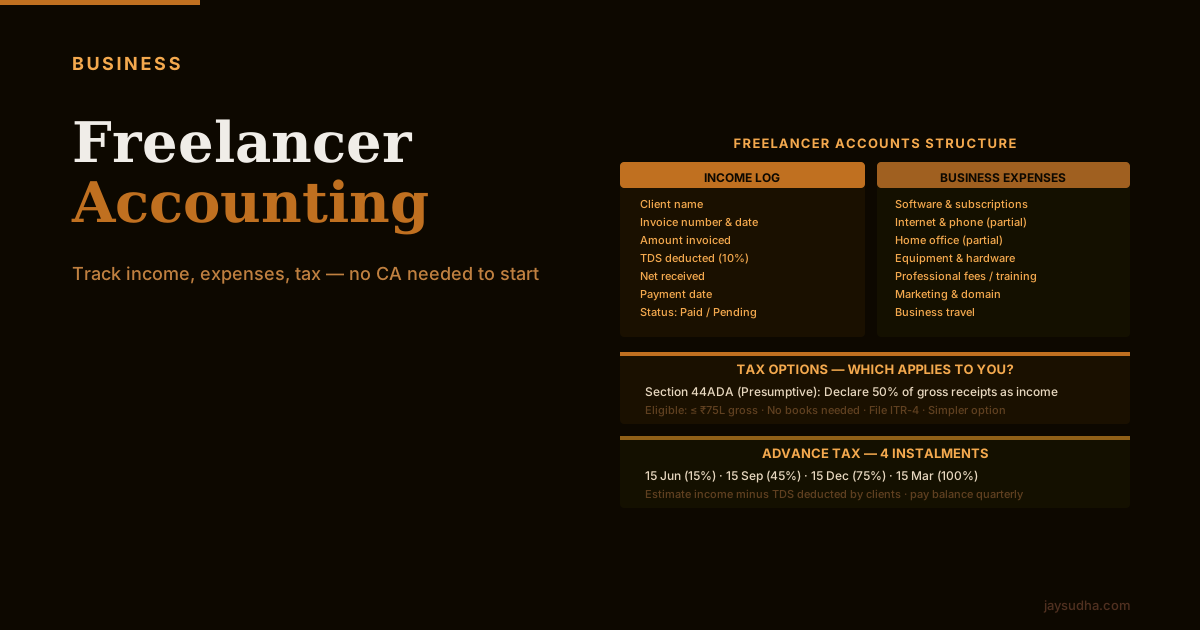
When you move from employment to freelancing, the mechanics of your tax life change completely. Your employer used to calculate your tax, deduct it, and pay it to the government. That's gone. Now you handle it — advance tax payments, reconciling TDS from multiple clients, maintaining income records, deciding which tax regime makes sense, potentially dealing with GST.
This isn't complicated once you understand the structure. But ignoring it creates compounding problems: missed advance tax installments attract interest, unreconciled TDS becomes a refund mess, and poor records make ITR filing a guessing exercise.
The Tax Framework: How Freelance Income Is Classified
Under the Income Tax Act, freelance or self-employed income falls into two categories depending on what you do:
Professional income covers specified professions: doctors, lawyers, engineers, architects, accountants (including Chartered Accountants), management consultants, interior decorators, technical consultants, and others listed under Section 44ADA. If your work falls here, you're in the professional income category.
Business income covers everyone else — freelancers doing work that doesn't fall under the specified professions. You might be a writer, photographer, programmer, or digital marketer. You compute income under the head "Profits and Gains of Business or Profession."
The distinction matters because the special provisions differ slightly between the two.
Section 44ADA: The Presumptive Scheme for Professionals
Section 44ADA is the most practically useful provision for many freelancers. Here's what it does:
Note on section numbers: the Income-tax Act, 2025 (effective 1 April 2026) consolidated Sections 44AD and 44ADA into a single Section 58 (confirmed against the Income Tax Department's official transition FAQ and the Act's own text) — the 50%/8%/6% rates and receipt thresholds discussed below are unchanged. This page keeps the familiar 1961-Act names ("44ADA", "44AD") since they remain in common use.
If you're a specified professional (those listed above) and your gross receipts are up to ₹75 lakh in a year (verify current limit at incometax.gov.in), you can opt to declare 50% of your gross receipts as taxable income without maintaining detailed books of accounts.
What this means in practice: If you earn ₹30 lakh as a consultant in a year, you declare ₹15 lakh as taxable income. You don't need to track and prove every expense. The remaining 50% is presumed to cover all your business expenses — rent, travel, software, equipment, professional development, everything.
If your actual expenses are less than 50% of receipts — which is common for pure service businesses with low overhead — this scheme gives you a tax break while eliminating compliance burden.
Conditions:
- Gross receipts must not exceed ₹75 lakh (verify current threshold)
- You must declare at least 50% as profit — you cannot declare less unless you maintain books and get audited
- If you claim less than 50%, a tax audit is required under Section 44AB
- You cannot maintain detailed books and then switch to presumptive in the same year
Important: Even under 44ADA, you must still maintain basic records — keep all your invoices, bank statements showing receipts, and proof of major expenses. "No books required" doesn't mean no documentation at all.
For business income (non-professionals), the equivalent provision is Section 44AD, which allows declaring 8% of turnover as profit (or 6% if receipts are through banking/digital channels). The turnover limit is ₹3 crore (verify current limit). This is used less by knowledge-work freelancers since 8% is a low assumed profit rate for service businesses.
When to Maintain Proper Books
You need to maintain detailed books of accounts and get a tax audit if:
- Your gross receipts exceed the 44ADA/44AD threshold
- You want to declare less than 50% (44ADA) or 8%/6% (44AD) as profit
- Your business income is above ₹1.5 crore and you're in certain categories
Proper books means: a cash book (record of all receipts and payments), a journal, a ledger, and supporting documents like invoices, receipts, bank statements, and contracts.
Invoice Essentials for Freelancers
Even if you're below the GST threshold and not registered, your invoices should be professional and complete. The minimum elements:
- Invoice number — sequential numbering. Simple: INV-001, INV-002. Consistency matters more than format.
- Invoice date
- Your full name and address
- Your PAN number — required. Clients need this for TDS compliance.
- Client's name and address
- Description of service provided — specific, not vague. "Consulting services for April 2025" is better than "services rendered."
- Amount — break down hourly/project rate if applicable
- Payment terms — NET 15 or NET 30 is standard
- Bank account details — account number, IFSC, bank name
- If GST-registered: GSTIN, HSN/SAC code, GST amount (CGST + SGST or IGST), total amount with GST
Keep a copy of every invoice you issue. Maintain a simple spreadsheet: invoice date, client name, invoice number, amount, GST (if any), payment received date, TDS deducted (if any). This is your minimum income tracking system.
TDS: What Clients Deduct from Your Payments
Companies, firms, and LLPs that pay professional or technical fees are required to deduct TDS under Section 194J before paying you. The standard rate is 10% for professional services. For pure technical services (as opposed to professional services), the rate is 2% — there are specific definitions in the Act that matter here. (Section 194J was renumbered Section 393 under the Income-tax Act, 2025, effective 1 April 2026 — same rates.)
This only applies to entities — not individual clients. If a private limited company pays you ₹1,00,000 as consulting fees, they will pay you ₹90,000 and deposit ₹10,000 as TDS with the government in your name. An individual hiring you for the same work has no TDS obligation.
TDS applies when the total payment in a financial year exceeds ₹50,000. Below ₹50,000 from a single payer in a year, no deduction is required. This threshold was raised from ₹30,000 with effect from 1 April 2025, and the Income-tax Act, 2025 carries the same ₹50,000 figure forward — if a client is still working to ₹30,000, they are using the old limit.
What you receive: A Form 16A from the client every quarter (or at the end of the year). This certificate shows how much was deducted and deposited. Request this from every entity client. They are legally required to issue it.
Reconciling Your TDS: Form 26AS Is the Ground Truth
Form 26AS is your consolidated tax credit statement, maintained by the income tax department. Every TDS deducted in your name should appear here after the client deposits it.
Log in to incometax.gov.in, go to the 26AS section, and check that every TDS entry your clients claimed to have deducted actually appears. If a client deducted TDS but didn't deposit it with the government, it will not appear in your 26AS, and you will not get credit for it in your tax return.
Reconciliation steps:
- Collect Form 16A from all clients who deducted TDS
- List all TDS amounts from your invoice records
- Match against Form 26AS
- If something is missing from 26AS: contact the client, ask them to verify their TDS deposit. The deduction without deposit is the client's compliance failure, but you bear the cost of not getting credit.
From FY 2023-24, the Annual Information Statement (AIS) on the income tax portal also shows TDS data along with other financial transactions. Cross-reference this too.
Advance Tax: Quarterly Payments You Cannot Skip
This is the area most new freelancers miss. Unlike salaried employees where TDS handles most of the tax, freelancers get income without automatic deduction. The government requires you to pay tax in advance, in quarterly installments.
The schedule (verify on incometax.gov.in for current due dates):
- By June 15: 15% of estimated annual tax
- By September 15: 45% of estimated annual tax (cumulative)
- By December 15: 75% of estimated annual tax (cumulative)
- By March 15: 100% of estimated annual tax (cumulative)
The advance tax calculation: estimate your total income for the year → compute tax at applicable slab rates → subtract TDS already deducted → what remains is your advance tax liability.
If your total tax liability minus TDS is less than ₹10,000, you are exempt from advance tax.
Interest for not paying advance tax: Section 234B and 234C levy interest at 1% per month for shortfall in advance tax payment. This isn't a penalty — it's interest, and it accumulates from the quarterly due dates. Pay advance tax on time.
Deductible Expenses When Maintaining Books
If you're above the 44ADA threshold and maintaining books, or if you're opting out of presumptive scheme, these are the kinds of expenses typically deductible for a freelancer/professional:
- Professional development: books, online courses, conferences directly related to your work
- Home office: proportionate rent or mortgage interest, electricity, internet — based on the percentage of your space used exclusively for work
- Equipment: laptops, cameras, recording equipment — either full deduction in year of purchase or depreciation over years, depending on the cost and your preference
- Software and subscriptions: design tools, project management software, cloud storage, professional membership fees
- Travel: for client meetings, site visits — keep records with the business purpose noted
- Communications: phone bills (business portion)
- Professional services: accounting fees, legal fees for business matters
Under Section 44ADA (presumptive), you declare 50% as income and no separate deductions are allowed — the 50% is supposed to cover everything.
Which ITR Form to File
- ITR-4 (Sugam): If you're opting for the presumptive scheme under 44ADA or 44AD. This is the simpler form, available for residents whose income from business/profession is covered under the presumptive scheme.
- ITR-3: If you're maintaining books, not using the presumptive scheme, or if you have capital gains, speculative business income, or other complex income types.
If you have income from salary (partial employment) plus freelancing, you typically file ITR-3 (if maintaining books) or ITR-4 if the freelance income qualifies under presumptive.
Building a Minimum Viable Accounting System
You don't need Tally or complex software at the start. What you need:
A spreadsheet with two tabs:
- Income tracker: Date, client, invoice number, service, amount billed, GST billed (if applicable), date received, TDS deducted, net received.
- Expense tracker: Date, vendor, description, category (software/travel/equipment/etc.), amount, GST paid (if applicable), invoice number.
Run this monthly. At the end of the year, you have your total receipts, your TDS credits, and your expenses — everything you need for ITR filing.
Bank account: Keep a separate account for freelance income. All client payments go here. All business expenses are paid from here. Personal expenses should be transferred to a personal account on a regular schedule. Mixing accounts makes reconciliation painful.
Digital invoice storage: Keep PDFs of every invoice issued and every expense receipt. A cloud folder organised by financial year is enough.
Year-End Tax Prep
Before March 31 (and again in July during ITR filing season):
- Total up all invoices issued — this is your gross receipts
- Reconcile against bank credits — any discrepancy needs investigation
- Check Form 26AS for all TDS credits
- Compute your taxable income (50% if on 44ADA, actual profit if on books)
- Calculate tax at slab rates, subtract TDS, check if advance tax was sufficient
- Ensure you have made the March 15 advance tax payment if needed
A CA who handles freelancer ITR filings in India typically charges ₹2,000–₹10,000 for the filing depending on complexity. If your income is above ₹20-25 lakh or you have multiple income sources, this cost is worth it for the accuracy and for catching things you might miss.
How the New Tax Regime Affects Freelancer Accounting
From FY 2023-24, the new tax regime is the default. Freelancers who don't specifically opt for the old regime at filing time are automatically assessed under the new regime. The key accounting implication:
Under new regime: Most deductions (80C, 80D, HRA, LTA, home loan interest) are not available. Standard deduction of Rs.75,000 is available. The lower slab rates mean even without deductions, tax may be lower than old regime for many.
Under old regime: All standard deductions and exemptions apply. You need documentation for each deduction claim: LIC premium receipts, health insurance premium receipts, PPF passbook, home loan interest certificate, rent receipts for HRA, etc.
Impact on accounting: Under the new regime, business expense tracking for income tax purposes is simplified — you're declaring 50% of receipts under 44ADA regardless, and the personal deductions don't apply anyway. Under old regime, you need both business expense records and personal deduction documentation. Either way, your business invoice records, bank statement, and Form 26AS remain essential.
Annual decision: The regime choice must be made at the time of filing ITR (and is locked for the year). For salaried employees, it's declared at the start of the year with the employer. For freelancers (who file ITR-3 or ITR-4), you compute tax under both regimes at filing time and choose the lower. Good accounting throughout the year means you have the numbers to do this comparison accurately.
Common Accounting Errors That Create Tax Problems
Based on patterns that Indian CAs see frequently in freelancer ITR filings:
Reporting net bank credit instead of gross income: If a client pays Rs.90,000 after deducting Rs.10,000 TDS, your income is Rs.1,00,000 — not Rs.90,000. Report the gross. The Rs.10,000 is claimed as TDS credit. Reporting only what you received understates income and creates an AIS mismatch.
Missing income from foreign clients: If you receive payment from foreign clients via PayPal, Payoneer, Wise, or direct wire transfer, that income is taxable in India. Many freelancers who work on international platforms underreport or miss this income entirely. The RBI tracks foreign inward remittances; the income tax department has access to this data.
Counting GST collected as income: If GST-registered, your revenue is exclusive of GST. The GST collected is a liability, not your income. Including it in income overstates taxable receipts and results in higher-than-necessary tax.
Claiming personal expenses as business deductions: Software subscriptions that you use personally (Netflix, Spotify, gaming) claimed as "software tools," gym memberships claimed as health maintenance required for work, personal travel with a thin business justification. These create audit risk without proportionate tax saving.
Not claiming legitimate deductions: The mirror image of the above. Not claiming coworking space rent, professional development courses, relevant software subscriptions, phone bills, and home office proportion because "I didn't know these were deductible." Under regular accounting (ITR-3), every legitimate business expense reduces taxable income. A Rs.2 lakh in genuinely business-related expenses saves Rs.60,000 in tax at 30% bracket.
For your specific ITR form, deduction eligibility, or regime choice, that decision is worth making with a CA rather than from a general guide.
Frequently Asked Questions
Sources and references
- Goods and Services Tax — Official GST Portal, Government of India
- Income Tax Department, Government of India
- Income Tax Department — Income-tax Act, 2025 (FAQs on Interplay and Transition, and Act text)
Rules, rates, and thresholds in India change over time. Always confirm the current position with the official source above before acting on it.