Lifestyle Inflation India: How Income Growth Gets Absorbed Without Wealth Growth
Why salaries grow but savings don't — lifestyle inflation explained, how it compounds silently, and the practical fix to keep wealth growing alongside income.
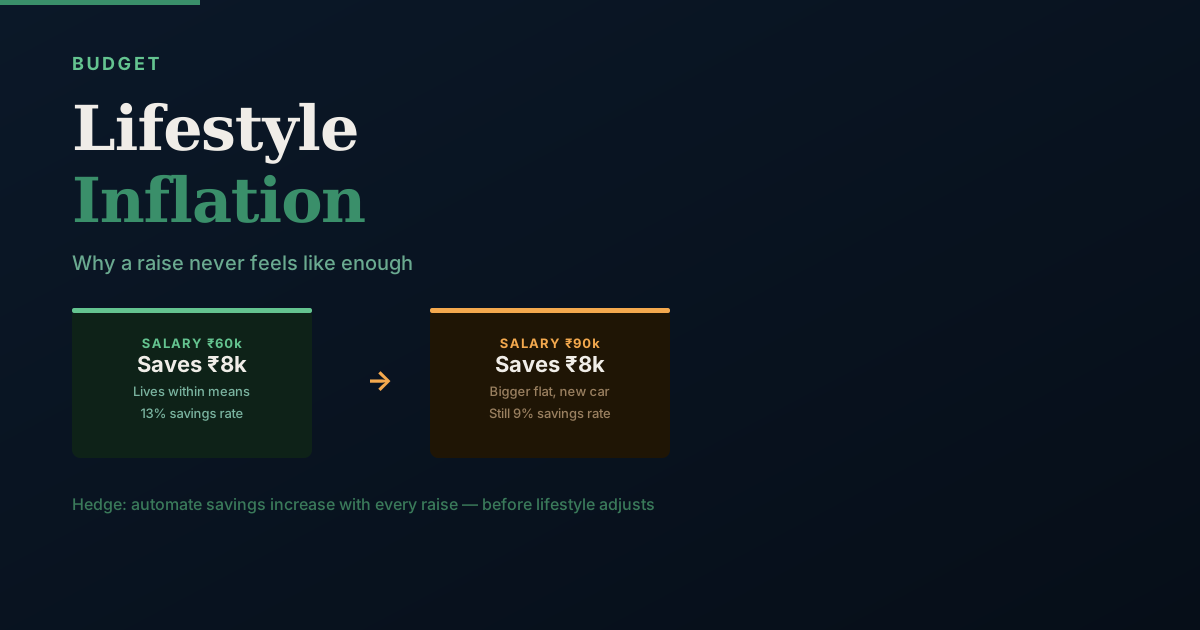
A common financial paradox: income doubles over a decade, yet the monthly savings amount stays roughly the same — or barely grows. The culprit is lifestyle inflation: the gradual expansion of spending in proportion to income.
It is not a single decision. It is dozens of small ones: the apartment upgrade after a promotion, the streaming services added one by one, the weekend dining that shifted from occasional to weekly, the phone upgrade cycle that shortened. None of these alone is significant. Together, they absorb each increment of income growth.
How lifestyle inflation compounds silently
At ₹5 lakh annual salary, a person saves ₹30,000/year (savings rate: 6%).
After 5 years, salary grows to ₹12 lakh. The savings are now ₹80,000/year (savings rate: 6.7%). Income grew 140%; savings grew 167% — but in absolute terms, only ₹50,000/year more.
Meanwhile, lifestyle expenses grew from ₹4.7 lakh/year to ₹11.2 lakh/year — absorbing about 93% of the income growth.
The compounding consequence: if the same person had maintained a 25% savings rate throughout, they would be saving ₹3 lakh/year by year 5 — nearly 4× more into compounding investments.
The increment trap
The most common manifestation of lifestyle inflation is salary increments. A 15% appraisal in April feels significant. By July, the new salary figure is normal, and last year's lifestyle feels inadequate by comparison.
This is not psychological weakness — it is a predictable human response to changed reference points. The practical defence is a pre-commitment mechanism: decide before the raise arrives what percentage goes to investment increases.
The 50% rule for raises
When your take-home income increases — whether via increment, promotion, or a new job — direct at least 50% of the monthly increase to investment or savings before it reaches your spending account.
The mechanism: increase your SIP amount on the same day your new salary is first received. Set up the auto-debit before you experience the new balance. What you never see in your spending account, you do not miss.
At ₹10,000/month raise: ₹5,000 goes to additional SIP. ₹5,000 improves your lifestyle.
This rule preserves the compounding potential of income growth while still allowing lifestyle improvement. It does not require austerity — it requires capturing half the gain rather than letting it all become spending.
The lifestyle floor vs lifestyle ceiling framing
Useful mental model: your lifestyle floor is the minimum standard of living you need to function and feel stable. Your lifestyle ceiling is what you could spend if there were no savings goal.
Most financial planning works better when the gap between floor and ceiling is kept consciously wide — meaning savings, not spending, fills the gap as income rises.
Lifestyle investments (a better home, better health, things that genuinely improve capability or wellbeing) are different from lifestyle inflation (upgrading for status, habituation, or social comparison). The distinction requires conscious evaluation of each spending increase.
Practical audit: the lifestyle growth check
Once a year, compare:
- Your current monthly spending (from bank statement averages)
- Your monthly spending 2 years ago
Calculate the percentage increase in spending. Compare it to the percentage increase in income over the same period.
If spending is growing faster than income, lifestyle inflation is at work. If spending growth is below income growth, the gap is going into savings — which is the goal.
The Real Cost: What Those Absorbed Raises Could Have Become
Lifestyle inflation feels harmless because nothing visibly breaks. The cost is invisible — it's the wealth that never formed. Take the earlier example: letting lifestyle absorb your raises leaves you saving ₹80,000/year by year 5; holding a 25% savings rate gets you to ₹3 lakh/year. Project that ~₹2.2 lakh annual gap forward at 11% over 20 years and the difference compounds to more than ₹1 crore of foregone corpus. Lifestyle inflation doesn't cost you the spent rupee — it costs you everything that rupee would have grown into.
Not All Upgrades Are Equal — Watch the Sticky Ones
The most damaging lifestyle increases are the recurring, fixed ones, because they commit future income:
- Housing: a ₹15,000/month rent or EMI jump is worse than its size suggests — ₹1.8 lakh/year, locked in, hard to reverse, and it resets your "normal."
- Vehicle EMIs: a car loan turns a discretionary choice into a 5-year fixed obligation plus running costs.
- Subscriptions and memberships: individually small, collectively a permanent drag.
A one-time upgrade — a better phone, a good trip — is a single hit you absorb and move past. A recurring upgrade raises your fixed-cost floor forever. Be far more cautious with anything that adds a monthly commitment than with a one-off purchase of the same value.
Raise the Floor Slowly, Bank the Rest
You don't have to freeze your lifestyle — you have to make improvement deliberate and lagging rather than automatic. When income rises:
- Increase the SIP/auto-save first (the 50% rule), the day the new salary lands.
- Hold the rest of your spending flat for 2–3 months, so the new income stops feeling novel.
- Then choose one intentional improvement that genuinely adds to your life — preferring one-time over recurring.
Letting the upgrade lag the raise by a quarter is usually enough to break the automatic absorption, because the reference point has already reset by the time you spend.
For the savings rate framework, see the guide on savings rate.
The Lifecycle Pattern of Lifestyle Inflation in India
Lifestyle inflation in Indian professional households follows a recognisable pattern across career stages:
Age 22–26 (First job): Take-home of ₹25,000–50,000. The jump from student life feels enormous. The first upgrades — better phone, new clothes, eating out — are genuine improvements from necessity. Savings rate is often 10–15%. This phase is psychologically benign: the spending is genuinely new utility.
Age 27–30 (First significant raise / job switch): Salary doubles or more, often to ₹60,000–1,20,000. This is the critical inflection point. The first premium apartment, the first car purchase (or upgrade from two-wheeler), the first premium gym membership, the first systematic restaurant habit. If savings rate is not explicitly raised, it often stays flat or falls in absolute percentage terms. The "I've worked hard, I deserve this" narrative is strongest here.
Age 31–36 (Marriage, home purchase): Fixed costs spike. Wedding expenses (or contribution to family's wedding costs), home loan EMI, potential child care costs, lifestyle aligned to dual-income expectations. Many households discover that two incomes create the illusion of financial comfort while locking in much higher fixed costs. Savings rate, if not deliberately protected, can fall to 10–15%.
Age 37–45 (Career peak, school fees, aging parents): This is when the lifestyle decisions of the previous decade compound. Multiple EMIs (home loan, car loan, possibly a personal loan for renovation), children's private school fees at ₹10,000–25,000/month, and parents who may now require financial support. Savings rate varies enormously at this stage — households that managed lifestyle inflation carefully are saving 35%; households that did not are saving 12–15% despite high incomes.
The pattern shows that the cumulative impact of lifestyle inflation is largely determined by decisions made in the 27–36 window. The choices at that stage — which apartment, which car, whether to buy immediately or wait, how quickly to upgrade — create the fixed cost structure that determines financial flexibility for the next 15 years.
Worked Example: Two Colleagues, Same Salary, Divergent Outcomes
Karan and Vikram both joined the same Mumbai company at ₹6 lakh CTC in 2016. They receive identical raises and job changes and by 2026 both earn ₹24 lakh gross (approximately ₹18 lakh take-home after tax and EPF).
Karan: Applied the 50% rule throughout. Each raise, half went to SIP increase. Now has:
- SIP of ₹35,000/month (raised gradually from ₹5,000 in 2016)
- Monthly expenses: ₹85,000 (comfortable but not lavish)
- Investment portfolio accumulated over 10 years: approximately ₹60–70 lakh (conservative estimate at 11% average return)
- Emergency fund: 6 months intact
- Zero personal loan; home loan of ₹30 lakh outstanding
Vikram: Raised lifestyle with each increment. Now has:
- SIP of ₹12,000/month (never raised beyond the original setup)
- Monthly expenses: ₹1,18,000 (rent upgrade, BMW loan, overseas trips, premium schooling)
- Investment portfolio: approximately ₹18–20 lakh
- Home loan ₹55 lakh outstanding
- Car loan ₹8 lakh outstanding
- Personal loan ₹4 lakh outstanding (renovation)
Same income history. Karan has built roughly 3.5× more investment wealth in the same period. Neither is living poorly — Karan just chose which lifestyle upgrades were genuinely worth the trade-off, and consistently kept the savings rate rising alongside income.
Lifestyle Upgrades Worth Making vs Those That Are Traps
Not all lifestyle spending is equal. Some spending genuinely compounds quality of life or earning capacity; other spending is pure consumption with high recurring cost.
Generally worthwhile:
- Better housing in a location that reduces commute time significantly (commute time has measurable health and productivity impact)
- Good health insurance (super top-up cover on an existing employer policy is excellent value — ₹15,000–20,000/year for ₹40–50 lakh additional cover)
- Tools and subscriptions that directly increase earning capacity (professional software, relevant courses, a reliable laptop)
- One quality family experience per year (a real vacation matters more than 12 weekend dinners)
Often traps:
- Vehicle upgrade from a functional car to a luxury car for commuting (the status return per rupee is very poor; the EMI and running cost impact lasts 5 years)
- Premium apartment in a competitive location primarily for social optics (higher rent, longer commute, same functional space)
- Upgrading the phone every year to the latest model
- Multiple food delivery apps and premium restaurant habit as a default weeknight behaviour
The framing that helps: does this upgrade change something functional in my daily life, or does it primarily change how I feel about myself relative to others? Functional improvements have lasting utility. Comparison-driven upgrades require continuous escalation to maintain the same feeling.
Social Pressure and the Indian Context
Lifestyle inflation in India has a specific social dimension that makes it harder to resist than the purely individual version. Financial decisions in Indian households are often visible to extended family, in-laws, and a social group with shared income brackets.
The apartment you rent becomes a reference point for others' expectations. The car you drive is seen by family. Weddings, festivals, and social gatherings create explicit comparison and expectation. For many Indian professionals, the social cost of being seen to "live below their means" relative to peers feels real and ongoing.
Two practical responses:
Separate social spending from structural spending. A wedding gift or a Diwali celebration is a social spending category that can be budgeted and bounded. The ₹5,000 gift for a colleague's wedding is a bounded event expense. The decision to rent in a building because "everyone at my level lives there" is a structural commitment with 24 months of financial implications. Treat these as categorically different.
Build a reference group that normalises saving. The social comparison effect works in both directions. If your close friends are also intentional about finances — discussing investments, sharing savings goals, normalising not ordering every time — the social pressure toward lifestyle inflation weakens. The people you spend time with shape what feels normal. This is not an argument for social isolation; it is an observation that the environment you choose influences the financial baseline you feel pressure to meet.
The Tax Bracket Illusion
One underappreciated accelerant of lifestyle inflation in India is the salary hike narrative. When someone announces they got a 30% raise, the implicit understanding is that they now have 30% more money to spend. But for someone moving from ₹12 lakh to ₹15.6 lakh CTC, the actual increase in take-home is considerably smaller.
A rough illustration (old tax regime, approximate numbers):
- ₹12 lakh CTC → take-home approximately ₹90,000/month
- ₹15.6 lakh CTC → take-home approximately ₹1,08,000–1,12,000/month
The 30% CTC increase translates to approximately 20–22% more take-home, not 30%. Lifestyle decisions made on the assumption of a 30% spending increase overestimate available funds. Calculating the actual take-home increase before upgrading any recurring cost is essential.
This is also why the 50% rule should be applied to the actual take-home increase (₹18,000–22,000/month in this example), not to the CTC increase. Half of ₹20,000 more take-home is ₹10,000 to investment — not half of the announced gross raise.
Frequently Asked Questions
Sources and references
Rules, rates, and thresholds in India change over time. Always confirm the current position with the official source above before acting on it.