Buffer Fund vs Emergency Fund: Why You Might Need Both
Emergency and buffer funds solve different problems. Confusing them leads to under-saving for real emergencies or over-saving in low-yield instruments.
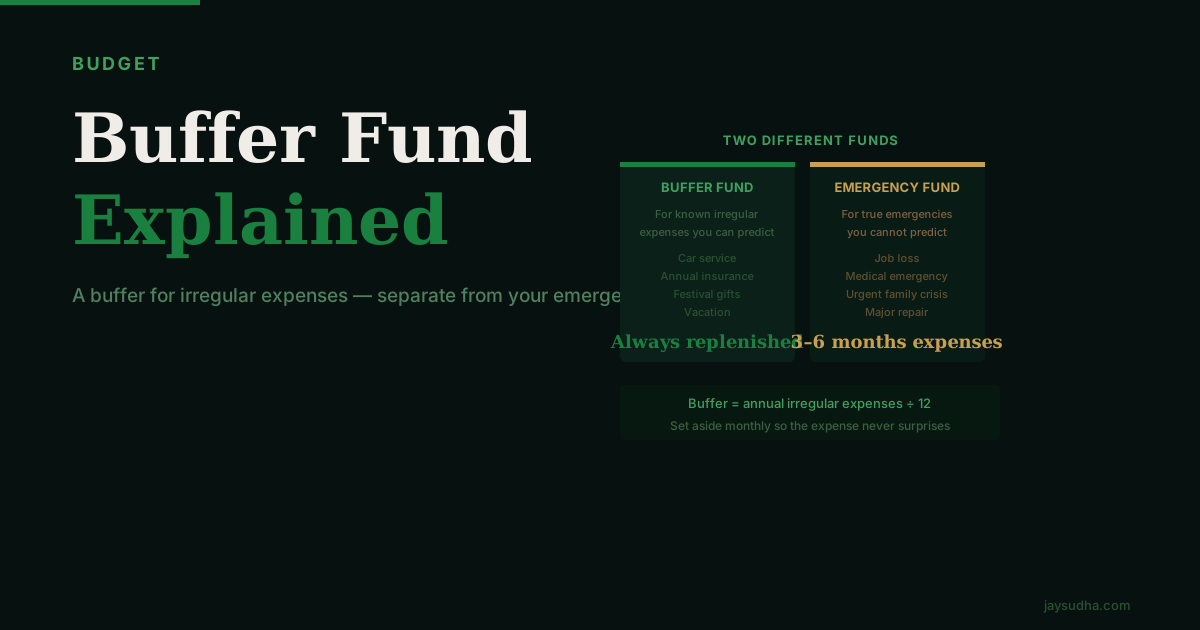
Almost everyone has heard they should have an emergency fund. Three to six months of expenses, in a liquid account, for when things go wrong.
But there's a category of financial disruptions that don't qualify as emergencies — they're not sudden, not catastrophic, just irregular. Your car needs a service. Your refrigerator breaks down. Diwali comes around. Your annual insurance premium is due. You haven't budgeted for any of it, so you either dip into your emergency fund or use a credit card.
This is what a buffer fund is for — and separating the two concepts makes both more useful.
The Emergency Fund: What It's Actually For
An emergency fund is for genuine emergencies. Situations that are:
- Sudden and unexpected
- Disruptive to your basic financial functioning
- Not addressable through normal monthly income
The three real emergencies it covers:
Job loss or income disruption. If your primary income disappears — layoff, serious illness that keeps you from working, business collapse — the emergency fund buys you time to recover without taking on debt or selling investments. This is its most important use.
Serious medical event. Even with good health insurance, there are gaps — network hospitals not available when needed, sub-limits on room rent, the 20-30% you're still paying out of pocket on a ₹3 lakh hospitalisation. Or a family member's medical event not covered by your policy.
Critical sudden repair. A water pipe bursts and floods your apartment. Your car meets with an accident. These are high-cost, immediate-obligation events.
The amount: 3–6 months of essential expenses. Essential here means the non-negotiable floor — rent/EMI, groceries, utilities, insurance premiums, loan repayments, school fees. Not your full monthly spending including dining out and entertainment. For a fuller walkthrough of sizing this to your own situation — income stability, dependants, health risk — see how much emergency fund you actually need.
Illustrative calculation: If your essential monthly expenses are ₹45,000:
- 3-month emergency fund: ₹1,35,000
- 6-month emergency fund: ₹2,70,000
Where to keep it: A liquid mutual fund gives you same/next-day redemption, currently returns around 6.5–7.5% annually, and has no lock-in or withdrawal penalty. A regular FD works but the premature withdrawal penalty (usually 0.5–1% of returns) creates minor friction during an actual emergency.
A caveat on "high-yield" savings accounts: several digital and small finance banks advertise headline rates of 6–7%, but check the fine print — most use a slab structure, similar to income tax slabs, where each portion of your balance earns the rate for that slab, not the top rate on the whole amount. IDFC First Bank's published slabs, for instance, pay 3% on the first ₹1 lakh, 5% on the next ₹1–10 lakh, and only 6.5% above ₹10 lakh — so a ₹1.5–2.7 lakh emergency fund earns a blended rate well below the 6–7% headline, not the advertised top rate. Read the slab table for any account before assuming the advertised rate applies to your actual balance; a liquid fund's return doesn't have this problem.
The emergency fund is not where you put your spare money. It's specifically sized, kept separate, and touched only for genuine emergencies.
The Buffer Fund: A Different Problem
A buffer fund (also called a "rainy day fund" or "float") handles the irregular, predictable, non-emergency expenses that your monthly budget doesn't capture.
These are expenses that are:
- Not monthly — they hit once a quarter, once a year, or at unpredictable intervals
- Not large enough to be "investments" but big enough to disrupt cash flow
- Predictable in category even if not in exact timing
Examples of buffer fund territory:
- Car service (every 10,000 km or 6 months): ₹3,000–8,000
- Annual vehicle insurance renewal: ₹8,000–20,000
- Annual health insurance premium: ₹15,000–35,000 for a family
- Appliance repair or replacement (washing machine, geyser, mixer): ₹2,000–15,000
- Festival and Diwali shopping: ₹10,000–30,000 for many households
- Annual school supplies and uniforms: ₹3,000–8,000
- One-time clothing purchase (winter, occasion): ₹3,000–8,000
- Domestic travel: ₹8,000–25,000
None of these are emergencies. But all of them can land in a month where you haven't planned for them, causing you to either go into your emergency fund (which depletes it for something it wasn't intended for) or reach for a credit card (which adds interest costs).
Buffer fund size: 1–2 months of total variable spending, typically ₹30,000–60,000 for a household spending ₹80,000–1.2 lakh/month.
Where to keep it: A separate savings account works well. The goal is accessibility and separation from your regular account — not returns. This isn't an investment; it's a float.
Why Most People Blend Them (and the Problem)
Most people either:
a) Have one "emergency fund" they also use for irregular expenses. The result is a fund that's constantly being depleted and rebuilt — it never reaches a stable 3–6 month balance. Every Diwali shopping trip "borrows" from the emergency fund. Every car service "borrows" from it. It always feels low, which creates anxiety and sometimes leads to topping it up by cutting investments.
b) Keep everything in one savings account with a vague "savings" label. When something irregular comes up, they just pay from wherever money happens to be sitting. This works but provides no visibility into whether the emergency cushion is actually intact.
The separation forces clarity. If your emergency fund is a separate named account with ₹1,50,000 in it and you touch it, you know you touched it. That's useful information. If it's all one pool, you can deplete your emergency coverage without noticing.
The Sinking Fund Concept
A sinking fund is a variant of the buffer fund, earmarked for a specific predictable future expense — see sinking funds explained for a dedicated walkthrough of setting these up.
Instead of waiting for the car insurance renewal to arrive and scrambling for ₹15,000, you set aside ₹1,250/month (₹15,000 ÷ 12) in a sinking fund throughout the year. When the renewal arrives, the money is already there.
Common sinking funds for Indian households:
| Expense | Annual Amount | Monthly Set-Aside |
|---|---|---|
| Vehicle insurance renewal | ₹12,000 | ₹1,000 |
| Health insurance renewal | ₹24,000 | ₹2,000 |
| Annual school supplies | ₹8,000 | ₹667 |
| Festival / Diwali expenses | ₹20,000 | ₹1,667 |
| Annual vacation | ₹40,000 | ₹3,333 |
| Vehicle maintenance | ₹12,000 | ₹1,000 |
| Total | ₹1,16,000 | ₹9,667/month |
This is ₹9,667/month that would otherwise feel like ₹20,000–40,000 landing unpredictably. Sinking funds transform irregular expenses into smooth monthly provisions.
You can run multiple sinking funds in a single savings account (just track them as separate line items in a spreadsheet) or use a bank that allows multiple sub-accounts or goals. Several banks now offer goal-based savings features for exactly this purpose.
The Correct Structure
Here's how to think about the layering:
Layer 1 — Buffer fund / sinking funds (₹30,000–60,000 combined) For irregular predictable expenses. Held in a separate savings account. Replenished monthly through planned contributions.
Layer 2 — Emergency fund (3–6 months of essential expenses) For genuine emergencies. Held in a liquid mutual fund or high-yield savings account. Not touched unless the situation genuinely qualifies.
Layer 3 — Investments (long-term wealth building) Equity mutual funds, PPF, NPS, stocks, real estate. Not liquid by design — these should not be the source of funds for either emergencies or irregular expenses.
The error most people make is skipping Layer 1 entirely, keeping a thin Layer 2, and then wondering why their Layer 3 keeps getting disrupted by minor financial surprises.
Building Both From Scratch: Priority Order
If you're starting from zero, here's the order that makes sense:
Step 1: Fund the buffer (1–2 months first) Before you worry about a 6-month emergency fund or your SIPs, get ₹30,000–50,000 into a separate account. This prevents the most common disruptions. Without this, every irregular expense lands as a crisis.
Timeframe: 2–4 months of directed saving if you set aside ₹10,000–15,000/month specifically for this.
Step 2: Start your SIPs while building the emergency fund Don't stop investing entirely while you build the emergency fund — you'll deprive yourself of compounding time that you can't recover. Start SIPs at a minimum level (even ₹2,000–3,000/month) and use remaining savings to build the emergency fund.
Step 3: Reach 3 months of essential expenses in the emergency fund This is the minimum viable emergency cushion. Once you're here, you have meaningful protection against job loss.
Step 4: Increase SIPs, then build to 6 months Once you have 3 months covered, shift the priority back to investments. Build the emergency fund from 3 to 6 months more slowly, in parallel with investments growing.
Step 5: Build sinking funds for known annual expenses As cash flow allows, add monthly contributions toward vehicle insurance, health insurance renewals, and festival expenses. This is the final layer of smoothing that eliminates most financial "surprises."
The Psychological Case for Separation
Beyond the mechanics, there's a genuine psychological benefit to keeping these separate.
When you have a clearly labelled, intact emergency fund and a clearly labelled buffer fund, you feel financially stable in a way that a single blended "savings balance" doesn't provide — even if the total amounts are the same.
The emergency fund sitting at ₹1,50,000 untouched gives you a kind of daily confidence. "If I lose my job tomorrow, I have 3 months." That's worth something in terms of risk-taking, career flexibility, and day-to-day peace of mind.
And when the car service bill comes and you pull from the buffer fund (not the emergency fund), you don't have that nagging feeling that you "used your emergency savings for something small."
They serve different purposes. Keeping them separate makes each purpose clearer.
The Most Common Amounts to Plan For: India-Specific Reference
A realistic buffer fund requires knowing what irregular expenses actually cost. Here are typical ranges for common irregular expenses in Indian households:
| Expense | Typical Cost Range | Frequency | Monthly Provision |
|---|---|---|---|
| Car service (petrol, mid-range) | ₹3,000–6,000 | Every 6 months | ₹1,000–1,500 |
| Two-wheeler service | ₹800–2,500 | Every 3 months | ₹500–800 |
| Vehicle insurance renewal (car) | ₹8,000–20,000 | Annual | ₹700–1,700 |
| Health insurance renewal (family floater ₹10L) | ₹18,000–30,000 | Annual | ₹1,500–2,500 |
| Diwali shopping and gifts | ₹10,000–40,000 | Annual | ₹833–3,333 |
| School fees / books / uniform | ₹5,000–15,000 | Annual | ₹420–1,250 |
| Home maintenance | ₹10,000–50,000 | Every 3–5 years | ₹200–800 |
| Appliance replacement | ₹3,000–15,000 | Every 3–7 years | ₹100–400 |
| Domestic travel (1–2 trips) | ₹15,000–50,000 | Annual | ₹1,250–4,200 |
A household with a car, two children in school, standard Diwali obligations, and one annual trip is looking at ₹75,000–₹1,50,000 in irregular annual expenses — ₹6,250–₹12,500/month in sinking fund provisions. Without these, the year delivers 8–10 "surprises" that each feel like a financial crisis.
Bank Accounts for Separation in India
The multi-account structure recommended here is achievable with no-cost accounts at most major Indian banks. Some practical options (once you have more than two or three, see tracking multiple bank accounts so the separation doesn't become its own source of confusion):
Zero-balance savings accounts: Several banks including IDFC First Bank, Kotak Mahindra Bank (811 account), and Axis Bank's ASAP account offer zero-minimum-balance savings accounts that can be opened fully digitally. These work well for the buffer fund — they sit separately from the salary account and do not require maintenance fees that erode small balances.
Sub-accounts or "Goals" features: HDFC Bank allows setting up savings goals within the same account — effectively labelled pots within one account. This is not ideal (the money is technically in one place) but works as a mental accounting tool if opening multiple accounts feels burdensome.
Liquid mutual fund account: For the emergency fund beyond the first 1–2 months, a liquid mutual fund folio is better than a bank account. Accessible via your mutual fund app (Kuvera, MFCentral, or directly through AMC apps such as HDFC AMC or Nippon AMC). Redemption requests made before 2:30 PM are typically processed by the next business day. Returns currently run at 6.5–7.5%, notably better than standard savings accounts at 3–3.5%.
The practical structure for a household with ₹50,000 monthly essential expenses:
- Salary account: primary day-to-day use
- Buffer account (zero-balance): ₹30,000–50,000 (IDFC First or Kotak 811)
- Emergency fund (liquid fund): ₹1,50,000–3,00,000 depending on multiplier
Opening these accounts takes 30–60 minutes online. Maintaining them requires only monthly review.
How the Festival Season Tests Both Funds
Diwali is the most common moment when the distinction between buffer and emergency fund breaks down in practice. October–November spending in Indian households typically includes:
- Gifts for family, household staff, business associates
- Diwali puja items and decorations
- New clothes (the tradition of wearing new clothes on Diwali)
- Electronics or appliances (heavily sold during the season)
- Sweets and dry fruit gifts
- Travel if celebrating with family elsewhere
For a household spending ₹25,000–35,000 in this period, this is clearly buffer territory — not an emergency. Yet without a dedicated buffer, the money comes from wherever it can be found: the emergency fund, a credit card, or the salary account, leaving the last week of October or early November in low-balance stress.
A sinking fund specifically for "festive season" funded at ₹2,000–3,000/month from April means the Diwali spending is already provisioned by October. The festival becomes a celebration rather than a financial stress event. This is among the highest-return uses of the sinking fund concept in the Indian calendar.
Frequently Asked Questions
Sources and references
Rules, rates, and thresholds in India change over time. Always confirm the current position with the official source above before acting on it.