Budgeting Methods Compared: 50/30/20, Zero-Based, Envelope and More
Compare the 50/30/20 rule, zero-based, envelope and conscious spending budgets for Indian incomes, with rupee worked examples and when each method works.
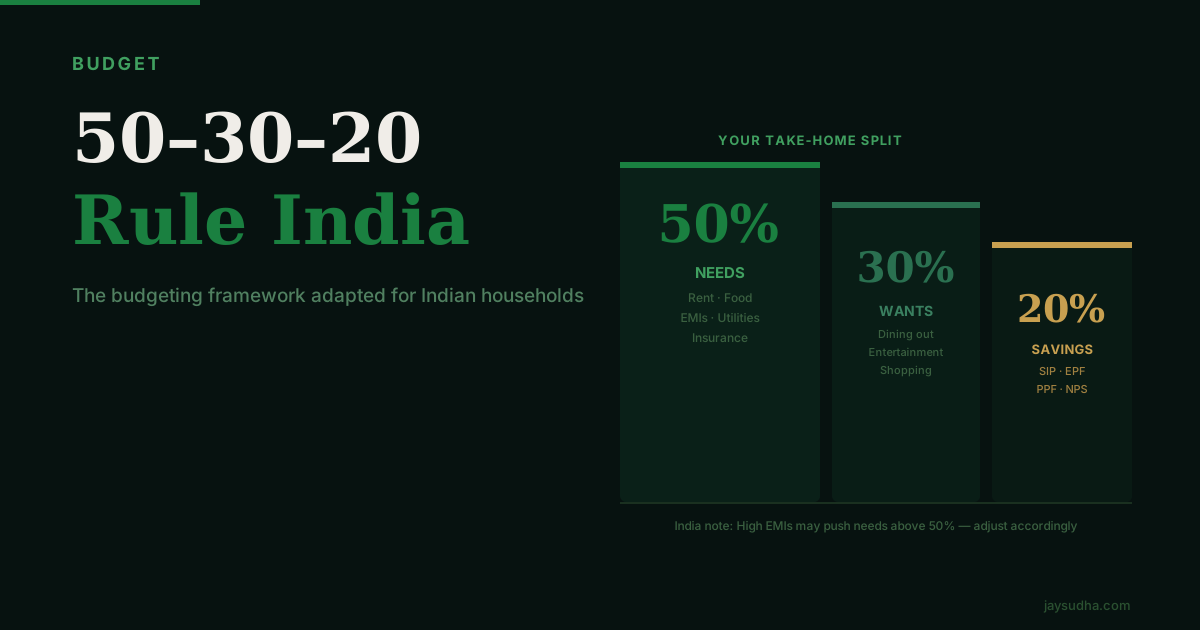
The 50/30/20 rule, zero-based budgeting, envelopes and the conscious spending plan all settle spending decisions before the month starts, rather than reviewing them after. They differ in structure and upkeep, and every one of them depends on an honest line between needs and wants. The popular versions were built for other conditions — the 50/30/20 rule and the conscious spending plan for American incomes, envelopes for paper cash — so each needs adjusting for Indian EMIs, taxes, school fees, family obligations and UPI.
Needs vs wants: the foundation every method relies on
Every budgeting method asks you to separate needs from wants. It sounds obvious — of course rent is a need and a designer handbag is a want — but in practice it is one of the slipperiest distinctions in personal finance.
Why the usual line fails
The mind reframes wants as needs. When you want something badly, you unconsciously construct a story in which it is necessary. The want for a car becomes "I need reliable transport"; the newest phone becomes "I need it for work." The reframing feels completely sincere, which is exactly why it defeats budgets. You are not lying to anyone; you are convincing yourself.
Marketing and social pressure push wants upward. An enormous amount of effort goes into making wants feel like needs. Combined with seeing peers spend (the FOMO that drives so much of lifestyle inflation), wants steadily migrate into the needs column without you noticing.
The line is genuinely blurry for many expenses. Food is a need; restaurant food is mostly want. A phone is arguably a need now; a premium phone is largely want. Arguing about whether "food" or "a phone" is a need misses the point, because the answer is "partly." Labelling whole categories is the wrong unit of analysis.
A test that holds: does its absence cause real harm?
A need is something whose absence causes real harm or makes life genuinely unworkable. Everything else is a want — no matter how reasonable, sensible, or enjoyable. The key word is harm, not preference and not even reasonableness. Many wants are entirely sensible; a reasonable want is still a want.
- Go without food, shelter, or essential utilities, and you suffer real harm. Needs.
- Go without basic transport to your job, and you cannot earn a living. Need.
- Go without your medication or health insurance, and a setback could be catastrophic. Needs.
- Go without eating out this month, a nicer phone, a streaming subscription, a brand upgrade — and nothing actually bad happens. You are less comfortable, but unharmed. Wants.
Applied honestly, this often shrinks the needs list dramatically, and that is the point. A small, clear needs list tells you the floor: the spending that must be protected no matter what. Everything above the floor is negotiable. This is the same instinct behind the 50/30/20 rule, which caps needs at around half of income precisely because true needs, honestly defined, usually fit there.
Splitting expenses into a need layer and a want layer
The single most useful move is to stop labelling whole categories and split each expense into a baseline that meets a genuine need and an upgrade above it that is want.
| Expense | Need layer | Want layer (above the need) |
|---|---|---|
| Food | Cooking basic meals at home | A ₹600 dinner delivery, frequent restaurants |
| Phone | A reliable ₹15,000 handset | The latest ₹80,000 flagship |
| Transport | Bus/metro to work | Daily cabs, or a car bought for convenience |
| Clothing | Functional, weather-appropriate clothes | Brand-name and frequent fashion upgrades |
| Housing | Adequate space in a reasonable area | A larger flat in a premium location for status |
| Internet | A basic plan that lets you work | The top-tier plan you do not fully use |
This changes how you cut. You do not "give up food" to cut food spending; you trim the want layer (less delivery) while fully protecting the need layer. Almost every "need" you cannot cut has a generous want layer on top that you absolutely can.
It is also why the framework pairs naturally with the envelope method: you fund the need layer of each category as a baseline, and budget the want layer separately, where it can flex up in good times and down in tight ones.
Holding up under pressure
The distinction proves itself during a financial shock. When income drops — a job loss, a medical setback, a brutal month — a clear needs list becomes your survival budget: the need layer of every expense is what you protect, and the want layer is what you pause. The detailed mechanics are in the guide on budgeting after a job loss, but without this distinction a survival budget has no organising principle.
Pressure is the worst time to make these judgments for the first time. Under stress, people protect comfortable wants out of habit (the daily cab, the food delivery, the subscriptions) while neglecting genuine needs (letting health insurance lapse to save a premium), and the instinct that inflates wants into needs gets stronger when you are anxious. So define your needs while calm, in a normal month; when a tight month or a job loss arrives, you follow a list you wrote with a clear head instead of arguing with yourself under stress.
Worked example: Meera pressure-tests her budget
Meera is 34, a single salaried professional in Delhi with a take-home of ₹78,000. She has never been in financial trouble, but after a colleague's sudden layoff she asks: if her income dropped to zero tomorrow, what would she actually have to protect? She applies the harm test and splits each expense into layers.
| Expense | Monthly | Need layer | Want layer |
|---|---|---|---|
| Rent | ₹24,000 | ₹24,000 (adequate, near work) | — |
| Groceries | ₹9,000 | ₹7,000 (basic cooking) | ₹2,000 (premium items) |
| Eating out / delivery | ₹7,000 | ₹0 | ₹7,000 |
| Transport | ₹5,000 | ₹2,000 (metro) | ₹3,000 (cabs) |
| Health + term insurance | ₹4,000 | ₹4,000 | — |
| Utilities + phone | ₹4,500 | ₹3,500 | ₹1,000 (top-tier plan) |
| Subscriptions | ₹2,000 | ₹0 | ₹2,000 |
| Shopping / personal | ₹6,000 | ₹1,000 | ₹5,000 |
| SIP / savings | ₹12,500 | (pause in a crisis) | — |
| Total spending | ₹61,500 | ₹41,500 (needs) | ₹20,000 (wants) |
Her genuine survival floor is about ₹41,500, not the ₹61,500 she spends. Fully ₹20,000 a month, about a third of her spending, is want layer — none of it wasteful, just not need.
Two things change. Her emergency fund target gets clearer: it has to cover ₹41,500 a month of true needs, not her full ₹61,500 lifestyle, so it stretches further than she assumed. And she now has a pre-written survival budget: protect the ₹41,500 of needs and keep insurance active; pause the ₹20,000 of wants and, temporarily, the SIP. Seeing that ₹20,000 is optional also makes it easier to trim a little now and redirect it to savings, so the framework improves her good months, not just her bad ones.
The point is not to live forever on the needs floor. It is to know where the floor is, so you can enjoy wants confidently in good times and cut them decisively in bad ones.
The 50/30/20 rule and how to adapt it to Indian incomes
The 50/30/20 rule comes from Elizabeth Warren — yes, the US senator — and her book All Your Worth, co-authored with her daughter in 2005: split your after-tax income so that 50% goes to needs, 30% to wants, and 20% to savings and debt repayment. It is widely cited because it is simple, memorable, and gives people a starting reference point when they have no other framework. But it was designed for American middle-class incomes, housing costs and tax structure, so Indian incomes — especially in metros, at middle-to-high income levels, with the obligations Indian households carry — need some adjustment.
What the three categories mean
Needs (50%) are expenses you cannot reasonably avoid without disrupting your basic life. In the original framework:
- Rent or home loan EMI (housing)
- Groceries and household supplies
- Utilities: electricity, gas, water, internet, phone
- Minimum debt repayments (the minimum required, not extra payments)
- Insurance premiums (health, life, vehicle)
- School fees
- Commute costs
Warren's test is: would your life be seriously disrupted if you cut this? Not inconvenient — disrupted. A gym membership is not a need by this logic. Netflix is not a need.
Wants (30%) make life enjoyable but aren't essential: dining out, weekends away, new clothes beyond necessity, streaming services, gadgets, hobbies, entertainment.
Savings and debt repayment (20%) is the "pay yourself forward" bucket — investments, retirement contributions, and extra debt payments beyond the minimum. In Indian terms: SIPs, PPF contributions, NPS, FD, extra EMI payments, and emergency fund contributions.
Where the rule gets complicated in India
Housing and EMIs. In Mumbai, Bangalore, Pune, Delhi, and most Tier-1 cities, housing alone often pushes needs past 50% for middle-income earners. On ₹1 lakh take-home in Bangalore, a 2BHK rental in a decent area costs ₹25,000–35,000; a home loan EMI on a ₹60 lakh apartment at 8.5% over 20 years is roughly ₹52,000 a month — more than half the take-home before groceries or utilities. That is not a failure of discipline. It is a structural mismatch between the rule's design assumptions and Indian metro housing.
Tax and CTC. In the 30% tax bracket with TDS deducted, take-home sits far below CTC: someone with a ₹20 lakh CTC might see ₹1.1–1.2 lakh a month after tax and PF, not ₹1.67 lakh, the gross monthly equivalent.
Family obligations. The original framework does not account for supporting parents, contributing to family events (weddings, functions), sending money to a hometown, or covering a sibling's education. These aren't "wants" in any meaningful sense — they're obligations with real social and moral weight.
The 20% savings floor. Indian households, particularly first-generation earners, often need to save significantly more than 20% — when parents' retirement isn't separately funded, when you're building property in the hometown, when you're funding a child's education without access to federal student loans. Use 20% as the minimum check, not the target. It is a floor, not a ceiling: if you're saving 35% and your lifestyle is comfortable, you don't need to inflate your wants spending to hit 30%.
How to adapt the rule for Indian incomes
Use post-tax, post-PF take-home. Budget against what lands in your bank account after EPF, professional tax, and TDS — not a CTC figure that includes employer's PF contribution, gratuity, and other components you never see. PF is already forced saving, so you can count it toward your 20%, but calculate your percentages against actual bank inflow. Illustrative example: gross salary ₹85,000 a month; after TDS (assuming old regime, standard deduction, and basic 80C), take-home is approximately ₹70,000. Budget against ₹70,000.
Reclassify EMI principal as savings. A home loan EMI's interest portion is a cost and goes under needs; the principal repayment builds equity and counts under savings. Your bank statement won't show the split — check your loan amortisation schedule. Early in a loan, interest dominates: on a ₹50 lakh loan at 8.5%, the first EMI is roughly 80% interest and 20% principal, so calling the whole EMI a need isn't wrong in the early years. As the loan ages, more of each payment is principal.
Build a "family and social" category. Give family support and social obligations an explicit category in the needs bucket — "family obligations" or "social commitments." Once it is named and sized, you can plan around it rather than being surprised by it.
Accept that 50% needs is a target, not a law. In metros it's common for needs to run at 55–65% of take-home, which compresses the savings and wants buckets. The framework's value then is clarity: you can see exactly how much runway you have and decide deliberately how far to reduce wants while you're in this phase.
What the split looks like on ₹70,000 and ₹1 lakh
On ₹70,000 take-home, the split is Needs ₹35,000 (50%), Wants ₹21,000 (30%), and Savings ₹14,000 (20%). If metro rent pushes Needs past 50%, you trim the Wants bucket, never the Savings one. The 20% is the line you protect.
Jay's operating note: The only non-negotiable number in 50/30/20 is the 20. Automate it on salary day and the other two buckets tend to sort themselves out.
For a household on ₹1 lakh take-home in a metro, the illustrative numbers look like this:
| Category | Ideal (50/30/20) | Metro Reality |
|---|---|---|
| Needs | ₹50,000 | ₹58,000–65,000 |
| Wants | ₹30,000 | ₹15,000–22,000 |
| Savings/Investments | ₹20,000 | ₹15,000–20,000 |
A typical ₹58,000 of needs: rent/EMI ₹28,000, groceries ₹8,000, school fees ₹5,000, utilities (electricity, gas, internet, phone) ₹4,000, commute (fuel/cabs) ₹4,000, insurance premiums ₹3,000, minimum debt payments ₹6,000. When needs run over 50%, the shortfall usually comes from wants first (which is fine), then from savings (which requires attention).
When your numbers don't fit
If needs exceed 60% of income, you likely have a housing cost or debt load problem — structural, not discretionary. Check whether refinancing debt reduces the EMI burden, and make future housing decisions with this constraint in mind. Meanwhile, protect the savings floor even if wants compress severely, and work on raising income or cutting a big fixed cost.
If savings fall below 10%, take it seriously. A 10% savings rate on ₹1 lakh is ₹10,000 a month — ₹12 lakh over a decade even without investment returns. Below 10% you're genuinely at risk of having no cushion for anything. Check whether wants are the lever or needs are structurally too high.
If wants approach zero, you're likely in a high-cost housing situation or carrying significant debt. That is sustainable short-term but not long-term; people need some discretionary breathing room. If it persists beyond 12–18 months, look at the structural inputs.
Applying 50/30/20 across different income levels
Take-home ₹40,000–60,000 a month (entry to early career): in metros this is genuinely tight. Rent alone at ₹12,000–18,000 is 20–45% of take-home before groceries. Needs at 50% are standard and savings may only reach 10–15%. The priority is building the habit of saving anything at all and keeping lifestyle fixed as income grows; the 50/30/20 is aspirational here, but useful as a direction.
Take-home ₹80,000–1,20,000 a month (mid-career): the range where the rule becomes most actionable. Needs can potentially be held at 50% with deliberate housing and EMI decisions, savings of 20–25% is achievable without serious hardship for most, and the 20% habit has the most compounding time ahead of it.
Take-home ₹1,50,000–2,50,000 a month (senior/leadership): the 50% needs ceiling becomes increasingly achievable, because fixed costs are a smaller share of a larger income. The real challenge is the 30% wants bucket, where lifestyle inflation crowds out savings. Households here who maintain 30–35% savings rates are building wealth rapidly; those who spend 45% on wants and save 10–15% are not.
Tier-2 and Tier-3 cities: the rule works better. Rent of ₹10,000–15,000, against ₹28,000–40,000 in a metro, makes needs of 45–50% achievable even on modest incomes. A household earning ₹60,000 in Nagpur or Coimbatore may find the 50/30/20 fits more naturally than the same income in Mumbai.
Worked example: a ₹90,000 household in Pune
Take-home: ₹90,000 (one earner).
- Needs ₹46,000 (51.1%): rent ₹20,000, groceries ₹8,500, school fees ₹5,500, utilities and phone ₹4,200, health insurance ₹2,500, vehicle loan EMI ₹5,300
- Wants ₹22,000 (24.4%): dining and food delivery ₹8,000, entertainment and OTT ₹2,000, personal care and clothing ₹5,000, weekend activities ₹4,000, miscellaneous ₹3,000
- Savings ₹22,000 (24.4%): SIP ₹15,000, emergency fund contribution ₹5,000, PPF ₹2,000
Needs are slightly over at 51%, but with wants below 30% and savings above 20%, this household's financial health is solid. That is why the rule is a diagnostic, not a prescription: the outcome is good regardless of which bucket the 1% overspend on needs comes from.
Using 50/30/20 as a diagnostic, not a rule
The rule was designed as a simplification, not something to feel guilty about violating. Run your numbers through it and use the gaps as a conversation starter with yourself or your household.
It works best as a quarterly or annual check rather than monthly micromanagement. At the end of each quarter, download three months of bank and credit card statements, total all spending, tag each transaction as Needs, Wants, or Savings, and calculate the three percentages. It takes 45–60 minutes and gives the clearest single-page picture of your financial health.
Watch the savings percentage most closely: it should be rising. If it stays flat at 20% for three years while income has grown, lifestyle inflation is capturing all the growth; if it falls below 15%, something structural needs attention. The needs percentage is less controllable but worth monitoring — a rise from 45% to 58% over two years, driven by housing and EMI decisions, means the fixed-cost floor has risen, and knowing it lets you make the trade-off explicitly rather than discovering it when there is no savings left.
Once a year, ask whether your categories still let you save meaningfully and live a life you find worthwhile. If both are true, you're doing fine regardless of the exact percentages.
Your 50/30/20 checklist
The most common mistake is applying the rule to gross salary instead of take-home, or treating savings as "whatever is left at month-end" rather than a fixed transfer at the start.
- Percentages applied to take-home pay, not gross
- Savings auto-transferred on salary day, before spending
- Each expense honestly tagged Need or Want
- EMIs counted inside Needs, except home loan principal, which counts as savings
- Review it quarterly, and raise the savings share as income grows
Zero-based budgeting: giving every rupee a job
In zero-based budgeting (ZBB), every rupee of income is assigned a purpose before the month begins. Income minus all allocations equals zero — not because everything is spent, but because every rupee is directed somewhere intentional, including savings, SIPs, and EMI payments. It is a planning discipline rather than a cost-cutting tool: the value is in deciding before spending, rather than reviewing after.
The core principle
A conventional budget subtracts known expenses from income and tracks what happens after the month begins. Zero-based budgeting reverses this: you start with take-home income and allocate every rupee to a category until the balance is zero, so the discipline is front-loaded, not reactive. A simplified example on ₹60,000 monthly take-home:
| Category | Monthly Allocation |
|---|---|
| Rent | ₹18,000 |
| Groceries and household | ₹7,000 |
| Utilities (electricity, gas, broadband) | ₹3,000 |
| Transport (fuel/metro) | ₹3,500 |
| Phone | ₹800 |
| OTT and subscriptions | ₹600 |
| Emergency fund SIP | ₹4,000 |
| Equity mutual fund SIP | ₹6,000 |
| NPS or PPF contribution | ₹2,000 |
| EMI payment (personal loan) | ₹5,000 |
| Dining out | ₹2,500 |
| Personal care | ₹1,500 |
| Clothing and miscellaneous | ₹3,000 |
| Buffer / unplanned | ₹3,100 |
| Total | ₹60,000 |
The ₹3,100 buffer is intentional — assigned, not left over. If ₹800 of it is unused at month-end, that ₹800 is redirected before the next month begins, usually to savings or debt repayment.
What zero-based budgeting does well
- Forces explicit trade-offs. Overspending in one category requires a visible reduction in another, so dining out more visibly means investing less.
- Makes savings a first-line item. SIPs and savings are allocated before discretionary categories instead of being whatever remains. People who save first usually end up saving more than people who save what is left.
- Suits debt payoff. You can allocate an aggressive repayment on a personal loan, credit card balance, or home loan prepayment at the start of the month, see how it affects every other category, and track progress month to month.
- Catches spending drift early. A new subscription or a price increase noticed in January costs less, literally and in budget adjustment, than the same expense discovered in an annual review.
Where zero-based budgeting creates friction
- Time. Allocating takes 30 to 60 minutes at the start of each month, plus time to adjust when reality diverges. For simple, stable finances, that cost may exceed the benefit.
- Irregular income. The method assumes income is known before allocation, and freelancers, the self-employed, and anyone with a variable salary cannot allocate what they do not yet know. The workarounds below work, but add complexity.
- It can feel punishing. When a vehicle repair, a medical bill, or last-minute travel breaks the plan, re-allocating can feel like failure, and people who experience deviations that way abandon it. Zero-based budgeting works if you adjust and continue; it fails if deviation causes abandonment.
When zero-based budgeting is the right choice
It produces the most value when:
- You are in an active debt repayment phase and want to maximize the monthly allocation
- Your spending has become opaque — you are genuinely unsure where money is going
- Your income changed recently (promotion, job change, income cut) and your spending has not adjusted
- You are building toward a near-term goal that needs deliberate monthly allocation: emergency fund, home down payment, large purchase
- Your savings rate is consistently lower than you intend
It is less necessary when income is stable, your savings rate is where you want it, and there is no high-interest debt; when a simpler system already produces the results you want; or when the monthly setup keeps not happening — any system you will not maintain is worse than a simpler system you will.
How to implement zero-based budgeting in India
- Calculate your net monthly take-home — salary credit, not CTC. Include side income only if it is reliable enough to plan around.
- List fixed and committed obligations first: rent, EMIs, insurance premiums, family support, fixed SIPs. Sum them.
- Allocate savings and investment goals next, before discretionary spending: emergency fund, investment SIPs, any specific goal. Treat these as expenses, not leftovers.
- Allocate flexible categories: groceries, dining, transport, entertainment, clothing. This is where adjustments happen.
- Confirm the total equals zero. If it does not, adjust the flexible categories until every rupee is assigned.
- Track during the month against UPI transaction history or a Google Sheets tracker.
Worked example: a complete zero-based month
Priya earns ₹75,000 take-home in Chennai and is repaying a personal loan at 15% with ₹1.8 lakh outstanding. Her July budget:
| Category | Allocation | Notes |
|---|---|---|
| Rent | ₹18,000 | Fixed |
| Groceries | ₹6,500 | Slightly above usual — Eid in family |
| Utilities (electricity, gas, broadband, phone) | ₹3,800 | Summer; AC running |
| Transport (fuel + Ola) | ₹4,000 | Capped strictly |
| Health insurance premium | ₹1,200 | Monthly equivalent |
| Personal loan EMI | ₹7,500 | Scheduled repayment |
| Personal loan extra prepayment | ₹5,000 | Voluntary, debt payoff focus |
| SIP (index fund) | ₹8,000 | Non-negotiable |
| Emergency fund top-up | ₹3,000 | Still building |
| Dining out | ₹2,000 | Hard cap this month |
| Personal care | ₹1,500 | |
| Clothing | ₹0 | Deferred this month |
| Gifts and occasions | ₹2,000 | One birthday |
| Subscriptions | ₹600 | Netflix mobile only |
| Irregular expenses buffer | ₹2,000 | Vehicle service expected |
| Buffer / unplanned | ₹7,400 | Residual, assigned not spare |
| Savings for insurance renewal | ₹2,500 | Annual premium due September |
| Total | ₹75,000 |
The ₹7,400 buffer is named: it sits in the salary account, is not available for impulse spending, and if unused rolls into next month's irregular buffer.
Mid-month check (15th): transport has run ₹2,800 of ₹4,000 with two weeks left, so Priya switches from Ola to the metro for the rest of the month.
Month-end: transport came in at ₹4,200 (₹200 over) and dining at ₹1,750 (₹250 under) — net, on plan. The untouched ₹7,400 buffer transfers to the irregular fund.
Her outstanding loan falls from ₹1,80,000 to approximately ₹1,69,750: about ₹5,250 of principal from the scheduled EMI (the rest of the ₹7,500 was interest at 15%) plus the ₹5,000 prepayment. Keeping that up clears the loan well ahead of schedule and saves a meaningful amount of interest.
Naming family obligations in a zero-based budget
Priya's parents live in a different city, and she sends them ₹8,000 a month for household and medical expenses. That is a fixed, non-negotiable allocation, so in her real ZBB it sits in the committed obligations alongside rent. Households that run ZBB without naming informal family obligations find the budget "mysteriously" running short, because the transfer was treated as a situational expense rather than a fixed commitment.
Running zero-based budgeting without a paid app
A Google Sheets or Excel spreadsheet works as well as any app, and often better, because you can structure it exactly the way your finances work. The method needs a framework and the habit, not a subscription.
- Google Sheets: one tab per month. Row 1 is income; each following row is a category with planned allocation, actual spend, and variance columns. A formula at the bottom,
=Income - SUM(all allocations), should equal 0; if it does not, adjust allocations. Add a "spent so far" column and update it weekly from your bank statement or UPI history, so any category running hot is visible. - PhonePe and Google Pay summaries show monthly spending by merchant, not category, but you can map merchants to your categories as a quick sanity check.
- Mid-month bank statement: most Indian banks allow statement download for any date range in the mobile app. Categorising a partial statement on the 15th takes 10 minutes.
The most common reason ZBB fails is the check-in: people set up the allocation and do not look again until month-end. The allocation is the plan; the check-in is the execution.
Zero-based budgeting with irregular income
Last month's income method: base this month's budget on what arrived in your bank account last month. Anything above that total is a windfall, allocated in a pre-defined priority order (emergency fund → investments → discretionary).
Conservative forecast method: build the budget on a conservative estimate of what will arrive (floor income from the variable income framework). If income exceeds the forecast, allocate the surplus explicitly when it arrives.
Either way, no money is ever unallocated: every rupee, including the surplus from a good month, gets a job the moment it is confirmed.
Envelope budgeting with cash, bank accounts or UPI
Most budgets fail in the same quiet way. The numbers look fine on the 1st, and by the 20th spending has drifted well past the plan — not through one big decision, but through forty small ones: a food delivery here, an online sale there, an extra grocery run that turned into a trolley full of things. The envelope system solves this with a mechanism instead of willpower. Each spending category gets a fixed amount at the start of the month, kept physically or financially separate. When an envelope is empty, that category is done for the month; the limit is built into the money itself.
Why envelopes work when spreadsheets do not
A spreadsheet budget tells you a number; an envelope shows you a balance. A grocery budget of "₹12,000" in a column has to be remembered, checked, and voluntarily obeyed every time you shop — a willpower tax paid dozens of times a month. ₹12,000 sitting in a specific place and visibly shrinking enforces itself: you can see you are down to ₹2,000 with ten days left.
This is the same logic behind paying yourself first: the decision is settled in advance, away from the moment of temptation. Envelopes do for spending what auto-debit SIPs do for saving. They are also honest about trade-offs — move money from eating out to groceries and you can see eating out shrink.
Three ways to run envelopes in India
The principle is identical in all three — separation and a hard limit. Only the format changes.
1. Physical cash envelopes. On salary day, after fixed costs and SIPs are handled, withdraw your variable spending in cash and divide it into labelled envelopes. This still works for people who handle a lot of cash — vegetable vendors, kirana stores, autos, household help, maids' salaries. The downside in 2026 is that most urban spending is digital, so pure cash leaves out food delivery, online shopping, and card payments.
2. Multiple bank accounts. Open a second savings account (most banks let you do this online in minutes, and zero-balance digital accounts are common). Keep the salary account for fixed costs, EMIs, and SIP debits, and transfer your total variable spending to the second account on salary day. All discretionary spending — groceries, eating out, shopping — runs from that account's debit card and UPI. You are not micro-managing categories, but you have one hard wall between money for the month and money already committed.
3. UPI category envelopes. The most realistic version for digital-first spenders. Some banking and budgeting apps let you create sub-wallets or labelled pots inside one account; alternatively, use a prepaid wallet or a separate account per major category. Load each envelope with its monthly amount and do not top it up mid-month. The discipline shifts from "do not spend" to "do not reload" — a single decision instead of forty.
| Method | Best for | Main strength | Main weakness |
|---|---|---|---|
| Cash envelopes | Vendors, kirana, household help, autos | Most tangible, hardest to overspend | Misses digital and online spending |
| Multiple bank accounts | Salaried, digital-first households | Simple, one wall, low effort | Categories are coarse, not granular |
| UPI / wallet pots | App-comfortable, heavy online spenders | Matches real spending, granular | Easy to top up if you lack discipline |
Most people end up with a hybrid: a separate account for the bulk of variable spending, plus a small cash envelope where cash still rules. The guide on expense tracking methods compares apps, spreadsheets, and the envelope approach side by side.
Which categories deserve an envelope
Envelopes are for spending that varies and responds to willpower. Good candidates:
- Groceries and household supplies
- Eating out and food delivery
- Personal and fun spending (clothes, gadgets, hobbies)
- Transport and fuel
- A small "miscellaneous" envelope for the things you forget
Rent or EMIs, insurance premiums, SIPs, fixed utility bills, and school fees do not need envelopes — you cannot impulse-pay them. They belong in your monthly budget system as fixed obligations, allocated and automated; mixing them in clutters the system and hides what really needs watching.
Keep the count low: three to five is the sweet spot. Once you have envelopes for "stationery," "festive sweets," and "gifts for colleagues," you will stop maintaining the system within two weeks. Cap the categories that actually cause drift and let everything else sit inside a couple of broad envelopes.
Worked example: a first month of envelopes in Pune
A 29-year-old salaried marketing executive in Pune takes home ₹62,000. Her fixed costs and SIP are automated: ₹16,000 rent, ₹9,000 EMI on a personal loan, ₹4,000 insurance, ₹10,000 SIP. That leaves ₹23,000 for everything else, which has quietly become ₹27,000–28,000 every month, with the gap going onto her credit card.
On the 1st she moves ₹23,000 to a separate "spending account" and splits it:
| Envelope | Monthly amount | How she spends it |
|---|---|---|
| Groceries | ₹9,000 | Spending-account UPI at kirana and supermarket |
| Eating out and delivery | ₹4,000 | Spending-account card on Swiggy/Zomato and restaurants |
| Transport and fuel | ₹3,500 | Spending-account UPI for fuel and autos |
| Personal and fun | ₹4,000 | Clothes, outings, small purchases |
| Buffer (unallocated) | ₹2,500 | Stays in the account for overflow |
By the 18th her eating-out envelope is down to ₹400. In the old system she would not have noticed until the credit card bill arrived; now she cooks more for the last twelve days rather than raid groceries. By the 25th she has ₹1,900 left in the buffer and ₹600 in groceries, which is enough. For the first time in two years, nothing goes on the credit card. Her income did not change — only the structure did.
In month three, groceries has been consistently tight, so she raises it to ₹9,500 and drops the personal envelope to ₹3,500. The total stays ₹23,000: the system calibrating to reality instead of fighting it.
Rollover rules: carry forward or sweep
Decide in advance what happens to money left in an envelope at month-end.
Carry forward adds leftovers to next month's amount. It suits lumpy categories: two months of under-spending on personal items can fund a larger purchase guilt-free. This is essentially how a sinking fund works, and you can run sinking-fund envelopes alongside the monthly ones for festivals, school fees, and insurance renewals.
Sweep to savings moves leftovers to your emergency fund or investments on the last day, treating every unspent rupee as a win and keeping it from loosening next month's discipline. It pairs naturally with building an emergency fund.
Use carry-forward for envelopes tied to future lumpy spends and sweep for everyday categories. What matters is choosing, rather than letting leftover money sit ambiguously and inflate the next month.
Setting up your envelopes
- Pick your format: cash if you spend a lot in notes, a separate account if you are digital-first, UPI or wallet pots if your apps support them — or a hybrid.
- List your variable categories. From the last two or three months of spending, find the three to five categories that actually move. Use the monthly budget calculator to set realistic amounts.
- Set each amount from your real average, not an aspirational low number. Aspirational envelopes empty too fast and you stop trusting the system.
- Automate the boring layer first. Fixed costs and SIPs go on auto-debit from your main account; only variable spending gets envelopes. Set this up using the monthly budget template.
- Choose your rollover rule and write it down so you do not improvise mid-month.
- Add a small buffer of ₹2,000–3,000, unallocated. It absorbs genuine surprises — a guest visit, a small repair — without forcing you to raid a category, so a minor bump does not feel like a budget failure.
- Review after one month, not one week. Adjust the envelopes that were too tight or too loose, keep the total the same, and run it again.
The failure mode to watch is topping up without thinking — silently transferring "just ₹2,000 more" when an envelope runs low. That is the same as having no limit. If you must move money, take it visibly from another envelope so you feel the trade-off.
The conscious spending plan, adapted for India
Most budgeting advice runs on restriction — track every rupee, label spending good or bad, feel a little guilty about anything bought for pleasure — and budgets get abandoned within a few months precisely because they feel joyless. The conscious spending plan flips this. You make a small number of deliberate decisions up front — how much goes to obligations, to savings, to investments — and the rest is guilt-free money to spend however you like. The discipline lives in the structure, not in your daily willpower.
The framework comes from American personal finance writing, and its original percentages assume American incomes, costs, and family structures. In India it has to allow for higher family obligations, school fees, joint-family contributions, and incomes that are lower in absolute terms but often rising fast.
The four buckets
Take-home income goes into four buckets, trading granular control for simplicity and psychological ease:
- Fixed costs — the non-negotiables that arrive every month: rent or home loan EMI, other EMIs, insurance premiums, utilities, school fees, household help, basic groceries, transport, phone and internet.
- Short-term savings — goals within the next few years and known irregular costs: your emergency fund while you build it, sinking funds for festivals and insurance, a holiday, a planned purchase. Cash you expect to spend, just not this month.
- Investments — long-term, growth-oriented money for goals five-plus years away, like retirement or a child's higher education: SIPs in mutual funds, PPF, EPF contributions beyond the mandatory, NPS. This is the bucket that builds real wealth over decades.
- Guilt-free spending — everything else: eating out, films, clothes, gadgets, hobbies, weekend trips, the daily coffee.
Because the saving already happened in buckets two and three, the fourth bucket is honestly free — no nagging voice and no tracking. It is the same paying-yourself-first logic behind a healthy savings rate: the important things happen first, automatically, and spending fills what is left.
Calibrating the buckets for India
The original framework suggests something like 50–60% fixed costs, 10% savings, 10% investments, and 20–35% guilt-free spending. Four things shift in India:
- Fixed costs run higher, especially with a home loan. Indian EMIs consume a large slice of take-home pay because property prices are high relative to incomes, so a household with a home loan can easily see fixed costs at 55–60% before anything else.
- Family obligations are a real fixed cost. Support for parents, a joint household, or extended-family responsibilities barely features in Western frameworks; in India it belongs in the fixed-costs bucket and needs to be named, not hidden. Leave it out of bucket one and it leaks into guilt-free spending and quietly breaks the plan.
- Investments should generally be higher, not lower. With long horizons, compounding, and the need to self-fund retirement (most private-sector workers have no pension), push the investment bucket toward 20–25% where income allows — above the original 10%.
- School fees are lumpy and large. Private-school fees, often paid in big termly chunks, need either a fixed-cost line or a dedicated sinking fund inside short-term savings.
A reasonable starting calibration for a salaried Indian household:
| Bucket | Original framework | Adapted starting point (India) | Notes |
|---|---|---|---|
| Fixed costs | 50–60% | 50–55% | Higher with a home loan; include family obligations |
| Short-term savings | ~10% | 5–10% | Emergency fund + sinking funds for fees, festivals, insurance |
| Investments | ~10% | 20–25% | Push higher for compounding; self-funded retirement |
| Guilt-free spending | 20–35% | 20–25% | Genuinely free once the rest is funded |
These are a starting point, not a rule. A young person renting with no dependents might run fixed costs at 40% and investments at 30%; a single-income family with a home loan and two children in school might be at 60% fixed costs with investments squeezed to 15%. The percentages flex; the four-bucket structure stays. For a closely related three-bucket version, see the 50/30/20 rule for India.
Spend extravagantly on what you love, cut hard on the rest
The most useful idea in the plan is the principle behind the fourth bucket: rather than trimming a little off everything, spend generously on the two or three things you genuinely value and cut ruthlessly on everything else. If you love good food, let the bucket lean toward eating out and stop apologising for it — then be ruthless about the subscriptions you forgot you had, the gadgets bought out of boredom, and the upgrades that impress others but do nothing for you. The point is deliberate asymmetry, not uniform deprivation. A person who spends ₹8,000 a month on travel they love and almost nothing on things they do not care about is far more conscious than someone spreading ₹8,000 thinly across things they barely notice.
This is also the antidote to lifestyle inflation: when a raise arrives, direct most of it to investments, allow a deliberate upgrade in the one area you genuinely value, and leave the rest unchanged. And if spending from bucket four still feels bad, resize the buckets until the guilt-free amount feels genuinely free.
Worked example: Sneha builds her plan
Sneha is 31, a single salaried product designer in Bengaluru with a take-home of ₹85,000. She loves eating out and travel, and guilt about that spending made her quit every budgeting system she tried. She maps her fixed costs first:
| Fixed cost | Monthly |
|---|---|
| Rent (shared flat) | ₹22,000 |
| Insurance (health + term) | ₹3,500 |
| Utilities, phone, internet | ₹3,500 |
| Basic groceries | ₹6,000 |
| Transport (cab/metro/fuel) | ₹4,000 |
| Support to parents | ₹6,000 |
| Fixed costs total | ₹45,000 (53%) |
That leaves ₹40,000:
- Short-term savings: ₹7,000 (8%) — ₹4,000 to finish building her emergency fund, ₹3,000 to a sinking fund for travel and annual insurance renewals.
- Investments: ₹18,000 (21%) — ₹14,000 SIP in index and flexi-cap funds, ₹4,000 to PPF.
- Guilt-free spending: ₹15,000 (18%) — eating out, films, clothes, weekend plans, the gym, coffee.
Her SIP and PPF debit on the 3rd and the emergency-fund and travel-fund transfers go on the 4th. The ₹15,000 left in her everyday account is guilt-free money she spends without tracking a single line item. A ₹1,200 dinner used to come with a faint sense of failure; now her SIP, PPF, emergency fund and travel fund are funded automatically, so the dinner is just a dinner.
Two months in, the guilt-free bucket runs tight in the last week. She spends slightly less on clothes, which she does not deeply value, so she can keep eating out, which she does, and nudges the guilt-free bucket up by ₹2,000 by trimming her travel sinking fund for now.
Adapting the plan as life changes
The split should move as your life does. When income rises, hold guilt-free spending steady in rupee terms for a few months and route the entire raise into the investment bucket until your savings rate steps up a notch. A new EMI or a new baby pushes fixed costs higher, so the guilt-free bucket shrinks first — never the investments. If you turn self-employed, build a larger short-term savings layer to absorb income swings before you size the other buckets. After every major change — a new job, a move, a marriage, a loan, a child — resize the split deliberately rather than letting the buckets drift.
Setting up your conscious spending plan
- Total your fixed costs, including EMIs, insurance, utilities, basic groceries, transport, school fees, and any family obligations. Be honest about that last one.
- Set your four percentages from the adapted starting points, then adjust. The 50/30/20 calculator is a useful sanity check even though it uses three buckets.
- Protect the investment bucket. Push it toward 20–25% if your fixed costs allow; it builds wealth and funds a self-financed retirement, so cut guilt-free spending before you cut SIPs.
- Build a short-term savings layer: your emergency fund, sized using how much emergency fund you need, plus sinking funds for fees, festivals, and insurance.
- Automate buckets one to three right after salary day, so the guilt-free bucket is simply whatever remains. Without auto-debit you make the saving decision manually every month, which brings back the willpower problem the plan is meant to remove.
- Spend the fourth bucket without tracking — on what you value, cutting hard on what you do not.
- Review every few months. If the guilt-free bucket is chronically short or there is a surplus, resize the buckets rather than abandoning the plan.
The methods side by side
| Method | How it works | Upkeep | Works best when | Where it strains |
|---|---|---|---|---|
| 50/30/20 rule | Three buckets of take-home: 50% needs, 30% wants, 20% savings and debt repayment | One decision per broad category; a quarterly or annual check | Income is stable and spending patterns are clear; mid-career incomes; Tier-2 and Tier-3 cities | Metro housing and EMIs push needs past 50%; the categories can feel too blunt |
| Zero-based budgeting | Every rupee is allocated before the month starts, including a named buffer, until income minus allocations equals zero | 30 to 60 minutes at the start of each month, plus mid-month check-ins | Active debt repayment, a recent income change, opaque spending, a near-term goal | Irregular income is harder to plan around; re-allocating can feel punishing when real life departs from the plan |
| Envelope budgeting | A fixed amount for each variable category, kept separate in cash, a second account or UPI pots; an empty envelope ends that category's spending for the month | Amounts set once at the start of the month; review after one month | Variable, willpower-heavy categories such as groceries, food delivery and shopping | Too many envelopes; topping up mid-month; annual costs, unless you add sinking-fund envelopes |
| Conscious spending plan | Four buckets: fixed costs, short-term savings, investments and guilt-free spending | Percentages set once, the first three buckets automated, a review every few months | You have abandoned budgets that felt joyless or guilt-driven | Trades granular control for simplicity; breaks if family obligations or sinking funds are left out |
Choosing or switching methods
The right budgeting method is the one you will maintain across months that are easy and months that are not. Zero-based budgeting, for instance, is not superior by default: it produces its best results when implemented consistently over several months, not as a one-off exercise, and if it fits your situation and temperament it is one of the most effective cash flow tools available. It is often better for people who've tried 50/30/20 and found the categories too blunt.
Using methods together
The envelope system does not replace a monthly budget; it sits inside one. The monthly budget decides how much each category gets — income allocated first to savings, fixed costs, and spending categories — and the envelopes are the enforcement mechanism that holds the spending categories to their numbers through the month.
Simpler alternatives
Pay-yourself-first. Decide the savings and investment number first, automate it on payday (SIP debit, RD, or transfer on day 1), and spend the remainder without a formal budget. It works well when the primary goal is hitting a savings target or your savings rate is already at the right level, and discretionary spending is not the problem.
Percentage-of-excess. For highly variable income (freelancers, business owners), saving a fixed percentage of every receipt — say, 25% of every client payment — is more practical than fitting a monthly budget framework onto irregular cash flows.
Spending tracker without a budget. Track every transaction and review patterns monthly, with no pre-allocation. Useful for building awareness without a structural constraint.
Putting it into practice
Setting your needs floor
- Write your needs list while calm, using the harm test: what, if removed, would actually harm you or make life unworkable? Keep it short and honest.
- Split each expense into layers and total just the need layers. That is your true survival floor, usually far below your full lifestyle; the want layers above it are where real, painless cuts live.
- Reset your emergency fund target against the needs floor, not your full spending, using the emergency fund calculator. Your fund covers more months than you think.
- Keep a ready survival budget: save the needs list as a pre-made plan for any income shock, alongside the steps in budgeting after a job loss.
- Use the layers to trim in good times, redirecting want-layer spending to savings without feeling deprived. Track it with the monthly budget template.
- Re-run the test yearly. Needs and wants shift with life stage — a child, a move, a new job.
Planning for irregular annual costs
Envelopes handle the monthly stuff well but miss the annual costs, and a conscious spending plan without short-term savings sees the same lumpy bills crash into its guilt-free bucket. For insurance renewals, Diwali, and school fees in April, divide each annual amount by 12 and set it aside monthly — as sinking-fund envelopes, a short-term savings layer, or a named line like the zero-based example's savings for an insurance renewal. See budgeting for irregular annual expenses.
Frequently Asked Questions
Sources and references
Rules, rates, and thresholds in India change over time. Always confirm the current position with the official source above before acting on it.