Template
Housing Society / RWA Maintenance & Accounts
A housing society’s treasurer is usually a resident doing the job in the evenings, and the books have to survive a change of committee every year or two. The recurring work is always the same: bill every flat, record who paid, chase who did not, pay the guard and the lift contract, reconcile the bank, and put accounts in front of the AGM. This workbook does that cycle for a society of 10 to 100 flats, with bills worked out per flat, payments applied to the oldest dues first, and the controls an auditor or a new committee will ask about already built in.
₹1,999 on Gumroad · Google Sheets (your own copy) · Filled example · Quick Start Guide (PDF) · Delivered by email — see what’s inside below.
What it does
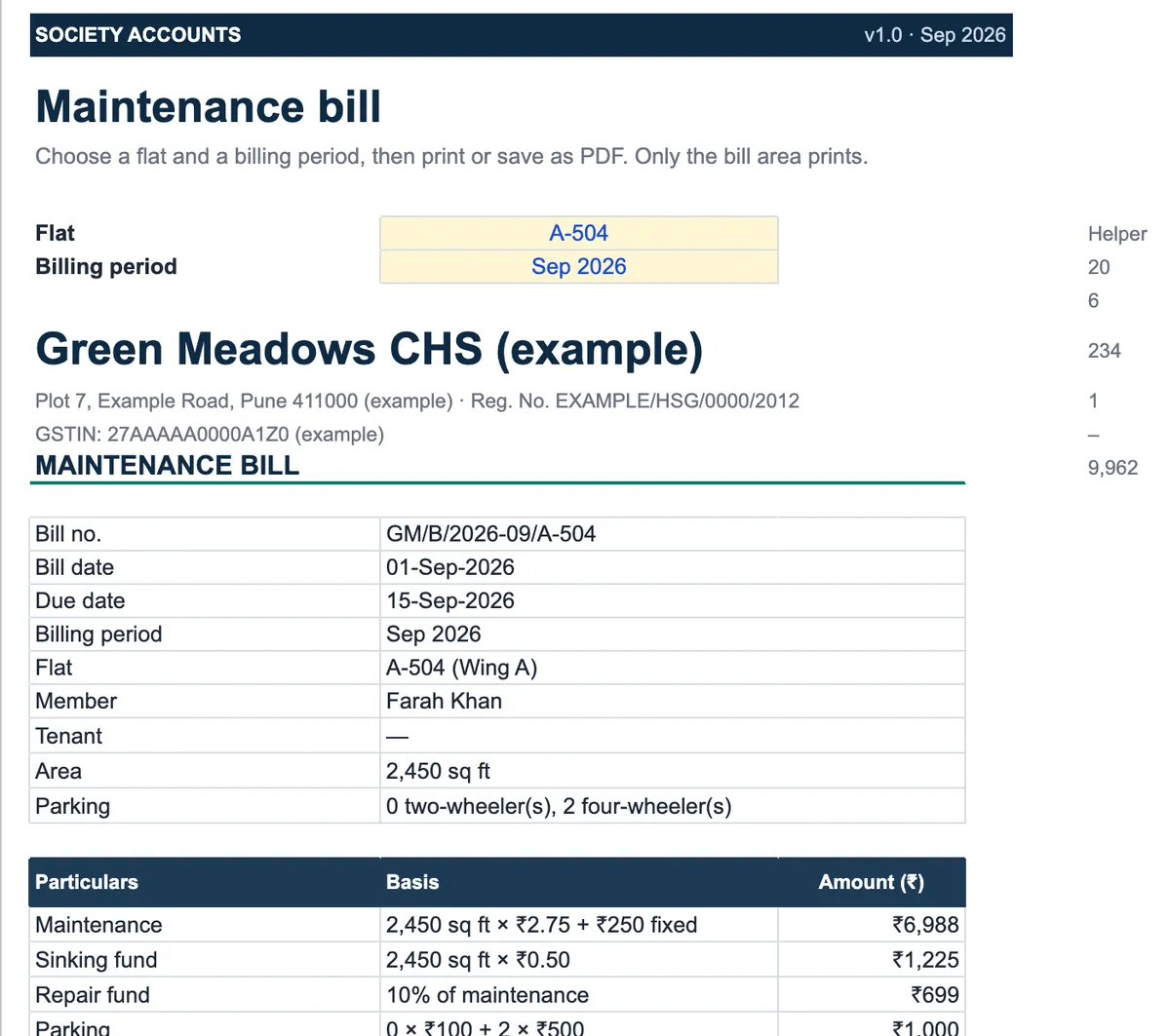
Setup holds the society’s details and its billing rules: monthly or quarterly billing, maintenance per square foot plus any fixed charge, sinking and repair fund rates, parking and non-occupancy charges, interest on arrears, the GST settings, the second-approver limit for payments and the opening balances. Flats is the member master — one row per flat with occupancy, area, parking, a WhatsApp number and opening arrears — and each flat’s monthly charges are worked out there. Bills then builds the register for every flat and billing period, and Maintenance Bill prints any one of them. Receipts logs every payment with an automatic receipt number and applies it to the oldest dues first; Member Ledger shows each flat’s balance, oldest unpaid bill and ageing in buckets of current, 1–30, 31–60, 61–90 and 90-plus days, with a reminder link; Member Statement prints a flat’s account. Expenses records every payment by head and fund and flags those above your limit that lack a second approver; Budget compares actual spending with the annual budget; Bank Reconciliation takes a monthly reconciliation with preparer and reviewer sign-off. Funds keeps general, sinking and repair fund balances, and AGM Accounts prints the Income & Expenditure account, Receipts & Payments and fund balances. GST Check applies an indicative test to every flat and month, with its sources listed in the file.
Who it’s for
- Volunteer treasurers and managing committees of apartment societies, CHS and RWAs with 10 to 100 flats.
- Societies moving off a paper register or a spreadsheet nobody else understands, without a subscription app.
- Accountants who keep the books of a few small societies, with one licence per society.
Fields included
How to use it
- In Setup, type the society details, the billing rules and charges, the interest and GST settings, the approval limit and opening balances.
- Fill Flats once: one row per flat with occupancy, area, parking, WhatsApp number and opening arrears.
- Each billing period, print or send bills from Maintenance Bill; the Bills register fills itself.
- Record every payment received in Receipts and every payment made in Expenses, with the second approver where required.
- Reconcile the bank each month in Bank Reconciliation and get it signed off by a reviewer.
- Use the Dashboard and Member Ledger to chase dues, and print AGM Accounts at year end.
Preview
₹1,999
Get it on Gumroad ↗Google Sheets (your own copy) · Filled example · Quick Start Guide (PDF) · Delivered by email
Sold by Jay Sudha. Checkout and delivery by Gumroad.
Example workflow
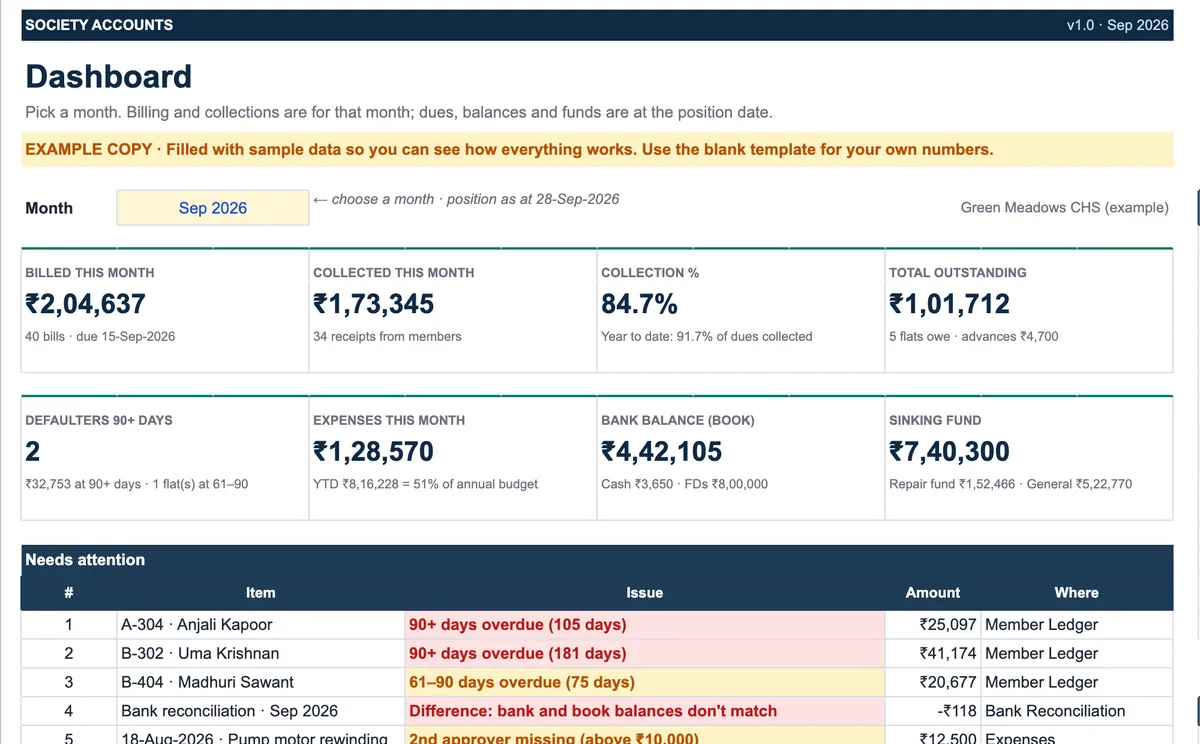
The EXAMPLE file is a fictional 40-flat society in Pune, shown as at 28 September 2026. September’s bills came to ₹2,04,637 and 34 receipts brought in ₹1,73,345 — 84.7% of the month’s billing and 91.7% of the year’s dues so far. Five flats still owe ₹1,01,712 between them, and the ledger ages it: ₹32,753 is more than 90 days old, one flat’s oldest unpaid bill is 181 days overdue and another’s 105. The Dashboard lists what needs attention before the next committee meeting: the September bank reconciliation is out by ₹118, an August payment of ₹12,500 for rewinding the pump motor went out without a second approver although it was above the ₹10,000 limit, the repairs head has passed its annual budget, and the GST check flags two flats whose monthly bill is above ₹7,500. The bank shows ₹4,42,105 in the books and ₹8,00,000 in fixed deposits, and the sinking fund stands at ₹7,40,300.
Frequently Asked Questions
Reviews
No reviews yet.
Bought this template? Review it
I read every review and publish it here, with the name you give, once I have matched your email to a Gumroad purchase. Your email is never shown. Privacy Policy