Template
GST ITC Reconciler — GSTR-2B vs Purchase Register
Input tax credit is claimed on what GSTR-2B shows, not on what the purchase register says, and the two rarely agree line for line: a supplier writes INV/0012/26-27 where your books say 12, a credit note is reported twice, an invoice never reaches 2B at all. This workbook takes both as they come — the GSTR-2B Excel from the portal and your purchase register exported from Tally, Busy or anything else — pairs them even when the numbers are written differently, puts every entry in a clear bucket with its rupee effect, and ends with a reconciliation statement that ties out to zero and a list of suppliers to chase before you file GSTR-3B.
₹1,999 on Gumroad · Google Sheets (your own copy) · Filled example · Quick Start Guide (PDF) · Delivered by email — see what’s inside below.
What it does
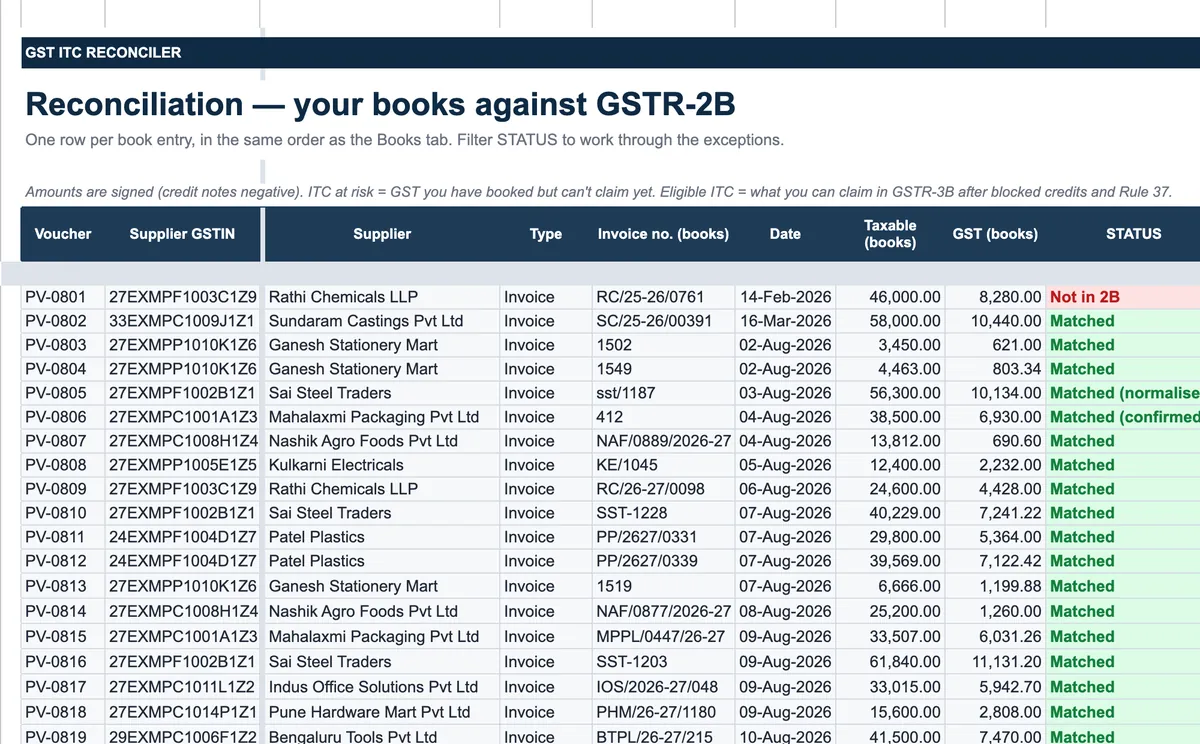
Setup takes your GSTIN, the period, matching tolerances, the credit-note layout of your GSTR-2B file and your financial-year tags. You paste the GSTR-2B B2B sheet into 2B B2B, the B2B-CDNR sheet into 2B CDNR (both the October 2025 and the older column layouts are handled), and your purchase register into Books, which also has columns for your own review — blocked credit, and accepting a probable match. Matching then runs in four tiers: exact; the same after separators and case are ignored; invoice number and amount after prefixes, financial-year tags and leading zeros are stripped; and finally supplier, amount and date, to catch a voucher number typed in place of the invoice number. Reconciliation lists every book entry with its 2B partner, the difference, a status — matched, value mismatch, probable (confirm), ITC not available, duplicate, not in 2B — the ITC at risk and the eligible ITC, with flags for Rule 37 (unpaid after 180 days), the section 16(4) time limit and section 17(5) blocked credit. 2B Engine does the same from the 2B side. Summary gives the reconciliation statement from ITC as per GSTR-2B to ITC as per books, status tables for both sides and a bridge to the ITC you can claim. Vendor Follow-up ranks suppliers by ITC at risk with a ready email and the invoice list, and Rules & Sources lists the provisions the file relies on.
Who it’s for
- Accountants and CA firms preparing GSTR-3B for a business each month.
- SMEs and traders who claim ITC and want to know what is at risk before filing, not after a notice.
- GST consultants, under the product’s professional licence for client work.
Fields included
How to use it
- In Setup, type your GSTIN and the period, and pick the credit-note layout that matches your GSTR-2B file.
- Save GSTR-2B as Excel from the GST portal and paste its B2B and B2B-CDNR sheets into the two 2B tabs.
- Export your purchase register and paste the listed columns — supplier GSTIN, invoice number, date, taxable value and taxes — into Books.
- Work through the Dashboard to-do list: confirm probable pairs, check value mismatches, record purchases that are in 2B but not in your books.
- Send each supplier on Vendor Follow-up the ready email and invoice list for credit that is missing from 2B.
- Take the eligible ITC from Summary to your GSTR-3B working, and keep the reconciliation statement for your CA.
Preview
₹1,999
Get it on Gumroad ↗Google Sheets (your own copy) · Filled example · Quick Start Guide (PDF) · Delivered by email
Sold by Jay Sudha. Checkout and delivery by Gumroad.
Example workflow
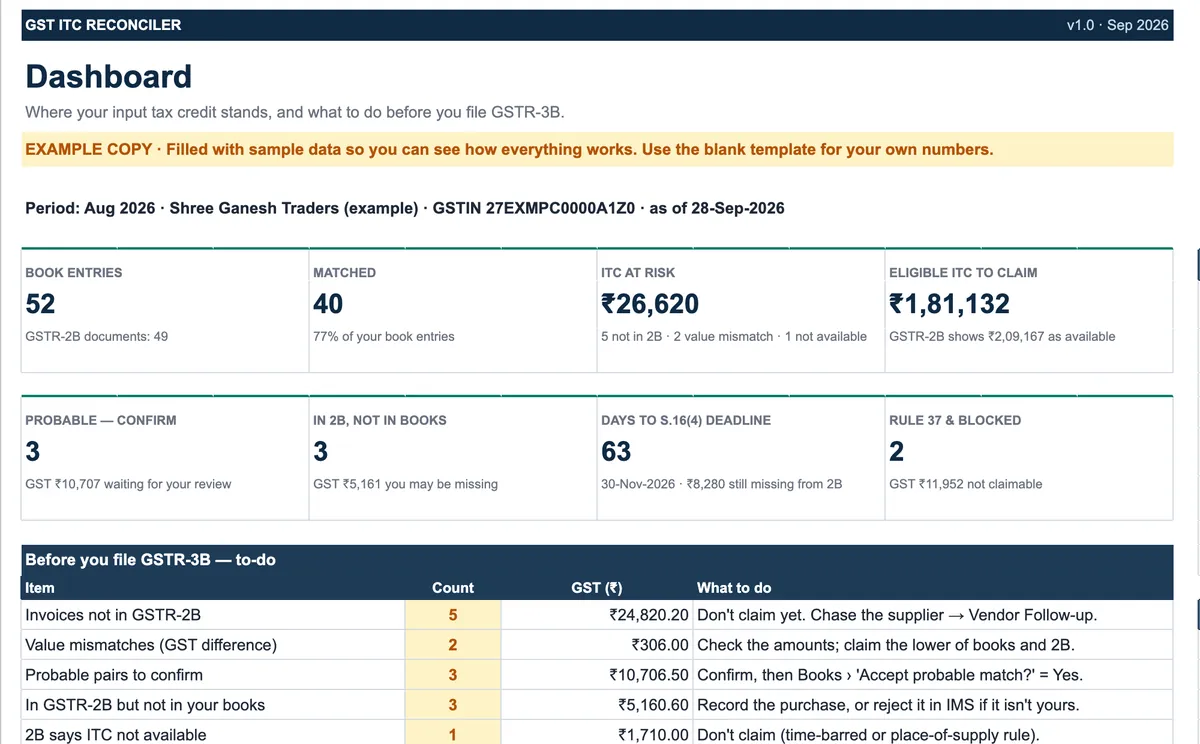
The EXAMPLE file reconciles August 2026 for a fictional trader: 52 purchase entries in the books against 49 documents in GSTR-2B. Forty entries match — two of them only after the number format was normalised and two confirmed by hand — and three more are probable pairs worth ₹10,707 of GST, waiting for review. Five invoices worth ₹24,820 of GST are not in 2B at all, so they are held back and their suppliers go onto the follow-up list; three documents in 2B are not in the books; one invoice is unpaid for more than 180 days and has to be reversed under Rule 37; one entry is a duplicate. The reconciliation statement starts from ₹2,09,167 of ITC shown as available in 2B, walks through each of those differences, and ends exactly at the ₹2,32,436 the purchase register holds — a difference of ₹0. The ITC that can be claimed today is ₹1,81,132, and ₹26,620 is at risk until suppliers act.
Frequently Asked Questions
Reviews
No reviews yet.
Bought this template? Review it
I read every review and publish it here, with the name you give, once I have matched your email to a Gumroad purchase. Your email is never shown. Privacy Policy