Two Credit Cards Strategy: How to Use Multiple Cards Wisely
Two credit cards, used correctly, lower utilisation, maximise rewards, and build credit. Used carelessly, they double the risk.
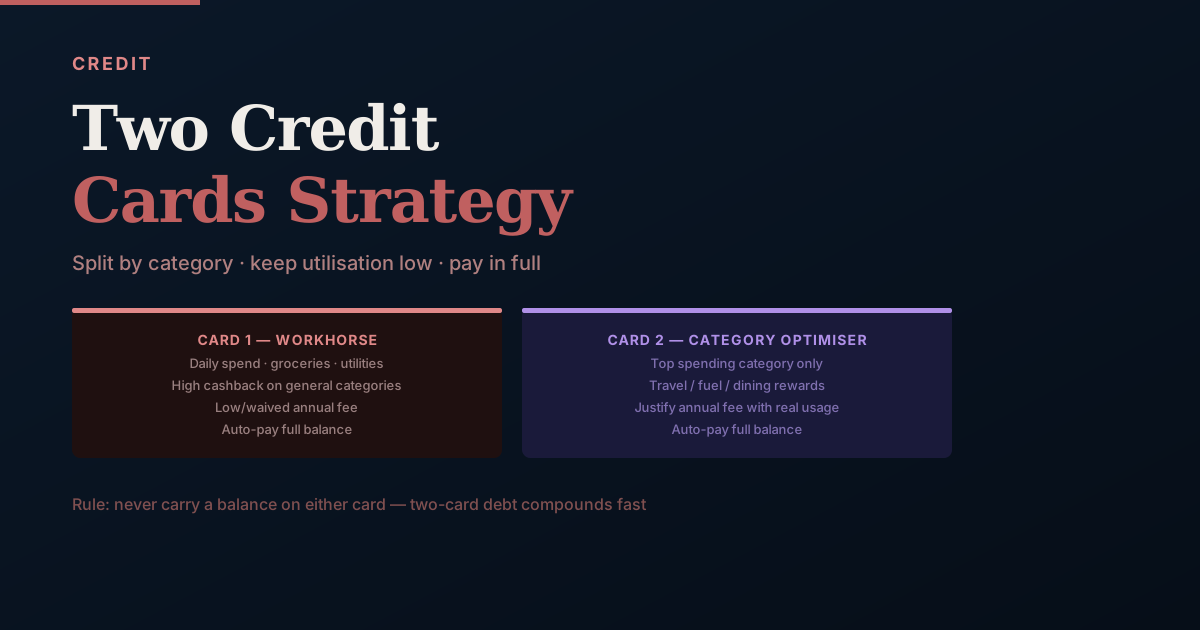
Most people with strong credit habits end up with two credit cards at some point. The question is whether you're using them strategically or just accumulating plastic.
Why Two Cards Can Make Sense
Lower utilisation ratio: If you spend ₹30,000/month and have one card with a ₹50,000 limit, your utilisation is 60% — high enough to hurt your score. Two cards with ₹50,000 limits each gives ₹1 lakh total limit. Same spending = 30% utilisation.
Category-matched rewards: No single card is best across all categories. A travel card excels at air miles; a cashback card wins on groceries and online shopping. Two cards lets you optimise each major spending category.
Backup: If one card is compromised, blocked, or not accepted by a merchant, you have a functional backup.
Building credit history: Each card with responsible usage adds to your credit history, diversifies your credit mix, and can contribute to score improvement.
The Two-Card Framework
The most effective two-card setup:
Card 1 — The Workhorse
- Purpose: Daily spend (groceries, food delivery, utilities, online shopping)
- Ideal features: High cashback or reward rate on general categories, auto-pay compatibility, low/waived annual fee
- Examples: HDFC Millennia, Axis Flipkart, SBI SimplyCLICK, Amazon Pay ICICI
Card 2 — The Category Optimiser
- Purpose: Your single largest spending category that Card 1 doesn't cover well
- Ideal features: High reward rate specifically on travel, dining, fuel, or EMI
- Examples: HDFC Diners Black (travel), ICICI Rubyx (premium), IndusInd Celesta (lifestyle)
Keep spending on each card organised. Don't use Card 2 for groceries just because you reach for it — use it only for its intended category.
Utilisation Management with Two Cards
| Total Spend | Single Card ₹1L limit | Two Cards ₹1L each |
|---|---|---|
| ₹40,000/month | 40% utilisation | 20% utilisation |
| ₹60,000/month | 60% utilisation | 30% utilisation |
| ₹80,000/month | 80% utilisation | 40% utilisation |
At ₹80,000/month spend, one card with ₹1L limit puts you at 80% utilisation — significantly damaging to credit score. Two cards (or one card with ₹2L limit) resolves this.
The Critical Rules
-
Pay the full balance on both cards every month — not just the minimum. If you can't, you're overspending.
-
Never carry a balance on either card. Two-card debt compounds faster than one-card debt.
-
Keep annual fees in check — a ₹5,000 annual fee card needs to generate ₹5,000+ in verified benefits to justify the cost. Calculate this annually.
-
Don't open more than two in the same year — hard inquiries and new accounts within a short period compound score impact.
-
Don't close the older card — account age matters for credit score. Keep older cards active with at least one transaction per quarter.
When Two Cards Is Too Many
Two cards becomes problematic when:
- You're tracking spending across cards poorly and underestimating total spend
- You pay only minimum dues because the combined total feels too high
- You've started carrying a balance on either card
- You're using the extra available credit as permission to spend more
The benefit of two cards is structural (utilisation, rewards). If it's changing spending behaviour negatively, one card is better.
Expanding Beyond Two
Three or more cards is reasonable only if:
- You have a strong credit management system (tracking software, spreadsheet, or linked banking view)
- Each additional card has a specific, non-overlapping purpose
- You've demonstrated you can manage two cards with zero balance carrying for 12+ months
For most people, two well-chosen cards with disciplined usage covers the optimisation surface without adding complexity.
Choosing the Right Two Cards for Your Spending Pattern
The optimal two-card combination depends entirely on where your money goes each month. Before picking cards, audit three months of bank statements and categorise every expense. Most Indian salaried professionals find spending concentrated in:
- Online shopping (Amazon, Flipkart, Meesho, Myntra)
- Groceries and supermarkets
- Food delivery (Swiggy, Zomato)
- Fuel
- Travel (flights, hotels, cab aggregators)
- Utility bills and rent
Once you know your top two or three categories, match cards to those categories rather than selecting based on brand reputation or advertising.
The specific cards and reward rates below are illustrative examples as of writing — issuers revise cashback rates, caps, and fees frequently, so confirm the current terms on the issuer's website before applying.
High online shopping spends: Amazon Pay ICICI gives 5% cashback on Amazon, 2% elsewhere. Axis Flipkart gives 5% on Flipkart, 4% on Myntra. These two together cover the two largest e-commerce platforms at premium cashback rates.
High travel spends: HDFC Diners Black (if you qualify for the ₹10,000 limit requirement) earns 5 reward points per ₹150 and has extensive airport lounge access. For domestic travel, the Vistara SBI card earns Club Vistara points usable on Air India flights. If you prefer cashback over miles, the Axis Atlas card at ₹5,000 annual fee earns Edge Miles redeemable for flights and hotels.
High fuel spends: BPCL SBI Card earns 4.25% value back on BPCL fuel. IndianOil Axis card earns 20X reward points at IndianOil outlets. A fuel card paired with a general cashback card is a strong combination for someone commuting by car.
Mixed daily spending: HDFC Millennia at ₹1,000 annual fee (waived at ₹1 lakh annual spend) earns 5% on Amazon, BookMyShow, Cult.fit, Flipkart, Myntra, Sony LIV, Swiggy, Tata CLiQ, Uber, and Zomato — essentially covering the entire app economy of an urban Indian. Pair this with a fuel or travel card as the second.
Annual Fee Calculation: When Is a Fee Worth It?
Premium cards with annual fees are only worthwhile when the benefits you actually use exceed the fee. Here is how to run the calculation:
Say you're considering HDFC Regalia Gold at ₹2,500 per year.
| Benefit | Estimated Annual Value |
|---|---|
| Airport lounge visits (6/year at ₹1,000 each) | ₹6,000 |
| Milestone bonus (₹1,500 voucher at ₹5L spend) | ₹1,500 |
| Reward points (4 per ₹150 at ₹5L annual spend) | ~₹5,300 |
| Total benefit if fully utilised | ₹12,800 |
Against a ₹2,500 fee, this is a strong positive return — but only if you actually use the lounges and hit the spend milestone. If you don't travel much, the lounge benefit disappears, and the return equation changes.
Apply this calculation to every fee-based card you hold or consider. If the verified, extractable value doesn't clearly exceed the fee, downgrade to a no-fee alternative.
Managing Two Cards Without Losing Track
The operational risk of two cards is forgetting due dates or losing track of spending across cards. Practical systems that work:
Single payment date consolidation: Most banks allow you to change your credit card statement date. Set both cards to close statements on the same date (e.g., the 1st of each month) and pay both together on the same due date. One mental checkpoint instead of two.
Category tagging in a budgeting app: Apps like Money View, YNAB, or even a simple Google Sheet can pull transactions from both cards and tag them by category. This ensures you see total monthly spend across both cards, not just each card's statement in isolation.
Auto-pay setup on both cards: Set up NACH mandates for full statement balance on both cards. This eliminates the risk of forgetting a payment, which is the single most damaging error in a two-card setup. Verify that your bank account maintains sufficient balance before each due date.
Separate categories, no overlap: Use Card 1 exclusively for categories A and B, Card 2 exclusively for category C. Never mix. This keeps each card's statement clean and makes it easier to verify rewards earned match expectations.
How Two Cards Affect Your CIBIL Score Over Time
The short-term impact of opening a second card: a hard inquiry (typically -5 to -10 points) and a new account entry (another small dip). Most people see a 15–25 point drop in the 1–3 months after opening a new card.
The medium-term impact (12–18 months of responsible usage):
- Total credit limit increases: If Card 1 has ₹1.5L limit and Card 2 adds ₹1.5L, total available credit is now ₹3L. Same ₹40,000/month spend = 13.3% utilisation instead of 26.7%. This is a meaningful improvement.
- Payment history builds on two accounts: Two cards paying on time adds twice the positive payment history entries per month.
- Credit mix improvement: If your Card 1 was your only credit product, Card 2 deepens your credit card history.
After 18 months of clean behaviour with both cards, your CIBIL score should be higher than with one card — typically by 20–40 points, depending on starting score and usage pattern.
One caveat: if you apply for the second card too soon after the first, the combined hit of two new accounts and two inquiries can cause a more significant short-term dip. Space new card applications by at least 6 months when possible.
Common Mistakes That Turn Two Cards Into a Problem
Treating combined limit as spending permission: A total limit of ₹3 lakh is not a spending budget. It is a credit facility. Your actual spend should still be driven by what you can pay from income, not what your combined limit allows.
Missing the annual fee justification review: Card issuers change reward structures. An HDFC Regalia that was excellent value in 2022 may have had its benefits revised. Review the value proposition of each card annually, not just when you first apply.
Carrying balance on one card while the other sits idle: Some people put all expenses on one card (hitting 80% utilisation) while leaving the second card unused. The optimal approach is to use both cards such that utilisation stays below 30% on each.
Closing Card 1 after getting Card 2: The original card, if it is your older card, contributes to credit history age. Keep it open and minimally active even if Card 2 is now your primary.
The Tax Angle: Reward Points and GST
A frequently misunderstood aspect of Indian credit card rewards: GST is levied at 18% on credit card annual fees and on several fee-based transactions (cash advance fees, foreign transaction fees, late payment fees). This is not avoidable but should be factored into annual fee calculations.
On reward points: Reward points and cashback received on credit cards are not treated as taxable income for individuals in India under current tax rules — they are considered a discount or rebate on spending, not income. High-value reward earners (those earning lakhs of reward points through business spending on personal cards) should consult a CA regarding their specific situation, but for typical salaried consumers, reward points do not generate a tax liability.
GST on annual fees: If your card charges ₹5,000 as annual fee, the actual charge is ₹5,900 (including 18% GST). The fee amount advertised by the card issuer usually does not include GST. Account for this in your annual fee value calculation.
Fuel surcharge waivers: Fuel surcharge waivers (typically 1% of the transaction value, waived for fuel purchases above a threshold) are a genuine cash benefit and not subject to additional tax for the cardholder. They represent actual savings of ₹100–400 per month for regular car users.
When to Reassess Your Two-Card Setup
The right two cards in 2024 may not be the right two cards in 2026 — card issuers change reward structures, merchants change which cards they accept, and your spending pattern shifts with life stage.
Triggers to reassess:
- A card's annual fee increases without proportional benefit increases
- Your primary spending category shifts (e.g., you stop commuting by car and lose the fuel card's primary value)
- A new card launches with materially better rewards for your top categories
- Your credit limit on one card is no longer adequate for your spending pattern
- You are applying for a major loan in the next 6 months and want to maximise CIBIL score by strategic management
Annual fee anniversary (typically when the fee is charged for the next year) is a natural reassessment trigger — the bank usually reaches out at this point, and some banks offer fee waivers, milestone bonuses, or upgrade options that should be considered before auto-renewing.
Frequently Asked Questions
Sources and references
- Goods and Services Tax — Official GST Portal, Government of India
- TransUnion CIBIL — Credit Scores & Reports
Rules, rates, and thresholds in India change over time. Always confirm the current position with the official source above before acting on it.