Sole Proprietor vs LLP vs Private Limited: Choosing Your Business Structure
Your business structure affects tax, liability, compliance, and fundraising. The right choice depends on your business scale and risk appetite.
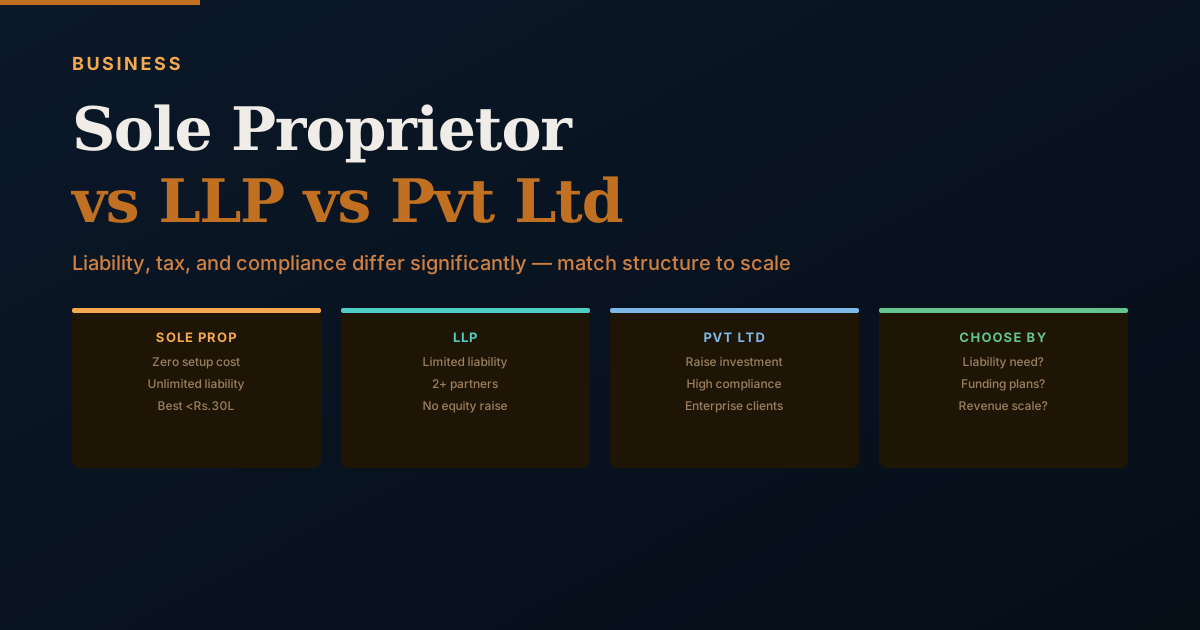
The business structure you choose affects how you pay tax, what happens if something goes wrong, and how much administrative work you take on each year.
The Three Main Options for Indian Small Businesses
1. Sole Proprietorship
What it is: You and the business are the same legal entity. No separate registration needed in most cases.
Advantages:
- Zero setup cost and minimal compliance
- All income is your income (taxed at individual rates)
- Complete control
- Simplest banking and financial management
Disadvantages:
- Unlimited personal liability — business debts are personal debts
- Business cannot outlive you (no separate legal entity)
- Harder to get institutional clients who prefer dealing with a company
- Cannot raise equity investment
Best for: Solo freelancers, consultants, service providers with low litigation risk and under Rs.20-30 lakh revenue.
2. Limited Liability Partnership (LLP)
What it is: A partnership structure where partners have limited liability (up to their capital contribution).
Advantages:
- Limited liability protection
- Flexible profit-sharing between partners
- Lower compliance than Pvt Ltd (no need for mandatory board meetings, simpler annual filings)
- Taxation: LLP is taxed at a flat 30% (plus cess) at the entity level, after which the partners' profit share is tax-free in their hands under Section 10(2A) — it is not pass-through to your personal slab
- Suitable for 2+ partners
Disadvantages:
- Cannot raise equity (venture capital, angel investors)
- Requires at least two designated partners
- Annual ROC filing required
- Professional tax registration needed in some states
Best for: Professional service firms, boutique agencies, businesses with 2-5 partners who want liability protection without full corporate structure.
3. Private Limited Company
What it is: A separate legal entity from its owners. Shareholders have limited liability.
Advantages:
- Full limited liability protection for shareholders
- Can raise equity investment (VC, angels, employees with ESOPs)
- Preferred by institutional clients and large corporates
- Better credibility for enterprise contracts
- Can have employees with formal equity stakes
Disadvantages:
- High setup and maintenance cost (CA, CS required)
- Significant compliance burden (board meetings, ROC filings, statutory audit)
- Corporate tax rate (25% for small companies); dividend distribution taxed additionally in shareholders' hands
- More complex if you want to take money out of the company
Best for: Startups seeking investment, businesses with significant scale or enterprise clients, companies with multiple employees.
Quick Comparison
| Feature | Sole Proprietor | LLP | Pvt Ltd |
|---|---|---|---|
| Setup cost | Minimal | ~Rs.10,000 | ~Rs.15,000-25,000 |
| Personal liability | Unlimited | Limited | Limited |
| Equity investment | No | No | Yes |
| Tax rate | Individual slab | Flat 30% (entity) | ~25% (small co.) |
| Compliance | Minimal | Moderate | High |
| Best for turnover | <Rs.30L | Rs.20L–Rs.5Cr | Rs.1Cr+ |
A Fourth Option: One Person Company (OPC)
If you're a solo founder who wants limited liability but has no partner, the OPC sits between sole proprietorship (unlimited liability) and LLP (needs two partners). It's a private company with a single shareholder plus a nominee — you get liability protection and a corporate identity, but with most of a Pvt Ltd's compliance load. It's worth it mainly when liability is a genuine concern and a co-founder isn't an option. Note: since FY2021-22 an OPC can grow without any mandatory conversion — the earlier rule that forced conversion at ₹2 crore turnover or ₹50 lakh paid-up capital was removed (an OPC may still convert to a private limited company voluntarily).
A Correct Word on LLP Taxation
A common myth is that an Indian LLP is "pass-through" like a US LLC. It isn't. The LLP pays a flat 30% (plus surcharge where applicable and 4% cess) at the entity level; the partners' share of profit is then exempt under Section 10(2A), so there's no double taxation — but the effective rate is 30%, not your personal slab. Partner remuneration and interest on capital (if provided in the LLP deed) are taxable in partners' hands and deductible for the LLP within Section 40(b) limits. So a profitable LLP isn't automatically cheaper — run the actual numbers.
How to Actually Choose
Work through four questions in order:
- Liability risk — does your work expose you to claims (signed deliverables, advice, physical products)? If yes, rule out sole proprietorship. I have carried significant business debt without any legal separation between "business money" and "my money," and that line disappears fast once leverage gets large — the unlimited-liability downside of a proprietorship isn't theoretical, it's the exact mechanism that turns a business problem into a personal one.
- Client type — do your target clients require a company on the contract (large corporates, government, international)? If yes, lean toward Pvt Ltd.
- Funding — will you raise angel/VC money or issue ESOPs? Only a Pvt Ltd supports this; LLP and OPC don't.
- Scale and cost tolerance — Pvt Ltd compliance realistically runs ₹25,000–50,000+ a year (CA + CS + audit). Below a certain revenue, that overhead isn't justified.
Most solo service providers start as sole proprietors, register for GST when they cross the threshold, and convert to an LLP or Pvt Ltd only when liability, clients, or funding demand it. Converting later is routine — over-structuring early just buys cost you don't need yet.
Tax Filing Requirements by Structure
Your business structure determines which ITR form you file and the compliance calendar you follow:
Sole Proprietorship:
- File ITR-4 if using 44ADA/44AD presumptive taxation (both consolidated into Section 58 under the Income-tax Act, 2025, effective 1 April 2026, with the same rates)
- File ITR-3 if maintaining books of accounts or having capital gains
- No separate entity-level return — your personal ITR includes all business income
- Advance tax: quarterly (or single instalment by March 15 for 44ADA users)
- GST: individual GSTIN in your own name
- No statutory audit unless turnover crosses Rs.50 lakh (professions) or Rs.1 crore (business)
LLP:
- The LLP files its own income tax return (ITR-5) as a separate entity
- Partners file their own ITR-3 or ITR-2 (their share of profit is exempt under Section 10(2A), but they must show it in their return)
- LLP must maintain books of accounts (mandatory, unlike sole proprietors under presumptive scheme)
- Annual Return (Form 11) and Statement of Accounts (Form 8) to ROC every year
- Tax audit mandatory if LLP turnover exceeds Rs.1 crore or if it claims losses
Private Limited Company:
- Separate corporate ITR (ITR-6)
- Mandatory statutory audit regardless of turnover
- ROC compliance: Annual Return (MGT-7), Financial Statements (AOC-4), Board meeting minutes, Director disclosures
- Directors who are also employees file their own ITR with salary income
- More compliance, but also more credibility with institutional clients and investors
Converting Between Structures: The Process
Moving from sole proprietor to LLP or Pvt Ltd is a routine process, but it does have tax and operational implications:
Sole proprietor to LLP: Requires incorporating a new LLP, transferring business assets and contracts to it, and winding down the sole proprietorship's tax registrations. Section 47(xiiib) of the Income Tax Act provides capital gains exemption for business transfer to LLP if specified conditions are met — consult a CA on structuring this correctly. GST registration must be surrendered and new GSTIN obtained for the LLP.
LLP to Pvt Ltd: More complex. Requires incorporation of a new Pvt Ltd, taking approval from ROC and other authorities, transferring assets. The LLP doesn't "convert" directly in most cases — the business is transferred to the new Pvt Ltd and the LLP is wound down. This is a significant legal exercise and requires a CA and company secretary.
Tax implications: Conversions done without proper structuring can trigger capital gains tax on the transfer of business assets. Goodwill, client relationships, and intellectual property built up in the proprietorship have value that the tax department can assess on transfer. Proper advance planning with a CA typically mitigates this.
GST Registration Per Structure
GST registration is tied to the legal entity, not just the person:
Sole proprietorship: GST registered in your own name, with your PAN. GSTIN format: state code + your PAN + ZZ + check digit.
LLP/Pvt Ltd: GST registered in the entity's name, with the entity's PAN. Different GSTIN from your personal one.
This means when you convert from proprietorship to LLP, you must surrender the old GSTIN and obtain a new one for the LLP. Client relationships must be updated with the new GSTIN. Outstanding ITC in the old registration can be transferred to the new entity through Form GST ITC-02 — ensure this is done before surrendering the old registration.
MSME Registration by Structure
All three structures can register as MSME (Udyam Registration):
Sole proprietorship: Register with your Aadhaar as the proprietor. The MSME registration is in your name and linked to your Aadhaar.
LLP: Register with the designated partner's Aadhaar. The LLP's PAN and business details are entered.
Pvt Ltd: Register with a director's Aadhaar. The company's PAN and CIN are entered.
Udyam registration benefits (collateral-free loans under CGTMSE, 45-day payment protections, government tender preferences) apply equally across all structures for qualifying businesses. The registration process is the same regardless of structure.
Comparative Compliance Cost
Annual compliance cost is a real factor in structure selection. Approximate ranges:
| Structure | Annual Compliance Cost (CA fees + govt fees) |
|---|---|
| Sole proprietorship | Rs.5,000–15,000 (ITR filing + GST returns) |
| LLP (no employees) | Rs.25,000–50,000 (ITR + ROC filings + books) |
| Pvt Ltd | Rs.50,000–1,50,000+ (audit + ROC + CS + ITR) |
These are approximate and vary significantly by CA, city, and complexity. The gap is real — a Pvt Ltd with all mandatory compliance properly handled costs roughly 10x more than a sole proprietorship in annual compliance overhead.
At Rs.10-20 lakh revenue, sole proprietorship compliance costs are under 1% of revenue. At Rs.50-75 lakh revenue, an LLP's compliance costs are still under 1% and the liability protection and structure advantages become worth it. At Rs.1 crore+ revenue with employees and institutional clients, Pvt Ltd's compliance load (2-5% of revenue) is justified by the operational and credibility benefits.
When International Clients Change the Calculus
If your clients are outside India, the business structure question has additional dimensions:
GST on exports: Services exported are "zero-rated" under GST — you charge 0% GST and can claim refund of ITC paid on inputs. This applies regardless of business structure, but is easier to manage through a current account with clear transaction records (better supported by LLP/Pvt Ltd structures).
Foreign Remittance (FEMA compliance): All foreign payments must be received through proper banking channels. Pvt Ltd companies have clearer documentation requirements for foreign inflows under FEMA. As a sole proprietor receiving foreign payments, your bank will require FIRC (Foreign Inward Remittance Certificate) for each payment — also available as BRC (Bank Realisation Certificate) under RBI guidelines.
Transfer pricing and invoicing: For ongoing service relationships with foreign clients, invoicing in USD, GBP, or other currencies means you take exchange rate risk. Structuring this through an LLP or Pvt Ltd, with a proper foreign currency bank account (EEFC), gives you more flexibility to hold and deploy foreign currency proceeds before converting to INR.
The Real Annual Running Cost of Each Structure
The compliance cost comparison often understates the full picture. Here is what you realistically pay each year for each structure once you account for all mandatory items:
Sole Proprietorship (with GST, no audit required):
- ITR filing (CA): ₹5,000–12,000
- GST returns monthly (if handled by CA): ₹1,000–2,000/month = ₹12,000–24,000/year
- Professional tax: ₹2,500/year
- Total: approximately ₹20,000–40,000/year
LLP (2 partners, no employees, no audit required):
- LLP ITR-5 filing (CA): ₹8,000–15,000
- Partners' personal ITRs (2 × ₹5,000): ₹10,000
- ROC annual filing (Form 8 + Form 11): government fees ₹200–600, CA/CS preparation ₹5,000–8,000
- GST returns (if applicable): same as above
- Total: approximately ₹40,000–70,000/year
Private Limited Company (2 directors, no public listing):
- Statutory audit (mandatory regardless of turnover): ₹20,000–50,000
- Corporate ITR-6 filing: ₹8,000–15,000
- ROC annual compliance (MGT-7, AOC-4, board meeting minutes): CS + CA fees ₹20,000–40,000
- Directors' personal ITRs: ₹10,000–20,000
- GST returns: same as above
- Total: approximately ₹80,000–1,50,000+/year
At ₹15 lakh annual revenue, the Pvt Ltd compliance premium over sole proprietorship is 5–8% of your income — before you've drawn a rupee. At ₹1 crore annual revenue, the same premium is under 1% and the structure advantages (liability, credibility, funding) justify it.
A Decision Framework for Common Indian Freelancer Scenarios
Scenario A: Solo IT consultant, ₹20–40 lakh revenue, all clients are companies, no employees planned: Start as sole proprietor with GST registration. The 44ADA presumptive scheme simplifies tax. Consider LLP only if personal liability from a contractual dispute becomes a real concern — for pure service work with written contracts, this risk is low.
Scenario B: Two designers running a joint studio, ₹30–60 lakh combined revenue: LLP is the natural structure. It formalises the partnership (protecting both partners), provides liability separation, and the flat 30% entity tax on the LLP's profit is often competitive with individual slab rates at this income level depending on how profits are structured.
Scenario C: B2B software product business targeting enterprise clients: Pvt Ltd from the start. Enterprise procurement teams require a company on the MSA. If you plan to raise money, there is no alternative. The compliance cost is a cost of doing business.
Scenario D: Solo freelancer, ₹8–15 lakh revenue, mix of individual and small business clients: Stay sole proprietor. GST registration when turnover approaches ₹20 lakh. No corporate structure needed until revenue or liability risk demands it.
These scenarios are illustrative starting points, not a substitute for a CA or company secretary reviewing your specific liability exposure and funding plans.
Frequently Asked Questions
Sources and references
- Goods and Services Tax — Official GST Portal, Government of India
- Income Tax Department, Government of India
- Reserve Bank of India (RBI)
- Income Tax Department — Income-tax Act, 2025 (FAQs on Interplay and Transition, and Act text)
Rules, rates, and thresholds in India change over time. Always confirm the current position with the official source above before acting on it.