Secured vs Unsecured Loans: Key Differences and When Each Makes Sense
Secured loans need collateral like property or gold; unsecured loans rely on your creditworthiness. Knowing the difference helps you borrow smarter.
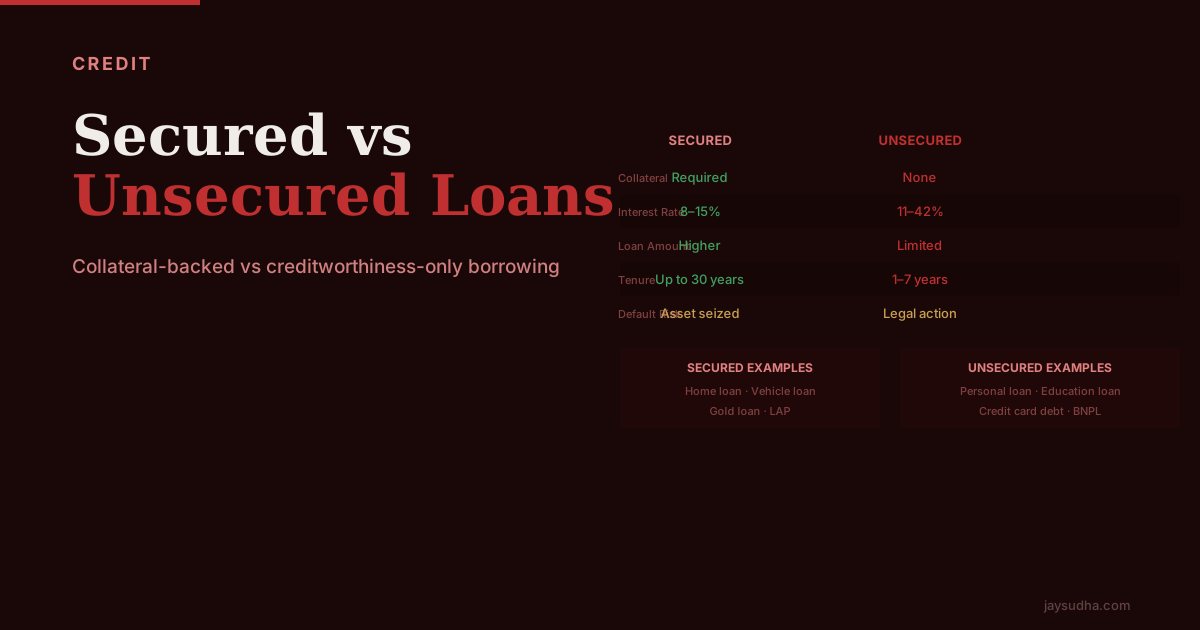
When you borrow money, you're making two kinds of implicit promises to the lender: a promise to repay, and — in the case of secured loans — a pledge of specific assets as backup if you can't.
This distinction between secured and unsecured borrowing affects nearly everything: the interest rate, the loan amount available, the documentation required, the risk you take on, and the consequences of default.
What Makes a Loan Secured
A secured loan is one where the borrower pledges an asset — called collateral — that the lender can claim if the borrower defaults. The collateral reduces the lender's risk, which is why secured loans generally come at lower interest rates.
The most common secured loans in India:
Home Loan: The property being purchased serves as collateral. The bank holds the property documents (title deed) until the loan is repaid. If you default, the bank can initiate foreclosure proceedings. Interest rates: currently 8–10% per annum.
Loan Against Property (LAP): An existing property (residential or commercial) is mortgaged to borrow cash — not to purchase that property. Often used for business needs, large personal expenses, or debt consolidation. Interest rates: 9–13% per annum, typically 1–3% higher than a home loan.
Vehicle Loan: The vehicle (car, two-wheeler) is the collateral. The bank holds the Registration Certificate (RC) until the loan is cleared. Defaulting enables the lender to repossess the vehicle. Interest rates: 8–15% per annum depending on vehicle type and borrower profile.
Gold Loan: Physical gold (jewellery, coins) is pledged to a bank or NBFC. You get typically 65–85% of the gold's value as a loan. The gold is held in the lender's custody until you repay. Quick disbursement, minimal documentation. Interest rates: 10–18% per annum.
Loan Against Securities: Shares, mutual funds, or bonds are pledged. You get a credit line or term loan against the portfolio. Interest rates: 10–14% per annum. Risk: if the value of the pledged securities falls below a threshold, the lender may require additional collateral or sell some holdings.
Fixed Deposit Loan: You pledge your own FD to borrow. The FD continues to earn interest while you borrow against it, at rates typically 1–2% above the FD interest rate. Very low documentation, fast approval.
What Makes a Loan Unsecured
An unsecured loan has no collateral backing it. The lender lends based on your creditworthiness — your income, credit score, employment stability, and repayment history. If you default, the lender has no specific asset to seize (though they can pursue legal action to recover the debt).
The higher risk to the lender is reflected in significantly higher interest rates.
Personal Loan: The most common unsecured loan in India. Used for almost any purpose — medical emergency, travel, home renovation, debt consolidation. Banks and NBFCs offer these based on salary, credit score, and employer profile. Interest rates: 11–24% per annum. See personal loan vs credit card for how it stacks up against the other common unsecured option.
Credit Card Debt (when balance is carried over): When you don't pay your full credit card bill, the outstanding balance becomes an unsecured loan at extremely high rates. Interest rates: 36–42% per annum — the most expensive mainstream borrowing option in India. If you're carrying a balance, see the full credit card debt strategy for a structured way out.
Consumer Durable Loans (Zero-Cost EMI): Often presented as zero-interest, these frequently have processing fees that translate to an effective interest rate of 8–14%. They are unsecured loans extended to finance the purchase of electronics, appliances, or furniture.
Education Loan (partially): Education loans up to ₹7.5 lakh from most banks are unsecured. Above that, collateral is typically required. Interest rates: 8–15% per annum, with interest subsidy available for certain categories under government schemes.
The Key Differences Side by Side
| Secured Loan | Unsecured Loan | |
|---|---|---|
| Collateral required | Yes | No |
| Interest rate | Lower (8–15%) | Higher (11–42%) |
| Loan amount | Higher | Limited by credit profile |
| Processing time | Longer (due diligence on asset) | Faster (income and credit check only) |
| Documentation | More (asset documents, valuation) | Less (income proof, ID, credit report) |
| Tenure | Can be very long (30 years for home loan) | Usually shorter (1–7 years) |
| Risk of asset loss | Yes, if you default | No specific asset at risk |
| Purpose restriction | Often yes (home loan for property) | Usually flexible |
When Secured Loans Make Sense
For large, planned purchases: A home or commercial vehicle is the obvious use case. You wouldn't take a personal loan to buy a home — the quantum would be far too large and the rate unsustainable.
For lower-cost cash against assets you own: If you own a property or have a large gold holding and need cash for a business purpose or large expense, a LAP or gold loan gets you that cash at 10–14% rather than 16–24% for a personal loan.
When you want a longer repayment window: Secured loans can have much longer tenures. A home loan can run 30 years. Personal loans typically cap at 7 years. A longer tenure means a lower monthly EMI for the same loan amount.
When your credit profile isn't strong enough for unsecured: Borrowers with moderate credit scores who would be declined or charged premium rates for personal loans may qualify for secured loans because the asset reduces the lender's risk.
When Unsecured Loans Make Sense
For small, urgent, short-term needs: A personal loan for a medical expense that you'll repay in 12–18 months is a legitimate use. The documentation is minimal, disbursement is fast, and the total interest cost is manageable if the tenure is short.
When you don't want to risk specific assets: If you have a gold collection you're not willing to put at risk, or a property that represents your family's primary security, an unsecured loan — even at a higher rate — may be the right choice.
For purposes that don't have a natural asset to pledge: Travel, professional courses, a wedding — there is no asset to pledge here. An unsecured personal loan is sometimes the appropriate product.
Credit cards (when used correctly): A credit card is an unsecured credit product that, used well (paid in full every month), is essentially free credit for 20–50 days. The 36–42% interest rate only activates if you carry a balance.
What to Never Use Each Loan For
This comes down to the good debt vs bad debt distinction: the loan type matters less than what it funds.
Never use an unsecured personal loan to invest in equity or crypto. If the investment falls (as investments can), you still owe the loan. You're taking 16–22% guaranteed cost against uncertain, volatile returns. The math doesn't work even in favourable scenarios.
Never use a home loan to fund lifestyle spending. Taking out equity from a home (top-up loan, LAP) to fund a wedding, vehicle, or vacation puts your home at risk for a depreciating or zero-return expense. This is one of the fastest routes to financial distress.
Never carry a credit card balance for more than one month unless genuinely unavoidable. At 36–42%, a ₹1 lakh balance costs ₹36,000–42,000 in interest over one year. This is among the most expensive money in the Indian financial system.
Avoid loan against securities for long-term borrowing. If you're pledging equity shares or equity mutual funds, a market correction can trigger a margin call — forcing you to pledge more or repay — at exactly the moment your portfolio is down.
Choosing Between the Two
When you need to borrow, the decision framework is:
-
Do you have a suitable asset to pledge? If yes, and if you're comfortable pledging it, a secured loan is almost always cheaper. Check your debt-to-income ratio first — it tells you how much more you can realistically service before adding a new loan of either kind.
-
How urgent is the need? Unsecured loans disburse faster. If it's a genuine emergency and you can't wait for property valuation, an unsecured loan may be necessary even at a higher rate.
-
How long will you need the money? For long tenures, secured loans are far more cost-effective. For short tenures (under 2 years), the rate difference matters less in absolute rupee terms.
-
What's the total interest cost? Calculate the actual total interest payment for each option over your repayment period, not just the monthly EMI. A ₹5 lakh personal loan at 18% for 3 years costs approximately ₹1.5 lakh in interest. The same loan at 10% (if you had gold to pledge) would cost approximately ₹80,000. That ₹70,000 difference is real money.
-
What are the risks? If pledging the asset would leave you with no financial cushion (all your savings in a pledged FD, or your only property mortgaged to the maximum), the lower rate may not be worth the exposure.
The goal is not to minimise the interest rate at all costs. It's to borrow the right amount, for the right purpose, at the lowest cost that's appropriate for your risk tolerance and financial situation.
How Security (Collateral) Affects Loan Approval When Your Credit Score Is Lower
One significant practical advantage of secured loans is that they remain accessible even when credit scores are below the threshold for unsecured products.
A borrower with a CIBIL score of 650–680 would typically be declined for a personal loan from most major banks, or offered rates of 20–24%. The same borrower with a property to mortgage can access a Loan Against Property at 11–13% — a meaningful rate advantage, obtained specifically because the collateral reduces the lender's risk enough to offset the credit score concern.
This is why secured borrowing is sometimes the better path for borrowers who are rebuilding their credit rather than waiting until their score improves.
Loan against FD: For borrowers with a low score who have substantial FD savings, a loan against FD is approved almost automatically — the FD itself is the collateral, and there is minimal underwriting risk. Rate: FD interest rate + 1–2%. This is often the cheapest and most accessible borrowing option for someone in financial transition.
Loan Against Property (LAP): India-Specific Details
Loan Against Property is one of India's most significant secured loan products, particularly for self-employed individuals and business owners. Key details:
Eligible properties: Residential (your own home, a relative's property with NOC), commercial property (office space, shop), industrial land in some cases. The property must have clear title with no existing mortgage.
Loan to value (LTV): Typically 60–75% of the market value for residential properties, 50–65% for commercial. If your home is valued at ₹1 crore, the maximum LAP would be ₹60–75 lakh.
Documentation: Property documents (title deed, sale deed, encumbrance certificate, approved building plan, property tax receipts), income documents, KYC. The documentation is more involved than an unsecured personal loan but less than a new property purchase.
Typical uses: Business working capital, debt consolidation (replacing high-rate personal loans with lower-rate LAP), higher education funding, large medical expenses, home renovation.
Risk: Your property is pledged. If you default and SARFAESI Act proceedings are initiated, the lender can take possession and auction the property. LAP should not be used for speculative investments or non-essential consumption — the risk-reward doesn't support putting your home on the line for discretionary spending.
Processing time: 7–15 business days for a straightforward application, longer if the property documentation is complex.
The SARFAESI Act and Secured Loan Default
When a secured loan (home loan, LAP, vehicle loan) defaults and the account is classified as an NPA (Non-Performing Asset — typically after 90 days of missed payments), the Securitisation and Reconstruction of Financial Assets and Enforcement of Security Interest (SARFAESI) Act, 2002, provides banks and specified NBFCs with a powerful tool.
Under SARFAESI, the lender can:
- Send a 60-day notice to the borrower demanding repayment
- If the borrower does not repay within 60 days, take possession of the secured asset (property, vehicle)
- Sell the asset through a public auction to recover the outstanding
The borrower has the right to object within 60 days of the notice, and can approach the Debt Recovery Tribunal (DRT) to challenge the proceedings. However, the process moves faster than a civil court — SARFAESI was designed specifically to speed up asset recovery.
Practical implications:
- For home loan borrowers: defaulting on a home loan is not a theoretical risk — SARFAESI proceedings have resulted in homes being auctioned. Banks do exercise this power.
- For LAP borrowers: mortgaging your home for a business loan and having the business fail can result in losing the home.
- For vehicle loans: NBFC-financed vehicles have been repossessed within weeks of default using the SARFAESI framework.
Understanding that secured loan default has concrete asset loss consequences — not just credit score damage — is important context for the secured vs. unsecured decision.
Frequently Asked Questions
Sources and references
Rules, rates, and thresholds in India change over time. Always confirm the current position with the official source above before acting on it.