Quarterly Business Review for Freelancers: What to Measure
A quarterly financial review for freelancers and solopreneurs stops small problems from growing. These are the numbers that matter every three months.
Most freelancers only look at their finances once a year — when preparing for tax filing. By then, it's too late to act on what they find. A quarterly review, done in 45-60 minutes, gives you enough visibility to correct course before problems compound.
This is the same discipline I try to build into any business I run — a plain spreadsheet reviewed regularly catches a problem while it is still small, whereas waiting for the CA's once-a-year number means you only find out after the damage is already done.
Why Quarterly (Not Annual) Reviews Matter
Annual reviews are a retrospective. They tell you what happened. A quarterly review is close enough to real-time that you can respond:
- Revenue was 30% below target in Q1? You can increase client outreach in Q2.
- Advance tax was underpaid in Q2? You can top up in Q3 to avoid a shortfall.
- One client grew to 60% of your revenue? You can start diversifying before it becomes a dependency.
The value of the quarterly cadence is in the response window it creates.
The Four Areas to Review
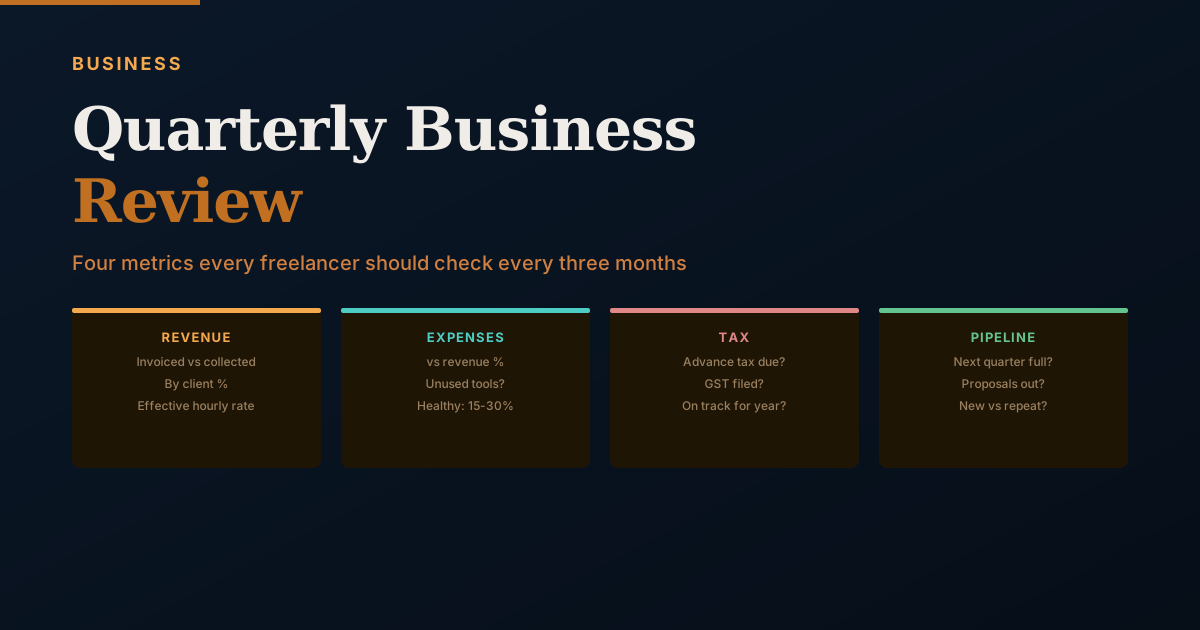
1. Revenue: What Actually Came In
Total invoiced vs total collected this quarter: Pull your bank statement and add all client payments received. Compare to total invoices you issued. The gap is your outstanding receivables — money earned but not yet collected.
Revenue concentration: What percentage came from each client? If one client represents more than 40% of your quarterly revenue, you have a concentration risk. That client leaving or pausing work creates an immediate income crisis.
Effective hourly rate: Total revenue for the quarter divided by total hours worked (including non-billable admin, business development, proposal time). This is your true rate. Track it quarter over quarter. If it's declining despite stable billing rates, you're spending increasing time on non-billable activities.
2. Expenses: What Went Out
Total business expenses this quarter: Software subscriptions, professional fees, equipment, travel, and any other business costs. Sum everything from your business bank account or expense log.
Expenses as a percentage of revenue: For most solo service businesses, healthy expense ratios are 15-30% of revenue. Above 40% signals either high overhead or under-billing. Below 10% may indicate under-investment in tools and professional development.
Subscriptions audit: Look at every recurring charge. Are you actively using everything? Which subscriptions renew quarterly or annually? Any that can be cancelled?
3. Tax Position: Are You Current?
Advance tax instalment — was it paid on time? Quarterly advance tax deadlines are June 15 (15%), September 15 (45%), December 15 (75%), and March 15 (100%). Missing any of these triggers 1% monthly interest on the shortfall. Check that the instalment was paid.
Year-to-date tax position: Based on actual income received so far this year, estimate your total annual tax liability. Compare to total TDS deducted (from Form 16A if applicable) plus advance tax paid. Are you on track or accumulating a deficit?
GST filed for all months? If GST registered, confirm GSTR-1 and GSTR-3B were filed for each month in the quarter. Missing even one month creates cascading late fees.
4. Pipeline and Business Health
Confirmed work for next quarter: List projects with signed contracts or firm commitments for the coming quarter. What is the confirmed revenue? Is it above, at, or below your minimum required?
Proposals in progress: How many proposals are currently outstanding? What is the potential revenue if they convert? Thin pipeline now = revenue problem in 6-8 weeks.
New vs repeat client revenue ratio: Healthy freelance businesses typically get 50-70% of revenue from repeat clients over time. A very high new-client dependency means significant business development effort is permanent. Very low new clients means the business is stagnant and vulnerable to attrition.
Acting on What You Find
The review is only valuable if it produces one or two specific next actions. After reviewing:
| Finding | Action |
|---|---|
| Revenue 25%+ below quarterly target | Increase outreach: 5 warm emails or proposals this week |
| One client = 50%+ of revenue | Prioritise landing one new mid-size client this quarter |
| Advance tax behind | Calculate deficit and pay immediately |
| Expenses growing faster than revenue | Audit and cancel 2-3 unused subscriptions this week |
| Pipeline thin for next quarter | Send 3 follow-up emails to past clients today |
The quarterly review should take 45-60 minutes. End it with a written list of 1-3 specific actions and a deadline for each.
5. GST and TDS Compliance Health Check
The quarterly review is the natural time to audit your compliance standing:
GST status:
- Were all GSTR-1 returns filed by the 11th of each following month?
- Were all GSTR-3B returns filed and tax paid by the 20th?
- Is your ITC (Input Tax Credit) position reconciled with GSTR-2B?
- Any late fees accumulating from missed returns?
If you use the QRMP scheme (Quarterly Return Monthly Payment — available for businesses with turnover up to Rs.5 crore), confirm your quarterly GSTR-1 was filed on time and monthly PMT-06 payments were made.
TDS position:
- For each client that deducted TDS: does it appear in Form 26AS?
- Log in to incometax.gov.in, check Form 26AS under Services. Part A2 shows TDS on income other than salary (Section 194J entries — renumbered Section 393 under the Income-tax Act, 2025, effective 1 April 2026, with the same rates).
- Any TDS deducted but not appearing in 26AS means the client hasn't deposited it. Follow up immediately.
Missing TDS in 26AS creates a problem at ITR filing: you'll either need to claim credit without the portal entry (risky, may create a mismatch) or forgo the credit and pay the tax yourself. The quarterly check catches this while it's still correctable.
6. Pricing and Rate Review
Once a year is too infrequent; the quarterly review is the right moment to ask whether your current rates are adequate:
Effective hourly rate trend: Total quarterly revenue divided by total hours worked. Is it going up, flat, or declining? If declining despite stable billing rates, you're spending more unbillable time proportionally — either in admin, in scope creep, or in longer project cycles.
Rate last increased: When did you last raise rates? Most professional service markets see 8-12% annual cost inflation. A freelancer who hasn't raised rates in 2-3 years is effectively working at a 15-25% real discount to their original rate.
Scope creep assessment: Review each project completed in the quarter. How much delivered work was outside the original scope? Was it billed? Unbilled scope creep is a silent revenue leak. Two "while you're at it" additions per project at Rs.5,000 each across 12 projects is Rs.1,20,000 in unbilled work per year.
Proposal win rate: How many proposals sent versus won? If win rate is above 80%, you may be underpriced (clients accept too readily). If below 30%, you may be overpriced for your current market position or the proposals need work.
7. Personal Finance Integration
The quarterly business review should connect directly to your personal financial health:
Owner's draw vs business profit: What percentage of business profit did you draw as personal income? At what frequency? Erratic draws — taking whatever is available — makes personal financial planning impossible. A quarterly review confirms whether your monthly draw is sustainable and appropriate.
SIP and investment continuation: Did personal investment contributions (SIPs, NPS, PPF) continue uninterrupted this quarter? A missed SIP due to cash flow issues is a signal worth flagging. The quarterly review should confirm that business cash flow disruptions didn't cascade into personal investment stoppages.
Tax position — old vs new regime: With actual quarterly income data, re-evaluate whether the old or new tax regime is better for the current year. The decision is made at the start of the year, but verifying the math quarterly with actual numbers (rather than estimates) ensures you haven't changed income or deduction patterns in a way that would alter the optimal choice.
Emergency fund status: Is both the business emergency fund (target: 2-3 months of operating costs) and personal emergency fund (3-6 months of expenses) at target? A strong quarter is the time to top up a depleted emergency fund, not to increase discretionary spending.
Structuring the 60-Minute Review Session
A structured agenda makes the review faster and more consistent:
Minutes 0-15: Financial snapshot
- Pull quarterly P&L from accounting software or CA
- Note total revenue, total expenses, net profit
- Compare to same quarter last year if available
Minutes 15-25: Tax and compliance check
- Verify GST filings complete for each month in the quarter
- Check Form 26AS for TDS entries from this quarter
- Calculate current advance tax position: is the cumulative instalment paid sufficient?
Minutes 25-35: Receivables and pipeline
- List all outstanding invoices (issued but unpaid)
- Confirm follow-up actions for overdue invoices
- Assess pipeline: confirmed work for next quarter, proposals outstanding
Minutes 35-45: Client and rate health
- Revenue concentration: any single client above 40%?
- Effective hourly rate vs prior quarter
- Any unbilled scope creep to address?
Minutes 45-55: Next quarter planning
- Revenue target for next quarter
- Key client relationships to maintain
- Business development actions needed (if pipeline is thin)
- Any major expenses coming up (subscriptions, equipment, professional development)?
Minutes 55-60: Write down the 3 specific actions No review produces value unless it ends with specific, dated commitments. Three is the right number — more is unactionable, fewer may miss something important.
The Tax Calendar Embedded in the Quarterly Review
Align your quarterly reviews with the Indian tax calendar:
Q1 Review (April-June) — conduct in early July:
- Advance tax Q1: 15% due June 15 — did it go out?
- GST for April, May, June filed?
- Previous year ITR: file by July 31 (this is ITR filing month)
Q2 Review (July-September) — conduct in early October:
- Advance tax Q2: cumulative 45% due September 15 — was it paid?
- GST for July, August, September filed?
- Form 16A from Q1 clients: have they issued it?
Q3 Review (October-December) — conduct in early January:
- Advance tax Q3: cumulative 75% due December 15 — paid?
- GST for October, November, December filed?
- Year-end planning: are there any tax-saving investments to make before March 31?
Q4 Review (January-March) — conduct in early April:
- Advance tax Q4: 100% due March 15 — final instalment made?
- GST for January, February, March filed?
- ITR preparation: collect all Form 16As, verify 26AS, reconcile annual income
Treating the quarterly review as an extension of tax compliance — not a separate activity — reduces the total time you spend on financial administration across the year.
What to Do When the Numbers Are Bad
Most quarterly review frameworks describe what to measure. Fewer address the harder question: what do you actually do when the numbers look bad? Here are the specific responses to the most common negative findings:
Revenue 30%+ below target for the quarter: Don't adjust the annual target downward yet — one bad quarter often reflects timing (projects delayed, invoicing bunched into next quarter) rather than a structural decline. First, check whether invoiced-but-unpaid receivables account for the gap. If Rs.3 lakh of your expected Rs.5 lakh quarterly revenue is sitting in unpaid invoices, the problem is collection, not generation. If receivables are clean and the shortfall is genuine, the response is immediate outreach — not passive waiting. Send 5 warm follow-up emails to past clients that day. A 30-minute reconnect conversation with an existing client often surfaces work faster than a new lead campaign.
Advance tax shortfall identified: If the quarterly review reveals that your cumulative advance tax paid is below the required percentage of estimated annual tax, pay the top-up immediately. Don't wait for the next official deadline. The 234C interest accrues from the deadline date, not from when you discover the shortfall — but catching it early means you can pay before additional shortfall accumulates.
Single client representing 50%+ of quarterly revenue: This is not a problem to solve this quarter — it is a risk to manage over the next two quarters. Do not disrupt the existing client relationship. Instead, set a specific goal: identify and convert one new client in the next 90 days whose billing would bring the concentration below 35%. Track this as an action item in every subsequent quarterly review until the concentration drops.
Effective hourly rate declining three quarters in a row: This is the most important signal in a quarterly review that most freelancers ignore. Declining effective rate while stated rates hold means hidden cost growth: scope creep, slower project cycles, increasing non-billable time. The response is a project audit — go through completed projects and identify where unbilled hours accumulated. Either increase your rates, add scope-change clauses to your contract template, or reduce non-billable overhead. One or all three.
Emergency fund below one month of operating costs: This is a cash-management priority above everything except paying taxes on time. Redirect the next large payment — whatever it is — to replenish the emergency fund before drawing personal income from it. A depleted emergency fund is not a background concern; it is an open vulnerability.
For advance tax, GST, and other filing-specific questions this review surfaces, confirm the exact figures with your CA before acting on them.
Frequently Asked Questions
Sources and references
- Goods and Services Tax — Official GST Portal, Government of India
- Income Tax Department, Government of India
- Association of Mutual Funds in India (AMFI)
- Income Tax Department — Income-tax Act, 2025 (FAQs on Interplay and Transition, and Act text)
Rules, rates, and thresholds in India change over time. Always confirm the current position with the official source above before acting on it.