Pricing Your Services as a Freelancer: How to Set Rates That Work
Underpricing is the most common freelancer mistake. Your rate must cover taxes, business costs, unpaid time, and savings, not just match a salary.
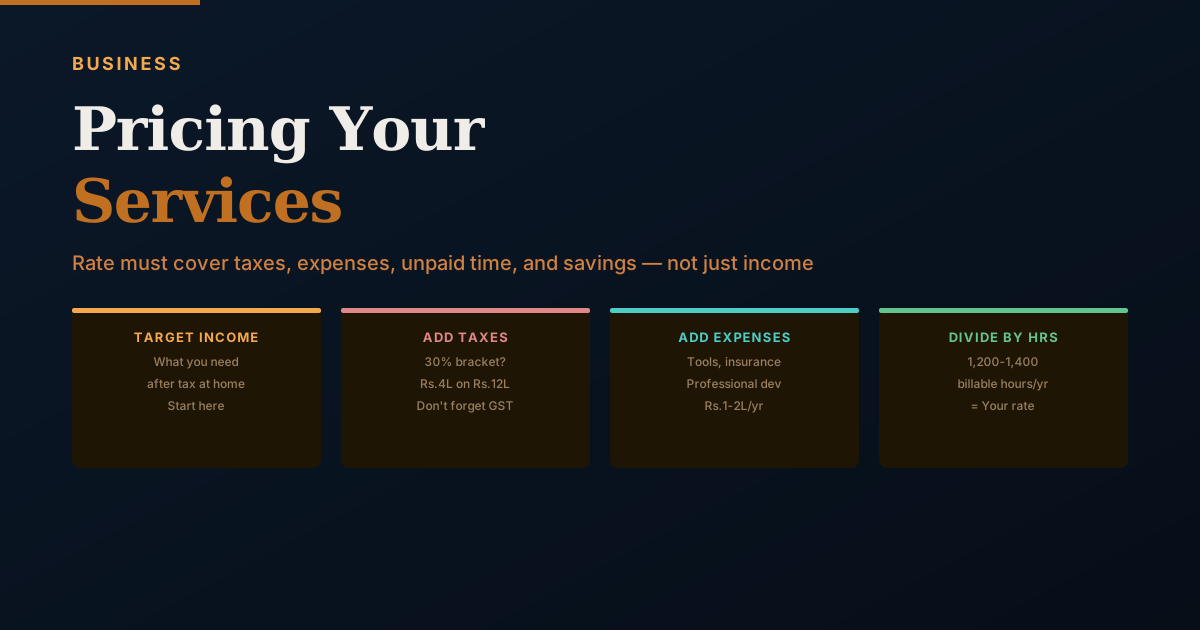
Most freelancers arrive at their rate by picking a number that feels reasonable, copying what a friend charges, or converting their last salary to an hourly figure. All three approaches lead to systematic underpricing — and a freelance income that doesn't actually support the lifestyle the person intended.
Why Freelancers Systematically Underprice
The core mistake is treating freelance income like salary income. A salaried employee who earns Rs.10 lakh per year receives Rs.10 lakh in actual value from employment (or close to it). A freelancer who invoices Rs.10 lakh does not take home Rs.10 lakh — they take home Rs.10 lakh minus taxes, minus business expenses, minus the cost of unpaid time, minus the absence of employer-funded benefits.
The gap between gross billing and actual take-home is typically 35-50% once all costs are accounted for. Freelancers who don't build this into their rate are effectively subsidising their clients.
The Freelance Pricing Formula
Work backward from your target take-home income:
Step 1: Determine target annual take-home. What do you need after all taxes and expenses? Be specific. Rs.10 lakh, Rs.15 lakh, Rs.20 lakh.
Step 2: Add income tax. For Rs.12 lakh target take-home, income tax at 30% bracket on the taxable amount adds approximately Rs.4-5 lakh to gross billing needed.
Step 3: Add business expenses. Software subscriptions, professional development, equipment maintenance, coworking or home office proportion, accountant fees, phone and internet: typically Rs.1.5-3 lakh per year for a solo service professional.
Step 4: Add variable income buffer. Freelance income has gaps: proposal periods with no billing, client payment delays, slow months, mandatory leave. A 20-25% buffer on top of target billing is realistic for most freelancers.
| Component | Annual Amount |
|---|---|
| Target take-home | Rs.12,00,000 |
| Income tax (approx.) | Rs.4,00,000 |
| Business expenses | Rs.1,50,000 |
| Variable income buffer (20%) | Rs.3,50,000 |
| Required annual gross billing | Rs.21,00,000 |
Step 5: Divide by billable hours. Not total hours worked — billable hours. A 50-hour work week includes business development, admin, accounting, and downtime. Realistically, 25-30 hours per week are billable on average.
46 working weeks × 28 billable hours/week = 1,288 billable hours/year
Required hourly rate: Rs.21,00,000 ÷ 1,288 = approximately Rs.1,630/hour
Round to Rs.1,500 or Rs.2,000 depending on your market positioning.
The Full-Time Equivalent Benchmark
Cross-check your rate with the employer cost of a full-time equivalent (FTE):
- Gross salary for equivalent FTE: Rs.15,00,000
- Employer costs (PF, gratuity, benefits, leave, office space): approximately 35% = Rs.5,25,000
- Total employer cost: Rs.20,25,000
- Freelance premium for variability, no benefits: add 30% = Rs.26,32,500
If you're billing significantly below Rs.26 lakh for the equivalent of a full-time role, you're providing your clients a discount at your own expense.
Why Hourly Pricing Punishes Expertise
Consider: a graphic designer charges Rs.1,000/hour. They take 20 hours to complete a logo project, earning Rs.20,000. After gaining 3 years of experience, they complete the same quality logo in 8 hours — but at the same Rs.1,000/hour, they now earn only Rs.8,000 for equivalent or better work. Hourly pricing structurally penalises expertise.
Project pricing breaks this. A logo project is Rs.25,000, regardless of hours. As you get faster and better, your effective hourly rate increases — which is the correct incentive structure.
Raising Your Rates
With existing clients: give 60-90 days notice and frame it as an annual adjustment. "My rates are increasing from April 1" — professional, direct, expected.
With new clients: your new rate applies immediately. There is no obligation to offer new clients the rate you gave previous clients.
When to raise: when demand exceeds your capacity (you're turning down work), when you've significantly upgraded your skills, annually as a standard practice.
The Tax and GST Layer in Your Pricing
One element most freelancers underestimate is the full tax cost sitting inside their billing. When you charge Rs.21 lakh in a year, here is what happens:
If you are GST-registered (mandatory above Rs.20 lakh turnover), GST at 18% is charged on professional services. That GST belongs to the government — it is not your income. A client who pays Rs.1,18,000 on a Rs.1,00,000 invoice is not paying you Rs.1,18,000. They are paying Rs.1,00,000 to you and Rs.18,000 on your behalf to the government. Your revenue is Rs.1,00,000.
If a client deducts TDS at 10% under Section 194J (mandatory for companies and firms paying professional fees above Rs.50,000 per year to the same professional, a threshold raised from Rs.30,000 with effect from 1 April 2025; renumbered Section 393 under the Income-tax Act, 2025, effective 1 April 2026, with the same 10% rate), they pay you Rs.90,000 and deposit Rs.10,000 to the government. You claim that Rs.10,000 as advance tax credit when you file your ITR. Your effective receipt is Rs.90,000, but you report Rs.1,00,000 as income and get credit for Rs.10,000 already paid.
This means your pricing must account for:
- GST on your invoices (not your revenue, but affects client budget and your compliance obligations)
- TDS deducted by clients (reduces cash received; recovered via ITR)
- Advance tax on net income (25-30% of taxable income, paid quarterly)
- Professional tax (up to Rs.2,500/year in states that levy it — small but real)
Pricing Across Business Structures
Your business structure directly affects your effective tax rate on income, which affects how you should price:
Sole proprietorship (most freelancers): Your business income is taxed at individual income tax slab rates. At Rs.20 lakh net income, your tax is roughly Rs.3-4 lakh depending on deductions and which regime you choose. Under Section 44ADA (presumptive taxation for specified professionals; consolidated into Section 58 under the Income-tax Act, 2025, effective 1 April 2026, with the same 50% rate), 50% of gross receipts is deemed profit — so at Rs.20 lakh gross receipts, your taxable income is Rs.10 lakh, substantially reducing tax. This is why many freelancers who opt for 44ADA can price slightly more aggressively — their effective tax burden on gross receipts is lower.
LLP: The LLP pays a flat 30% tax on its profits. Partners' share of profit is then exempt in their hands. If you're structured as an LLP with a partner, price your services to ensure the post-tax retained amount meets both partners' income needs plus the LLP's overheads.
Private Limited Company: Corporate tax at 25% (for companies with turnover under Rs.400 crore). Dividends distributed to you are taxed additionally in your hands. This double-layer means the effective cost of extracting money from a Pvt Ltd is higher — price accordingly if you operate through a company.
Segment Your Clients by Price Tolerance
Not all clients have the same price tolerance, and failing to segment your approach leaves money on the table:
Large corporates and MNCs: Highest price tolerance. They have procurement processes and budgets set by HR or finance, not negotiated project by project. They also impose the most process overhead — SOWs, purchase orders, NET 60 payment terms, TDS deduction, potential GST compliance requirements. Price your work to these clients 20-40% above your standard rate to account for the overhead.
Established Indian startups (Series A and above): Price-sensitive but process-savvy. They understand market rates, budget at project level, and typically pay within 30 days. Your standard calculated rate applies.
Small businesses and early startups: Often have tight budgets and highest negotiation pressure. These clients can be valuable for volume or experience, but do not discount below your calculated floor rate — the floor is the floor.
Individual professionals (doctors, lawyers, consultants): Highly price-sensitive on small projects but can be excellent repeat clients for ongoing work. Consider a retainer structure rather than project billing.
How to Present Your Rate Without Flinching
The way you state your rate matters. Three approaches and what they signal:
Direct: "My fee for this project is Rs.80,000 + applicable GST." Confident, professional, no hedging. This is the correct approach once you've done the pricing homework.
Anchored: Present a higher option alongside your standard rate. "I offer two versions: a full solution at Rs.1,20,000 or a scoped version at Rs.75,000." Clients often choose the middle option. The anchor makes your actual preferred rate look reasonable.
Avoided: "I was thinking maybe around Rs.60,000-70,000?" The range signals negotiability. The "maybe" signals doubt. Clients hear: "Start at Rs.55,000." Never present your rate as a question or a range if you want to be taken seriously.
Tracking Your Effective Rate Over Time
The most important pricing metric is not your stated rate — it is your actual effective rate: total revenue divided by total hours worked across the year. Track this quarterly.
If your stated rate is Rs.2,500/hour but your effective rate is Rs.900/hour, one of these is happening:
- Large amounts of unbillable admin and business development time
- Scope creep on fixed-price projects not being billed
- Client negotiations are eroding your rate in practice
- Projects are running significantly over estimated hours
The gap between stated and effective rate is your pricing efficiency problem to solve. Either increase your stated rate, reduce unbillable time, or both.
GST Registration as a Pricing Lever
Near the Rs.20 lakh turnover threshold, many freelancers hesitate to cross it because GST registration means adding 18% to invoices. This thinking is backwards for B2B work.
If your clients are GST-registered businesses, the 18% GST you charge them is reclaimed by them as Input Tax Credit — it costs them nothing net. What they actually pay is your base fee. Being GST-registered is not a price increase for them. It makes you a cleaner vendor for their accounts payable process.
Voluntarily register for GST before crossing Rs.20 lakh if your clients are primarily companies or GST-registered entities. The ITC you can claim on your business purchases (software, equipment, coworking space, professional services) adds up to a real benefit — GST paid on business inputs reduces your net GST liability. On Rs.3-4 lakh of annual business expenses at 18% GST, that's Rs.54,000-72,000 of ITC you can offset against your GST payable.
The Retainer Model: Pricing for Predictability
Project pricing and hourly pricing both result in variable monthly income. A retainer arrangement — a fixed monthly fee for a defined scope of ongoing work — provides the predictability that makes financial planning possible.
Retainers work when:
- The client has ongoing, predictable work requirements
- You can define a monthly scope clearly (e.g., "4 blog posts per month" or "monthly accounts reconciliation")
- The relationship is established enough that both parties trust the arrangement
Pricing a retainer: take your estimated project rate for the monthly scope, then apply a 10-15% retainer discount in exchange for the commitment. The discount compensates the client for the certainty they provide you. You gain predictable cash flow; they gain priority access and lower unit cost.
For a retainer, include a clause that unused hours or deliverables in one month do not roll over — the fee is for availability and capacity, not just deliverables.
Value-Based Pricing: Moving Beyond Cost-Plus
The formula in this article is a cost-plus approach — you calculate what you need to earn, add a buffer, and arrive at a floor rate. This is the right starting point. But it is not the ceiling.
Value-based pricing says: price what the outcome is worth to the client, not what it costs you to produce. The client who hires a financial consultant to restructure a business earning ₹2 crore/year is not paying for 20 hours of work — they're paying for a decision that might be worth ₹20-30 lakh in improved outcomes. A pricing conversation anchored on "what is this worth to your business" rather than "here's my hourly rate times estimated hours" positions you as a business partner, not a vendor.
When value-based pricing applies:
- High-stakes outcomes (increasing revenue, reducing costs, avoiding a legal problem)
- Expertise that's hard to find and replicate
- Projects where the client's upside is substantially larger than your fee
- Repeat engagements where the relationship is established
How to estimate value: Before quoting, ask the client what problem they're solving and what a good outcome looks like in financial terms. "If this website redesign improves your conversion rate by 1%, what does that mean in monthly revenue?" If the answer is ₹5 lakh/month, pricing the redesign at ₹3-5 lakh is not expensive — it is priced proportionally to value.
Most freelancers find value-based pricing uncomfortable because it requires the conversation about client outcomes. That discomfort is worth pushing through — it consistently produces higher fees and better client relationships.
The Pricing Ratchet: How to Raise Rates Without Losing Clients
Raising rates with existing clients is the part of freelance finance that most people handle worst — either avoiding it entirely (and eroding their real income over time) or doing it abruptly (and triggering a client exit).
The ratchet approach: Increase rates gradually at predictable intervals so clients expect it rather than being surprised.
- Year 1: standard rate
- Year 2: 8–12% increase, communicated 60 days before the new year or contract renewal
- Year 3: same 8–12% increase on the new base
A client who has worked with you for two years and is satisfied with your work will almost never leave over an 8-10% annual rate increase — it is within inflation. The client who leaves over 8% wasn't going to stay for the long term anyway.
The communication that works: "My rates are adjusting to ₹X from April 1, in line with my annual review. I've valued working with you and wanted to give you early notice." This is not a negotiation opener — it is information. Do not invite counter-offers. If the client pushes back, the response is: "I understand — I'm happy to hold the current rate through [specific date] while you decide if you'd like to continue."
Frequently Asked Questions
Sources and references
- Goods and Services Tax — Official GST Portal, Government of India
- Income Tax Department, Government of India
- Income Tax Department — Income-tax Act, 2025 (FAQs on Interplay and Transition, and Act text)
Rules, rates, and thresholds in India change over time. Always confirm the current position with the official source above before acting on it.