MSME Registration Benefits: Is Udyam Registration Worth It?
MSME (Udyam) registration is free, takes 10 minutes, and unlocks real benefits: priority loans, payment protections, government tenders, and patent subsidies.
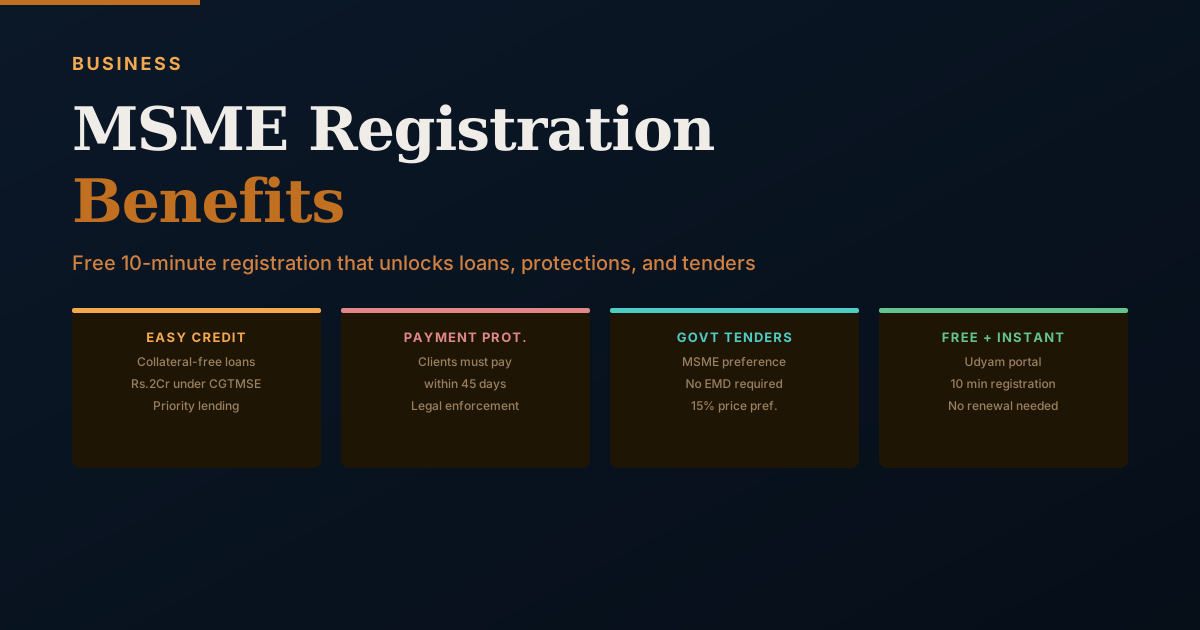
Udyam Registration (previously known as Udyog Aadhaar or MSME registration) is India's official small business registration. It is free, takes approximately 10 minutes to complete online, requires no professional assistance, has no ongoing compliance requirement, and unlocks several concrete benefits that are available exclusively to registered businesses. For freelancers and small business owners who qualify, there is no reason not to register.
Who Qualifies
Any business engaged in manufacturing or providing services with:
| Category | Investment in Equipment | Annual Turnover |
|---|---|---|
| Micro | Below Rs.1 crore | Below Rs.5 crore |
| Small | Below Rs.10 crore | Below Rs.50 crore |
| Medium | Below Rs.50 crore | Below Rs.250 crore |
Most freelancers and solo service professionals qualify as micro enterprises. Service businesses with no significant physical equipment investment are assessed primarily on turnover.
Benefit 1: Access to Collateral-Free Loans
The Credit Guarantee Fund Trust for Micro and Small Enterprises (CGTMSE) provides guarantee coverage for loans up to Rs.10 crore per borrower — doubled from Rs.5 crore for guarantees approved on or after 1 April 2025 — extended to micro and small enterprises without any collateral or third-party guarantee. This is significant: most banks require collateral for business loans to individuals or small businesses. CGTMSE coverage removes that barrier for registered MSMEs, though it is worth being clear that the guarantee protects the lender, not the borrower — the loan itself still has to be repaid in full.
Additionally, RBI guidelines require banks to maintain specific lending targets to the MSME sector. Udyam-registered businesses are classified as priority sector, meaning banks actively seek to lend to them. Interest rates under government MSME schemes (PMEGP, SIDBI, Mudra Shishu) are typically 1-4% below market rates.
Benefit 2: The 45-Day Payment Protection
This is the most powerful benefit for freelancers and consultants dealing with large corporate clients.
Under the Micro, Small and Medium Enterprises Development (MSMED) Act, 2006:
- Buyers (clients) must pay MSME suppliers within 45 days of delivery and acceptance of goods or services
- If payment is delayed beyond 45 days, compound interest accrues on the outstanding amount at three times the RBI bank rate — payable by the buyer to the seller
- This interest obligation is automatic, not dependent on a contract clause — it applies by law
For dispute resolution, MSME Facilitation Councils exist in every state to resolve payment disputes between MSME suppliers and their buyers. These are faster and less expensive than civil court proceedings.
The practical value: when you send a payment reminder to a large corporate client who is 60 days past your invoice date, mentioning your Udyam registration and the MSMED Act's compound interest provisions typically accelerates payment.
Benefit 3: Government Tenders and Public Procurement
MSMEs receive preferential treatment in government procurement:
Tender exemptions: Many government tenders waive the Earnest Money Deposit (EMD) requirement for MSME bidders, reducing the capital needed to participate in tendering.
Price preference: In some government procurement categories, MSME suppliers receive a price preference of up to 15% over non-MSME bidders. This means even if your quote is up to 15% higher than a large supplier's quote, the government buyer may still prefer your bid.
Set-aside tenders: Certain government contracts are reserved exclusively for MSMEs — large businesses cannot bid. This creates a protected market for qualifying small businesses.
Benefit 4: Fee Reductions and Subsidies
Patent and trademark registration: 50% reduction in official government fees for MSME applicants. Trademark registration for MSMEs: Rs.4,500 instead of Rs.9,000 per class.
Trade fair participation: The Ministry of MSME subsidises participation in domestic and international trade fairs for registered businesses. This can cover travel, exhibition space, and display costs.
Technology upgradation: Various state governments and the central government offer subsidised financing for technology adoption, quality certification (ISO, BIS), and digital transformation for MSMEs.
How to Register: 10 Minutes on Udyamregistration.gov.in
- Go to udyamregistration.gov.in
- Select "For New Entrepreneurs who are not Registered yet as MSME"
- Enter your Aadhaar number and verify via OTP
- Fill in: name, date of birth, PAN, mobile, email
- Enter business details: type of organisation, address, bank account, main business activity
- Select your NIC (National Industry Classification) code for your activity
- Self-declare your investment and turnover figures
- Submit — your Udyam Registration Certificate with a unique URN is issued immediately
No registration fee. No professional required. No documents to upload. The certificate is downloadable in PDF.
Benefit 5: State-Level Schemes and Electricity Tariff Concessions
Central government benefits get most attention, but state governments operate their own MSME support programmes. Many states — Maharashtra, Gujarat, Tamil Nadu, Rajasthan, Karnataka, and others — offer:
Capital subsidies on machinery: A percentage of the cost of new plant and equipment reimbursed as a subsidy after installation and commencement of production. Rates typically range from 10-25% of fixed capital investment, subject to state-specific caps.
Electricity tariff concessions: Many states offer concessional electricity rates for registered MSME units. For a manufacturing unit consuming meaningful quantities of power, this is a direct recurring cost saving.
Land allotment at preferential rates: MIDC (Maharashtra), GIDC (Gujarat), SIPCOT (Tamil Nadu), and similar state industrial development corporations reserve plots in industrial estates for MSMEs at rates below open market. Priority allotment to registered enterprises.
Quality certification subsidies: Reimbursement of ISO certification costs, BIS mark acquisition, and other quality standard certifications — typically 50-75% of certification fees, subject to limits.
Check your state's MSME department website or the MSME Helpline (1800-180-6763) for current state-specific schemes.
Benefit 6: Export Promotion and Market Development
For businesses with export aspirations or existing exports, the MSME Ministry operates specific programmes:
ZED (Zero Defect Zero Effect) Certification: A government initiative to help MSMEs achieve quality standards aligned with international requirements. Registered MSMEs receive financial support for ZED certification — which improves product quality and supports export market access.
International Cooperation Scheme: Financial assistance for registered MSMEs to participate in international trade fairs, buyer-seller meets, and exhibitions. NSIC (National Small Industries Corporation) organises international technology exchange programs that MSME-registered businesses can access.
MSME Market Development Assistance: For those exporting, the Ministry reimburses costs related to sample development, testing, and market development for export promotion.
MSME and GST: Complementary Registrations
MSME registration and GST registration serve entirely different purposes and should both be obtained when applicable:
| Registration | Purpose | Authority | Mandatory? |
|---|---|---|---|
| Udyam/MSME | Business classification for schemes and protections | Ministry of MSME | Voluntary (strongly advised) |
| GST | Tax compliance and returns | Central/State Tax Authority | Mandatory above ₹20L turnover |
Having Udyam registration does not reduce your GST obligations, nor does GST registration substitute for Udyam. However, when applying for a bank loan under CGTMSE, you typically need both — GST returns as income proof and Udyam certificate for MSME classification.
For new businesses just below the GST threshold, get Udyam registration first (it's immediate) and plan for GST registration as turnover approaches Rs.20 lakh.
Delayed-Payment Recovery: ODR Portal and MSEFC
One of the most underused features of Udyam registration is access to the delayed-payment complaint system for buyers who don't pay on time. New complaints are filed on the MSME ODR portal (odr.msme.gov.in) today — the older Samadhaan portal (samadhaan.msme.gov.in) mainly continues to service cases filed before the transition.
How it works, broadly:
- If a buyer (company, government department, or individual) has not paid within the statutory 45-day (or 15-day default) deadline, you file a reference on the ODR portal
- It is forwarded to the relevant Micro and Small Enterprise Facilitation Council (MSEFC) for your state
- The MSEFC notifies the buyer and attempts conciliation
- If conciliation fails, arbitration proceedings begin
- The arbitration award is enforceable like a court decree
The compound interest provision is powerful: if payment was delayed beyond the deadline, the buyer owes you compound interest, monthly rests, at three times the RBI bank rate on the outstanding amount for the period of delay. This is statutory — it applies automatically regardless of whether your invoice mentioned it. For the full 45-day rule, worked interest examples, and an interactive calculator, see our MSME delayed-payment guide.
Large companies know this law. When you mention your Udyam registration number and the MSMED Act in a payment follow-up, it typically produces a faster response than a generic late payment reminder.
TReDS: Invoice Discounting for Faster Payment
Udyam-registered MSMEs supplying to large corporates and government departments can access TReDS (Trade Receivables Discounting System) — an RBI-approved platform that enables early payment on outstanding invoices.
How it works: you upload an invoice for a large buyer (the platform maintains a list of approved buyers), and financiers on the platform bid to purchase the receivable at a discount rate. You receive 90-95% of the invoice value within 1-2 business days. The buyer pays the financier on the original due date.
The effective cost is the discount rate — typically 7-12% annualised depending on buyer creditworthiness. For an invoice that would otherwise wait 60-90 days, this converts a large receivable into immediate working capital.
This is exactly the kind of instrument I would have wanted years ago in a trading business where a good, honest buyer still meant waiting weeks to actually get paid. Trading a receivable for immediate cash, even at a discount, is not a compromise — it is a legitimate way to keep the business moving instead of sitting idle waiting on someone else's payment cycle.
TReDS platforms operational in India: M1xchange, RXIL, Invoicemart. Companies with turnover above Rs.250 crore (reduced from the earlier Rs.500 crore threshold, per a November 2024 government notification) are required to onboard TReDS, which means the large buyer base is well-populated.
Udyam and the PSB 59-Minute Loan Portal
Udyam registration is one of the required inputs for the government's PSB Loans in 59 Minutes portal (psbloansin59minutes.com) — a platform for fast MSME loan processing from public sector banks.
The portal pulls data from GST returns, ITR, and bank statements to generate an in-principle loan approval within 59 minutes for amounts up to Rs.5 crore. Udyam certificate is part of the required document set.
For established businesses with 2-3 years of clean financials, this is significantly faster than the traditional bank loan application process. After in-principle approval, documentation and disbursement at the bank typically takes 1-4 weeks.
Record What Your Udyam Certificate Unlocks
After getting your Udyam Registration Certificate (which arrives immediately in PDF), maintain a list of the benefits you've actually claimed or are eligible for. This helps at renewal, during bank applications, and when consulting your CA:
- CGTMSE collateral-free loan: document the amount covered
- Patent/trademark fee reduction: 50% of official fees
- State subsidies claimed: retain all subsidy letters and acknowledgments
- TReDS transactions: keep records for banking and tax purposes
- ODR/MSEFC references filed: case number and status
The Udyam portal allows you to update business details if your turnover or investment changes significantly. Keep the registration current — a business that has crossed the small enterprise threshold but still presents as micro will face scrutiny if it applies for medium-enterprise-level benefits.
Using Your Udyam Number With Clients and Banks
The Udyam Registration Number (URN) is not just a certificate to file away. It is an active identifier you should include in multiple business documents:
On client invoices: Adding your URN to invoices from MSME-registered businesses signals to your client that the MSMED Act's 45-day payment clock applies. This is particularly useful for B2B invoices to large companies that have procurement teams managing payment cycles. Including "Udyam Registration No: UDYAM-XX-00-0000000 — Payment due within 45 days as per MSMED Act, 2006" creates a documented reference for any future ODR/MSEFC filing.
In bank loan applications: Your Udyam certificate is a required document on the PSB Loans in 59 Minutes portal and for CGTMSE-covered loans. Keep the PDF accessible alongside your PAN, GST certificate, and latest ITR.
For government tender bids: When submitting bids on GeM (Government e-Marketplace) or tendering portals, your URN is required for MSME-specific preferences (EMD exemption, price preference). Register on GeM at gem.gov.in — MSME registration integrates directly.
In professional communications: When onboarding to large corporate vendor panels, the vendor form often asks for MSME status. Providing your URN enables the buyer to comply with their own MSME payment obligations under the Companies Act (large companies are required to disclose their MSME payables in annual reports).
How to Keep Your Udyam Registration Current
Udyam registration is permanent and requires no annual renewal, but you must update it when your business circumstances change materially:
Update required when:
- Annual turnover crosses the threshold from micro to small (₹5 crore to ₹50 crore), or small to medium (₹50 crore to ₹250 crore)
- You add or change a business activity
- Business address or contact details change
- Bank account changes
How to update: Log in at udyamregistration.gov.in, authenticate with your Aadhaar OTP, and edit the relevant fields. The portal allows updates without starting a fresh registration.
Why it matters to stay current: If your turnover has grown to ₹30 crore but your Udyam certificate shows micro-enterprise status, applying for benefits meant for micro enterprises creates a mis-declaration risk. Banks and government agencies are increasingly cross-referencing Udyam data with GST turnover figures.
Checking your Udyam certificate details takes 2 minutes. Do it alongside your annual ITR preparation — at that point you have the actual turnover figures ready and can update the classification if needed.
Scheme eligibility and benefit amounts change with policy updates, so confirm specifics with your CA or the relevant scheme portal before relying on a figure quoted here.
Frequently Asked Questions
Sources and references
- GST Council — Notification 10/2019-Central Tax
- RBI — Priority Sector Lending FAQ
- Udyam Registration — Classification Criteria
- CGTMSE — Circular No. 250/2024-25: Increase in ceiling of guarantee coverage from Rs.5 crore to Rs.10 crore
Rules, rates, and thresholds in India change over time. Always confirm the current position with the official source above before acting on it.