Index Funds vs Active Mutual Funds: The Case for Passive Investing in India
Most active funds underperform their benchmark over the long run. Here's the evidence, the exceptions, and how to decide for yourself.
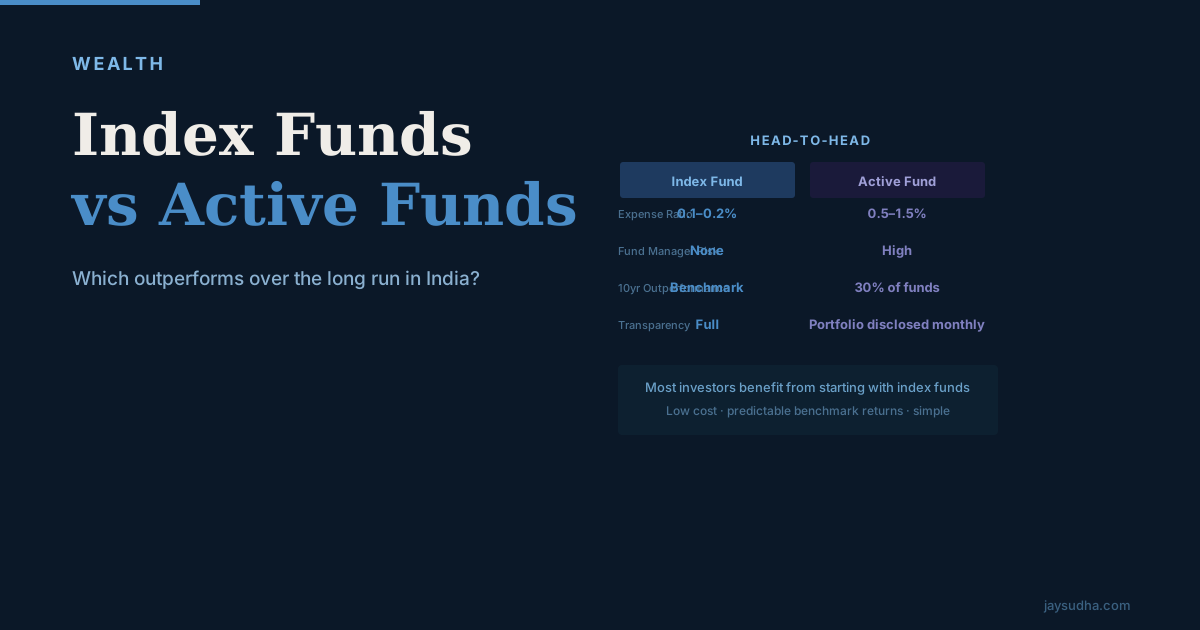
An index fund is a mutual fund that does not try to pick stocks. Instead, it holds all (or a representative sample of) the stocks in a specific index, in the same proportion that index dictates. A Nifty 50 index fund holds all 50 companies in the Nifty 50, weighted as the index weights them.
Active mutual funds do the opposite. A fund manager and their team research companies, form views on valuations and growth prospects, and construct a portfolio they believe will outperform the benchmark. They charge more for this effort — typically 0.5% to 2% per year in expense ratios.
The central question: does the active manager's skill justify that additional cost?
The Evidence from India: SPIVA Data
SPIVA (S&P Indices Versus Active) produces a regular report comparing active fund performance against benchmarks in India. The findings, consistently, are not flattering to active management.
According to SPIVA India reports (published periodically, latest available on the SPIVA website):
- Over 5-year periods, roughly 60-70% of large-cap active funds have underperformed their benchmark
- Over 10-year periods, the underperformance rate rises further — often 70-80% of active funds fall short of their index
This is not unique to India. It's a global phenomenon. The arithmetic is straightforward: the market return is what it is, active managers collectively own the market, so before costs, their average return equals the index. After costs (expense ratios, transaction costs, tax drag from higher turnover), the average active manager must underperform.
Some active managers beat the index over some periods. The problem is consistency — evidence that any particular fund manager will outperform in future periods is weak, even if they outperformed in the past.
Important caveat: The SPIVA data covers a specific time period. In any given short-term window, active funds may dominate. This is not a reason to dismiss the evidence — it's exactly what you'd expect from random variation.
The Expense Ratio Impact: A Number That Compounds Silently
Here is where index funds have an unambiguous, quantifiable advantage over active funds.
A typical direct-plan Nifty 50 index fund in India has a total expense ratio (TER) of about 0.1% to 0.2% per year. A typical actively managed large-cap fund might have a TER of 0.7% to 1.5% in direct plan, and 1.5% to 2.5% in regular plan.
Let's look at what 1.3% annual cost difference does over 20 years:
Illustrative example — ₹10 lakh invested, 12% gross return (before fees):
| Fund Type | Annual TER | Effective Annual Return | Value After 20 Years |
|---|---|---|---|
| Index Fund (direct) | 0.15% | 11.85% | ₹93.9 lakh |
| Active Fund (direct) | 1.50% | 10.50% | ₹73.7 lakh |
| Active Fund (regular) | 2.00% | 10.00% | ₹67.3 lakh |
The gap between the index fund and a regular plan active fund is about ₹26.6 lakh on a ₹10 lakh investment over 20 years — entirely from fees, assuming identical gross returns.
The active fund would need to consistently outperform the index by 1.5-2% annually just to break even with the index fund after fees. That's a high bar. Very few active funds clear it over 20-year periods.
When Active Funds Might Still Make Sense
The efficient market hypothesis is a spectrum, not a binary. Larger markets with more institutional participants and extensive analyst coverage tend to be more efficient — which is why passive investing dominates in US large-caps. Smaller, less-covered segments may have more opportunities for skilled active managers.
Mid-cap and small-cap India: There is a reasonable argument that mid-cap and small-cap Indian companies are less efficiently priced than Nifty 50 constituents. Analyst coverage is thinner, information asymmetry is higher, and liquidity constraints mean large institutional investors are sometimes structurally limited. In this space, a skilled active manager may have a more legitimate edge.
Evidence from India's mid-cap segment: A larger proportion of active mid-cap funds have historically outperformed mid-cap indices compared to large-cap funds. This is not a guarantee, and it still requires identifying funds (and managers) who will outperform prospectively — but the theoretical case is stronger.
Tactical consideration: For someone starting out, a Nifty 50 index fund is a defensible core. For mid and small-cap allocation, you might reasonably consider a well-regarded active fund — but the bar for selecting it should be high: long track record (10+ years including a full market cycle), consistent risk-adjusted returns, stable fund manager tenure, and low turnover.
Survivorship Bias: The Problem With Fund History
When you look at a 10-year track record of mutual funds, you're only seeing the funds that survived 10 years. Funds that did poorly were merged, closed, or renamed. This means the published historical returns for active funds are systematically biased upward — the worst performers aren't in the sample.
This is survivorship bias. It artificially inflates the apparent average performance of active funds over time. When SPIVA accounts for this (they include dead funds), the underperformance rate of active managers increases.
Practically: when an AMC markets a fund's 10-year SIP return to you, they are showing you a survivor. You didn't know, 10 years ago, which funds would survive. You would have been choosing from the full universe.
How to Pick an Index Fund
If you decide to go passive, here's what to look at — in rough order of importance:
1. Tracking Error
Tracking error measures how closely the fund's returns match the index. A lower tracking error means the fund is more faithfully replicating the index. Look for annualised tracking error below 0.3% for a Nifty 50 index fund. Higher tracking error suggests the fund is either not holding all components correctly or has cash drag.
2. Total Expense Ratio (TER)
For Nifty 50 index funds, the range is roughly 0.05% to 0.20% in direct plans. Prefer the lower end. Over 20 years, 0.1% makes a difference.
3. AUM (Assets Under Management)
Larger AUM generally means more liquidity for the fund in managing inflows and outflows smoothly, which reduces tracking error. Very small index funds (below ₹500-1000 crore) sometimes have slightly higher tracking errors due to operational constraints.
4. AMC Reputation and Operational Track Record
Stick with AMCs that have been managing index products for a meaningful period and have a stable fund operations history. This isn't a guarantee, but it reduces operational risk.
One thing that matters less than you think: Star ratings on mutual fund comparison sites. Most rating methodologies are backward-looking and change frequently. For index funds, ratings are particularly irrelevant — a Nifty 50 index fund from AMC A and AMC B should deliver nearly identical returns. Just check TER and tracking error.
Nifty 50 vs Nifty Next 50 vs Nifty 500
These are the three most common index choices in India. Understanding what's in them matters:
| Index | What It Covers | Risk Level | Notes |
|---|---|---|---|
| Nifty 50 | Top 50 companies by market cap | Lower | Most liquid, most stable |
| Nifty Next 50 | Ranks 51-100 by market cap | Moderate-higher | Acts more like a large-mid blend; higher volatility |
| Nifty 500 | Top 500 companies | Moderate | Broader coverage; includes mid and small cap exposure |
| Nifty Midcap 150 | Mid-cap companies | Higher | More volatile; longer investment horizon needed |
The Nifty Next 50 is interesting because it has historically shown periods of meaningful outperformance over Nifty 50 (and periods of underperformance). It's not a mid-cap index — these are large companies, just outside the top 50. Over long horizons, some investors combine Nifty 50 (70%) + Nifty Next 50 (30%) to get broader large-cap coverage.
There is no single "correct" choice. The differences in long-term returns between these indices tend to be smaller than the variation introduced by choosing between well-run index funds and underperforming active funds.
A Framework for Deciding
Here is a simple decision structure:
Use index funds if:
- You want the simplest, lowest-maintenance equity strategy
- You're investing in large-cap equities
- You don't have time or interest in evaluating fund managers
- You want to minimise costs with certainty
Consider active funds if:
- You're allocating to mid-cap or small-cap where manager skill has more scope
- You have conviction (backed by research, not marketing) in a specific fund manager's long-term process
- You're willing to monitor the fund's manager stability and process adherence over time
Avoid active funds if:
- You're choosing them primarily based on recent 1-3 year performance
- You're in regular plans without a specific advisor adding clear value
- The expense ratio is above 1.5% and the fund has no strong differentiated process
The index vs active debate often gets framed as religion. It shouldn't be. It's a cost-benefit question, and for most retail investors in India investing in large-cap equities over long horizons, the cost-benefit calculus favours passive investing with current available index funds.
What tracking error actually means in practice
Tracking error is the annualised standard deviation of the difference between the fund's daily return and the index's daily return. A simpler way to understand it: tracking error measures how reliably the fund mirrors the index every single day, not just at the end of the year.
A tracking error of 0.05% means on most days, the fund's return and the index return are nearly identical. A tracking error of 0.5% means there is more daily variation — which can add up to meaningful underperformance or overperformance over a year.
For Nifty 50 index funds in India, tracking error above 0.2–0.3% annually suggests the fund is not efficiently replicating the index. Causes include:
- Cash drag (holding cash for redemptions rather than being fully invested)
- Delayed rebalancing when the index adds or removes a constituent
- Securities lending income (partially offsets tracking error in some funds)
- Differences in dividend reinvestment timing
Worked example: Fund A tracks Nifty 50 with 0.05% tracking error. In a year where Nifty 50 returns 14%, Fund A returns approximately 13.8% (14% minus 0.15% TER = 13.85%).
Fund B has 0.4% tracking error and 0.15% TER. In the same year, Fund B might return 13.45% (14% minus 0.15% TER minus 0.4% tracking error).
Over 15 years, that 0.4% annual gap between Fund A and Fund B compounds into approximately ₹3.6 lakh on a ₹10 lakh investment — purely from tracking difference, not fees.
Check tracking error on AMC fact sheets or mutual fund data platforms before choosing an index fund. For Nifty 50, aim for tracking error below 0.15% in well-established large-AUM funds.
Why fund manager tenure matters for active fund evaluation
When evaluating an active fund, the advertised track record only has meaning if the same fund manager who built that record is still in charge.
Indian fund houses have seen significant fund manager movement over the last decade. A fund with a 10-year track record may have had 2–3 different managers in that period. The historical return is not the current manager's return.
What to check:
- On AMFI or AMC websites, the fund manager's name and tenure are disclosed
- If the fund manager has been in place for less than 3 years, the earlier track record has limited predictive value for their management
- Some funds are known as "house view" funds — where the entire team makes decisions collectively. These are less susceptible to single manager risk
The index fund answer to this problem: An index fund has no fund manager to evaluate. The process is the index. Tracking error and TER are the only variables that matter, and both are transparent. This is one of the underappreciated advantages of passive investing: zero key-person risk.
Practical portfolio construction: a starting point
For most Indian retail investors building a core equity portfolio, a simple structure works:
Core (70–80% of equity allocation): Nifty 50 index fund or Nifty 100 index fund in direct plan. Low TER, negligible tracking error, fully passive.
Satellite (20–30% of equity allocation): One mid-cap allocation — either a Nifty Midcap 150 index fund (fully passive) or a well-established active mid-cap fund with stable fund manager tenure and consistent risk-adjusted returns over 7–10 years.
This core-satellite structure gives you the cost certainty of passive investing for the majority of your equity allocation while allowing a limited active bet where the case for manager skill has more support.
More complexity than this — multiple thematic funds, international funds, small-cap allocations — is for investors who have already established a core. Beginners building their first portfolio are better served by simplicity.
Fund names, TERs and category rankings shift over time, so confirm the current numbers on AMFI or the AMC's own factsheet before you invest — what's cited here is a snapshot, not a live feed.
Related calculatorinvestment calculator
Frequently Asked Questions
Sources and references
Rules, rates, and thresholds in India change over time. Always confirm the current position with the official source above before acting on it.