Guarantor Risks in India: What You're Actually Agreeing To
Signing as a loan guarantor means you're fully liable if the borrower defaults. Before signing, understand exactly what you're taking on.
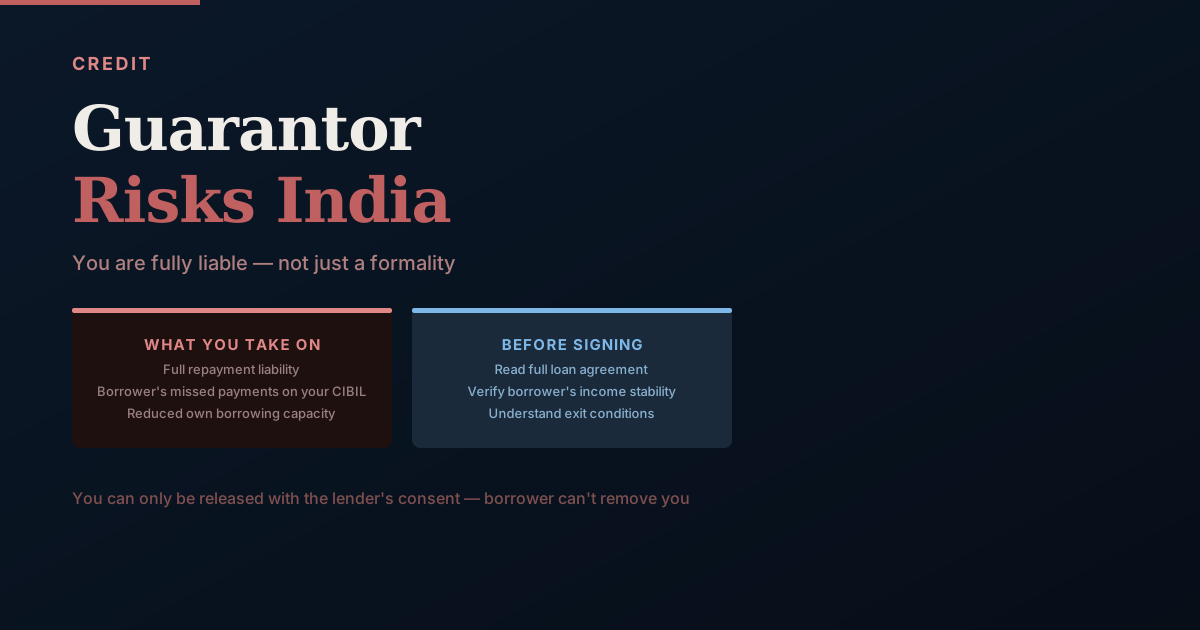
When someone asks you to be their loan guarantor, the ask sounds small — just sign here. The reality is that you are co-signing a legal obligation to repay the entire loan if the primary borrower cannot or does not.
What a Loan Guarantee Actually Means
When you sign as a guarantor, you are making a legally binding promise to the lender that if the primary borrower defaults, you will repay the outstanding loan amount.
There is no partial liability. The lender can pursue you for the full outstanding balance — principal plus interest plus any penalties that have accrued.
In India, lenders can approach the guarantor simultaneously with, or even before, taking action against the primary borrower. Some guarantee agreements are "on demand" — meaning the lender can demand payment from you the moment the borrower misses a payment, without waiting for recovery proceedings against the borrower.
What Appears on Your Credit Report
The guaranteed loan appears on your CIBIL and other bureau reports as a contingent liability. Two direct consequences:
-
Missed payments by the borrower affect your score. If the borrower pays late or misses payments, those DPDs (Days Past Due) show on your report too.
-
Your borrowing capacity is reduced. When you apply for your own home loan or personal loan, lenders calculate your total debt obligation. The guaranteed loan is typically counted at 50–100% of its outstanding value against your debt-to-income ratio.
This means your ability to get your own credit is materially impacted by a loan you didn't take.
Situations Where Guarantors Are Common
In India, guarantors are typically required:
- Home loans: When the primary borrower's income isn't sufficient alone, or they lack credit history
- Education loans: Often parents or relatives as guarantors for student borrowers
- Business loans: Directors guarantee company loans personally
- MSME loans: Business owners guarantee loans for their businesses
- Personal loans: For borrowers with thin or damaged credit files
What to Do Before Signing
If you're being asked to be a guarantor, do the following before agreeing:
- Read the entire loan agreement — understand the loan amount, tenure, rate, and your specific obligations as guarantor
- Check the borrower's financial health — income, existing debt, job stability
- Ask how the loan will be repaid — understand their actual repayment plan, not just their intention
- Get a copy of the loan sanction letter and agreement — you're entitled to one
- Understand the exit conditions — what would it take for your name to be removed
- Consider your own future credit needs — will you need a loan or credit in the next few years that this might affect
When to Say No
You should decline to be a guarantor if:
- You don't fully trust the borrower's ability or intention to repay
- The loan amount would be a significant financial burden for you to repay
- You have your own loans coming up (home, car, education) that this could affect
- The borrower has a history of financial mismanagement
- You don't understand what you're signing
Saying no to a family member or close friend is uncomfortable. Repaying their loan out of your pocket — or having a default appear on your credit report for years — is worse.
If the Borrower Defaults
Practical steps if you're already a guarantor and the borrower has defaulted:
- Engage the lender immediately — don't wait for formal notice
- Understand the outstanding amount — get a statement of account
- Try to negotiate a one-time settlement with the lender (possible in some cases)
- Seek legal advice if the lender begins recovery proceedings
- Consider subrogation rights — as a guarantor who repaid, you have legal rights to recover the amount from the borrower
How Guarantee Works Under Indian Law
Under the Indian Contract Act, 1872, a contract of guarantee is defined as a contract to perform the promise or discharge the liability of a third person in case of their default. The person who gives the guarantee is called the surety (or guarantor), the person for whom the guarantee is given is the principal debtor (borrower), and the person to whom the guarantee is given is the creditor (lender).
Key legal provisions that affect guarantors in India:
Section 128 — Co-extensive liability: A surety's liability is co-extensive with that of the principal debtor unless it is otherwise provided by the contract. This means the lender can proceed against the guarantor for the full amount simultaneously with proceedings against the borrower — there is no legal obligation to exhaust remedies against the borrower first.
Section 133 — Discharge by variation in terms: If the lender and borrower agree to vary the terms of the original contract (interest rate, repayment schedule, loan amount) without the guarantor's consent, the guarantor may be discharged from liability for the varied portion. This is a protection worth knowing — if the bank restructures the original loan without your knowledge as guarantor, you should get legal advice on whether your liability is affected.
Section 140 — Right of subrogation: After the guarantor pays off the lender, the guarantor acquires the right to recover the paid amount from the primary borrower. Legally, you step into the lender's shoes. In practice, recovering money from someone who has already defaulted can be extremely difficult.
Section 144 — Guarantee obtained by concealment: A guarantee is void if the lender concealed material facts about the principal debtor's financial position that the guarantor would have considered important. In practice, proving this is difficult — get full disclosure of the borrower's financial situation before signing, rather than relying on this legal protection after the fact.
The Impact on Your Home Loan and Other Credit Applications
This is where many guarantors discover the real cost of their commitment — not when the borrower defaults, but when the guarantor themselves tries to borrow.
Scenario: Rahul signs as guarantor for his brother's ₹25 lakh home loan in 2021. In 2023, Rahul applies for his own home loan of ₹40 lakh.
The bank assessing Rahul's application sees on his CIBIL report:
- Rahul's own income: ₹1 lakh/month
- Rahul's guaranteed loan outstanding: ₹22 lakh (reported as contingent liability)
Depending on the lender's underwriting policy, they may count some or all of the guaranteed loan's monthly obligation (EMI ≈ ₹18,000) in Rahul's FOIR (Fixed Obligation to Income Ratio) calculation. If counted at 50%, Rahul has ₹9,000 of additional fixed obligation beyond his own EMIs.
This reduces the home loan amount the bank is willing to sanction — sometimes by ₹5–10 lakh or more on a ₹40 lakh application, depending on Rahul's existing EMI burden.
Additionally, if the brother has any missed payments on the guaranteed loan, those DPDs (Days Past Due) appear on Rahul's CIBIL report too, potentially lowering his score.
Types of Guarantees in Indian Lending
Understanding the type of guarantee you are signing is important — liability structures differ.
Personal guarantee (continuing guarantee): The most common form. You guarantee ongoing repayment for the entire duration of the loan. Your liability continues until the loan is fully repaid, not just for a specific period.
Specific guarantee: A guarantee for a particular transaction only. Less common in standard bank lending — more relevant in trade finance.
Limited guarantee: Caps your liability at a specified amount (e.g., guaranteeing only up to ₹10 lakh of a ₹20 lakh loan). Some lenders agree to this, though most prefer unlimited guarantees.
Collateral guarantee: Backed by your own assets — you pledge a property or FD as security for someone else's loan. The risk is concrete asset loss, not just credit score damage.
When signing any guarantee, read the exact guarantee clause in the agreement. If the document says "continuing guarantee for the entire outstanding," that is full unlimited liability. If it has a cap or a defined end date, those terms matter significantly.
Real-World Situations Where Guarantors Face Losses
Education loan guarantors: Parents routinely guarantee student loans of ₹10–25 lakh for higher education. If the student is unable to get employment in a field relevant to their education, or delays repayment, or settles abroad without clearing the loan, the parents face demands from the bank. Banks send notices to guarantors typically within 60–90 days of the first missed EMI.
Business loan guarantors: Directors of small companies often personally guarantee company loans. When a business fails, the banks pursue the personal assets of the directors through the guarantee. This is how many successful businesspersons end up with personal credit damaged by a business that failed.
Friend/family home loan guarantors: The most common emotional guarantee in India. A sibling or close friend cannot get a loan without a guarantor. The guarantor signs. Years later, the borrower divorces, loses their job, or simply becomes unable to pay. The guarantor, now trying to buy their own home, discovers the problem.
Questions to Ask Before Signing
Beyond the general checklist, ask these specific questions directly to the lender in writing before signing:
- What is the total outstanding loan amount I am guaranteeing?
- Is this a continuing guarantee for the full loan tenure, or limited?
- What are the exact conditions under which the lender can approach me for repayment?
- What notification will I receive if the borrower misses a payment?
- What is the process for me to be released from the guarantee (and under what conditions)?
- How will this guarantee be reported on my CIBIL report — and for how long?
If the lender refuses to answer these questions in writing or is vague, that itself is a signal about the risk you are taking on.
Getting Out of an Existing Guarantor Obligation
If you are already a guarantor and want to be released, the options are:
Loan repayment: The cleanest exit. When the loan is fully repaid and the lender issues a closure certificate, your guarantee automatically terminates. You should then verify that your CIBIL report shows the guaranteed loan as closed.
Substitute guarantor: If you find someone else willing and eligible to be the guarantor, and the lender agrees to the substitution, you can be released. The lender is not obligated to accept the substitution unless the replacement is financially equivalent or stronger.
Loan takeover / refinance: If the borrower refinances the loan with another lender — either as a better rate deal or as a personal loan that doesn't require a guarantor — the original loan closes and your guarantee on it terminates.
Partial prepayment to reduce exposure: If the outstanding drops significantly (say, below a threshold the lender considers low-risk), some lenders will agree to release the guarantee. This requires negotiation and lender goodwill.
Legal route: If you were induced to sign the guarantee through misrepresentation, or if the borrower has concealed material facts from you, a legal challenge to the guarantee contract is possible. This is expensive and time-consuming, and succeeds only in specific factual scenarios.
The most important lesson: prevention is vastly easier than exit. If you have doubts about whether to sign, those doubts are the answer.
Monitoring a Loan You've Guaranteed
If you are already a guarantor on an active loan, proactive monitoring protects you from being blindsided by a borrower's default. You are entitled to information about the loan you've guaranteed — the bank cannot refuse this to you as guarantor.
Steps to stay informed:
- Keep a copy of the loan agreement and sanction letter — these are your documents as guarantor, not just the borrower's.
- Check your own CIBIL report every quarter — the guaranteed loan will appear there, and any DPDs (late payments) will be visible on your report before the bank formally contacts you.
- Maintain communication with the borrower — if you know the borrower is facing financial difficulty, proactively engaging with them and the lender early creates more resolution options than waiting for default.
- Monitor the DPD code on the account — STD (standard/current) means payments are on time. SMA (Special Mention Account) means a slight delay and is an early warning. Once you see SMA in your report, take action.
The one practical advantage of being a guarantor rather than a co-borrower is that you are not primarily liable for the monthly payment — but this is also why guarantors often learn of problems too late. The quarterly credit report check is the guarantor's most important tool.
Frequently Asked Questions
Sources and references
- TransUnion CIBIL — Credit Scores & Reports
- Reserve Bank of India (RBI)
- Ministry of MSME — Udyam Registration, Government of India
Rules, rates, and thresholds in India change over time. Always confirm the current position with the official source above before acting on it.