Good Debt vs Bad Debt: 8 Questions to Ask Before You Borrow Money
Not all debt is equal. Understanding good debt vs bad debt in India helps you make borrowing decisions with clarity, before you sign and regret it.
People have complicated feelings about debt. Some believe all debt is bad and should be avoided entirely. Others borrow freely, treating every purchase as justifiable by EMI affordability. Both extremes create problems.
The more useful framework is neither avoidance nor acceptance — it is evaluation. Not all debt is the same. The right question before borrowing is not "can I afford this EMI?" but "does this borrowing make economic sense for my specific situation?"
This article builds the framework for answering that question, using Indian credit products and real examples.
The core distinction between good debt and bad debt
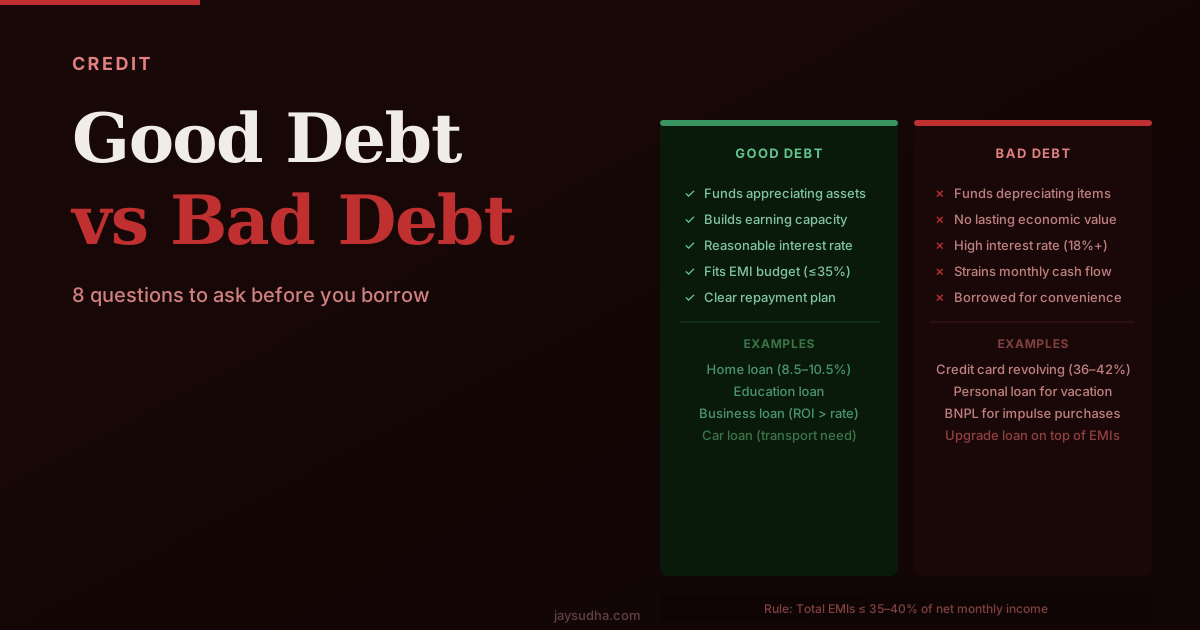
Good debt has these characteristics:
- It finances something that retains value, appreciates, or generates returns
- The interest rate is reasonable relative to the benefit
- The repayment fits within your income without creating financial fragility
- You have a clear plan for repayment within a defined timeline
Bad debt has these characteristics:
- It finances consumable or depreciating items with no lasting economic benefit
- The interest rate is high relative to any possible return
- Repayment creates persistent cash flow pressure
- The item purchased could have been saved for and bought without borrowing
These are not rigid categories — context matters considerably. The same loan type can be good debt for one person and bad debt for another depending on their income, existing obligations, and financial position.
The eight questions to ask before any borrowing
Before signing any loan agreement, work through these questions:
Question 1: What am I buying with this money — an asset, a capability, or a consumption item?
Assets appreciate or generate income: a home in a good location, equipment for a business, professional skills through education. Capabilities grow your earning potential. Consumption items — electronics, vacations, clothing — are used and done. Debt for consumption is difficult to justify economically. Debt for assets or capabilities can be.
Question 2: What is the interest rate, and does it make sense relative to what I am funding?
A home loan at 9% to fund an asset that has appreciated 5–7% annually in your city: reasonable. A personal loan at 18% to fund a home renovation that adds zero resale value: questionable. A credit card at 36% for a vacation: almost certainly bad debt regardless of the destination.
Question 3: What happens to this item in five years?
A house is likely to maintain or increase in value. A car will have lost 50–60% of value. A vacation will be a memory. Your skills from a good course will likely still be valuable. The depreciation profile of what you are buying tells you whether future income will service debt on an asset that still has value or one that has largely disappeared.
Question 4: What is my total EMI burden, and what happens if income drops 30%?
Calculate your total monthly EMI as a percentage of take-home income. Include all current EMIs plus the new one being considered. If the total exceeds 40% of net income, you are in the fragile zone — one significant income disruption (job change, business slowdown, medical leave) creates a repayment crisis.
Question 5: Do I have an emergency fund separate from this borrowing decision?
If you are taking a personal loan because you do not have a cash reserve for an emergency, the emergency fund problem is the real issue to solve. Borrowing to cover emergencies without addressing why the emergency fund does not exist means the cycle repeats.
Question 6: Is there a cheaper financing option I have not considered?
Before accepting a personal loan at 18%, consider: Does a home loan top-up or property-backed loan apply at 10%? Can this expense be funded from an FD that can be liquidated? Is there a zero-cost EMI option from the retailer for a considered purchase? Different debt products carry very different effective costs.
Question 7: Am I borrowing due to genuine need or current convenience?
"I could save for this over the next six months but the EMI is cheap" is a different situation from "I need this now and cannot wait." Some purchases genuinely cannot wait — medical, education with a deadline, a business opportunity with a time window. Others can. Distinguishing between the two prevents gradual EMI accumulation from convenience rather than necessity.
Question 8: Does this fit within a written financial plan, or am I improvising?
Ad-hoc borrowing — loans taken based on what feels affordable in the moment — tends to accumulate. A written financial plan that includes debt limits relative to income creates a check on individual borrowing decisions that might each seem reasonable but collectively create burden.
Debt by product type in the Indian market
| Debt Type | Typical Rate | Generally Good/Bad | Key Condition |
|---|---|---|---|
| Home loan | 8.5–10.5% | Good | EMI under 35% net income; buying for occupancy not speculation |
| Education loan | 8–12% | Depends | Returns on education must exceed cost |
| Business loan (secured) | 9–13% | Good if ROI > rate | Business cash flow must service debt comfortably |
| Car loan | 9–12% | Borderline | Car depreciates; loan ideally for reliable transportation need, not upgrade |
| Personal loan | 14–20% | Use sparingly | Genuine emergency or one-time need; not for lifestyle spending |
| Buy Now Pay Later | 0–24% | Depends heavily | Zero-cost EMI is fine if paid on time; deferred payment at high rates is expensive |
| Credit card revolving debt | 36–42% | Bad | Should be cleared in full every month; carry no balance |
Rates are representative ranges as of 2025–2026. Actual rates vary by lender, credit profile, and loan terms.
Your credit score in India determines the interest rate you qualify for on any loan — making score maintenance directly connected to the actual cost of debt.
The home loan — India's most common "good debt"
For most Indian households, the home loan is the largest borrowing decision of their lives. Understanding when it is genuinely good debt matters.
A home loan is good debt when:
- The property has reasonable appreciation potential in its location
- The EMI replaces or is comparable to what you would otherwise pay in rent
- The EMI is within 35–40% of net household income
- You have adequate term life insurance covering the outstanding loan amount
- The loan tenure is chosen to keep total interest cost manageable (15–20 years rather than 30 for the same loan, if cash flow allows)
A home loan becomes problematic when:
- The EMI leaves no room for savings, investments, or emergencies
- The property is bought entirely for price appreciation (speculative motive) in an uncertain market
- The buyer is taking on the maximum loan they qualify for, rather than the loan that fits their financial plan
- No insurance is taken to cover the loan in case of income disruption
The home loan is often good debt. It is not automatically good debt regardless of the price, terms, and your current financial position.
The car loan — where most people rationalize too quickly
Car loans sit in a grey zone. The vehicle itself depreciates rapidly — 15–20% in the first year, roughly 50–60% in five years. You are borrowing money, paying interest, to own something that loses value steadily.
That does not automatically make a car loan bad debt. Reliable transportation has real economic value — commuting to work, reaching clients, managing family logistics. A car loan is reasonable when:
- The vehicle is needed for work or family mobility (not primarily status)
- You are financing a practical vehicle for reliable transportation, not an upgrade from an already functional vehicle
- The loan tenor is no more than three to four years
- Total EMI burden stays within the 35–40% guideline
Where car loans become poor decisions: financing a significant upgrade over a working vehicle because the monthly EMI "looks manageable," stretching the loan to 7 years to reduce EMI (and thereby pay significantly more in total interest on a depreciating asset), or adding a car loan on top of already high existing EMI obligations.
Business debt — understanding working capital vs long-term borrowing
For small business owners and entrepreneurs, business debt requires a separate framework. Business loans are used for working capital (bridging the gap between expenses and receivables), equipment and infrastructure investment, or expansion.
Good business debt:
- Working capital loans that have a clear receivable to be repaid
- Equipment loans where the equipment generates revenue exceeding its cost
- Business expansion loans where the expanded capacity produces ROI above the loan rate
Problematic business debt:
- Loans that refinance operating losses (you are essentially borrowing to fund a business that is not profitable)
- Very high-rate debt (NBFCs, informal lending) that a business plan cannot realistically service
- Personal loans used for business without separating the risk between personal and business finances
Managing debt repayments effectively also means maintaining good cash flow management — EMI dates, timing relative to salary, and keeping the monthly outflow predictable.
The EMI-to-income guardrail
One practical rule that applies across all debt types: keep your total monthly EMI below 35–40% of net household income.
At 40% EMI burden, a 20–25% income disruption creates an immediate cash crisis. At 25% EMI burden, the same disruption is stressful but manageable.
Example: Net household income of ₹1 lakh per month. Maximum comfortable EMI: ₹35,000–₹40,000 total across all loans.
If you are at ₹28,000 in home loan EMI and considering a car loan that would add ₹12,000, you would be at ₹40,000 total — the upper boundary. Whether that car loan is worth it depends on the questions above, not just the monthly amount.
Most people do not track their total EMI burden across all loans simultaneously. This omission is how debt accumulation happens gradually — each loan individually seems affordable, but the total becomes a significant constraint on savings, investments, and financial flexibility.
The Education Loan Calculation: India-Specific ROI Framework
Education loans occupy a unique space in the good-debt/bad-debt spectrum. Unlike a home (which has a general market, so comparisons are possible), education outcomes depend heavily on the specific institution, programme, and placement outcomes.
A realistic Indian education loan ROI framework:
IITs, IIMs, and comparable tier-1 institutions: Median starting salaries of ₹15–30 lakh per annum for programmes costing ₹15–35 lakh in loans. Payback period typically 1–3 years. Clearly good debt under any framework.
Well-placed tier-2 MBA/engineering programmes: Median placements of ₹6–12 lakh per annum, loan costs of ₹10–20 lakh. Payback period 2–5 years. Still workable, but the margin is tighter — employment rate and branch placement data matter significantly.
Vocational certification courses, online programmes from emerging platforms: Costs of ₹2–5 lakh with variable career outcomes. These should be evaluated specifically: does this certification lead to measurable salary improvement? Is the issuing institution recognised by employers in the relevant sector? If the outcome is uncertain, avoid borrowing for it and seek cheaper or free alternatives.
Overseas education loans: Government banks (SBI, Bank of Baroda, Canara Bank) and private lenders (Axis, ICICI, HDFC Credila) finance overseas education. Loan amounts can reach ₹40–75 lakh+ for top programmes in the USA, UK, Canada, and Australia. The ROI depends heavily on whether the borrower secures employment in the country of study (higher salary, repayment in a strong currency) or returns to India (must service large foreign-currency loan on an India-scale salary). Calculate explicitly: expected starting salary in the currency of repayment vs. loan EMI.
Education loans under government subsidy schemes: The Central Sector Interest Subsidy Scheme (CSIS) covers interest during the moratorium period for students from economically weaker sections. If you qualify, this significantly improves the economics of education borrowing. Check eligibility at nationalsms.gov.in.
Understanding Debt Against Your Net Worth
A useful framework beyond monthly EMI ratios is examining debt as a proportion of your net worth (total assets minus total liabilities).
Debt-to-net-worth ratio:
- Below 30%: Healthy — liabilities are a manageable fraction of total assets
- 30–60%: Moderate — common during the home-buying phase when property is the primary asset
- Above 80%: High risk — most of what you "own" is effectively owned by lenders
Most salaried Indians in their 30s with a home loan are in the 50–70% range (home is the primary asset, loan is the primary liability), which is not inherently problematic. What makes it problematic is the combination of high home loan leverage with additional consumer debt — the layering effect.
Practical exercise: List your assets (current market value of home, investments, liquid savings, vehicle) and liabilities (outstanding home loan, personal loan, car loan, credit card dues). The ratio tells you where you stand structurally.
As income grows and debt is paid down, this ratio naturally improves. The risk is when new debt is added faster than wealth is built — the ratio stays elevated or worsens even as income grows.
Frequently Asked Questions
Sources and references
Rules, rates, and thresholds in India change over time. Always confirm the current position with the official source above before acting on it.