How to Get Your Free Credit Report in India From All Four Bureaus
Every Indian is entitled to one free credit report per year from each bureau. Here's exactly how to get them and what to look for.
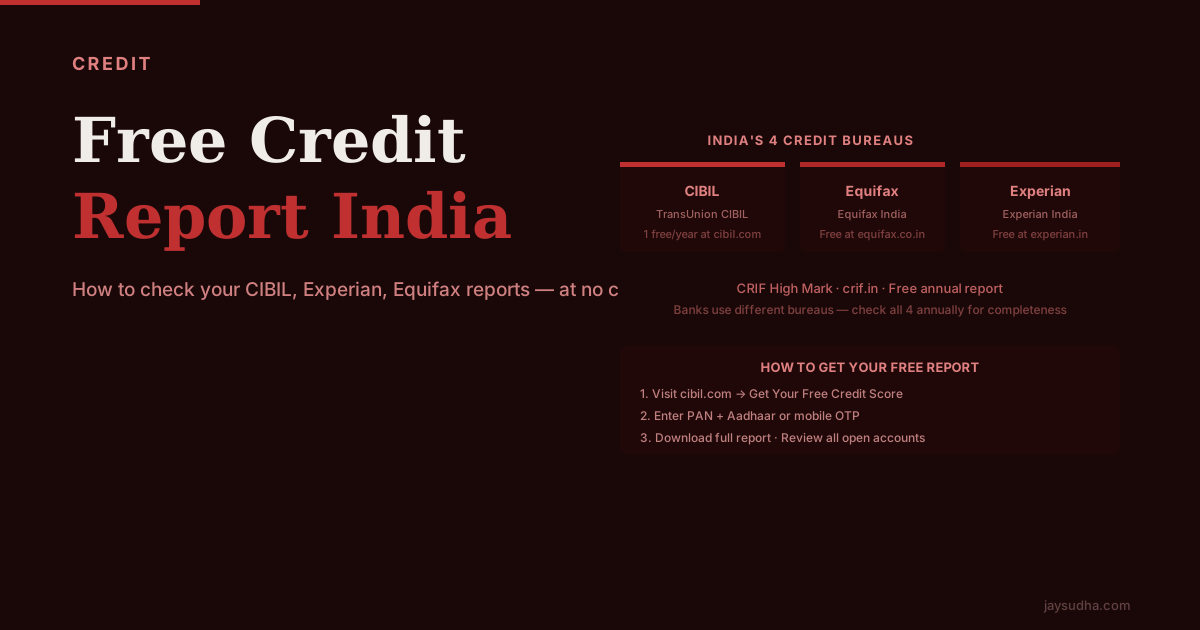
India has four credit bureaus operating under RBI mandate, and every Indian with a credit history has a right to one free credit report from each of them every year. Most people check none. Some check one. Very few check all four — which is a problem, because the information across bureaus is not always identical.
This article covers exactly how to get your free reports, what you'll find in them, and what to look for when you read them.
The Four Credit Bureaus in India
The Reserve Bank of India licenses four Credit Information Companies (CICs) to collect and maintain credit data:
- TransUnion CIBIL — the oldest and most widely referenced, commonly called "CIBIL"
- Experian
- Equifax
- CRIF High Mark
Lenders report your repayment behaviour to one or more of these bureaus every month. Not all lenders report to all four. A bank might report to CIBIL and Experian but not to Equifax. This means your credit report can legitimately differ across bureaus — not because of errors, but because of which lenders report where.
When you apply for a loan or credit card, the lender typically checks one bureau (most commonly CIBIL, but some lenders check Experian or CRIF depending on their systems). You don't usually know which one they'll pull. This is one reason to review all four.
Your Legal Right to Free Reports
RBI's circular on Credit Information Companies requires each bureau to provide one free credit report to individuals every calendar year upon request. This is a regulatory mandate — not a promotional offer. You don't need to sign up for a paid subscription to access it.
The free report includes your full credit history. Some bureaus will offer a free score with it; others will show you the report but charge separately for the score. The score is useful context, but the report itself — the detailed record — is what you need to review for accuracy.
How to Get Each Free Report
TransUnion CIBIL — mycibil.com
- Go to mycibil.com
- Click "Get Your Free CIBIL Report & Score" (or look for the free report section — it changes placement periodically)
- Create an account or log in
- Complete identity verification — you'll need your PAN, date of birth, and one other identifier (passport, voter ID, or driver's licence)
- Answer a set of authentication questions about your credit accounts (CIBIL calls this "Knowledge Based Authentication")
- Your report is available to view and download
CIBIL also has a paid subscription (MyCIBIL) that gives monthly score updates and monitoring. You don't need this to get your one free annual report.
Experian — experian.in
- Go to experian.in
- Find the free credit report section (usually under "Check Your Credit Score")
- Register with your mobile number and PAN
- Complete OTP-based verification
- Fill in personal details and complete identity verification
- Download your report
Experian India typically provides the score free along with the report.
Equifax — equifax.co.in
- Go to equifax.co.in
- Navigate to the personal credit report section
- Register and complete PAN-based verification
- Complete identity verification
- Access your free annual report
Equifax's India consumer portal has been updated over the years — the exact flow changes, but the PAN and identity verification process is standard across all bureaus.
CRIF High Mark — crifhighmark.com
- Go to crifhighmark.com
- Look for "Free Credit Report" in the consumer section
- Complete registration with PAN and mobile number
- Verify identity
- Access and download report
CRIF High Mark is particularly relevant if you have microfinance loans, rural credit, or two-wheeler loans — lenders in those segments often report primarily to CRIF.
What's in a Credit Report
A credit report has several sections. Here's what each one contains:
Personal Information
Your name, date of birth, PAN, addresses (current and previous), phone numbers, email addresses. This information is sourced from what lenders submitted when you applied for credit. Multiple variations of your name or address can appear here if different lenders captured it slightly differently.
Account Details (Credit Summary)
This is the main section. Each credit account you have (or have had) is listed — credit cards, home loans, personal loans, car loans, two-wheeler loans, education loans, overdraft accounts. For each account, you'll see:
- Lender name and account type
- Account number (partially masked)
- Date opened and closed (if applicable)
- Credit limit or loan amount
- Current balance outstanding
- Payment history — month-by-month for the last 24-36 months, showing whether each payment was made on time, late, or missed
Enquiry History
Every time a lender pulled your credit report (because you applied for a loan or credit card), it shows up here as a "hard enquiry." Each enquiry has the lender name, date, and the type of credit product applied for. This section lets you spot applications you didn't make — which can be a sign of fraud.
Default History / Suit Filed Accounts
This section shows accounts where you defaulted, where a "Written Off" or "Settled" status was recorded, or where the lender filed a suit for recovery. These entries significantly affect credit scores and stay on the report for several years.
What to Check When You Read Your Report
Getting the report is the easy part. Reading it with purpose is what matters.
Payment history accuracy: Go through the month-by-month payment record on each account. A payment marked DPD-30 (Days Past Due: 30) or DPD-60 means a late payment was recorded. Check if these match what actually happened. Banks sometimes record a payment as late even when it was made on time — processing delays, system errors, or disputes can cause this.
Open vs closed accounts: Find every account you've closed and verify it shows as "Closed" on the report. An account that's been paid off and closed but still shows as "Open" with an outstanding balance is a common error, and it can damage your credit score unnecessarily.
Accounts you don't recognise: If you see a loan or credit card account you never applied for or had, treat it as a potential fraud flag. This requires immediate action — someone may have taken credit in your name.
Hard enquiries you didn't authorise: Review every enquiry in the enquiry history section. Each one should correspond to a credit application you actually made. Enquiries you don't recognise could indicate someone trying to apply for credit using your PAN.
Personal information accuracy: Your name, date of birth, and address should be consistent and correct. Errors here occasionally cause issues during loan applications when the lender's KYC data doesn't match the bureau record.
Duplicate accounts: Sometimes the same loan appears twice — once correctly and once as an error. This inflates your apparent outstanding debt and can affect loan eligibility assessments.
The Annual Stagger Strategy
You get one free report per bureau per year — that's four free reports in total. Rather than pulling all four at once and then going a year before looking again, a more useful approach is to stagger them:
- Q1 (January–March): Check CIBIL
- Q2 (April–June): Check Experian
- Q3 (July–September): Check Equifax
- Q4 (October–December): Check CRIF High Mark
This gives you a fresh view roughly every three months without paying for anything. If you're planning to apply for a major loan (home loan, car loan), pull all four about two to three months before applying so you have time to address any errors before lenders check your report.
When You Find Errors
If you find inaccurate information in your credit report, you can file a dispute. Each bureau has a dispute centre on their website. The general process is: identify the specific account and error → file a dispute online → upload supporting documents (bank statements, NOC from lender, payment receipts) → wait for the bureau to investigate and the lender to respond.
The lender is expected to respond within 30 days. If confirmed as an error, the bureau corrects it. If it's a more complex dispute, or if the lender doesn't cooperate, you can escalate to the RBI's Banking Ombudsman.
Errors don't fix themselves. If you find one, the only way to correct it is to go through the dispute process — ideally well before you need to apply for any credit.
A Note on Paid Credit Monitoring
Several services — including CIBIL's own subscription product, BankBazaar, and others — offer monthly credit monitoring for a fee (typically ₹500–₹1,200 per year). These can be useful if you're actively rebuilding credit, recovering from a fraud incident, or applying for large loans in the near future and want to track changes month by month.
For most people, the free annual reports from each bureau are sufficient. The paid services provide convenience and frequency, not access to fundamentally different information.
Practical Takeaway
Schedule a credit report check right now. Pick one bureau, go to their website, complete the verification, download your report, and spend 20 minutes reading through it. Look for the things listed above. Then schedule the next one for three months later from a different bureau.
Your credit history directly affects the interest rate on your next home loan, the credit limit on your next card, and whether a lender approves or rejects your application. It's worth 20 minutes every quarter to make sure that record is accurate.
Reading the Days Past Due (DPD) Table
The most important section of your credit report for score diagnosis is the DPD (Days Past Due) table within each account's payment history. This shows — month by month — how each payment was classified.
DPD codes and their meaning:
| Code | Meaning | Score Impact |
|---|---|---|
| 000 or STD | Standard — paid on time | Positive/neutral |
| SMA | Special Mention Account — slight delay (less than 30 days in most frameworks) | Mild negative |
| 030 | 30–59 days past due | Moderate negative |
| 060 | 60–89 days past due | Significant negative |
| 090 | 90+ days past due | Severe negative |
| SUB | Sub-standard account (NPA for less than 12 months) | Very severe |
| DBT | Doubtful (NPA for 12–36 months) | Extremely severe |
| LSS | Loss — written off | Most severe possible |
| SET | Settled | Very severe — stays on report several years |
When you read your report, look at the DPD column for every account. A single 030 (30-day late payment) from three years ago has a much smaller impact today than a recent 090. Recent history is weighted more heavily than older history in all major credit scoring models.
What to Do If You Spot Fraud in Your Report
If your credit report shows an account, loan, or hard inquiry you do not recognise, treat it as a potential fraud incident requiring immediate action:
Step 1: Document everything. Screenshot the report showing the unrecognised account. Note the lender name, account number (as shown — may be partially masked), and the outstanding balance or loan amount.
Step 2: File a police complaint (FIR). Visit the nearest police station and file an FIR specifically about identity theft and financial fraud. The FIR number is an important document for subsequent steps. Some states now allow online FIR filing through the state police portal.
Step 3: Dispute through the bureau. File a dispute through CIBIL's dispute centre, selecting "Account does not belong to me" as the dispute type. Upload a copy of the FIR and a declaration that you did not take this credit.
Step 4: Contact the lender directly. The lender named on the fraudulent account should be contacted in writing (email + registered post) informing them of the fraud. Provide the police complaint details and request a freeze on the account and investigation.
Step 5: Register with RBI's Central Fraud Registry (if applicable). For cases involving significant amounts or identity theft, reporting to RBI's centralised fraud reporting mechanism helps track systemic fraud.
Step 6: Monitor all four bureaus. A fraudster who successfully opened credit in your name may have attempted applications at multiple lenders, which report to different bureaus. Check all four reports immediately after discovering fraud.
The PAN Aadhaar linkage system and KYC verification processes have made identity fraud in India harder than in earlier years — but fraudulent accounts still occur through SIM swap fraud, leaked OTPs, and compromised KYC data. Annual credit report checks are one of the few ways to catch this early.
Frequently Asked Questions
Sources and references
Rules, rates, and thresholds in India change over time. Always confirm the current position with the official source above before acting on it.