FIRE in India: A Realistic Look at Financial Independence
Financial independence is achievable in India — but the numbers are very different from what Western FIRE guides assume. Here's an honest framework.
Financial independence means reaching a point where your investment portfolio (and other passive income sources) generate enough to cover your living expenses without relying on a salary. Early retirement (the RE in FIRE) is optional — many financially independent people continue working because they choose to, not because they must.
Most FIRE content online comes from the US. The frameworks, the math, and the assumptions are American: Social Security, 401(k), healthcare systems, inflation patterns. Transplanting those frameworks to India wholesale leads to underprepared retirement plans.
Here's an honest look at what FI requires in India, with Indian numbers.
What Financial Independence Actually Means
You are financially independent when your investment returns (or passive income) can sustain your lifestyle indefinitely without depleting your capital.
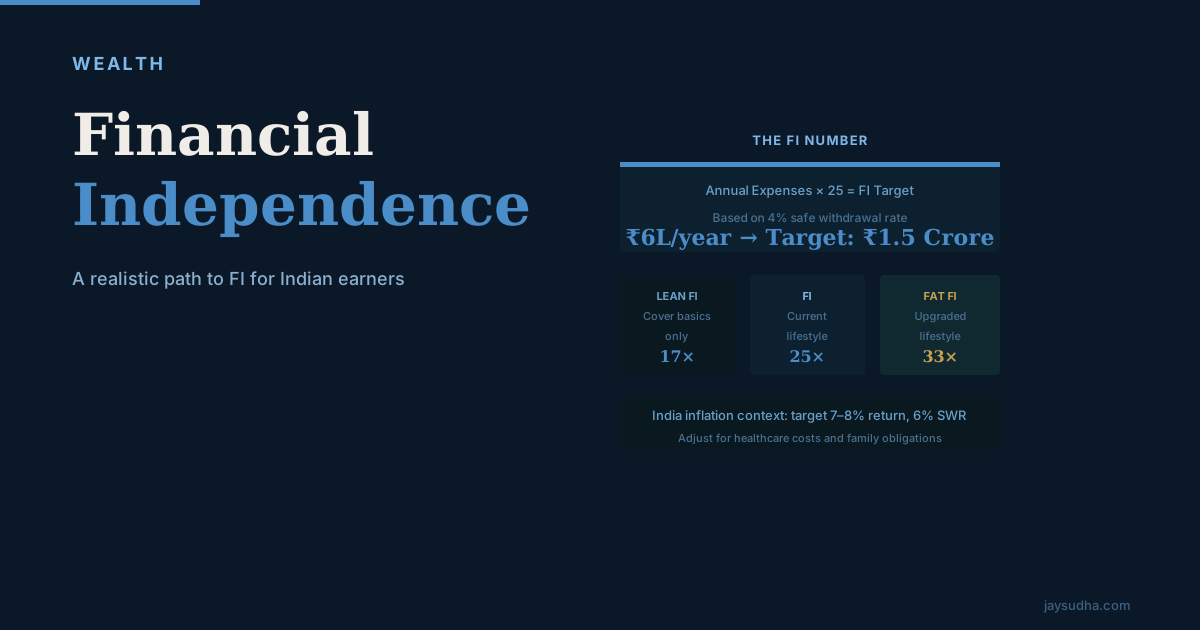
The simplest formula: FI corpus = Annual expenses × Your chosen multiple
The debate is about what multiple to use. That requires understanding the 4% rule — and why it probably needs adjustment for India.
The 4% Rule: Origin and Limitations
The 4% rule comes from the Trinity Study, a 1998 American academic paper that analysed historical US market returns. The finding: withdrawing 4% of your initial portfolio value per year, adjusted for inflation annually, had a 95%+ success rate over 30-year periods based on US historical data.
This translates to: if your annual expenses are ₹6 lakh, you need ₹1.5 crore (₹6L ÷ 4% = ₹1.5 crore = 25× annual expenses).
Why this needs adjustment for India:
1. Higher inflation, especially for healthcare and education India's headline CPI has averaged 5-7% over the past decade. But healthcare inflation in India often runs 10-15% annually. Education costs at quality institutions have inflated similarly. If a significant portion of your expenses are healthcare (which grows as you age), a 4% withdrawal rate against Indian inflation may be aggressive.
2. Longer retirement horizon Someone retiring at 40 in India has a 40-50 year horizon if they live to 80-90. The Trinity Study was based on 30 years. Longer horizons require lower withdrawal rates to maintain success probability.
3. No Social Security equivalent In India, there is no universal pension system for private sector workers. EPF and NPS provide some floor, but the gap between that floor and a comfortable middle-class retirement is entirely on the individual. American 4% rule calculations often assume Social Security covers a base layer. Indian calculations typically can't make that assumption unless you've worked in the formal sector long enough.
4. Sequence of returns risk is real If markets fall severely in the first few years of retirement, a 4% withdrawal forces you to sell more units at depressed prices. Recovery may take years, and if you're spending down the corpus during recovery, the damage can be permanent. India's equity markets have had severe drawdown periods (2000-2003, 2008-2009, 2020), and the sequence in which returns occur matters.
India-Specific FIRE Number: 25x, 30x, or 33x?
Given these factors, a more conservative multiple is appropriate for early retirees in India:
| Scenario | Multiple | Withdrawal Rate | Suitability |
|---|---|---|---|
| Standard FIRE (retire at ~55-58) | 25× | 4% | Moderate; shorter horizon |
| Conservative FIRE (retire at 40-50) | 30× | ~3.3% | Better for longer horizons |
| Highly conservative / early retire at 35-40 | 33× | ~3% | Healthcare inflation, long horizon |
For someone planning to retire at 45 with significant healthcare and education obligations ahead, 30-33× is more realistic than 25×.
Illustrative FIRE calculation:
Monthly expenses: ₹50,000 (₹6 lakh/year)
- At 25×: ₹1.5 crore corpus
- At 30×: ₹1.8 crore corpus
- At 33×: ₹1.98 crore corpus
These numbers assume you're not growing your expenses with age. In reality, most people's expenses change with life stage — lower in early retirement (active, healthy), potentially higher in mid-retirement (healthcare), different in late retirement (possibly lower activity but higher care costs).
Why Inflation Over 30-40 Years Is Not Trivial
A ₹50,000/month expense in today's rupees is not ₹50,000 in 2045 real terms. At 6% annual inflation:
| Year | Real Monthly Expense Equivalent |
|---|---|
| Today (Year 0) | ₹50,000 |
| Year 10 | ₹89,542 |
| Year 20 | ₹1,60,357 |
| Year 30 | ₹2,87,175 |
This is why your portfolio must grow faster than inflation, and why holding a significant equity allocation — even in retirement — is not reckless. A 30-40 year retirement on an all-debt portfolio will likely be slowly destroyed by inflation.
The portfolio allocation in retirement for a relatively young Indian FI retiree (say, retiring at 45) probably still needs 50-60% equity to maintain purchasing power over decades.
Income Sources in Financial Independence
A diversified retirement income structure is less fragile than relying on one source:
EPF and NPS corpus: If you've been in the formal workforce for 15-20 years, your EPF corpus at retirement may be ₹30-80 lakh depending on salary history and contribution rates. NPS adds to this with a combination of lump sum and annuity.
PPF corpus: After 15-25 years of PPF contributions, this can be ₹25-60 lakh. Tax-free on maturity; can be extended. Not the primary corpus, but a significant component.
Equity portfolio income: Either systematic withdrawal (SWP from mutual funds) or dividend income. Most FI planners use SWP — withdraw a fixed amount monthly from a large equity/balanced portfolio and let the rest compound.
Debt portfolio income: FD interest, bond coupon, liquid fund returns. Provides stability but needs to keep up with inflation.
Rental income: If you own property beyond your primary residence and it's rented. Rental yields in India are typically 2-4% of property value in most cities — lower than often assumed. Rental income is taxable (30% deduction for maintenance is allowed; remaining is added to income). Illiquid, concentrated, management-intensive.
Part-time, consulting, or freelance income: Many FI achievers in India continue some form of paid work — teaching, consulting, writing, advisory roles. This is not a failure of the FIRE plan; it's often a voluntary choice. Even ₹20,000-40,000/month from part-time work dramatically reduces the withdrawal pressure on the portfolio.
Tax on Retirement Income in India
This is often underestimated. Retirement doesn't mean untaxed.
| Income Type | Tax Treatment |
|---|---|
| EPF withdrawal (after 5 years service) | Tax-free |
| PPF maturity | Tax-free |
| Equity LTCG (over ₹1.25 lakh/year) | 12.5% (current rules) |
| Equity STCG | 20% |
| FD interest / RD / savings interest | Added to income; taxed at slab |
| NPS annuity | Added to income; taxed at slab |
| Rental income | Added to income; 30% standard deduction allowed |
| Dividend income | Added to income; taxed at slab |
If your FI income comes primarily from EPF, PPF, and long-term equity SWP, your effective tax can be low. Structure your retirement income sources with tax efficiency in mind — this is worth doing with an accountant in the years before you retire.
Healthcare Planning for Indian FI Seekers
Healthcare is the most underestimated expense in Indian retirement planning.
Health insurance: Get a comprehensive family floater policy with a high sum assured (₹1-2 crore for a couple post-50) well before retirement. Premiums rise sharply with age, pre-existing conditions can make new policies expensive or exclusionary, and employer cover disappears when you leave the workforce.
Premium inflation for health insurance policies has been significant — plan for premiums to increase 10-15% annually.
Self-insurance corpus: Some FI planners advocate setting aside a separate corpus of ₹25-50 lakh specifically for healthcare, which grows in a combination of liquid and stable instruments. This is especially relevant for people who retire before 50, when insurance access is more straightforward.
Senior citizen considerations: After age 60, senior citizen health insurance is available, and there are specific IRDA regulations around coverage. But planning from your 30s and 40s is far cheaper and more reliable than trying to sort it out later.
The Mental Side of Financial Independence
The financial math is solvable. The more underestimated challenge is the psychological shift.
Most people who achieve FI have spent a decade or more deriving identity, structure, and social connection from their work. The day you stop working for money, you need answers to: What do I do with my time? Who am I outside of my professional role? How do I maintain social connection without a workplace community?
People who answer these questions before retiring tend to thrive in FI. People who assume the absence of work problems will itself be fulfilling often find the first year difficult.
The "RE" (Retire Early) part of FIRE is optional. Many people pursuing FI don't intend to stop working — they want to stop working out of financial necessity. The distinction between working because you must and working because you choose to is significant.
In the Indian context, there is also family pressure and social perception. Leaving a senior corporate job at 42 requires managing family expectations, explaining your decision to relatives, and being at peace with not fitting the conventional life script. This isn't a financial challenge, but it's real and worth thinking through.
A Realistic Path to FI in India
For a household spending ₹60,000/month (₹7.2 lakh/year), targeting a ₹2.5 crore corpus (roughly 34× expenses, conservative for someone retiring at 45):
Assuming 12% CAGR on an equity-heavy portfolio:
- Starting at 25, investing ₹30,000/month with 10% annual step-up → reaches ~₹2.5 crore in roughly 13-15 years
- Starting at 30, same strategy → roughly 16-18 years
- Starting at 35 → roughly 18-22 years
These are illustrative projections — actual returns will vary, and these numbers exclude tax drag on investment returns.
The point is not the specific numbers. It's the structure: high savings rate, consistent equity-heavy investment, stepping up contributions with income growth, and a realistic corpus target based on Indian conditions.
FI in India is achievable. It requires a clear-eyed view of the numbers, honesty about lifestyle costs, and the discipline to let compound growth do its work over a long enough period.
Systematic Withdrawal Plans (SWP): the mechanics of drawing income in FI
Most discussions of FI focus on building the corpus. The mechanics of actually drawing it down in retirement receive less attention.
A Systematic Withdrawal Plan (SWP) is the redemption equivalent of a SIP: you instruct the AMC to redeem a fixed amount from your mutual fund every month and credit it to your bank account. The remaining corpus stays invested and continues compounding.
How to set up an SWP:
- Log into the fund house website or MF Central with your folio number
- Select the fund and choose "Systematic Withdrawal"
- Set the monthly withdrawal amount, date, and bank account for credit
- The AMC redeems units at that date's NAV to produce the requested rupee amount
Tax on SWP redemptions: Each SWP redemption is a partial redemption — subject to capital gains tax. For equity funds, redemptions of units held over 12 months attract 12.5% LTCG on gains above ₹1.25 lakh per year. Since SWP redeems the oldest units first (FIFO), a large, well-established corpus will mostly trigger LTCG rates.
For a corpus of ₹2 crore withdrawing ₹6 lakh per year, the annual LTCG exemption of ₹1.25 lakh reduces taxable gains significantly. Tax-efficient SWP structuring is worth planning with a chartered accountant.
ITR filing in FI: Contrary to a common misconception, financial independence does not exempt you from filing an ITR. If your total income exceeds the basic exemption limit (₹3 lakh in new regime, ₹2.5 lakh in old regime) from SWP gains, FD interest, rental income, NPS annuity, or any other source, you must file ITR annually. The filing also generates a documented income record useful for loan applications, visa applications, and financial verification after leaving employment.
Disclaimer: This article is for educational purposes only and does not constitute personalised financial advice. All corpus estimates, return projections, and withdrawal rate figures are illustrative and for explanatory purposes only. Actual investment returns, inflation rates, and tax rules will differ from illustrations. Financial independence planning requires analysis of your specific income, expenses, goals, and tax situation. Please consult a SEBI-registered financial advisor and chartered accountant for personalised retirement planning advice.